
Tag Archives: Trooper

Trooper Ernest Mitchell

Trooper Ernest Mitchell

Ernest Henry Mitchell was born in the autumn of 1889 in Worthing, West Sussex. The second of five children, he was the eldest son of Frederick and Rhoda Mitchell. Frederick was a baker and confectioner, and the family lived in and around the town centre. The 1891 census found them at 29 West Buildings; ten years later they were living at 7 Clifton Road; the 1911 census recorded the family at 62 Chapel Road.

By this point, FW Mitchell’s was a well known bakery, and would remain so through to the 1960s. The Chapel Road shop was bombed during the Second World War, and the family moved the business to North Road.

The 1911 census showed what the bakery has become. Frederick and Rhoda were running the business, while their three sons – Ernest, Reginald and Frederick Jr – were also involved. Their eldest daughter, Rhoda Jr, was an elementary school teacher, while their youngest child, Edgar, was still at school. The Chapel Road property was a bustling affair: the Mitchells employed four live-in servants: Emily Lyon, Annie Dannage, and Mabel Swan as shop assistants, and Edith Blunden as a domestic.
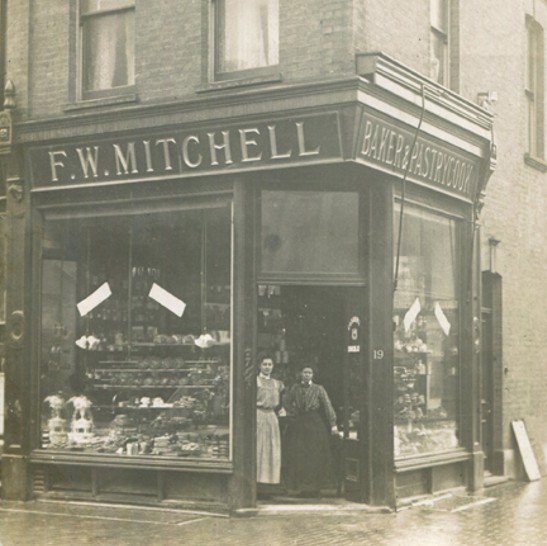

FW Mitchell’s bakery, Worthing

Away from work, Ernest showed other talents. “He was possessed of musical inclinations, and was at one time a member of the Choir of the Congregational Church, as well as of the Choral Society.” [Worthing Gazette: Wednesday 31st October 1917]

In January 1913, Ernest married Constance Banwell. She was the eldest daughter of nurseryman Henry Banwell and his wife, Ellen, and lived on Christchurch Road, not far from the Mitchells’ shop.

When war broke out, Ernest stepped up to serve his country. His service records show that, while he enlisted on 9th December 1915, he was not formally mobilised until March 1917. As a Trooper, he was assigned to the Household Battalion, and, after a brief period of training, he soon found himself in the thick of things.

The Household Battalion fought at Arras in the spring of 1917, but it was at Passchendaele that Ernest’s war was to come to an end. Wounded in the leg on 6th October – just three months after arriving in France – he was medically evacuated to Britain for treatment. Admitted to No. 2 War Hospital in Birmingham, he initially recuperated, but pneumonia took over and Trooper Mitchell succumbed. He passed away on 26th October 1917, at the age of 28 years old.

The body was removed from Birmingham, arriving in Worthing at midnight on Monday; and the internment took place at the Cemetery yesterday afternoon [20th October]. Among those who attended the ceremony were two soldier brothers of the deceased – RA Mitchell, who is in the Royal Flying Corps; and FE Mitchell, of the Middlesex Regiment. Still another brother is serving his Country in a Military capacity. This is Fred Mitchell, formally Organist of the Congregational Church, who is in the Army Service Corps, and was unable to be present yesterday, for he is now in Hospital in Wiltshire.

[Worthing Gazette: Wednesday 31th October 1917]

Ultimately, Ernest Henry Mitchell would be the only one of his siblings to pay the ultimate price while serving his country. He was laid to rest in the family plot in Broadwater Cemetery, on the then outskirts of the home town.


Ernest’s headstone also pays tribute to Alan Frederick Gill, who died in April 1925. This was his sister Rhoda’s child, who died at just four-and-a-half years old.
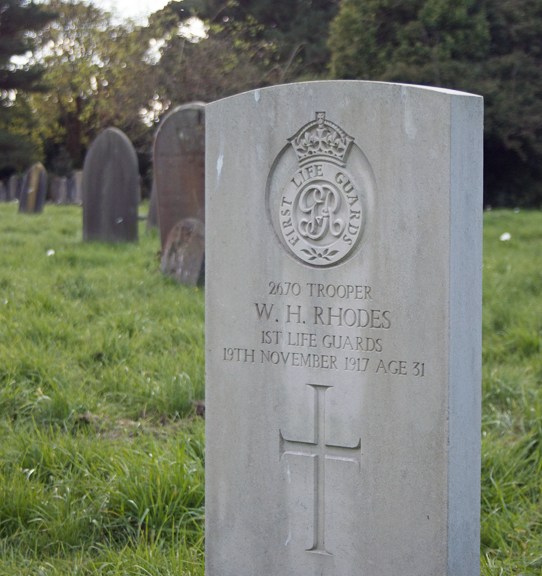
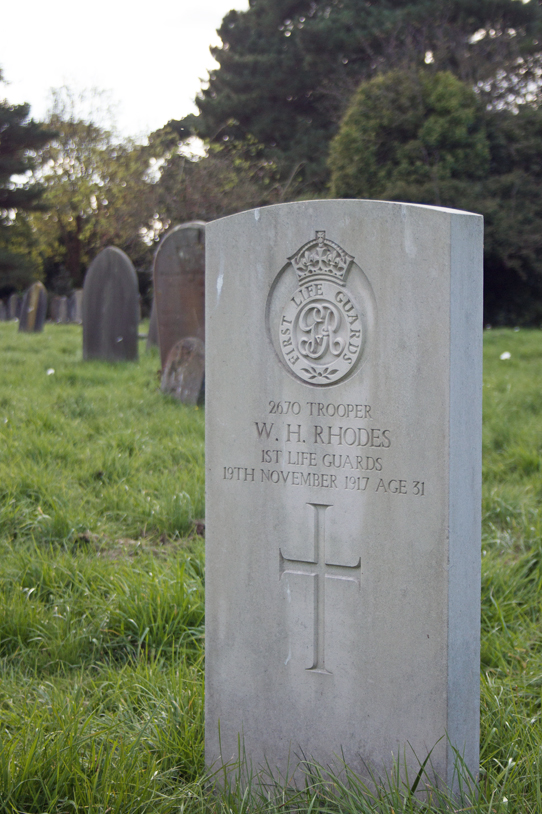
Trooper William Rhodes

Trooper William Rhodes

William Henry Rhodes was born in the summer of 1886 and was the youngest of six children. His father Reuben was a gardener who, with his wife Ellen, raised their family in a small cottage near the central station in Worthing, West Sussex.

When he left school, William found work as an assistant in a bookshop. This was just a stepping stone, however, and his mind was on a life of adventures. In March 1908, he enlisted in the army, joining the Household Cavalry, and was assigned to the 1st Life Guards. William’s medical report showed that he stood at just under 6ft (1.83m) tall, and weighed 141lbs (64kg). He had a fresh complexion, grey eyes and brown hair.

Trooper Rhodes was initially based on home soil; his barracks were in London and he served in Hyde Park, Regents Park and at Windsor, where he would have been called upon to be involved in royal duties that would have taken place. This changed when the Great War broke out, however, and his division was sent out to northern France as part of the British Expeditionary Force.

The 1st Life Guards were involved in the First Battle of Ypres, and went on to fight in many of the fiercest battles of the conflict. His service record identifies that he was wounded in February 1915, when he received a gunshot wound to the head, although, surprisingly, there is nothing in his medical record that suggests any subsequent hospital admission.

In fact, Trooper Rhodes did receive hospital treatment during his military service; he was admitted for bronchial catarrh in April 1908 and May 1909 and headaches in June 1911. Four years later, he contracted tuberculosis while in action in France, and moved back to London for treatment.

William’s condition was serious enough for him to be medically discharged form the army; having spent more than a month in hospital, he was released from duty on 31st August 1915.

There is little further information about William’s life back home. The next document on him confirms that he died on 19th November 1917. While the cause is not noted, it seems likely to have been connected to the lung conditions he suffered during the war. William was 31 years of age.

William Henry Rhodes was laid to rest in Broadwater Cemetery in the town of his birth, Worthing, West Sussex.


Trooper William Dawbin

Trooper William Dawbin

William Joseph Dawbin was born on 23rd April 1888, in Yeovil, Somerset. He was the oldest of three children to William and Julianna Dawbin, a farming family.

In 1897, when William Jr was 9 years old, the family emigrated to New Zealand, settling in the town of Feilding, 100miles (150km) north of Wellington.

William enlisted in 1905, joining the Wellington Mounted Rifles for a five-year term of service, and being promoted to the rank of Corporal. He re-enlisted on 14th August 1914, and the troop departed New Zealand for Europe a month later.

Trooper Dawbin arrived in Alexandria, Egypt on 3rd December, from where they travelled to Cairo for training. Initially planning on becoming involved in the defence of the Suez Canal, on 14th April 1915, William and his battalion landed in Gallipoli, to support the invasion there.

History knows that the fighting in this battle was some of the fiercest of the Great War. History also tells us that this campaign resulted in huge losses for the Anzac troops, including the Wellington Mounted Rifles. Sadly, Trooper Dawbin was not to escape injury.

On 27th May 1915, he received a gunshot wound to the back, fracturing his spine. He was evacuated by hospital ship back to Egypt, and, suffering from paralysis, was shipped back to England ten days later.

Trooper Dawbin was admitted to the Netley Hospital in Southampton, but his wounds appeared too severe; he died there on 22nd August 1915. He was 27 years old.

William Joseph Dawbin lies at peace in the quiet churchyard of St Andrew’s, in the village of Compton Dundon, Somerset, not far from extended family in Butleigh.