Tag Archives: tumour

Private Alex Jacobs

Private Alex Jacobs

Ephraim Alex Jacobs was born in the summer of 1883 in Birmingham, West Midlands and was the youngest child to Morris and Mary Jacobs. Morris was a tailor, but when he finished his schooling, Ephraim followed in his older brother’s trade, becoming a hairdresser.

This was not to prove a long-term career, however and, by the time of the 1911 census, things had changed. Ephraim, who now went by his middle name, had moved to Seend, near Melksham, Wiltshire. The document confirms that he had been married for four years by this point, although full details of his wife, the London-born Ethel, remain elusive. Alex was employed as a rubber worker in a factory in Melksham.

When war broke out, Alex stepped up to play his part. His service records no longer exist, but it seems that he enlisted in the Royal Army Service Corps, and was attached to one of the Mechanical Transport units. He seems not to have served overseas, and was demobbed on 14th September 1919. At this point Private Jacobs was suffering from neuritis, or nerve damage.

Alex’s trail goes cold at this point. He seems to have spent some time at the Pensioner’s Hospital in Bath, Somerset, and this is where, on 22nd December 1920, he passed away. The cause of his death was noted as being a cerebral tumour and asthma. He was 37 years of age.

With finances seemingly leaving Ethel unable to bring her late husband back to Wiltshire, Alex Ephraim Jacobs was instead laid to rest in the sweeping Locksbrook Cemetery, Bath.


Gunner James Wing

Gunner James Wing

James Joseph Wing was born in Tonbridge, Kent, in the summer of 1876 and was the oldest of six children to Henry and Frances Wing. Henry was a labourer, but when he finished school, James found work as an errand boy for the post office.

This was not a long-term career, however, and by the time of the 1901 census, when James was 25, he was labouring for the railway. His mother had died in 1897, and Henry remarried, to a woman called Frances Stapley.

In the spring of 1902, James also married, to Sussex-born Mary Ann Goacher. The couple wed in Steyning, near Worthing, but settled in Henfield. James seemed to be picking up work where he could – the census of 1911 recorded him as a coal porter, but by the time he enlisted, in June 1916, he gave his trade as a gardener.

James joined the Royal Garrison Artillery as a Gunner, and was initially assigned to the No. 1 Depot in Newhaven. Full details of his service are unclear, but he transferred to No. 2 Depot in Gosport, Hampshire, in the summer of 1918.

Gunner Wing had only been in Gosport for a couple of months, when he was admitted to the 5th Southern General Hospital in nearby Fratton. At 12:15pm on 4th December 1918, he passed away, a post mortem revealing he had succumbed to a cerebral tumour. He was 42 years of age.

James Joseph Wing was brought back to Sussex for burial. He was buried in the cemetery in his adopted home town of Henfield.


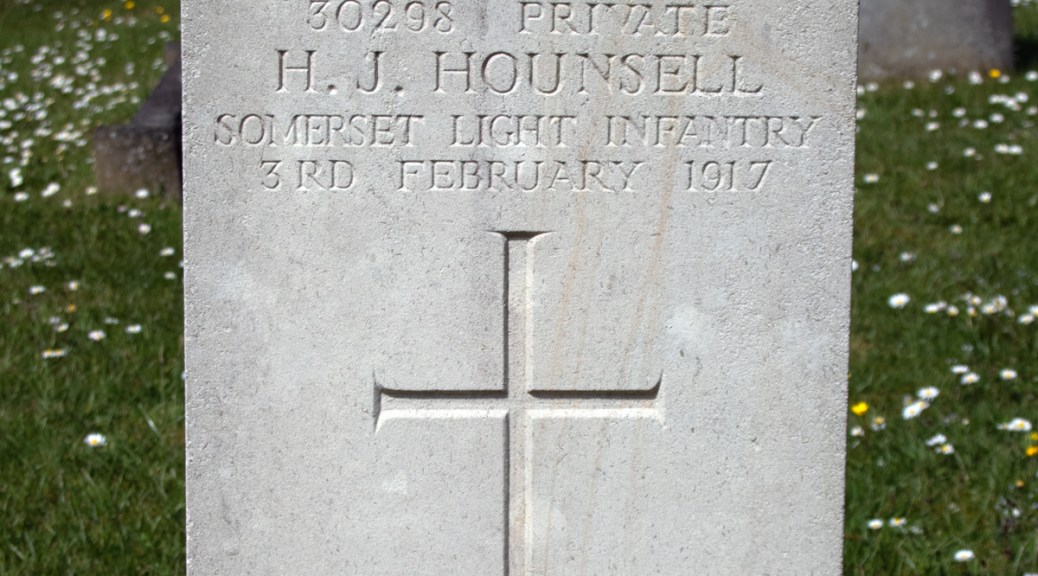
Private Henry Hounsell

Private Henry Hounsell

Henry James Hounsell was born in the spring of 1891, one of ten children to George and Emma Hounsell. George was a farm labourer and carter, and the family were raised in Tatworth, on the outskirts of Chard, Somerset.

Henry may have followed his father in farm work, but he wanted bigger and better things from life. The 1911 census recorded him as boarding with the Burt family in Corscombe, Dorset, where he was working as a baker’s van man.

Henry’s two older brothers, George and Alfred, died in 1913 and 1914 respectively; this left him as the oldest male of the siblings. In the summer of 1915, he married Lydia Lentell, the daughter of a shirt starcher and collar maker from East Coker, Somerset.

By this point, however, war was raging across Europe, and Henry was called upon to play his part. Full details of his service are lost to time, but it is clear that he enlisted in the Somerset Light Infantry as a Private in the 4th (Reserve) Battalion. By the time he joined up – at some point after August 1916 – his troop had already been sent out to Mesopotamia; it is unclear whether Henry also went overseas, but it appears unlikely.

The only other documents relating to Private Hounsell are those concerning his passing. His pension record confirms that he died on 3rd February 1917, having been suffering from a tumour in the back of his head, which had been aggravated by his military service. He was just 25 years old.

Henry James Hounsell was brought back to Somerset for burial. He was laid to rest in Tatworth Cemetery in Chard.


Lydia and Henry had had no children; she remained a widow for a number of years, before marrying for a second time in the autumn of 1939. Tragically, this was also destined to be a short-lived marriage – her new husband, Frederic Hodge, died just three years later.


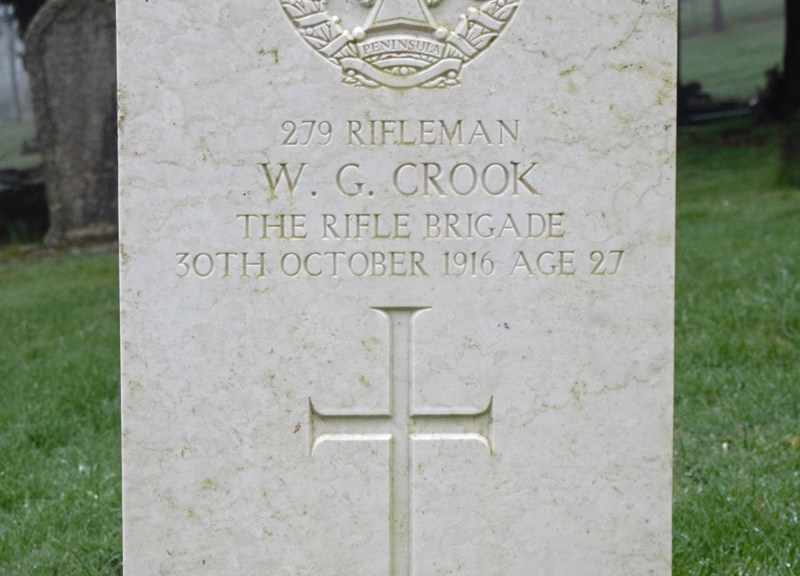
Rifleman Walter Crook

Rifleman Walter Crook

Walter George Crook was born in 1900, one of thirteen children to William – a gardener – and Elizabeth Crook from Shepton Mallet in Somerset.

When he left school, Walter worked as a printer for the town’s newspaper and, by the time of the 1911 census, he was living with his family in a six-roomed house in the middle of the town.

Walter moved on from the Shepton Mallet Journal, and found employment at the Hare and Hounds Hotel in the town. War was coming, however, and he enlisted in the 22nd (Wessex and Welsh) Battalion of the Rifle Brigade.

Rifleman Crook was stationed with his battalion in Salonica, Greece, and it was while he was here that he suffered a cerebral tumour. He was invalided home, and treated in the Royal Victoria Hospital in Netley, Hampshire. Sadly, he lost his fight, passing away on 30th October 1916, aged just 27 years old.

Walter George Crook lies at rest in the cemetery of his home town of Shepton Mallet.


Walter’s brother Gordon is also buried in Shepton Mallet Cemetery – read his story here.


A third brother, Bertie, was also gave his life in the Great War. The local newspaper had given a touching report on his death in April 1916.

Bertie Crook left school at the age of 13, and went into service with Mrs Dickinson at Whitstone, as a stable lad. He was there a year and then, on account of Mrs Dickinson giving up horses and leaving the town, they recommended him to Lord Derby’s stables at Newmarket, under the Hon. G Lambton. Small as he was, Bertie Crook undertook the railway journey alone, with a label in his buttonhole. He served five years apprenticeship, which expired at the beginning of October [1915]. He then tried to join the Royal Field Artillery, but not being tall enough he joined a West country regiment on the 20th October, and left Tidworth Barracks for France in the early part of January. He was in his 21st year, having been born on the 29th July. 1895.

The Hon. George Lambton writes “I was terribly shocked and grieved to hear of the death of your boy… Mrs Lambton and I send our deepest sympathy… I always liked your boy so much when he was in my stable; and I felt sure that with his quiet and courageous character he would make a good soldier. I shall have a plate put up in the stable in memento of his glorious death.”

Shepton Mallet Journal: Friday 21st April 1916

Lance Corporal Bertram Stanley Crook is buried at the 13th London Graveyard in Lavantie, France.


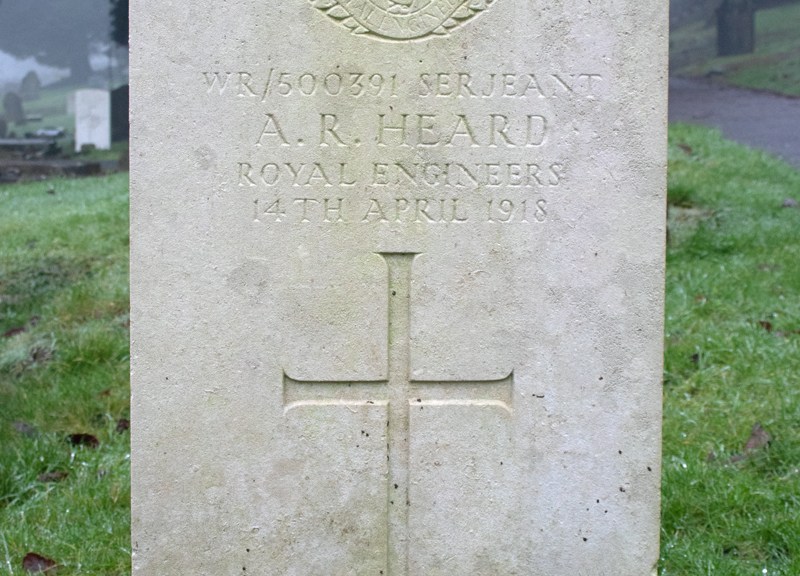
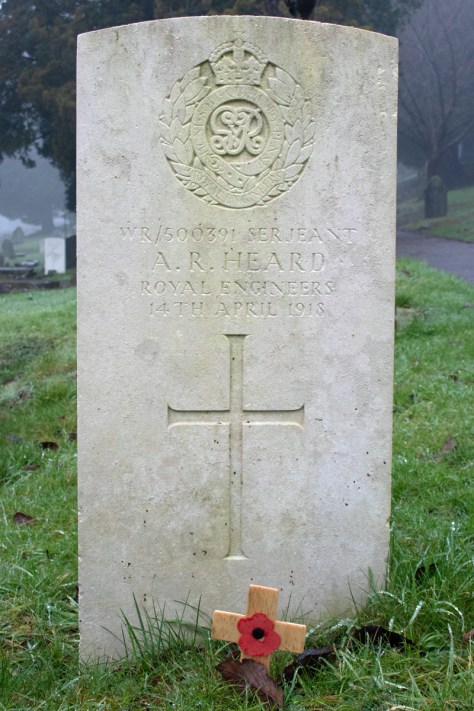
Serjeant Arthur Heard

Serjeant Arthur Heard

Arthur Reginald Heard was born in 1887, the youngest son to Herbert and Emily. Herbert was a local surveyor and land agent, and the family lived in the middle of Shepton Mallet in Somerset, two doors up from the town’s Baptist Church and within sight of the Magistrate’s Court.

In 1908, aged 21, Arthur made the journey across the Atlantic to Argentina, settling in Buenos Aires and working for the Pacific Railway Company. When war broke out, however, he immediately returned to England, when he enlisted in the army, and was assigned to the Royal Engineers.

Sapper Heard was shipped out to France and was quickly promoted, first to Corporal, then to Serjeant. In November 1917, Arthur was caught up in a shell impact on the front, and was buried. He was quickly dug out, and not severely hurt.

On 25th March 1918, Serjeant Heard was due to return home on leave, but was taken ill. Back in England, he was hospitalised in Birmingham, where meningitis was confirmed. He seemed to recover – even going out for tea with his sister-in-law when she visited him – and was transferred to recuperate in Saltash, Cornwall.

Within days of arriving, he collapsed with a fit, and passed away within half an hour. Subsequent examination confirmed that Arthur had died from a brain tumour. He was just 30 years old.

Arthur Reginald Heard lies at rest in the cemetery of his home town, Shepton Mallet.