Tag Archives: Wiltshire

Private James Williams

Private James Williams

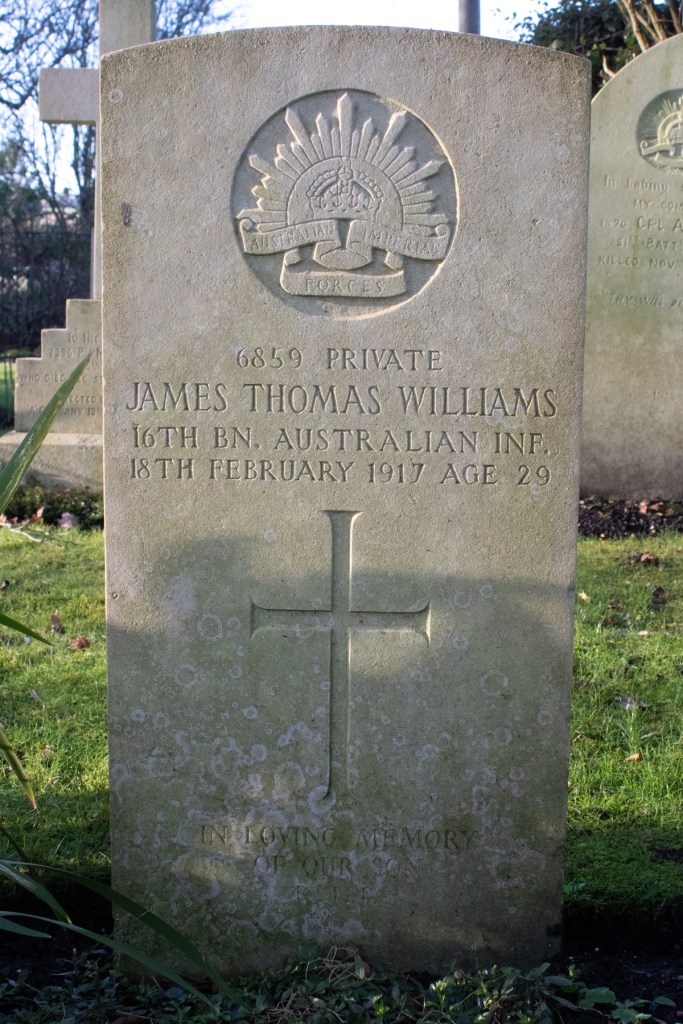
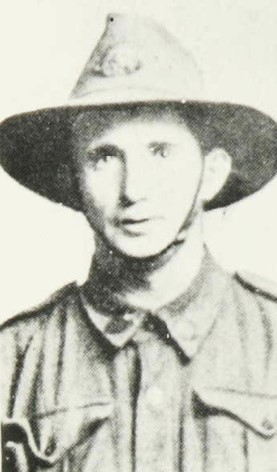
James Thomas Williams was born in Toodyay, Western Australia, in May 1888. The third of eight children, his parents were John and Mary Williams.

When he finished his schooling, James found work farming. Details of his early life are lost to time, but it seems likely that he had followed in his father’s footsteps.

When war engulfed the Empire, James stepped up to serve his King and enlisted in the Australian Imperial Force on 24th August 1916. His service records show that he was 5ft 6ins (1.68m) tall and that he weighed 134lbs (60.8kg). He was noted as having auburn hair, blue eyes and a fresh complexion.

Private Williams’ unit departed Australia from Freemantle on 9th November 1916. He would spend the next two months on board the Argyllshire, and eventually reached British shores on 10th January 1917. Assigned to the 16th Battalion of the Australian Infantry, his unit disembarked at Devonport, Devon, and made straight for base near Codford, Wiltshire.

The ANZAC troops had spent weeks cramped in the bowels of their ships, and space was once again at a premium in their army barracks. This congestion would prove fatal for numerous soldiers, as disease ran rife across the encampments.

Sadly, James would not be immune to poor health. Having contracted influenza, he was initially admitted to the camp infirmary, before being moved to the military hospital in nearby Sutton Veny. The condition was to get the better of him, and Private Williams passed away from a combination of flu and heart failure on 18th February 1917. He was 29 years of age.

The body of James Thomas Williams was laid to rest in the peaceful graveyard of St Mary’s Church in Codford, surrounded by others from his regiment.


Private James Williams
(from ancestry.co.uk)

Private Arthur Couchman

Private Arthur Couchman

Arthur John Couchman was born in the spring of 1887, the oldest of seven children to John and Emma. John was a farm labourer from the parish of Wilmington, Kent, and this is where he and Emma raised their family.

When he completed his schooling, Arthur found work as a house boy, but soon turned his hand to gardening. When the opportunity was presented to him, however, and in the autumn of 1908, he emigrated to Australia, presumably to find work as a farmer.

Little about Arthur’s time overseas is detailed. He settled in Freemantle, to the south of Perth, and, early in 1916, he married Sarah McAlinden. She had left London for the Antipodes to work as a domestic four years previously. Their marriage seems to have been spurred on by Arthur’s imminent departure for the home country, as, on 19th June 1916, he enlisted in the Australian Imperial Force.

Working as a general labourer by this point, Arthur’s service records show that he was 5ft 3.5ins (1.61m) tall, and weighed 146lbs (66.2kg). He was found to have fair hair, grey eyes and a ruddy complexion. He also had tattoos on both of his forearms.

Private Couchman’s unit departed Freemantle on 9th November 1916, on a journey to Devonport, Devon, that would take two months. On his arrival, he was assigned to the 51st Battalion of the Australian Infantry, and dispatched to a camp near Codford in Wiltshire.

Tragically, Arthur’s army career was to follow a not uncommon path for those arriving in Britain from overseas. Within a matter of weeks he had been sent to the New Zealand Hospital in Codford, as he was suffering from bronchial pneumonia. On 15th February 1917, just four days after his admission he passed away from the condition. He was 29 years of age.

Thousands of miles from his Australian life, Arthur John Couchman was laid to rest in the new extension to St Mary’s Churchyard in Codford, not far from the camp in which he had been briefly based.


Private Harold Spackman

Private Harold Spackman

Harold John Spackman was born on 24th May 1897 and was the youngest of two children to Frederick and Eliza Spackman. Frederick was a cowman from Wiltshire, and the family were raised on a farm in Manningford Bohune, near the village of Pewsey.

Harold was educated at Woodborough School, and found work as a nurseryman when he completed his schooling. When war broke out, he was quick to enlist, and joined the 10th (Service) Battalion of the Devonshire Regiment on 17th September 1914.

Private Spackman’s unit was sent to Somerset for training, and it was here, in cramped, busy barracks, that he contracted meningitis. He was admitted to the Red Cross Hospital in Bath, but succumbed to the condition on 12th March 1915. He was just 17 years of age.

Harold John Spackman was laid to rest in Bath’s Locksbrook Cemetery. His was a joint funeral with another Private from his unit, Albert Matthews, who had died on the same day in the same hospital.


Private Harold Spackman
(from findagrave.com)

Lance Corporal William Bence

Lance Corporal William Bence

Arthur William Bence was born in the village of Box, Wiltshire, in the spring of 1887. The oldest of eight children, his parents were James and Sarah. James was an engineer from Bathampton, Somerset, and by the time of the 1901 census, the young family had moved to 14 Hampton Row in nearby Bathwick.

Ten years later, and the Bence family had relocated again, this time to the northern outskirts of Bath, in a terraced cottage at 6 Brooklyn Road. By this point, Arthur had finished his schooling, and had found employment, working as a baker and bread maker. This was not to be a permanent career, however, and he sought out more of a career.

Arthur had long been a volunteer in the local militia, and on 14th November 1905 he enlisted in the army. Now known by his middle name, William Bence joined the Coldstream Guards as a Private. His service records show that he was 5ft 11ins (1.82m) tall, and weighed 148lbs (67.1kg). He was noted as having brown hair, brown eyes and a fresh complexion. Hs also had several tattoos on his left forearm, including a heart, cross, anchor, man’s face, crown and crossed flags.

Private Bence spent the first two years of his military career on home soil in Windsor, Berkshire, and London. In January 1908, his unit – the 3rd Battalion – transferred to Africa, and William would remain in Egypt and Sudan for more than three years. In March 1911 he returned to home soil, and that year’s census record noted his address as the Tower of London.

By the end of 1913 Private Bence had been formally stood down to reserve status. During his eight years on active service, he had been hospitalised a couple of times: for a sprained wrist in 1906, and for a bout of pneumonia in July 1910.

War was a matter of months away, however, and in the summer of 1914, William was to be mobilised again. By 12th August he was sent to France, and his battalion would be caught up at Marne and Aisne before the end of the year.

On 27th September 1914, William rose to the rank of Lance Corporal. This was not to last, however, and within six weeks the promotion was retracted for misconduct. He remained on the Western Front for nearly two and a half years, and had a mixed time of it. In April 1915, he Private Bence was confined to barracks for 14 days for being drunk on duty. In November that year, he was promoted to Lance Corporal for a second time.

This advancement coincided with William’s marriage. He had wed Amelia Oakley at St Saviour’s Church in Bath on 3rd November. There is little information available about her, other than that she had been born in Bath in 1888.

Back in France, and Lance Corporal Bence’s battalion fought at Loos and was heavily involved at the Somme. William would remain on the Western Front until December 1916, at which point his health forced him back to Britain. He had contracted tuberculosis, and this would lead to his ultimate discharge from military duty on 9th January 1917. William returned home, but his condition was to get worse. He passed away on 1st April 1917: he was 30 years of age.

The body of Arthur William Bence was laid to rest in the sweeping grounds of Bath’s Locksbrook Cemetery, in the city that was his home.


Private Frank Patience

Private Frank Patience

Frank Nicholas Patience was born in Mullewa, Western Australia, on 6th March 1898. The tenth of fifteen children (of which four did not survive childhood), his parents were Joseph and Elizabeth Patience.

There is little concrete information about Frank’s early life. When he finished his schooling, he found employment as a farm hand, and this is what he was working as when he stepped up to serve his country.

Frank enlisted in the Australian Imperial Force on 18th June 1917. Within six weeks he left his homeland for Europe, arriving in Liverpool, Lancashire, on 3rd October. Assigned to the 16th Battalion of the Australian Infantry, he was barracked in Wiltshire, at a camp not far from the village of Codford.

Tragically, Private Patience’s time in the army, and in Britain, was to be brief. Within weeks of arriving in Wiltshire, he contracted pneumonia, and was admitted to the camp hospital. The condition was to prove his undoing, however, and he passed away on 27th October 1917. He was just 19 years of age.

Frank Nicholas Patience was 9,000 miles (14,500km) from home. He was laid to rest in the extended graveyard of St Mary’s Church in Codford, Wiltshire.


Private Frank Patience
(from findagrave.com)

Private Harry Fletcher

Private Harry Fletcher

Harry David Fletcher was born in Leichhardt, New South Wales, Australia, on 1st November 1883. The seventh of ten children – and the only surviving son – his parents were Daniel and Charlotte Fletcher.

There is little information about Harry’s early life: he found work as a labourer when he finished school and, on 11th March 1911, he married Lillian Bosworth. The couple went on to have a son, Harold, who was born the following February.

When war came to Europe, the British Empire was called upon to play its part. On 19th February 1917, Harry enlisted in the Australian Infantry, although he did so under the alias of Harry Conway. His service records show that he had dark brown hair, hazel eyes and a medium complexion. He was also 5ft 7.75ins (1.72m) tall and weighed 140lbs (63.5kg). He had two noticeable scars: one on the inside of his right arm, the other on his right shin.

Private Conway/Fletcher set sail for Europe on 10th May 1917, arriving in Britain two months later. His unit – the 13th Battalion – was billeted in Wiltshire, near the village of Codford. Tragically, his time in the army was to be brief: he suffered issues with his gallbladder, and died in the camp hospital from cholecystitis and septicaemia on 29th July 1917. He was 33 years of age.

Harry David Fletcher was laid to rest in the Australian section of the new churchyard of St Mary’s Church in Codford. His burial records note that the service was officiated by Chaplain Captain Collins, with six of his friends from the battalion acting as pallbearers. He was buried in an elm and brass coffin, with a small oak cross being erected over the grave.


Private Harry Fletcher
(from findagrave.com)

Gunner Eli Trenchard

Gunner Eli Trenchard

Eli Trenchard and his twin Reuben were born on 29th December 1889 in Axminster, Devon. Two of nine children, their parents were George and Mary Trenchard. George was a gamekeeper turned farmer, and the family were brought up at Uphay Farm on the outskirts of the town.

The whole family helped out on the farm and, by the time of the 1911 census, when the twins were 20, seven of the Trenchards – George, Mary, Eli, Reuben and three of their siblings – were all living in the farmhouse and employed in the business.

On 25th March 1913, Eli married Lily Gillingham. Born in Dorset, she was the daughter of the landlord of the Lamb Inn in Axminster, and working as a dressmaker in her own right. The couple moved to the village of Chardstock in Devon, and went on to have a daughter, Lilian, who was born later that year.

In 1915, Eli found himself brought to the Petty Sessions in Axminster, charged with “moving pigs from Dorset to Devon without the necessary license” [Western Times: Wednesday 27th October 1915]. Eli stated that he had purchased the pigs from his brother, Reuben, at Uphay Farm. Despite Reuben confirming this, it was subsequently determined that they had, in fact, been bought from a Mr Wells of Penn in Dorset. Eli have been convicted of a similar offence before, and was fined £10.

War was raging across Europe by this point, and Eli was called upon to play his part. He enlisted in the Royal Field Artillery in January 1917. Assigned to the 23rd Reserve Battery, Gunner Trenchard was sent to a camp near Sutton Veny in Wiltshire.

Eli’s time in the army was not to be a long one, however, and he was soon admitted to the camp hospital, suffering from pneumonia. The lung condition was to get the better of him, and Eli passed away on 23rd February 1917. He was 27 years of age.

The body of Eli Trenchard was taken back to Devon for burial. He was laid to rest in Axminster Cemetery, not far from where his widow and family still lived.


The Trenchard family were soon back in the court, however, with Lily bringing a lawsuit against her father-in-law, George, in December 1917. The widow said that Eli and his father had agreed her late husband’s immediate tenancy of two fields the month before Eli had been called up for to serve.

However, the month after his death, when she had gone to the fields to sow them for the coming season, the gates had been locked and her entrance barred. George responded by saying that he had agreed to pass the fields to his son, but only on the event of his own death. He subsequently sold the land to another farmer.

The judge in the case found that Lily had “failed to prove that an agreement had been made between [George] and his son” [Western Times: Thursday 6th December 1917] and found in the defendant’s favour.


Air Mechanic 2nd Class Alfred Hale

Air Mechanic 2nd Class Alfred Hale

Alfred George Hale was born in Lechlade, Gloucestershire, in the spring of 1891. The youngest of four children his parents were George and Martha. George died when Alfred was just a babe-in-arms, and by the time of that year’s census, Martha was looking after her children alone.

The next census, taken in the spring of 1901, found Martha and the family living in a house on Oak Street in Lechlade. She was taking in laundry to earn a little money, while Alfred’s older brothers, George Jr and James, were employed as house boys. This meant there were three wages coming into the Hale household, but it would still have been a daily struggle for the family.

Tragedy stuck again in 1904 when James also died. Details are unclear, but it seems that he passed away in Headington, Oxfordshire, and was laid to rest in his home town. He was just 16 years of age.

By the time of the 1911 census, Alfred was the only one of Martha’s children to still be living at home. Home was the same four-roomed house on Oak Street, Lechlade. Martha was not noted as having any employment, but her son was working as a journeyman tailor.

On 10th November 1916, Alfred married Elizabeth Smith in Highworth, Wiltshire. There is tantalisingly little information about her, although it seems likely that they met during his travels with work. The couple would go on to have a child, daughter Sylvia, the following October.

1917 proved a year of upheaval for the Hale family. Six months before Sylvia’s birth, Alfred’s sister, Martha Jr, passed away. She had been a patient in the Berrywood Asylum in Northamptonshire, for a while: although the exact dates are unclear, she is recorded as a visitor to the Green family in Reading, Berkshire, in 1911, so her admission would have been after this.

Alfred had enlisted in the Royal Flying Corps by this point. It is likely that his tailoring skills were employed by the service – whose aircraft used canvas in their make-up – , and he was given the rank of Air Mechanic 2nd Class. His service records show that, when he joined up on 28th February 1917, he was 5ft 5.5ins (1.66m) tall.

Air Mechanic Hale transferred to the Royal Air Force on its foundation in April 1918, and within a matter of weeks, he found himself overseas. He remained in France until the end of the year, and was admitted to hospital on 22nd December as a result of an unconfirmed illness. His condition warranted transfer to Britain on 2nd January 1919, and was severe enough for him to be officially discharged from duty on 12th April 1919.

The funeral took place at Locksbrook Cemetery on Wednesday of ex-Private George Hale, formally 2nd Air Mechanic, RAF, who resided at 7 Kensington Gardens, Walcot [Somerset]. Deceased, after serving three years with the Colours, was demobilised in April, 1919, but still suffered from illness, due to active service. His condition grew worse, and he was received at the Pensions Hospital, Combe Park, two days before his death… He was a native of Lechlade, Gloucestershire, but had lived in Bath for about three months.

[Bath Chronicle and Weekly Gazette: Saturday 24th January 1920]

Alfred George Hale was 29 years of age when he died on 16th January 1920. He was laid to rest in the military section of Bath’s sweeping Locksbrook Cemetery. His widow, Elizabeth, and his mother, Martha – who had now outlived her husband and three of her four children – attended the funeral.


Private Sidney Crabb

Private Sidney Crabb

Sidney Edgar Crabb was born in the autumn of 1898 in the Dorset village of Chedington. One of ten children, his parents were shepherd-turned-farm labourer John Crabb and his wife, Mary.

Little information is available about young Sidney’s life. He was still at school when the 1911 census was taken, and was too young to enlist when war was declared in the summer of 1914. He enlisted in the Dorsetshire Regiment no earlier than October 1916, and was sent to Warminster for training.

The only other record for Private Crabb confirms his passing. He died from bronchial pneumonia while in hospital near his army camp in Warminster, Wiltshire, on 3rd April 1917. He was just 18 years of age.

Sidney Edgar Crabb’s body was taken back to Dorset for burial. He was laid to rest in the graveyard of St Mary’s Church, in his home village of Halstock. While only five of his siblings survived childhood, Sidney was the only one to pass away as a result of the conflict.


Corporal John Wetzlar

Corporal John Wetzlar

John Albert Wetzlar was born in Bendigo, Victoria, Australia, in the spring of 1895. One of four children, his parents were Ernest and Annie Wetzlar.

Little information about John’s life is available, and most of the detail that can be pieced together comes from his First World War service records. These confirm that he was working as a clerk when he enlisted on 14th July 1915. John’s medical record shows that he was 5ft 4.5ins (1.63m) and weighed 8st 5lbs (53kg). He had brown hair, blue eyes and a fresh complexion.

Private Wetzlar set sail for Europe on 8th February 1916, arriving with his unit in Alexandria, Egypt, six weeks later and landing in Marseille, France, on 31st March. Attached to the 23rd Battalion of the Australian Infantry, by the end of June, he found himself on the front line.

On 22nd August 1916, John’s unit was caught up in fighting, and he was wounded by shrapnel in his right leg. He was admitted to the 4th Australian Field Ambulance unit, before being transferred to the No 1. Canadian General Hospital in Etaples. His injuries required more care, however, and he was medically evacuated to Britain, and was sent to the 2nd General Hospital in Manchester.

Private Wetzlar spent the next six months recuperating, only re-joining his unit back in France on 10th March 1917. Back on the Western Front, he was promoted to Lance Corporal on 9th June, and to full Corporal four months later.

In January 1918, John was transferred back to Britain. Details are sketchy, but it may be that his experience was used to help train new recruits, as he was billeted at Tidworth Camp in Wiltshire. He remained on British soil until May, when he was sent to the Western Front for a third time.

Corporal Wetzlar’s time in France was to be fated. On 1st September 1918, John was wounded a second time, when he received a gun shot injury to his right leg once more. Medically evacuated back to Britain, he was admitted to Bath War Hospital in Somerset. The injury was severe enough to warrant an operation, and the damaged limb was amputated.

During his recovery, Corporal Wetzlar contracted influenza and pneumonia and, tragically, given what he had been through, these were to prove fatal. John died on 23rd October 1918: he was 22 years of age.

Thousands of miles from the home he had left nearly three years before, John Albert Wetzlar was laid to rest in the military section of Bath’s sweeping Locksbrook Cemetery, alongside other from his homeland.