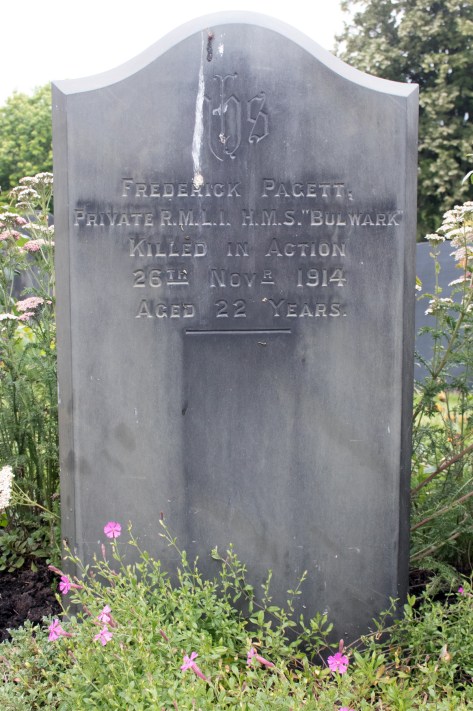
Frederick Pagett was born in the Worcestershire village of Hanley Castle on 27th July 1892. The seventh of eight children, he was the youngest son to Samuel and Ann Pagett.
Samuel was a policeman, but when he completed his schooling, Frederick found work as a miner. This seemed not to suit him, however, and, on 20th December 1910, he enlisted in the Royal Marine Light Infantry.
Private Pagett’s service records show that he was 5ft 4.5ins tall, and that he had brown hair, blue eyes and a fresh complexion. He had two small scars on his upper lip, and was noted as being able to swim.
Frederick was sent to Deal in Kent for his training. Over the next couple of years, he learnt his trade, and would serve in the Hampshire towns of Gosport and Portsmouth. His papers noted a very good character.
On 12th June 1912, Private Pagett was assigned to the battleship HMS Bulwark. He would remain part of her crew for the next couple of years.
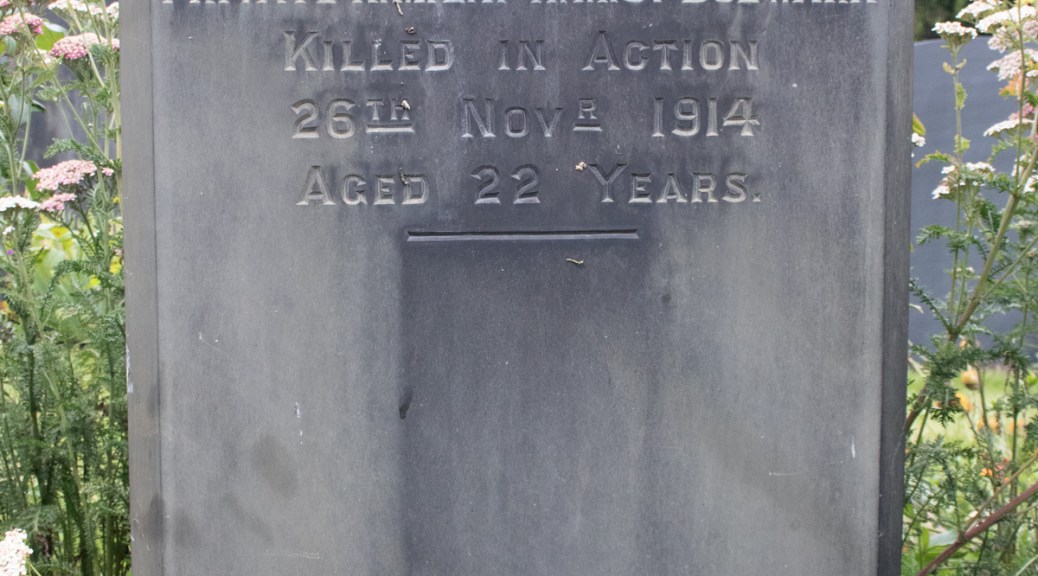
On the 26th November 1914, when Bulwark was moored close to Sheerness, Kent, an explosion ripped through the ship, sinking it and killing more than 740 people. Frederick was on board at the time, and was amongst those to be killed: he just was 22 years of age.
The body of Frederick Pagett was laid to rest in a marked grave in the naval section of Woodlands Cemetery, Gillingham, Kent.
Cecil Robert Stevens was born in Arrah, India, on 14th March 1867. One of six children, his parents were Charles and Mary Stevens. Charles was a civil servant who had been born in the South Sea Islands, while Mary has been born in Bengal.
The family appear to have moved to the United Kingdom by the late 1870s. Census records for them are a bit sparse, but the 1881 document found Mary living in Honiton, Devon, with four of Cecil’s siblings and three servants. Cecil, meanwhile, was a boarding student at Malvern College, Worcestershire.
By 1891, Cecil had moved to St Columb in Cornwall. He was boarding at a hotel on Fore Street, and was employed as a general medical practitioner.
Charles was later rewarded for his service to the Empire, and received a knighthood. The 1901 census found him residing in Harcourt Terrace, Kensington, Middlesex, while his wife, now Dame Mary Stevens, was visiting a friend from India in Devon. Sir Charles died at home in 1909, following a bout of influenza.
Cecil, meanwhile, had been making his own way in the world. A qualified surgeon, he married Katharine Duff, a nurse from Aberdeen. They went on to have two children, son Cecil Jr and daughter Mignonette.
On 29th July 1893, Cecil joined the Indian Medical Service as a Lieutenant. Three years later, he was promoted to Captain, and in July 1905, he rose to the rank of Major. His commitment to duty is evident: he spent many years overseas, separated from his wife and young family, and in January 1913, was promoted to the rank of Lieutenant Colonel.
Cecil’s time in the Indian Medical Service was not without danger. In 1895, he was involved in the Relief of Chitral, for which he received a medal and clasp. He was caught up in the Tirah Campaign of 1897/98, and received a further two clasps for his role.
Lieutenant Colonel Stevens’ role during the First World War is lost in the mists of time. Given his role in the Indian Medical Service, it is likely that he served overseas, but he returned to Britain after the war, coming by way of Egypt.
By the autumn of 1919, he was back in Devon, at the family home on Elmsleigh Park Road in Paignton. His health was failing at this point, having come down with diabetes while in North Africa. him. Cecil passed away on 18th November 1919: he was 52 years of age.
Cecil Robert Stevens was laid to rest in the sprawling grounds of Paignton Cemetery.
Lieutenant Colonel Stevens’ will left £4123 13s 10d (around £180,000 today) to his sister-in-law, Alice Duff.
Katharine outlived her husband by only eight years. She passed away on 22nd December 1927 at the Field Officers’ Quarters in Gibraltar: she was 61 years of age.
Charles Bayliss was born in Birmingham in 1861. Little concrete information is available about his early life, but later documents confirm his father was called John, and he was one of at least five children.
Charles married Ellen Kimberley on 8th April 1888. The couple wed at St Mary’s Church in Kidderminster, Worcestershire, and went on to have four children – Nellie, Charles, Burt and Eva.
Charles took up manufacturing work, and ended up being a machine belt maker. He also served in the South Staffordshire Regiment, although whether this was on a paid or voluntary basis is not clear.
When was came to Europe, Charles felt the need to serve his country once more. He enlisted on 23rd August 1917, taking five years off his age to ensure he was accepted. He was assigned to the Royal Engineers, and attached to the Inland Waterways and Docks unit.
Private Bayliss was based at Portbury Camp near Bristol, and records suggest that Ellen moved to be near him, finding lodgings on Myrtle Hill in Pill.
Charles was respected for the work that he was doing, and was promoted to Lance Corporal in May 1918. His health was against him, however, and just two months later he collapsed and died from a heart attack while at work. He was 58 years of age.
Charles Bayliss was laid to rest in the graveyard of St George’s Church, Easton-in-Gordano, not far from the docks where he had served, and the riverside home in which his widow still lived.
News has been received at Bathpool, Taunton, that Lieutenant HB Redler, MC (RAF), was killed while flying at Turnberry, near Ayr. Lieutenant Redler, who was 21 years of age, was the eldest son of Mr and Mrs DB Redler, of Moorreesbury [sic], South Africa, and formerly of Bathpool, Taunton, and he sailed from South Africa with a schoolfellow at the end of 1915, at the age of 18, in order to join the Royal Flying Corps. On arrival in England they found no vacancies, and entered the Artists’ Rifles OTC, from which they joined the RFC. After obtaining his commission, Lieut. Redler spent a few months in France last year, and was then sent to Ayr as a fighting instructor. In March of this year he was sent to France for a six weeks’ course, during which he won the Military Cross, and it is believed that his record will show a total of nearly twenty enemy machines brought down.
Taunton Courier and Western Advertiser: Wednesday 3rd July 1918
Harold Bolton Redler was born in Worcester, Worcestershire, on 27th January 1897. The oldest of five children, his parents were Daniel and Annie. Daniel was a flour miller from Devon, and the family had moved to Worcester the year before Harold was born.
In 1903, the Redlers emigrated to South Africa. Initially settling in King William’s Town (now Qonce), they moved to Moorreesburg after the birth of Harold’s youngest sibling, Norman, in 1906.
Harold was educated at the Bishops Diocesan College in Rondebosch, Cape Town, and it was from here that he and his friend decided to step up and serve their King and Empire. Sadly, his service records have been consigned to history, and only the newspaper report remains to piece together his time in service.
Lieutenant Redler’s awarding of the Military Cross, however, is documented:
For conspicuous gallantry and devotion to duty. He encountered four enemy two-seater machines and attacking the lowest drove it to the ground with its engine damaged. Later he attacked one of five enemy two-seater machines and drove it down out of control. He has destroyed in all three enemy machines and driven three others down out of control. He continually attacked enemy troops and transport from a low altitude during operations and showed splendid qualities of courage and determination throughout.
London Gazette: 22nd June 1918
On the morning of 21st June 1918, Lieutenant Redler was flying a de Havilland DH9 aircraft, accompanied by Captain Ian Henderson. The plane was fitted with a Lewis gun, which the pair were testing. At 10am, the aircraft crashed, and both were killed. No immediate cause was identified, and their RAF cards record an open verdict. Harold was just 21 years of age.
With his parents and siblings in South Africa, Harold Bolton Redler’s body was taken to Somerset for burial. He was laid to rest with his paternal grandparents in the peaceful St Augustine’s Churchyard in West Monkton.
Thomas James Clark was born in Worcester at the beginning of 1853, the oldest of two children to James Clark and his wife Sarah. James was an engine smith and gas fitter, and moved the family with his work, initially to London, then on to the Kent coast.
Documentation relating to Thomas’ early life is difficult to track down; the 1871 census has him listed as a gas fitter like his father, but it is likely that he enlisted in the army fairly shortly after this date.
In 1875, he married a woman called Emily Ann. There life was to take on a grand new adventure as their first child, a boy named after his father, was born in Bombay, India, later that year.
It seems likely that it was Thomas’ military service that took the young family overseas. This was to be the case for at least a decade, as Emily gave birth to four further children in India. James, their fifth child, was born in Bombay in 1884. Their sixth, and last child, Ellen, was born in Gillingham, Kent, ten years later.
Given that the standard time for military service was twelve years, it is possible that Thomas served all of that time overseas, returning to England in around 1887.
Back home in Kent, Thomas is given the commission of Quartermaster in November 1897. By this point, he has been in the Royal Engineers for just under 21 years. He and his family are living in central Gillingham, within easy walking distance of the Royal Engineers Barracks and School of Engineering.
The 1901 census also lists Thomas as Quartermaster for the regiment, while three of his sons are by this time working in the Naval Dockyard as shipwrights and engine fitters.
Ten years later and the family are still living in the same house. By now, and aged 57, Thomas is recorded as a Retired Captain and Quartermaster for the Royal Engineers. He and Emily have been married 36 years, and their three youngest children (now aged 29, 26 and 17) are still living with them.
War was looming by now, although, age 61 when it broke out, it is unlikely that Retired Quartermaster Clark would have been involved in any front line activity. While no military records survive for Thomas, it seems possible that he may have been recalled for a training or administrative role at the barracks nearby.
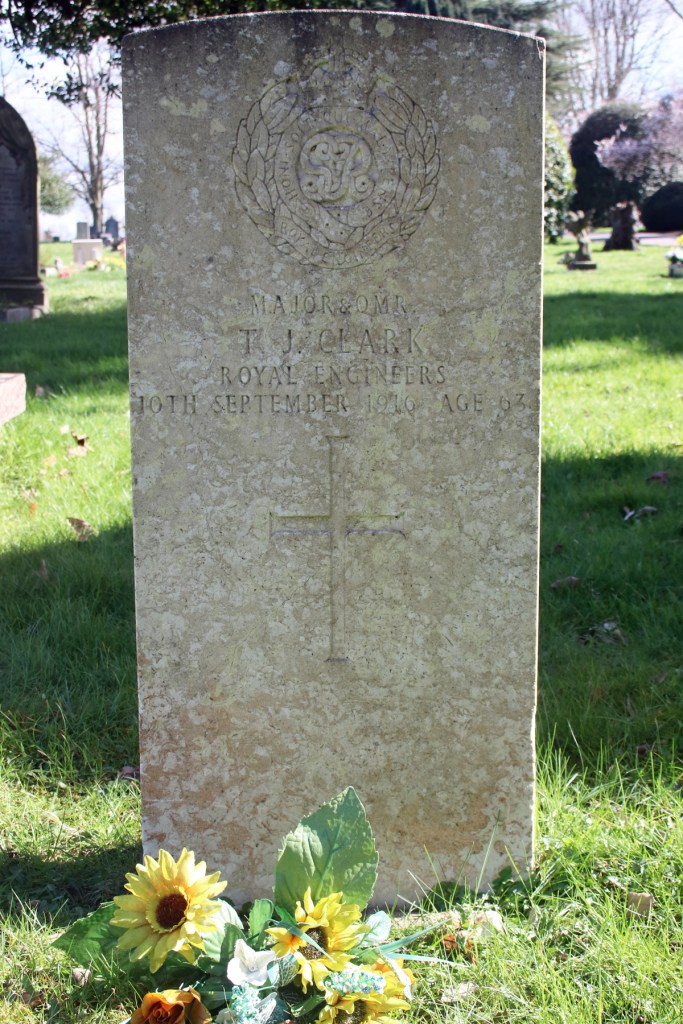
Any re-commission would not have lasted for long, however, as Quartermaster Clark passed away at home on 10th September 1916. He was 63 years old.
Thomas James Clark lies at peace in the Woodlands Cemetery in Gillingham, Kent.
Thomas’ widow, Emily, passed away just two years after her husband. She was also laid to rest in the Woodlands Cemetery.
Thomas left his estate in the hands of his youngest son, James, who was still living at his parents’ home when they passed away.



 Death and Service