
Tag Archives: York and Lancaster Regiment

Private Gilbert Smyth

Private Gilbert Smyth

Gilbert Rowland Locke Smyth was born in the summer of 1897, and was the oldest of three children to Charles and Elizabeth. Charles was a postman and bootmaker and both he and his wife came from North Molton in Devon. The 1901 found the young family taking rooms in Dobbs Cottage on East Street, midway between two pubs: the Poltimore Arms and the Miner’s Arms.

Gilbert – who was better known as Roy – found work as a clerk she he finished his schooling. By the time war broke out, he was had moved to East Sheen, Surrey, and was employed by the civil service. He was keen to play his part, and enlisted in the army on 10th December 1915.

Initially assigned to the Suffolk Regiment, Private Smyth’s service records give an insight into the young man he had become. At eighteen years of age, he was 5ft 8.5ins (1.74m) tall, and weighed 112lbs (50.8kg). While he had worn spectacles for a couple of years, he was noted as being of fair physical development. The document confirms that he had a mole on the top of his right arm.

Roy was not formally mobilised until October 1916. After four months’ training on home soil, his unit, the 14th Battalion, was sent to France. Private Smyth remained overseas for nearly a year, during which time he transferred to the 12th Battalion of the York & Lancashire Regiment.

At the end of July 1918 Roy was caught up in a German gas attack, and this would have a long-term effect on his health, particularly his eyesight. He returned to Britain on 30th November 1918, and, after a couple more months spent in France, he was formally discharged from the army on medical grounds on 5th April 1919.

The deepest sympathy is extended to Mr and Mrs C Smyth in the loss of their eldest son, Roy… Deceased, who was employed in London in the Civil Service, was taken ill with pneumonia, and died before his father could arrive.

[Exeter and Plymouth Gazette: Friday 6th August 1920]

Gilbert Rowland Locke Smyth died on 3rd August 1920: he was 22 years of age. He was brought back to Devon for burial, and was laid to rest in All Saints’ Churchyard in his home village of North Molton.
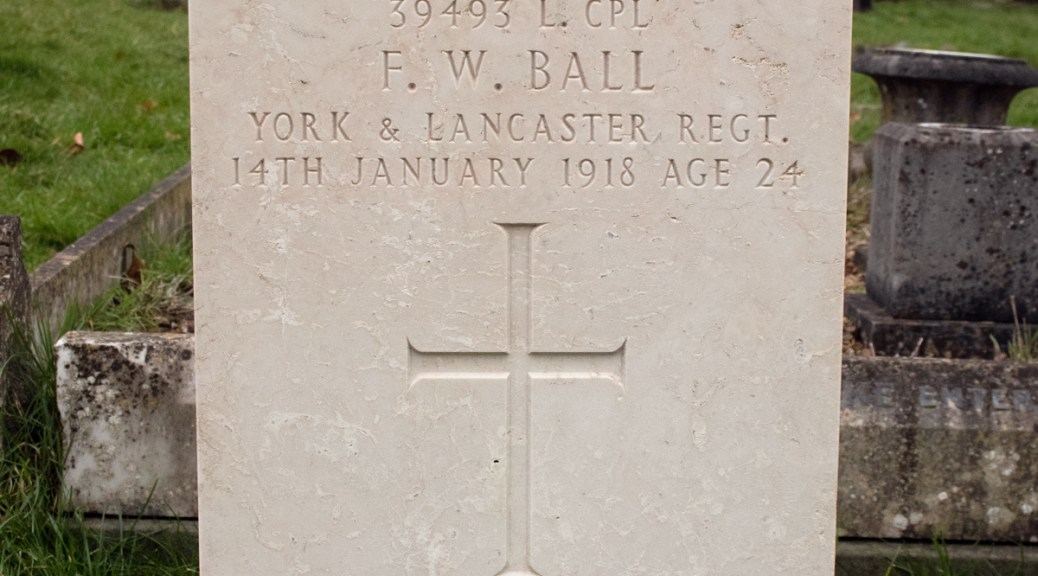

Lance Corporal Francis Ball

Lance Corporal Francis Ball

Francis William Ball was born in the spring of 1893 in the village of Wrington, Somerset and was one of ten children to Joseph and Mary Jane Ball. Joseph was a general labourer while Mary Jane took in washing to earn a little more money for the family.

Little information is available about Francis’ early life. The family travelled the county when he was growing up, and, according to the 1911 census, they were living in Walcot, a suburb of Bath. The same census notes that Francis was apprenticed, although crucially the trade he was learning is missing from the document.

When war came to Europe, he enlisted in the Yorkshire & Lancashire Regiment as a Private. Francis’ service records are lost to time, but he would have enlisted by the summer of 1917, and during his time in the army, he was promoted to Lance Corporal. He was attached to the 2nd/4th Battalion, who served in France, most notably at Arras and Cambrai.

At some point late in 1917, or early in 1918, Lance Corporal Ball was injured and medical evacuated to Britain for treatment. He was admitted to the 2nd Western General Hospital in Manchester, but his wounds were to prove too severe. He passed away on 14th January 1918, at the -age of just 24 years old.

Francis William Ball’s body was brought back to Somerset for burial. He was laid to rest in the St James Cemetery, Bath.


Private Bernard Sugg

Private Bernard Sugg

Bernard Charles Sugg was born in the spring of 1895 and was the third of eight children to Charles and Emma. Charles was a farm labourer from Somerset and the family were raised in Templecombe, to the south of Wincanton.

While Bernard’s older brother William followed their father into farm labouring, Bernard found employment working with a builder and mason when he left school.

When war broke out, the Sugg brothers wanted to step up and play their part for King and Country. William enlisted in the Royal Engineers in May 1915, while Bernard joined the Devonshire Regiment the following February.

Little information is available about Private Bernard Sugg’s military life. He was assigned to the 12th (Labour) Battalion, and was sent to France within a couple of months. He spent a year on the Western Front, but fell ill in the spring of 1917, and was brought back to Britain for treatment. Admitted to the Ladywell Hospital in Bermondsey, South London, with a fever, he passed away on 4th April 1917, aged just 22 years old.

Bernard Charles Sugg was brought back to Somerset for burial. He was laid to rest in the family plot in the graveyard of St Mary’s Church in his home village of Templecombe. Understandably distraught at her boy’s untimely death because of the conflict, on his mother’s wishes, his funeral was not accorded military honours.


Private William Sugg had an active career with the army. Having joined the Royal Engineers after being a platelayer for the local railway, he transferred across to the 2nd/4th Battalion of the York and Lancaster Regiment.

William was caught up in the fighting on the Western Front in the closing months of the war, and was killed on 25th August 1918. He was 25 years old, and was laid to rest at Gommecourt South Cemetery.

Charles and Emma had lost their two eldest boys to the Great War, but their younger three sons – Arthur, Reginald and Harold – were too young to be called up.


Lance Corporal Colin Clarke

Lance Corporal Colin Clarke

Colin Lewis Clarke was born in the spring of 1879 in Cardiff, South Wales. He was one of seven children to Bernard and Elizabeth Clarke. Bernard was a carpenter, but after Elizabeth died in 1886, he took over the running of the Windsor Hotel in Penarth.

When he left school, Colin found work as a clerk. Bernard also died in 1908, and the 1911 census records Colin and his brother Thomas living with his sister, Beatrice. They were sharing the house with Beatrice’s second husband, Charles, and her six children from her first marriage in the Cheshire village of Poulton.

Colin’s trail goes tantalisingly cold at this point. When war broke out, he enlisted to play his part, joining the 16th (Transport Workers) Battalion of the York and Lancaster Regiment by the summer of 1916. This troop was a territorial force, and Private – and then Lance Corporal – Clarke was based in the Yorkshire Dales.

At some point during the autumn Colin fell ill, and was admitted to the Military Hospital in Middlesbrough. His condition is unclear, but he was to succumb to it, passing away on 5th November 1916, the age of 37 years old.

Colin Lewis Clarke’s body was brought back to Wales for burial. He was laid to rest in the graveyard of St Augustine’s Church in Penarth, Glamorganshire.