
William John Payne was born on the 29th November 1896. The second youngest of ten children, his parents were Alfred and Alice. Alfred was a cab driver from St John’s Wood, Middlesex, but the family were born and raised in Paddington. The 1901 census recorded them lodging in a shared house at 100 Woodchester Street, but by 1911, they had taken two rooms around the corner at 89 Cirencester Street. Both were within easy reach of both Paddington Station and the Grand Union Canal.
When he completed his schooling, William found work as a van guard, possibly for the railway. On 19th July 1915, with war raging across Europe, he stepped up to serve his country, and enlisted in the Royal Navy. His papers show that he was 5ft 5ins (1.65m) tall, with light brown hair, grey eyes and a fresh complexion. He was recorded as having a scar on the back of his right hand, and tattoos on both forearms.
Stoker 2nd Class Payne was sent to HMS Pembroke, the Royal Naval Dockyard in Chatham, Kent, for his training. On 13th October 1915, he was given his first posting, on board the depot ship HMS Tyne. Based in the Firth of Forth, she provided support to the naval fleet patrolling the area.
Tyne remained William’s home for the next year, and, during this time, he was promoted to Stoker 1st Class. After a short spell back in Chatham in September 1916, William was reassigned to HMS Wallington. She was a shore base on the River Humber, and from here he would have had short postings on local patrols in the area.
By the spring of 1917, however, Stoker Payne was back at Pembroke. The dockyard was a busy and overcrowded place at this point in the war: the sinking of HMS Vanguard in July led to its replacement crew being stuck at the base while awaiting new assignments. In addition to this, an outbreak of spotted fever meant that sailors’ bunks had to be spaced out in an attempt to slow the spread of the disease. As a result, William found himself billeted in temporary accommodation in the dockyard’s Drill Hall.
On the night of the 3rd September 1917, the German Air Force carried out a daring raid on North Kent. Chatham was in the line of fire, and two bombs landed squarely on the Drill Hall. The glass roof shattered, raining shards down on the sleeping men beneath. Stoker 1st Class Payne was one of the dozens killed in the explosions: he was 20 years of age.
The body of William John Payne was taken back to London for burial. He was laid to rest in Paddington Cemetery, just a short walk from where his family were still living.
William was not the only one of his siblings to be killed during the war. His older brother Walter enlisted in the opening weeks of the conflict and, as a Private, he was attached to the 2nd Battalion of the King’s Royal Rifle Corps.
Private Payne quickly found himself on the Western Front, his unit fighting at Ypres in 1914, and Loos the following year. In April 1916 he was badly wounded, and admitted to a hospital near Béthune. His wounds would prove too severe, however, and he succumbed to them on 4th April: he was 25 years of age.
The body of Private Walter Payne was laid to rest in Béthune Town Cemetery.
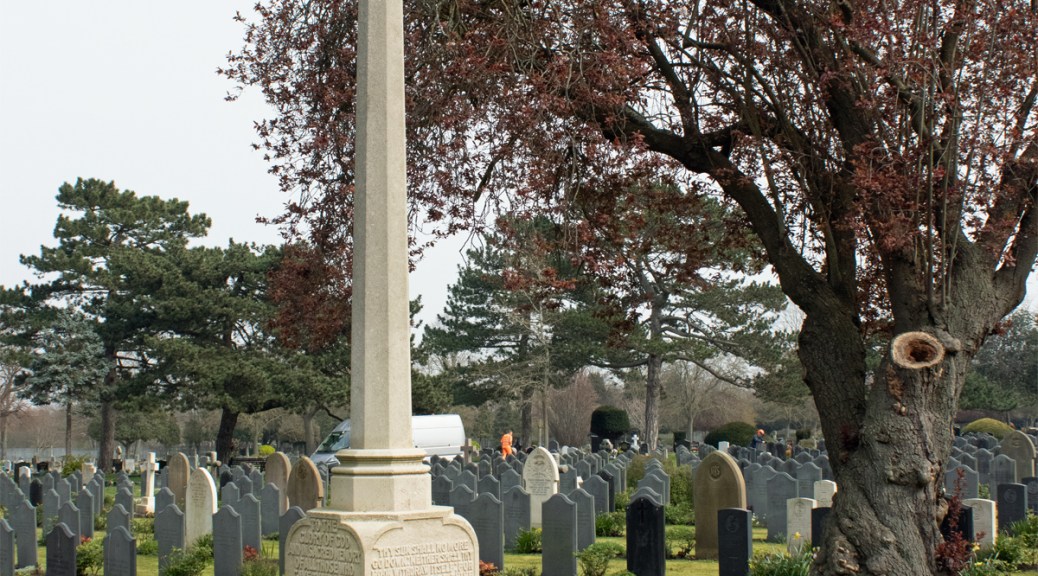
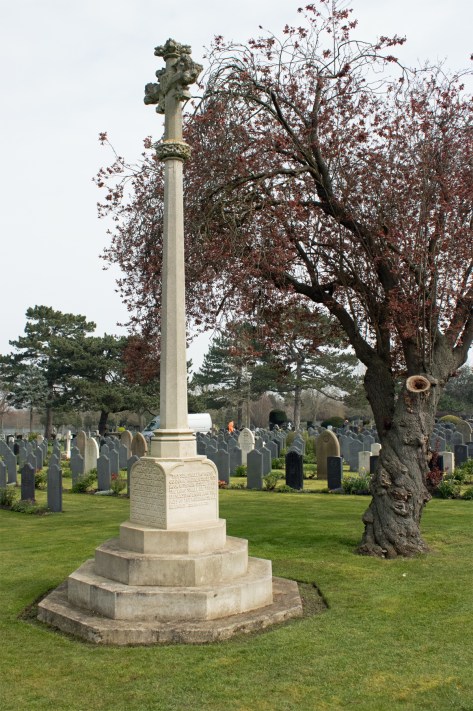
[Note: the photo above is of the memorial to the Chatham Air Raid victims, close to the mass grave for those whose bodies were not identified, in Woodlands Cemetery, Gillingham, Kent.]

