Category Archives: unknown

Air Mechanic 1st Class Joseph Chivers

Air Mechanic 1st Class Joseph Chivers

Joseph Shore Chivers was born in the summer of 1889 in Walcot, Bath, Somerset. He was the youngest of seven children to William and Jane Chivers. William was a blacksmith and, after he and Jane died within nine months of each other in 1904/05, Joseph went to live with his brother, Edward, remaining there with his sister-in-law when his sibling also died in 1910.

Joseph had found work as a French polisher and cabinet maker by this point and this is what he was doing when he married local woman Ellen West in on 11th September 1915.

War was on the horizon by this point and Joseph was soon called on to serve his country. On 26th July 1916 he enlisted in the Royal Flying Corps, as an Air Mechanic 2nd Class. His service records give little away, but do confirm that he was 5ft 8ins (1.73m) tall.

Joseph was dedicated to his role and, on 1st January 1918, was promoted to Air Mechanic 1st Class. Three months later, when the Royal Flying Corps and Royal Naval Air Service combined to become the Royal Air Force, Joseph made the transfer across.

In August, Air Mechanic Chivers moved to RAF Bracebridge, to the south of Lincoln, where he remained until the end of the war and beyond. He was attached to 120 Squadron, which delivered mail and communications to the troops overseas. Little additional information is available about his life there, other than his admission to the 4th Northern Hospital in April 1919, through causes unknown.

Whatever the cause of his need to be admitted, he was to succumb to it. Air Mechanic Chivers passed away on 1st May 1919, at the age of 29 years old.

Joseph Shore Chivers’ body was brought back to Somerset for burial. He was laid to rest in St James’ Cemetery, in his home city of Bath.

Private Joseph Viles

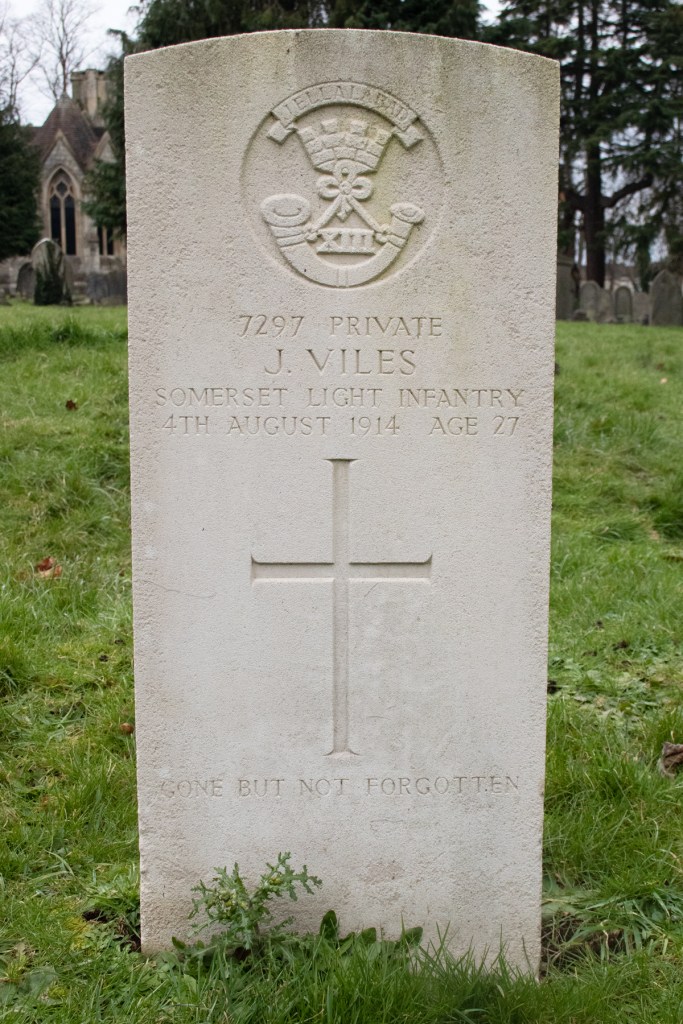
Private Joseph Viles

Joseph Viles was born at the end of 1886 in Bath, Somerset. One of seven children, his parents were collier-turned-general labourer Joseph Viles and his wife, Sarah.

When he left school, Joseph found work as an errand boy, but, in reality, there is little documented about his life. There are only really two records that give an insight into the man he became.

The first is the 1911 census, which confirms he was a Private in the 2nd Battalion of the Somerset Light Infantry. The return gives his location as the St Andrew’s Barracks in Malta.

The second document dates from 29th June 1909, and is a court martial for Private Viles’ for the use of insubordinate language towards a senior officer, in this case a Major. The trial was held in Portland, Dorset, and Joseph was sentenced to 30 days’ imprisonment.

Sadly, a lot of the service records for the Somerset Light Infantry have been lost over time, and those relating to Joseph are amongst them. The only other confirmed detail for Joseph is that of his passing, but even this raises questions.

Private Joseph Viles died on 4th August 1914 – just seven days after war was declared. His regiment was actually based in Quetta, India, at this point, so it is likely that he was at home on leave at the time he died. No cause for is death is noted, and it is likely to have been from an illness of some description, as nothing unusual was reported in the newspapers of the time. Joseph was 27 years of age.

Joseph Viles was laid to rest in Bath’s St James’ Cemetery, where his parents would also be buried, Joseph Sr in 1948, and Sarah in 1958.


Private Alfred Stoyle

Private Alfred Stoyle

Details of Alfred Lawrence Stoyle’s life a challenging to piece together. Most of the information comes from his service records, but even that is limited.

The Somerset Light Infantry records suggest that Private Alfred Stoyle was born in March 1890 in Widcombe, Bath. Physically, he was 5ft 8ins (1.73m) tall, and weighed 109lbs (49.4kg). He had blue eyes, brown hair, a tattoo of crossed flags on his right forearm and a scar above his right eye.

According to the document, Alfred’s parents were Alfred and Ellen Stoyle, and he had been working as a mason’s labourer before he enlisted on 13th February 1909. Early records for the Stoyles are hard to come by, The 1891 census found Alfred and Ellen living in Walcot, Somerset, with their eight children. They have a son, Alfred, although he is noted as being 19 at the time, which does not match the service records for the Alfred who enlisted. They have another son, Albert, who was born in 1886, and it seems that he may have used the name Alfred when enlisting (indeed, those service records note not only Alfred’s parents, but his older siblings Nellie, Ada, Henry and Alfred).

The next census, in 1901, recorded Alfred Sr as being a pauper in the Bath Union Workhouse. He was also listed there in the 1911 census, while that document recorded Ellen living in two rooms in the centre of Bath with Albert/Alfred and her youngest son, William.

Alfred Jr was recorded as being a general painter. By this time, he had enlisted in the Somerset Light Infantry, and was on reserve status, allowing his daily life to continue. He undertook annual training, and, when war broke out in August 1914, he was formally mobilised.

Private Stoyle was sent to France the following month, and ended up spending four months there. In January 1915 he returned home, and there appears to have been a medical reason for doing so. Within a matter of months, he was discharged from the army as he was no longer physically fit. The service records do not give a reason for his dismissal.

At this point, Alfred’s trail goes cold. He seems to have returned home to Somerset, and passed away on 21st August 1915. Based on his service records, he was just 25 years old, although his true age is debatable.

Alfred Lawrence Stoyle was laid to rest in St James’ Cemetery Bath.


Sapper Albert Colston

Sapper Albert Colston

Albert Edward Colston was born in the spring of 1887 in Bath, Somerset. The oldest of seven children, his parents were Thomas and Elizabeth Colston. Thomas was a carpenter and the family were raised in Lyncombe, to the south of the city centre.

Elizabeth died in 1905, by which time Albert had left school. He worked with Thomas and, by the time of the 1911 census, the family – father and four children at home – had moved to a terraced house in the suburbs of Twerton.

During this time, Albert volunteered with the Somerset Light Infantry. When war came to Europe, however, he was enlisted into the Royal Engineers. He joined on 28th February 1916, and was assigned to the Wessex Field Company. His service record show that he was 5ft 8ins (1.73m) tall, of normal physical development and with good vision.

A few months after enlisting, Albert married Alice Selway. She was a groom’s daughter from Bath who, at the time of their marriage, was working as a housemaid in a boarding house in the centre of the city.

Sapper Colston spent the next year on home soil. In March 1917, however, he was discharged from the army as he was deemed no longer medically fit for active duty. Sadly, the records do not confirm the complaint that led to his dismissal.

It is likely that he returned home when he was discharged. He died in Bath just weeks later, on 4th April 1917. He was thirty years of age.

Albert Edward Colston was laid to rest in St James’ Cemetery in his home city, the same location as Elizabeth, mother and son reunited again.


Alice married for a second time in May 1919. He husband was William Keepen, and the couple went on to have a son, Reginald, who was born in 1920. Reginald died in 1937, while Alice lived until 1918. The couple were buried in Haycombe Cemetery on the outskirts of Bath.


Gunner Douglas James

Gunner Douglas James

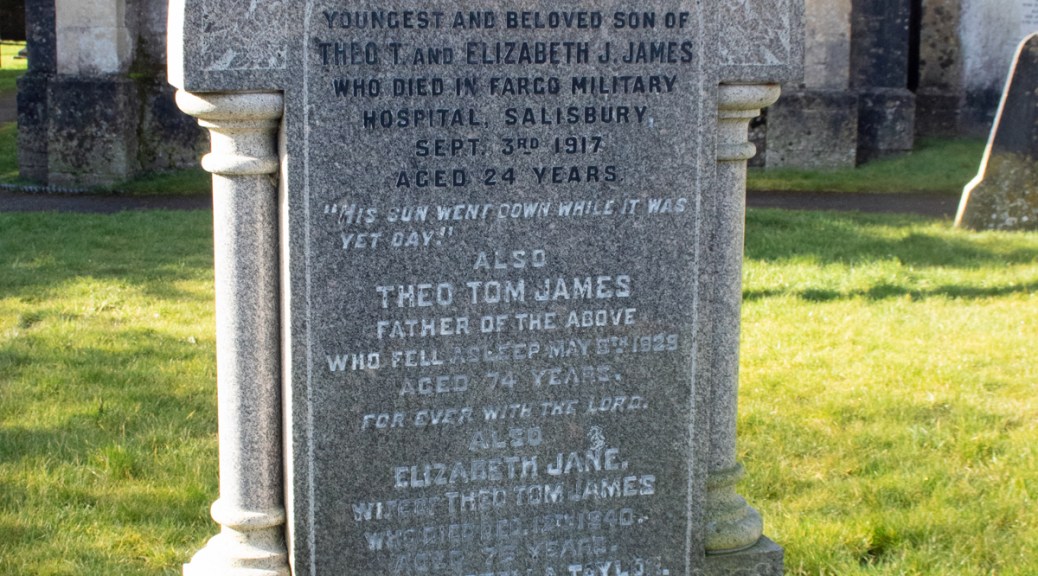
Douglas Arthur James was born on 8th May 1893 near Shepton Mallet, Somerset (records variously quote Oakhill, Stoke St Michael and Shepton itself, but all are within a few miles of each other). One of seven children, his parents were dairy farmers Theo and Elizabeth James.

When Douglas and his siblings left school, they all took up work on the farm, but when war broke out, Douglas wanted to play his part. He would not get his chance to do so until the spring of 1917, when he joined the Royal Field Artillery.

Again, the records differ, one suggesting that he was assigned to the 3rd (Reserve) Brigade, while another suggests that Gunner James was actually assigned to the 15th Reserve Battery. Both units served overseas, although it is impossible to determine whether Douglas went as well.

The only other identified document relating to Gunner James confirms that he was admitted to the Fargo Military Hospital at Larkhill, Wiltshire. The cause of his admission is unclear, but he passed away while there on 3rd September 1917. He was just 24 years of age.

The body of Douglas Arthur James was brought back to Somerset for burial. He was laid to rest in the family plot in the graveyard of St Bartholomew’s Church in West Cranmore.


Douglas remained alone in the family plot for a number of years. The family were eventually reunited, however, when Theo, who died in 1929, and Elizabeth, who passed in 1940, were also laid to rest there. Two of Douglas’ sisters were also buried in the plot – Evelyn, the oldest James daughter, who died in 1952, and Emily, the youngest of the siblings, who passed away in 1977.


Brigadier General Wellesley Paget

Brigadier General Wellesley Paget

Wellesley Lyndoch Henry Paget was born on 2nd March 1858 in Belgaum, India. The sixth of nine children – all boys – his parents were Leopold and Georgina Paget. Leopold was a Colonel in the Royal Artillery, and Wellesley was always destined to follow a military career.

The young Wellesley was schooled at Wellington College, Sandhurst and, went straight into the army: the 1881 census records him as being a Lieutenant in the Royal Artillery, based at the barracks in Newcastle-upon-Tyne. While a baptism record confirms the location of his birth, Wellesley may have been prone to embellishment – the census record suggests he was born on board the ship HMS Charlotte, off Goa in the East Indies.

On 29th February 1888, Wellesley married Isabelle Swire, a merchant’s daughter from Liverpool. The couple made their vows in All Saints’ Church, Leighton Buzzard, presumably not far from where Lieutenant Paget was then based. The couple went on to have two children, Leo and Mary.

[Wellesley] became Adjutant of the Royal Horse Artillery in 1895… He served in the South African War, where he commanded the 2nd Brigade Division, Royal Field Artillery, and took part in the relief of Ladysmith and operations in Natal and in the Transvaal. He took command of the A Battery (the Chestnut Troop), Royal Horse Artillery, in 1900 and went on service with them in the North-East Transvaal. He was mentioned three times in dispatches for his services in South Africa, was promoted Brevet-Lieutenant-Colonel, and received the Queen’s Medal with six clasps.

Somerset Standard: Friday 21st June 1918

The now Major Paget returned to Britain, and set up home with Isabelle in Dorchester, Dorset. They lived comfortably in a villa in Cornwall Road, and had four servants – a nurse, a cook and two housemaids – to tend their needs.

Leo was sent away to school, and followed his father – and grandfather – into the army. He joined the Rifle Brigade, while his family moved to pastures new. By 1911, Wellesley and Isabelle had moved to Ireland, settling in the village of Ballyellis, near Mallow in County Cork. Again, the family had a retinue of staff, including a teacher for Mary, a cook, a kitchen maid, parlour maid and two housemaids.

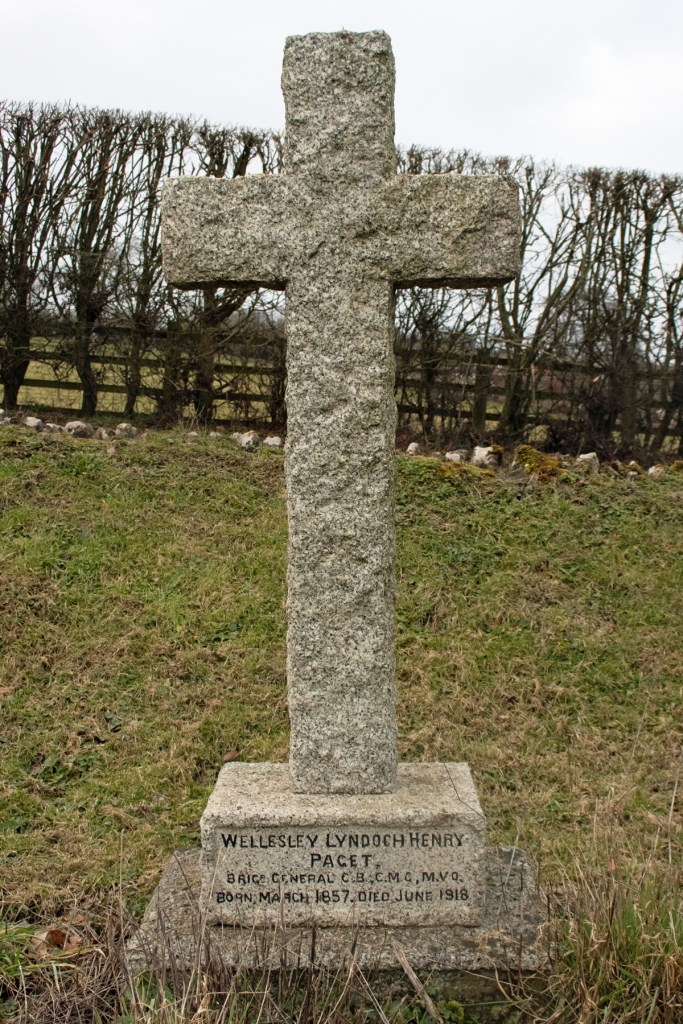
Despite being in his fifties when war was declared in 1914, Wellesley stepped up again to play his part. With the rank of Brigadier General, he was again mentioned twice in dispatches for his actions, and was awarded the Companion of the Order of Bath in 1914, and made Companion of the Most Distinguished Order of Saint Michael and Saint George in the King’s Birthday Honours the following year.

By 1916, Wellesley seems to have taken a step back from military life. The Pagets moved to Somerset, setting up home in North Cheriton, near Wincanton. The Brigadier General kept himself busy, however, and, in 1917, was appointed Agricultural Commissioner for Somerset.

At this point, Wellesley Lyndoch Henry Paget’s trail goes cold. He passed away at his home on 11th June 1918, at the age of 60 years old. He was laid to rest in the North Cheriton Cemetery, not far from where his widow still lived.


Private Robert Templeton

Private Robert Templeton

Robert Muckart Templeton was born in Glasgow, Scotland, in 1894. He was the fourth of five children to shipyard labourer William Templeton and his wife, Agnes.

There is little information on Robert’s early life: the family’s 1911 census records are lost, so it is not possible to identify what work he took on when he left school. It is, however, reasonable to assume that he joined his father in the shipyards.

When war broke out, Robert was one of the first to enlist. He joined the Royal Scots Fusiliers, and, as a Private, was assigned to the 8th (Service) Battalion. His troop was sent to Salisbury Plain, Wiltshire, for training, and he was camped at Codford St Mary.

Towards the end of October, the 8th Battalion was moving to Bristol, and it was at this point that the fates intervened for Private Templeton. Suffering from an acute bout of appendicitis, he was admitted to the Abbas and Templecombe hospital. The condition was to prove his undoing and, on 1st November 1914, he passed away. He was just 20 years of age.

A shipyard labourer’s wages were not going to be enough to transport a body halfway across the country, so the Templetons were left with little choice but to have their son buried close to where he died. Robert Muckart Templeton was laid to rest in the quiet graveyard of St Mary’s Church, in Templecombe, Somerset.


Editor’s note: My gratitude goes to Christine Scott, who was able to furnish me with details of Robert’s death.

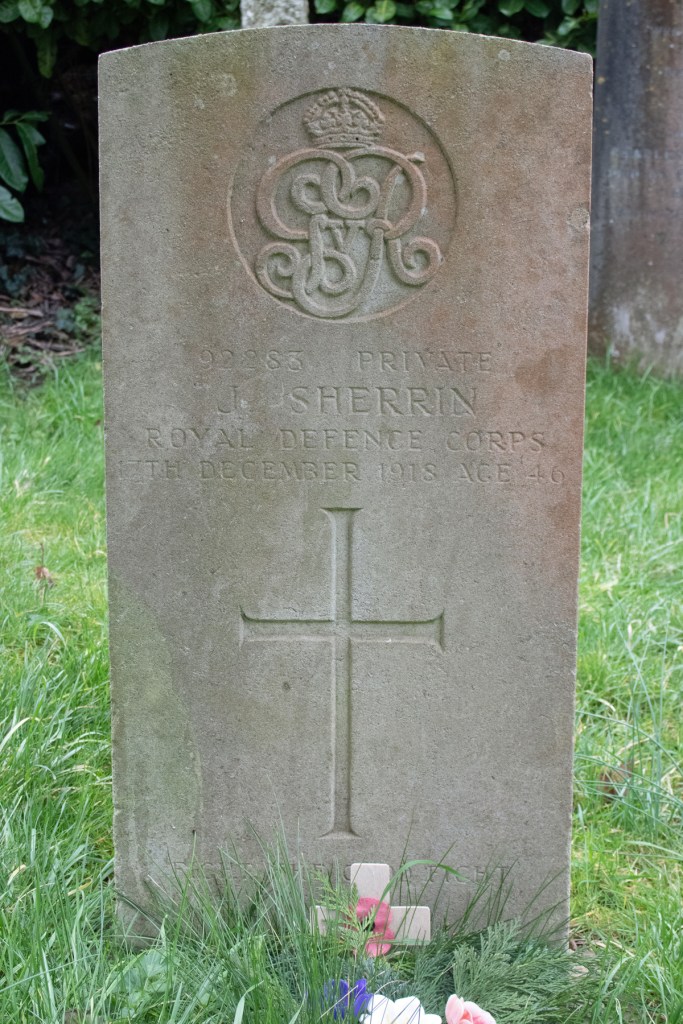
Private John Sherrin

Private John Sherrin

John Sherrin was born in Langport, Somerset, in the summer of 1874. The youngest of three children, his parents were Arthur and Elizabeth Sherrin. Arthur was a cowman and farmer, and John was to follow him into agricultural labouring when he left school.

Arthur took the family where the work was: by the time of the 1891 census, they were living in Broadchalke, a village to the west of Salisbury, Wiltshire. Ten years later, the census notes Arthur and Elizabeth living in Dorset, while John was in Swindon, Wiltshire, working on a farm as a butter churner.

John’s father died in 1906, and Elizabeth went to live with her daughter’s family in Devon. The same year, John returned to Somerset, where he married Bessie Kingsbury. She was a labourer’s daughter from Henstridge, who was working as a domestic servant. The couple went on to have four children – Marleen, Arthur, Albert and Grace.

John’s dairy work kept the family moving, and, according to the 1911 census, the Sherrins were living in a five-room cottage in Sturminster Marshall, Dorset.

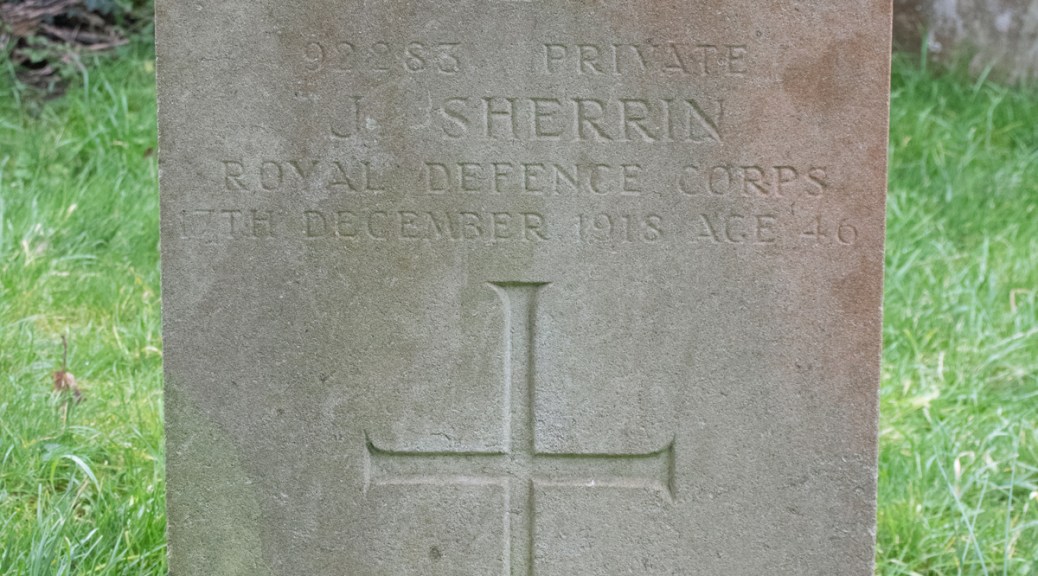
When war came to Europe, John had turned 39 years old. He did not initially enlist – presumably because of his farm work – and it seems that he was only conscripted in the closing months of the conflict. He was called up to the Royal Defence Corps during the summer of 1918, and was assigned to 254 Company.

Private Sherrin was sent to an army camp in Tidworth, Wiltshire, and it was here that he served through the Armistice. He was waiting to be demobbed in December 1918, when he was admitted to the camp’s hospital. Details of his condition are unclear, but it was in the hospital that he passed away on 17th December 1918. He was 44 years of age.

While her late husband was serving, Bessie had returned to her family in Henstridge, and it was there that John’s body was brought. He was laid to rest in the graveyard of St Nicholas’ Church in the village.


Private Herbert Burgess

Private Herbert Burgess

Herbert John Burgess was born in the spring of 1883 in the Somerset village of Henstridge. He was the only child to Stephen and Sarah Burgess. Stephen was a farm labourer and, by the time of the 1901 census, the family had moved to nearby North Cadbury, where Herbert had also found farm work.

At this point, Herbert’s trail goes cold. None of the Burgesses appear on the 1911 census and, when war broke out, while documents confirm that Herbert enlisted, further details are limited.

Private Burgess joined the Devonshire Regiment, and was assigned to the 12th (Labour) Battalion. The troop was sent to France in June 1916, although it is unclear whether Herbert also went abroad. The next available record for him is that of his passing. He died on 10th February 1918, although, again, the cause and location of his passing is unknown. He was 35 years of age.

Wherever and however Herbert John Burgess died, he was brought back to Somerset for burial. He lies in a quiet corner of the graveyard of St Nicholas’ Church in his home village, Henstridge.


Soldaat Armand Luchies

Soldaat Armand Luchies

Armand Joseph Marie Luchies was born in Antwerp, Belgium, on 3rd October 1888. Little accessible information is available for his early life, but when war broke out he joined the Belgian Army as a Soldier.

There is no confirmation of how Soldaat Luchies came to be in the UK – it seems likely that he was either injured or became unwell and was evacuated across the English Channel for treatment. Whatever happened, he passed away in Bath, Somerset – probably at the city’s War Hospital – on 9th August 1918. He was 29 years of age.

Armand Joseph Marie Luchies was laid to rest in the Roman Catholic Cemetery in on the outskirts of the city in which he died. The inscription on his headstone reads “Wie spreekt van dood leeft hij niet eeuwig in ons hart.” (“Whoever speaks of death does not live forever in our hearts.”)