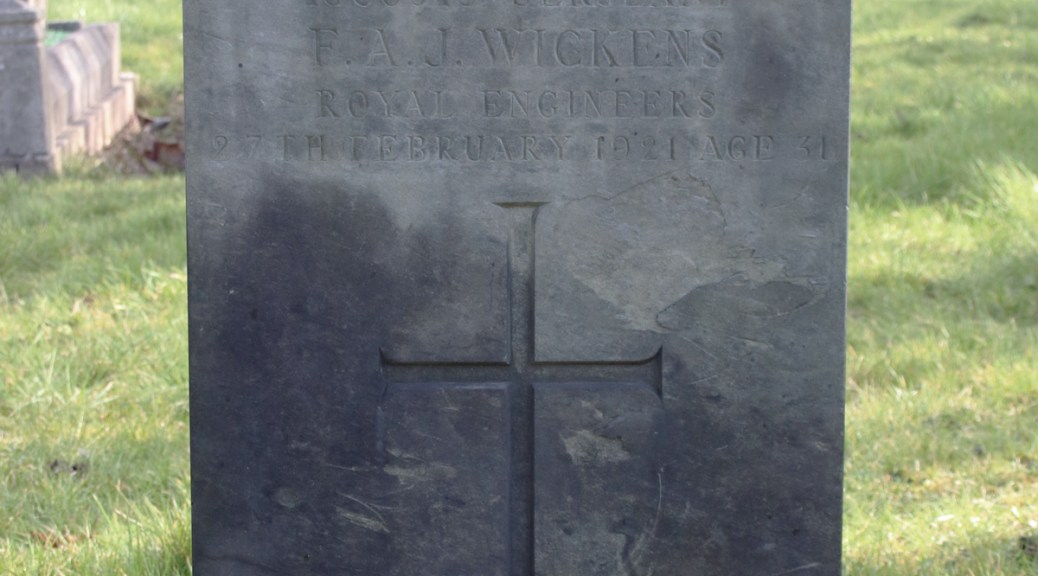
There are some lives that just don’t want to be discovered, that just hide tantalisingly out of reach. James Davidson’s was one of those lives.
The main two research websites I use – cwgc.org and findagrave.com – only have his initial and surname, which is understandable, as this is what is inscribed on his headstone. Unfortunately, that doesn’t act as a good base on which to carry out further research.
HMS Gunner was the wartime moniker for Granton Harbour, near Edinburgh. A naval history website managed to identify Chief Artificer Davidson’s first name – James – but again, with no other information to go on, this is still too common a name – particularly in Scotland – to narrow down any real results.
Sadly, then, the story behind James Davidson is destined to remain a mystery. All that can be confirmed for certain is that he passed away on 23rd January 1919, though the cause of his passing is lost to time, as is his age.
James Davidson lies at rest in the Woodlands Cemetery in Gillingham, Kent.
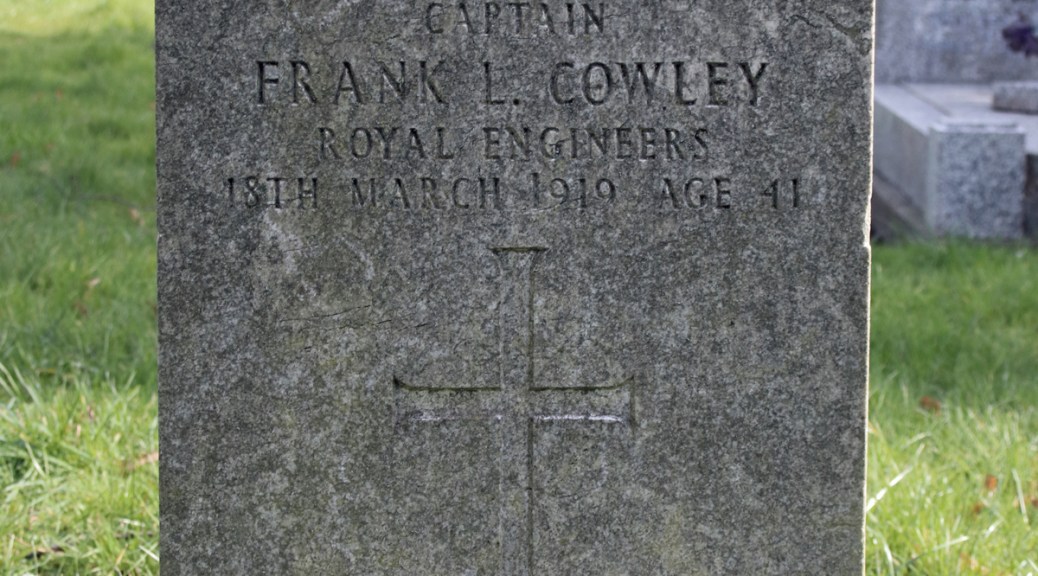
Francis Llewellyn Cowley – also known as ‘Frank’ was born in July 1877 on the Isle of Man. He was one of ten children to Thomas and Ann Cowley, farmers who owned 133 acres on the northern tip of the island.
Frank’s trail goes cold for a few years; he was still living on his father’s farm in 1891, but by 1913, had moved to to the mainland, settling in Kent.
It was here, in Gillingham, that Frank married Lily Matilda Carrington in the summer of 1913. Sadly there is little information about Lily, but the couple do not appear to have had any children.
Frank enlisted shortly after war broke out; he joined the Royal Engineers on 27th October 1914, and within a couple of years has reached the rank of 2nd Lieutenant.
Sadly again at this point Frank’s trail goes cold. He next appears in a newspaper article from 1st March 1919, when he is listed as having attended the funeral in Rainham, Kent, of Air Mechanic Herbert Holdstock. He is now listed as Captain F Cowley RE.
That was resolved to be a tantalising glimpse into Captain Cowley’s final few weeks. From this point, all the documents tell us is that he worked at the School of Military Engineering in Chatham.
Frank passed away on 18th March 1919, although no cause of death is recorded. He was 41 years old.
Francis Llewellyn Cowley lies at rest in the Woodlands Cemetery close to his home in Gillingham, Kent.
Christopher William Thomas Faulkner was born in 1881, one of five children to William and Harriet Faulkner. There is little information about Christopher’s early life, but the 1891 census shows him living with his mother and siblings in the St George’s Barracks in St Martin in the Fields in central London. William is not listed, so it can only be assumed that he was away on duty when the census was completed.
Christopher attended the military school; his record confirms that he was born on 17th June 1881, and spent four months at the school when he was ten years old. William is listed as a Sergeant and the family were living at the St George’s Barracks, which were located in the site now occupied by the National Portrait Gallery.
The military life was indelibly in Christopher’s life by this point. Whilst the records are sparse, he had certainly enlisted by the time he was 25. On Boxing Day 1904 he married a woman called Essie Brant, the daughter of a tailor from Croydon.
On the marriage certificate, Christopher was listed as a Lance Corporal in the Royal Marine Light Infantry and was based at the barracks in Chatham, Kent.
The young couple went on to have four children together and, by 1911, Essie was living in Gillingham, not far from the naval base in Chatham. The majority of Christopher’s career was served here, although when war broke out, he also saw conflict overseas.
By 1916, he was promoted to Sergeant and was assigned to HMS Dominion, which patrolled the North Sea. Ill health must have taken hold, however, and by the end of 1917, Sergeant Faulkner was reassigned to Chatham, before being medically discharged at the beginning of the following year.
Sadly, there is no record of the cause of his release from duty, but it appears to have been something to which he would eventually succumb. The next record is of Sergeant Faulkner’s death, on 5th January 1920, at the age of 39 years old.
Christopher William Thomas Faulkner lies at rest in the Woodlands Cemetery in Gillingham, Kent.
Christopher’s grave also acts as a memorial to his son.
Leslie Albert Gerald Faulkner was born on 9th June 1910. On leaving school, he sought military service like his father, and enlisted in the Royal Navy for a period of twelve years’ service.
Unusually, details of his service appear to end after just three years, in January 1929. However, later records confirm that he continued to serve at HMS Pembroke, the on-shore vessel in Chatham, through to the Second World War, achieving the rank of Chief Petty Officer.
Chief Perry Officer Faulkner’s military records did thrown up some further information, though. Surprisingly, his death records give specific details of the cause of his passing, stating that it was a “rupture of the liver due to secondary neoplasm of the liver, due to primary seminoma of testis”. In effect, Leslie had suffered testicular cancer, which then spread to his liver.
Leslie Albert Gerald Faulkner died on 28th November 1945, at the age of just 35 years old. He was buried in the same grave as his father, in Woodlands Cemetery, Gillingham.
Henry McCahearty was born in Glasgow in October 1864, one of four children to Henry and Bridget McCaherty. Sadly, few records remain, but it seems that Henry Sr, who had been born in Northern Ireland, was a soldier.
Henry falls off the radar quite quickly; from later records we can determine that he worked as a skilled labourer at the Naval Dockyard in Chatham, although it is not certain what particular skills he had.
He married Alice Radford on 3rd September 1901 in Walmer, on the Kent coast, although the couple subsequently moved to Gillingham. They went on to have four children – Reginald, James, Leonard and Alfred.
Henry was 49 when war broke out. While over the initial recruitment age, he did enlist – becoming a Private in the Royal Marine Light Infantry – although it is not certain exactly when he joined up.
Sadly Private McCahearty’s passing is also a mystery. There is nothing in the newspapers of the time to suggest anything out of the ordinary, so I can only assume that he died as a result of one of the illnesses that were rife at the time. Either way, he died on 14th November 1916, at the age of 51.
Henry McCahearty lies at rest in the Woodlands Cemetery in Gilingham, Kent.
William Henry May was born on 10th August 1854, the oldest of three children to James and Selina May. James was a carpenter’s mate from Plymouth, and the family lived in the Stonehouse area of the city, right next to the dockyard.
Maritime adventure was obviously going to be in William’s blood; by the time of the 1881 census, at the age of 25, he is working as a gunner’s mate and instructor for the Royal Navy. He married a Mary Jane Channing, the daughter of a labourer and fishmonger, in 1879; the coupe were living in their home town of Plymouth.
There are definite gaps in the William’s trail; this may be because he was abroad, or because the documentation relating to him has been lost or destroyed. He next appears on the 1901 census.
By this point, William was a Warrant Officer in the Royal Navy. He is married to Kate Doling, from Gosport in Hampshire, and the couple were living in Sheerness, Kent.
William continued to live close to port; ten years on, and aged 56, he and Kate had moved along the Kent coast to Gillingham, not far from the dockyards at Chatham. The couple had been married 23 years by this point, but had had no children.
By this point, William’s naval service had come to an end. He had served for twenty years, and had reached the rank of Lieutenant, but the census lists him as retired.
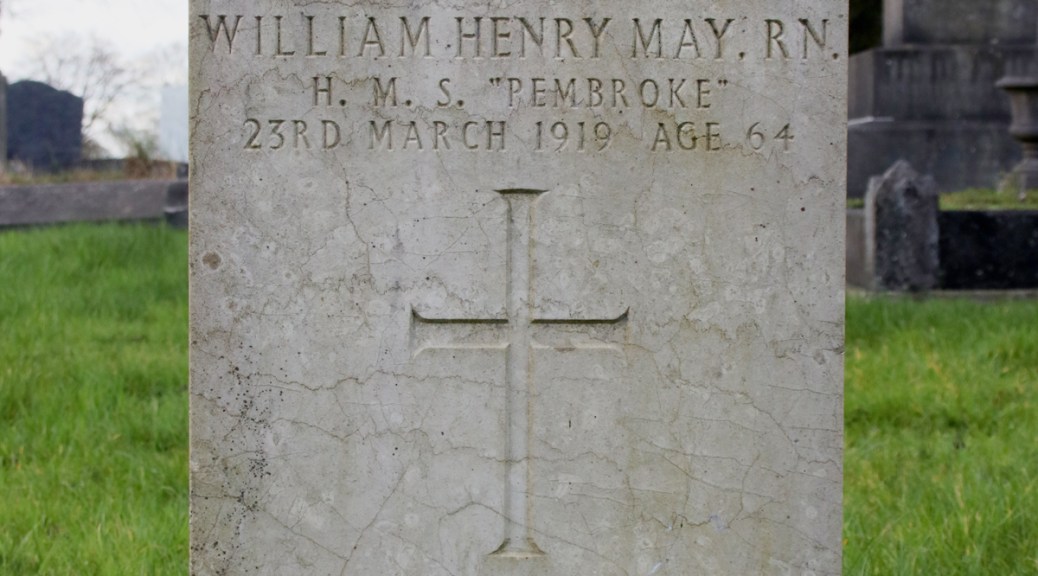
War arrived, however, and William’s services were called upon once more. He was assigned to HMS Pembroke, the shore-based naval barracks in Chatham, and served with the rank of Lieutenant Commander.
From this point, however, William’s trail goes cold. His gravestone confirms that he passed away on 23rd March 1919, at the age of 64, but I have been unable to find a cause of death. His entry on the Commonwealth War Graves Commission site confirms he was the husband of the late Kate Emily May, so she too must have passed away at some point after 1911.
William Henry May lies at rest in the Woodlands Cemetery in his adopted home of Gillingham, Kent.
Occasionally I have found that some people are destined to remain hidden. No matter how much research you try and do, details stay lost, and the name on a gravestone will remain just that.
Private Fred Hobbs is one of those people.
He was born in around 1891; he enlisted in the 1st/5th Battalion of the Somerset Light Infantry. Private Hobbs’ service records are not available, but he was awarded the Victory and British Medals for his actions.
His pension record gives Mrs Ellen Louisa Hobbs as his next of kin; there is no confirmation of whether this was his mother or his wife – research has uncovered nothing to identify either.
Private Hobbs does not appear in the contemporary media – this would seem to suggest nothing out of the ordinary about his passing.
All we know for certain is that Fred Hobbs passed away on 12th June 1920, aged 29 years old. He lies at rest in St John’s Cemetery in Bridgwater, Somerset.
William Reginald Coggan was born in Twerton, near Bath, at the end of 1882. His father, also called William, was a railway guard, and with his mother, Annie, he would go on to raise nine children, six of them girls.
William Jr became known as Reginald, presumably to avoid confusion with his father. He didn’t follow his father onto the railways, but found a way to serve his country. In the 1901 census, he was working as a baker for the Army Service Corps, and was based at the Stanhope Lines Barracks in Aldershot (along with more than 1800 others).
Ten years later – by the time of the 1911 census – William had left the army but continued his trade. He was listed as a baker of confections in Glastonbury, was living above the bakery with his wife of four years. I have been able to find little information about his wife, Kate, other than that she came from Dublin.
William Coggan’s former bakery in Glastonbury, Somerset.
William’s life becomes a little vague after the census. A newspaper report confirms that he had served in the South Africa war (1899-1902), and that he had seen five years’ service in France. The report – and William’s pension records – confirm that he had continued in the Army Service Corps, gaining the rank of Staff Sergeant.
William had died in Ireland, and his death registered in Fermoy, thirty miles to the north of Cork. The report confirmed that:
Nothing is yet known of how he came by his death, although a request was made for a post-mortem examination.
Taunton Courier and Western Advertiser: Wednesday 11th August 1920.
I can find no further information about his death and, unusually, his Pension Record gives the date, but not the cause. Staff Sergeant Coggan died on 29th July 1920, aged 38 years old.
William Reginald Coggan’s body was brought back to England for burial. He lies at rest in St John’s Cemetery in Bridgwater, Somerset.
Ernest James Wood was born in 1891, one of ten children to Alfred and Charlotte Wood. Alfred was a carpenter and machinist for a timber merchant, and, by the time of Ernest’s birth the family lived in Bridgwater, Somerset.
When hostilities broke out, Ernest was quick to enlist. He joined the Royal Army Service Corps in September 1914. Driver Wood was assigned to the Horse Transport Depot Company at Park Royal in London, and there is a note of him being injured on 29th July 1916. Sadly, little else of his military service remains.
In January 1916, Ernest married Hilda Williams. She was the same age as her new husband, and was the daughter of Thomas and Elizabeth, who were also from Bridgwater.
The trail of Driver Wood goes a little cold after that. He was demobbed om 6th January 1919 and on the release form declared that he was not medically unfit as a result of his military service.
Frustratingly, the trail goes totally cold at that point. All we know for certain is that Ernest died on 2nd March 1919, two months after leaving the army. There a no records confirming a cause of death but, as he does not appear in any contemporary newspapers, it is likely that the cause was not unusual; perhaps one of the respiratory conditions going around at the time, such as influenza or pneumonia. Whatever the cause, Ernest was just 28 years old when he died (his headstone is based on an incorrect date of birth).
Ernest James Wood lies at peace in the St John’s Cemetery in his home town of Bridgwater, in Somerset.
William James Bradbeer was born in the spring of 1888, the youngest of eight children to Alfred and Jane Bradbeer from Bridgwater in Somerset. Alfred was a carriage trimmer, fitting out the train coaches for the local railways.
Sadly, William lost both of his parents in 1910; by this point he was 22, and was working as a schoolmaster along with his older brother Alfred. Five of the Bradbeer siblings were living together by this point, along with Sidney Palfrey, a photographer, who was boarding with them.
On 27th December 1911, William married Selina Nurse, who was also from Bridgwater, and whose father was a master mariner. The couple did not have any children together.
There is little evidence of William’s life after his marriage. He was enlisted in the Royal Garrison Artillery during the war, although no details of his military service are available. The battalions provided support in key forts primarily along the south coast of England, but also in places like the Channel Isles, Malta and Sierra Leone. Without Second Lieutenant Bradbeer’s records, it is impossible to know specifically where he served, but it would seem likely that he remained in England during the war.
The last years of William’s are also shrouded in mystery; he passed away on 8th August 1920, at the age of 32. I have been unable to uncover a cause of death, but it seems likely to have been an illness, as there is nothing in the contemporary media to suggest anything unusual or untoward.
William James Bradbeer lies at rest in the Wembdon Road Cemetery in his home town of Bridgwater. Sadly, though, his grave is also lost to time, and I was unable to pinpoint its location. In death, as in his later years, William remains a mystery.
Note: The grave at the top of this page, however, is of a couple of his Bradbeer relatives, buried in the same cemetery.
Walter Ricks Treliving was born in Bridgwater, Somerset, in 1876, the middle of three children to James and Elizabeth Treliving. James was a commercial traveller in the drapery trade, and this is something his son followed him into.
According to the 1891 census, Walter was a pupil at the Commercial Traveller’s School in Pinner, Middlesex, which was, in effect, a boarding school-cum-children’s home for the children of commercial travellers and orphans.
Commerce was obviously engrained into Walter by this point and, after leaving school, he followed his father into the trade of trading. He travelled with his work, frequently boarding with others; in 1901, the census recorded him as living lodging with his maternal aunt Annie Ricks.
Love beckoned, however, and in 1904, Walter married Mabel Broadrick, the daughter of a Unitarian Minister from Worcestershire. The couple set up home in Weston-super-Mare and had a daughter, Beryl, two years later.
Things were not to go smoothly, however, as an article in the Western Daily Press were to show:
In the Divorce Court yesterday, a case was heard in which Mr Walter Treliving, a commercial traveller of Weston-super-Mare, petitioned for a divorce from Mabel Annie Treliving, on the ground of her misconduct with Mr Charles E Rust, an engineer. The case was undefended.
Mr Treliving said he was married on the 13th August 1904 at Bridgwater, and afterwards lived at Weston-super-Mare. There was one child of the marriage. The married life was happy until May 1913, when his wife told him that she cared for someone else.
In July 1913, his wife went away to Manchester on a visit, and when she came back she told him she had stayed with Mr Rust at the Grand Hotel… He forgave her for that, and took her away for a holiday to Lynton. He then discovered that she was still corresponding with the co-respondent, and afterwards that she was meeting him again.
On the 13th September his wife left him, and he heard that she had gone to Khartoum with the co-respondent. He received a letter from her, in which she said:
“Dear Walter. The divorce papers have come. Of course I cannot defend the case, nor he. So you have it all in your power. I hope you will be happy now you are free. If eve I came back to England, may I see Betty [sic]? I cannot marry Mr R. She will not divorce him. I do not know what I shall do now. I hope you will be happy if you marry again, as I hear you will. Oh! if you had only held out one hand to save me, how different it might have been. I am a broken woman. Yesterday, when the petition came, I realised it. You are fully paid back for all your sufferings. Enjoy your victory. Your wife.”
Petitioner said it was not his intention to marry again, as his wife suggested. He had done everything in his power to induce her to remain with him.
Western Daily Press: Thursday 1st April 1915
A decree nisi was granted to Walter and he was awarded costs.
Sadly, it has not been possible to track Walter’s military history. That he enlisted is evident; he joined the Royal Army Service Corps, and rose through the ranks to become Second Lieutenant Treliving. The divorce proceedings did not identify him as serving in the army, so it seems likely that he joined up at some point after April 1915 – his age and his status as a single father seem further proof of this assumption.
Walter returned to Bridgwater in October 1918 to attend his mother’s funeral. Elizabeth had contracted influenza and, sadly, after returning home Walter also caught and succumbed to it. He died on 11th October 1918, at the age of 42.
His probate confirms two beneficiaries; his sister Hilda Treliving, and another woman, Kate Symons, presumably as guardians and trustees for Beryl.
Walter Ricks Treliving lies at rest in the Wembdon Road Cemetery in his home town of Bridgwater, Somerset. He had been buried on the same day as Elizabeth, the mother whose funeral he had returned to attend.