Category Archives: Dorsetshire Regiment

Private Ernest Brister

Private Ernest Brister

The early life of Ernest Brister is a challenge to piece together. His baptism record – at St Mary Magdalene Church in Thornford, Dorset – suggests that he was born in the summer of 1891, but gives only the name of his mother, Rosina Brister.

The 1901 census identifies the 9-year-old Ernest as a visitor to the house of Eliza Brister, a 65-year-old widow working as a laundress. There are several other Bristers in the village – including Eliza’s own to children – but Rosina is nowhere to be seen.

The next census, taken in 1911, sheds a little more light on the situation. Ernest is still living with Eliza, but he is now recorded as being her grandson. Aged 75, she was still taking in laundry, but Ernest was employed as a mason.

In the autumn of 1913, Ernest married Beatrice Chalker. She was a shepherd’s daughter from Dewlish in Dorset. The couple wed in Dorchester and went on to have two children, Doris and Edwin.

When war broke out, Ernest stepped up to play his part. He enlisted in the Dorsetshire Regiment, and found himself in France by the summer of 1915.

There is little information about Ernest’s time in the army, but later in the war, he seems to have transferred over to the Wiltshire Regiment. Attached to the 3rd (Reserve) Battalion, his new unit served on home soil and, based in Kent, was part of the Thames & Medway Garrison.

Private Brister was based in Maidstone in the autumn of 1918, when he contracted influenza and pneumonia. He was admitted to the military hospital in Aylesford, but the conditions were to prove to severe. He passed away on 24th November 1918, aged 27 years old.

Ernest Brister’s body was taken back to Dorset for burial. He was laid to rest in the graveyard of St Mary Magdalene Church. His grandmother, Eliza, passed away just a month later, at the age of 82. She was laid to rest close to her beloved grandson.


The 1910s were harsh for Ernest’s widow, Beatrice. Her youngest son was born in March 1915, her mother dying a couple of months later. She lost her brother, Edwin, to the war – he was serving with the 1st Battalion of the Gloucestershire Regiment, when he was killed on 28th August 1916. He was just 19 years of age. Two years later, she was widowed when Ernest passed away.


Private Mark Lane

Private Mark Lane

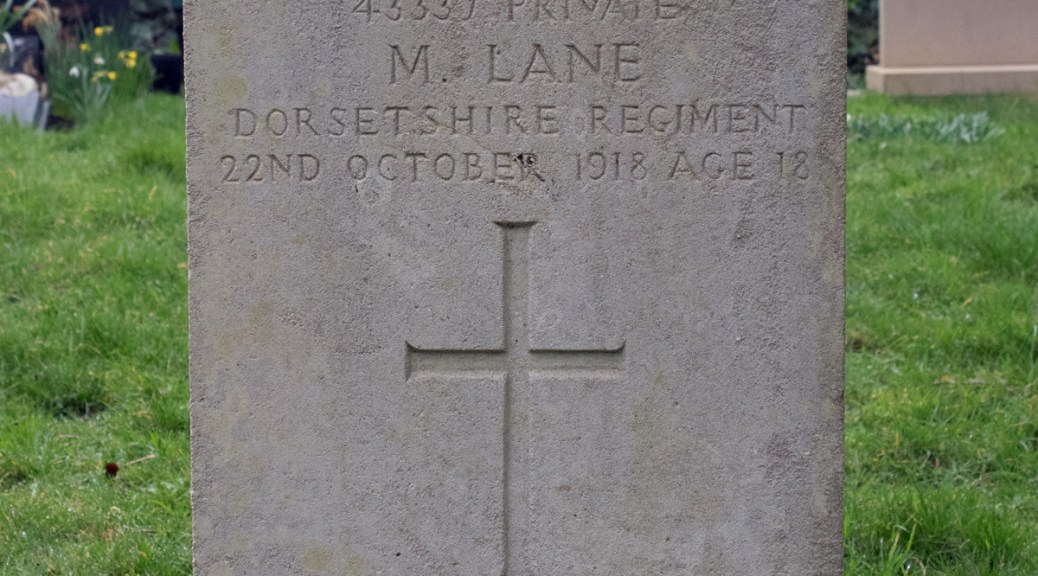
Mark Lane was born in the summer of 1900 in Thornford, Dorset. One of ten children, his parents were estate drainer Albert Lane and his wife, Sarah. Sadly. there is little concrete information about Mark’s life.

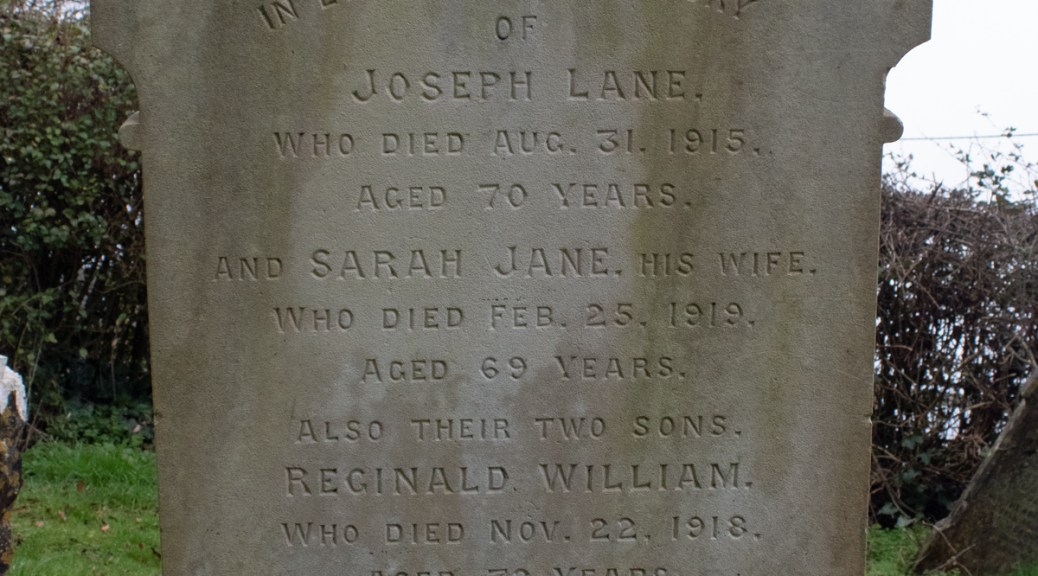
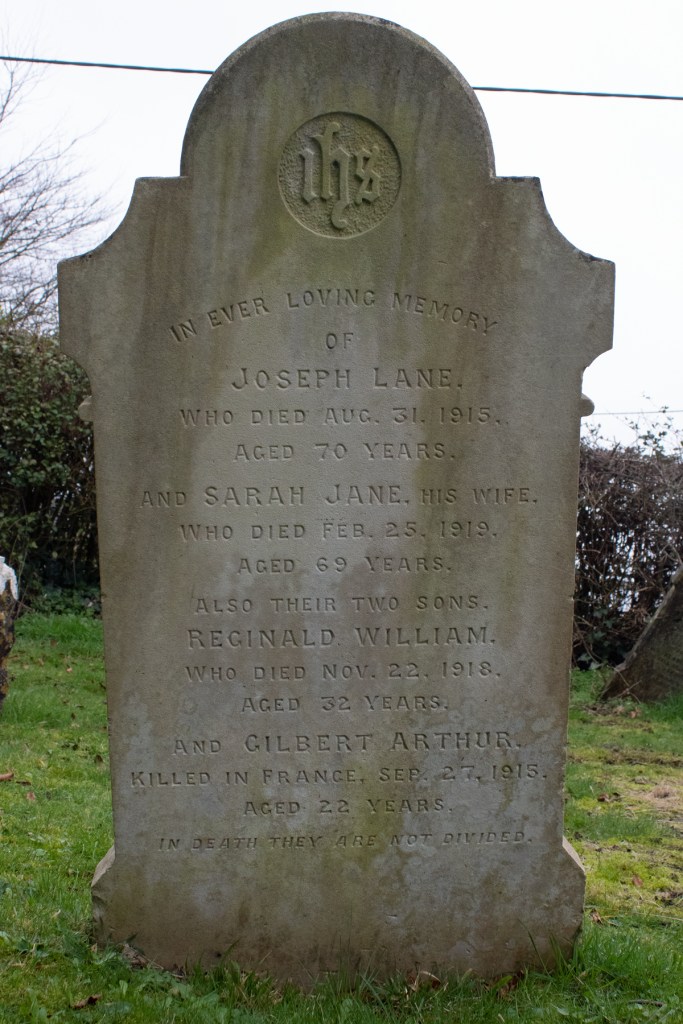
When war broke out, his eldest brother, Gilbert, served in the 5th Battalion of the Dorsetshire Regiment, rising to the rank of Serjeant. Having fought at, and survived, Gallipoli. his unit moved to France in July 1916. Involved in the Battle of the Somme, Gilbert was killed and was laid to rest at Bulls Road Cemetery in France.

His oldest brother dead, Mark seems to have wanted to serve his country and do Gilbert’s memory proud. He did not turn 18 until the summer of 1918, and he seems to have used this as an opportunity to enlist. He also enlisted in the Dorsetshire Regiment and, as part of the 4th (Reserve) Battalion was sent off to do his training.

Unfortunately, details of what happened to Private Lane are lost in the mists of time. He was admitted to a military hospital in the autumn of 1918, and died there on 22nd Octover. He was just 18 years of age.

The body of Mark Lane was laid to rest in the graveyard of St Mary Magdalene Church in his home village of Thornford.


Private William Pollard

Private William Pollard

William Pollard was born at the end of 1887, the youngest of seven children to John and Alice Pollard. Agricultural labourer John hailed from Hinton Charterhouse in Somerset, while his wife was from Southampton, Hampshire. The family were living in the village of Buckler’s Hard when William was born, but moved back to Somerset when he was just a toddler.

As with most of his siblings, William followed in his father’s footsteps when he completed his schooling. By the time of the 1911 census, only he and his older brother Thomas we still living in the family home: the two siblings were working as carters, while their father, now 61 years of age, was a general labourer.

Alice died in the summer of 1911, and would net get to see her youngest boy wed. On 11th April 1914, William married Augusta Loveless, a carpenter’s daughter from Bath. The couple were living in 2 Rossini Cottages, on Hedgemead Road, to the north of the city centre, and would go on to have two children, William Jr and Geoffrey.

When war was declared, William was called upon to play his part. He enlisted in the Somerset Light Infantry on 30th November 1915, but soon transferred over to the 5th (Service) Battalion of the Dorsetshire Regiment. Attached to the 673th Labour Company, while his unit served at Gallipoli and in France, there is no evidence that Private Pollard spent any time overseas.

William’s brother Thomas had also been called up. He joined the Somerset Light Infantry, and, as a Private, was attached to the 1st Battalion. His unit fought at the Somme, and Thomas was badly injured. He died of his wounds, and was laid to rest in the Puchevillers British Cemetery. He was 31 years of age.

In fact, William seems to have been dogged by ill health. Full service records have been lost to time, but he was medically discharged from the army on 12th September 1917.

John had died that February, at the age of 68 years old, and was laid to rest next to his wife in St John the Baptist Church, Hinton Charterhouse.

At this point, William’s trail goes cold. He returned to Bath, and spent at least some time in the city’s War Pensions Hospital. His condition warranted an operation, but he died of heart failure following the procedure on 12th December 1920. He was 33 years of age.

William Pollard was laid to rest in Bath’s sweeping Locksbrook Cemetery.


Private Charles Morris

Private Charles Morris

Charles William Morris was born in the summer of 1887, the third of four children – and the only son – to James and Emily Morris. James was a house painter: both he and Emily came from Bath, Somerset, and this is where the Morris family were born and raised.

When he completed his schooling, Charles found work as a clerk: by the time of the 1911 census, he was employed by the Urban Sanitary Authority. Only two of the children were still living at home by this point, and so James and Emily had taken in a boarder, 25-year-old motor engineer Zackarias MacPherson Jackson, to bring a little more money in.

When war was declared, Charles quickly stepped up to play his part. A later newspaper report provides an insight into his service:

The death occurred on Saturday midnight, at 11, Margaret’s Buildings, Hedgmead, of Mr Charles W Morris, at the age of 33. Previous to joining the forces in 1914, he was a member of the Coleford (Somerset) Cricket Club. Joining the North Somerset Yeomanry as a trooper, he went to France, afterwards being transferred to the 5th Dorsets (Cyclist Corps). Eventually he was taken prisoner and was in Germany for two years suffering great hardships. On his return to his native city he joined the St Stephen’s Rugby FC. He was a member of the Walcot Liberal Club, and at the time of his death was employed by his brother-in-law (Mr Z McJackson [sic], motor engineer). Another brother-in-law us Mr W Hollick, headmaster of Coleford schools, and formerly an assistant master at Holy Trinity School, Bath.

The funeral took place at Locksbrook Cemetery on Thursday. The deceased was extremely well known in the neighbourhood in which he resided, and quite a large number of friends attended the cemetery to pay their last respects.

Bath Chronicle and Weekly Gazette: Saturday 4th June 1921

Zackarias had married Charles’ younger sister, Gladys, in 1915, the one time lodger having literally become a member of the family.

Charles William Morris died on 28th May 1921, through causes unknown. He was laid to rest in a peaceful corner of the sprawling Bath cemetery.


Private Frank Hodge

Private Frank Hodge

Frank Hodge was born in the village of Orchard Portman, to the south of Taunton, Somerset in 1888. One of nine children, his parents were farm workers John and Sarah Hodge. When Frank finished his schooling, he first worked with horses, then became a herdsman on the farm.

By the time war broke out, only the British Army Medal Roll Index Card remains to confirm how Frank he served his King and Country. The document shows that he enlisted in the Somerset Light Infantry, but subsequently made the move to the Dorsetshire Regiment – the Commonwealth War Graves Commission gives his troop as the 2nd Battalion.

While it is unclear in which regiment he was serving at the time, Private Hodge was sent to France on 22nd June 1915. He served for four years, and appears to have been demobbed in May 1919. Private Hodge’s military career between these dates is lost to time.

When he left the army, Frank returned home. His health appears to have suffered, however, and he seems to have been on a downward decline. He passed away from ‘sickness’ on 15th November 1919: he was 31 years of age.

Frank Hodge was laid to rest in the peaceful churchyard of St Michael’s, in his home village of Orchard Portman.


Corporal Frank Crew

Corporal Frank Crew

Frank George Crew was born in Twerton, Somerset, on 25th January 1886. The fourth of five children, his parents were nurseryman and market gardener William Crew and his laundress wife, Fanny.

When Frank finished his schooling, he followed his father into the nursery trade, and this is how he was employed when war was declared. He enlisted in the Dorsetshire Regiment on 19th July 1915, and was assigned to the 3rd (Reserve) Battalion. Private Crew’s service records are limited, but his medical report shows that he was 5ft 9ins (1.75m) tall, weighing around 10st (63.5kg).

On 6th October 1918, Frank, who had been promoted to Corporal by this point, was admitted to the Military Hospital in York with a bullet wound to his right forearm. Given that his battalion remained on home soil for the duration of the conflict, it is unclear whether this was an accidental injury at camp, or if he transferred to another troop when he recovered.

Little additional information for Frank remains. He remained in hospital until 8th November 1918 and it is unclear if he continued with his army service once he recovered – although given the Armistice was declared three days later, it is unlikely that he did.

On 11th November itself, Frank married Kate May, a mason’s daughter from Limpley Stoke, to the west of Bath. By this point he recorded his profession as gardener, so it seems his army career was indeed behind him. The couple went on to have a daughter, Peggy, who was born a year later.

William died in 1920, and by the time of the following year’s census, Frank, Kate and Peggy were living with Frank’s now-widowed mother. The extended family had a home on Padleigh Hill, to the south west of Bath city centre, and Frank seemed to be the main breadwinner, working as a labourer for Stothert & Pitts Ltd, a crane company on the River Avon.

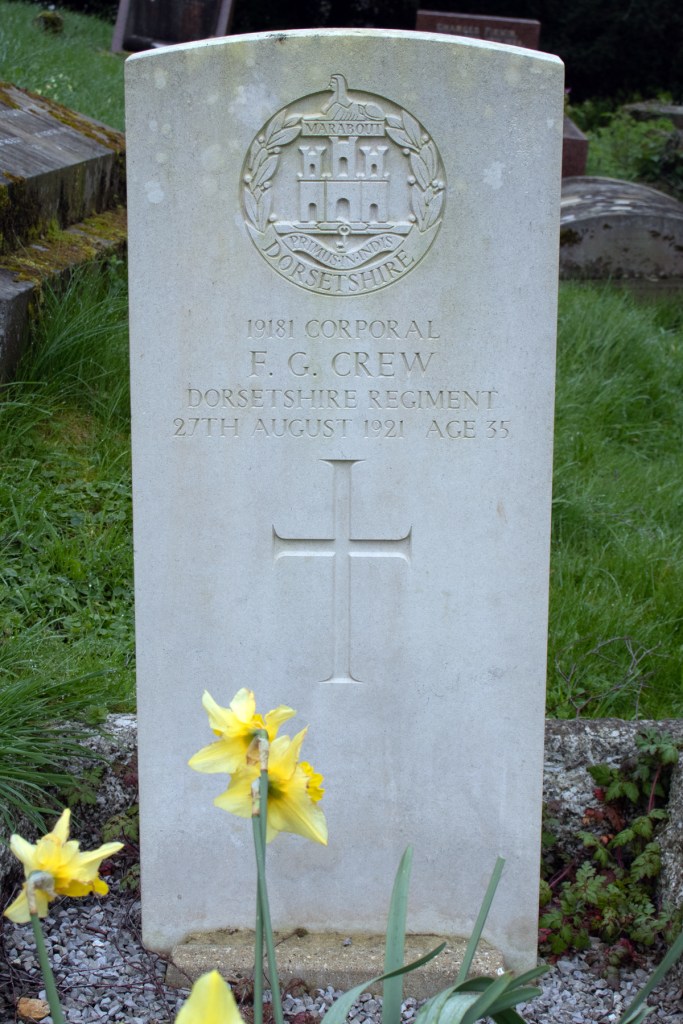
Sadly, Frank was only to survive the census by a couple of months. He passed away on 21st August 1921, dying from a combination of influenza and epilepsy. He was 35 years of age.

Frank George Crew was laid to rest in the quiet Englishcombe Churchyard, close to the family home.


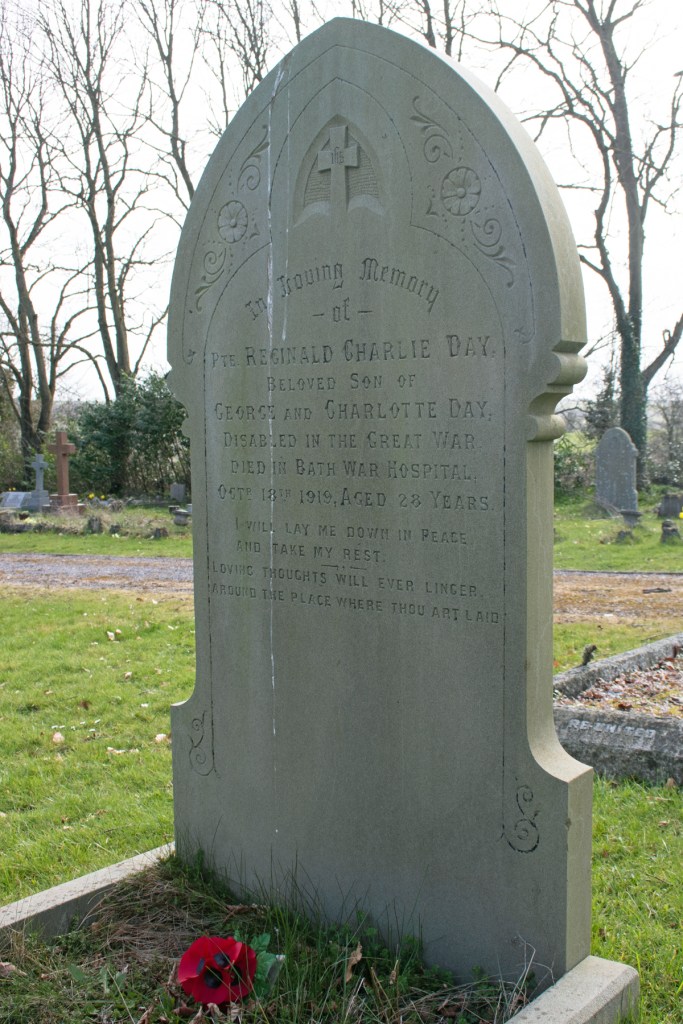
Private Reginald Day

Private Reginald Day

Reginald Charlie Day was born in the spring of 1891, the sixth of thirteen children. His parents – George and Charlotte Day – were born and raised in Gloucestershire, but had moved to Wellow in Somerset by the time Reginald was born.

George was originally a shepherd, but Wellow had two key industries – mining and the railways – and it was into the former that he went, presumably to bring in a regular wage for the expanding Day family.

When he left school, Reginald initially followed his father to the pit, but in April 1913, he opted for a more prestigious career, and enlisted in the army. He joined the Somerset Light Infantry as a Private but, because of his profession, he was not formally mobilised until 1916. His service records give away little about his stature, only that he was 5ft 7ins (1.7m) tall, with good vision and good physical development.

In January 1916, Private Day was moved to the North Somerset Yeomanry and, within a matter of weeks was bound for France. By that October, however, he was moved again, and became attached to the 5th (Service) Battalion of the Dorsetshire Regiment. He was assigned to one of the regiment’s depots, and remained close to the Western Front until the end of July 1917.

At this point, Reginald’s health was beginning to suffer, and he was moved back to the UK for treatment. He was admitted to hospital suffering from a pelvic abscess, and this was later diagnosed as carcinoma of the rectum. No longer fit for military service, he was dismissed from the army on 17th February 1918, his medical records noting that he had been fitted with a colostomy belt.

At this point, Reginald’s trail goes cold. It is likely that he returned home, but whether he was able to take up his previous employment – or work at all – is unclear. His headstone records that he died in Bath War Hospital, although again it is uncertain whether he was admitted from the point of leaving the army, or only in later months as his condition deteriorated. He passed away on 18th October 1919, at the age of 28 years old.

Reginald Charlie Day was laid to rest in the family plot in the peaceful Wellow Cemetery.


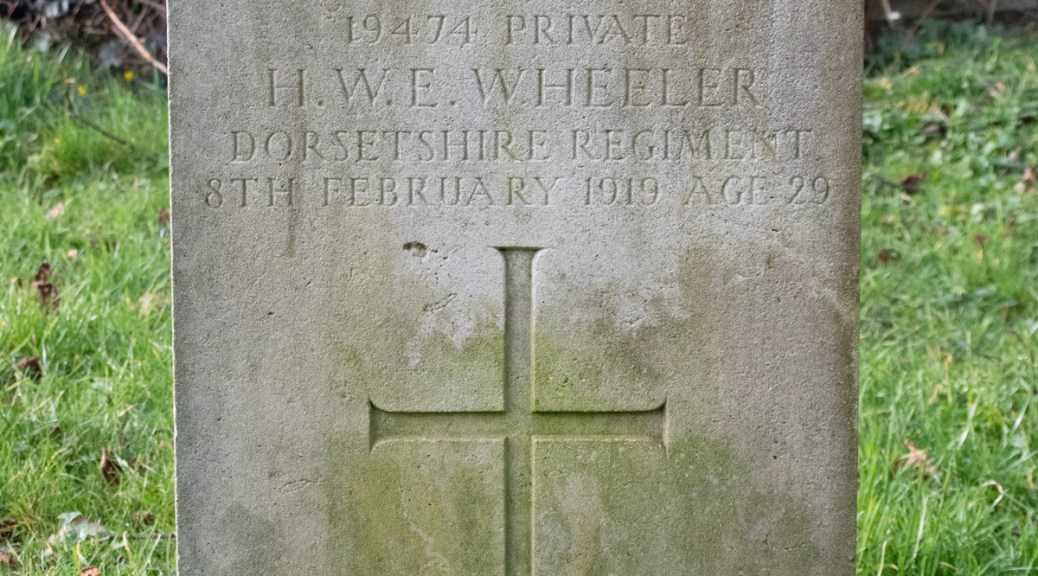
Private Henry Wheeler

Private Henry Wheeler

Henry William Edward Wheeler was born in early 1890, the fifth of thirteen children – and the oldest son – to Henry and Anne Wheeler. Henry Sr was a labourer from Witham Friary in Somerset, and this is where the family were born and raised.

When he left school, young Henry – who became known as Harry to avoid confusion with his father – found work as a postman. When war broke out, however, he enlisted as a Private in the Somerset Light Infantry. Full details of his military service are unclear, but his marriage certificate confirms that he was a soldier by the spring of 1915.

Harry’s wedding was to a woman called Mabel Hulbert, who was working as a domestic servant in Wotton-under-Edge, Gloucestershire. It was in the village’s church that the couple exchanged vows, and within a matter of weeks, Private Wheeler was sent to France.

Harry’s troop – the 1st Battalion – was involved in some of the fiercest fighting of the war, and it is likely that he was involved at The Somme in July 1916. At some point, though, he moved across to the 5th (Service) Battalion of the Dorsetshire Regiment, who had moved to France, having been fighting at Gallipoli. The specifics of Private Wheeler’s time in the army are, however, destined to be lost to time.

Private Wheeler’s trail can be picked up again after the end of the war, presumably when he had returned to Britain prior to being demobbed. Sadly, however, he was admitted to a military hospital in Wilton, Wiltshire, suffering from ‘disease’. He passed away on 8th February 1919, at the age of 29 years old.

The body of Henry William Edward Wheeler was brought back to Somerset for burial. He was laid to rest in the quiet graveyard of St Mary’s Church in his home village of Witham Friary.


Henry’s younger brother, John, also served in the First World War. He enlisted in the 8th (Service) Battalion of the Somerset Light Infantry, and arrived in France on 4th October 1915, just a couple of months after his older brother.

John was killed in fighting on 11th October 1917 – possibly as part of the opening salvos of the Battle of Passchendaele – and was just 20 years old. He was laid to rest in the Outtersteene Communal Cemetery in northern France.


Private William Tewkesbury

Private William Tewkesbury

William Gilbert Tewkesbury was born in Ilchester, Somerset, in the autumn of 1881. The middle of three children (although his older brother died in 1887), his parents were William and Jane Tewkesbury. William Sr was a farm labourer, and this is something that William Jr and his younger brother, Hedley, also went into.

When war arrived on Europe’s shores, William Jr stepped up to play his part. Full details of his military service are, sadly, lost to time, but he enlisted in the Dorsetshire Regiment, and was assigned to the 2nd Battalion. His mother, Jane, passed away in 1915, and it is unclear whether this loss proved to be the catalyst for her son’s enlistment.

Private Tewkesbury’s battalion served in the Middle East for the duration of the conflict.

During the past week we have had three of our local men who have seen active service home for a few days’ leave… Private William Tewkesbury… who has been on active service in Mesopotamia…

Western Chronicle: Friday 8th June 1917

William survived the war, and was awarded the Victory and British Medals for his service. He returned home, and, presumably, took up his previous employment once he was demobbed in February 1919.

The next available record for William is that of his passing, and even this is sketchy. He passed away on 21st March 1920 in Sherborne, Dorset, though the cause is unknown. He was 39 years of age.

William Gilbert Tewkesbury’s body was brought back to Ilchester for burial. He was laid to rest in the village’s parish cemetery. While not recorded, it is likely that this is where Jane had been buried five years earlier, and where William Sr would be laid to rest just months later, when he too passed away.


Private Albert Stockley

Private Albert Stockley

Albert William Stockley was born in the spring of 1897, the youngest of twelve children to Frank and Mary Ann Stockley. Frank was a clay cutter from Dorset, and he and his wife raised their family in the picturesque village of Corfe Castle.

Sadly, much of Albert’s life is lost to time. He would have been 17 years old when war broke out, so it seems likely that he would not have been in the first wave of men to enlist.

Albert joined the Dorsetshire Regiment and, as a Private, was assigned to the 1st/4th Battalion. His troop was based in India for the first part of the war, before moving to Mesopotamia in 1916. There is nothing to confirm, however, whether Private Stockley served abroad, or if he remained as part of a territorial force.

Private Stockley was demobbed on 22nd May 1919, and awarded the Victory and British Medals for his service. He returned to Dorset, but is it at this point that his trail goes cold.

All that is evident is that Albert William Stockley passed away on 1st April 1920, ages just 23 years old. was laid to rest in the Old Church Cemetery in his home town of Corfe Castle.


Albert shares his grave with his older sibling, George Stockley, who died in June 1916. The brothers are commemorated on the same headstone.