
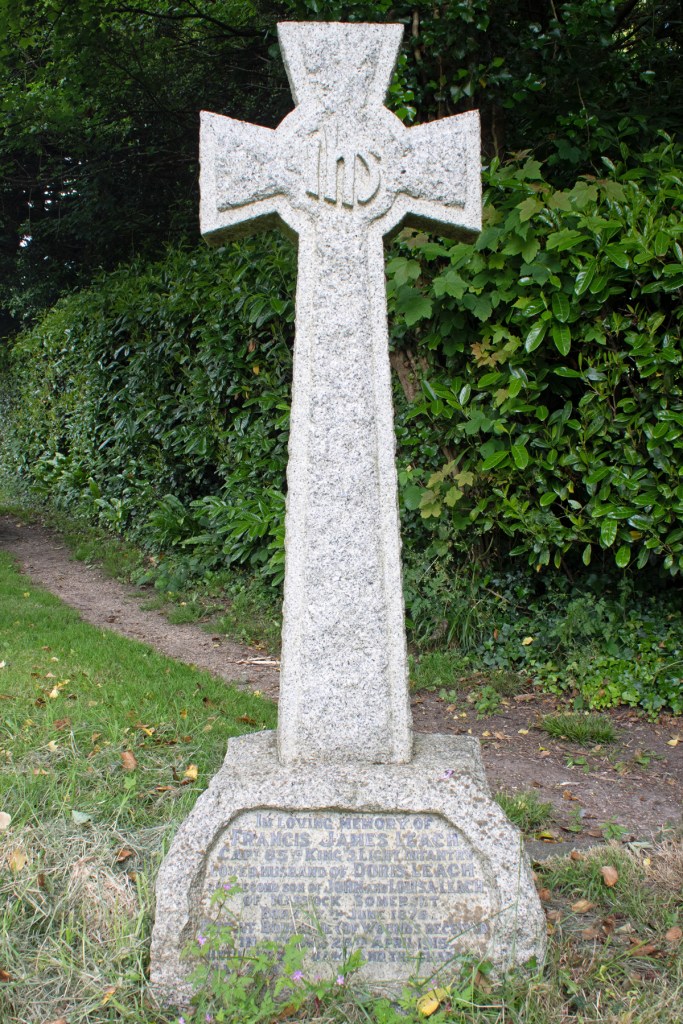
Francis James Leach was born on 27th June 1878 in the Somerset village of Martock. He was the middle of four children to John and Louisa Leach. John was a solicitor who was 17 years older than Louisa, who was his second wife, and by whom he had had two children. The 1881 census found the family living in a house called The Lawn on Church Street, supported by five servants: a nurse, an under-nurse, a cook, a housemaid and a footman.
The next census return, taken in 1891, recorded the family having moved to Seaton in Devon. Louisa was living at 7 West Cliff Terrace with five of the children and a domestic servant. John, however, is not noted on the document, although Louisa is still recorded as married, which would suggest that he had not passed away.
A later newspaper report helps build a picture of Francis’ life growing up:
…Leach was educated at Allhallows School, Honiton, was a thorough sportsman in every sense of the word, a good shot, a keen rider to hounds, a polo player, and cricketer.
[Exeter and Plymouth Gazette: Friday 7th May 1915]
When he finished his schooling, Francis felt drawn to an army career, and the newspaper confirmed his progress:
He served through the Boer War with the R Battery, Royal Horse Artillery, and was present at the relief of Kimberley and at the actions at Paardeberg, Poplar Grove, Zand River, Johannesburg, Pretoria, Diamond Hill and Wittebergen, and was awarded the Queen’s medal with six clasps and the King’s Medal with two. He was given his commission in the Shropshire Light Infantry in 1901, attained the rank of Captain last August and was appointed Adjutant of his Battalion February 2nd, 1914.
[Exeter and Plymouth Gazette: Friday 7th May 1915]
The 1911 census found Francis back with his mother. She was now living in the village of Hawkchurch, near Axminster, living in a 9-roomed house called The Vineyard. Louisa also had her daughter and two servants – a cook and a housemaid – supporting her. The census return also confirmed that Louisa was a widow, John having died some rears previously. Francis’ visit may have been a fleeting one, as his fiancée, Doris Maunsell-Smyth, was also visiting in preparation for a wedding.
Francis and Doris exchanged vows on 29th July 1911, the wedding taking place in Christ Church, Paddington, Middlesex. Their marriage certificate confirmed that the groom was an army officer, while the bride’s father, George Maunsell-Smyth, was noted simply as a gentleman.
When war broke out in the summer of 1914, Captain Leach and his unit was called up to play their part. Full details of his service have been lost to time, but he was sent to the the Western Front by December that year. Over the coming months, the battalion was involved in the Battle of Eloi and the Second Battle of Ypres.
The funeral of Captain Francis Leach of the 2nd Battalion Shropshire Light Infantry, as taken place in the village churchyard amid every token of respect and sympathy. The officer died at Boulogne of wounds received in action in Flanders.
[Exeter and Plymouth Gazette: Friday 7th May 1915]
Captain Leach died of his injuries on 26th April 1915. He was 36 years of age.
Interestingly, despite a decree that the conflict’s fallen would be buried overseas if that was where they died, it seems that Captain Leach’s family were able to circumvent that ruling. Whether that was because he died in a hospital ship in Boulogne’s harbour is unclear, but had he died in the town itself, he should have been laid to rest in France.
Either way, the body of Francis James Leach was brought back to Devon for burial. He was laid to rest in the graveyard of St John the Baptist Church, Hawkchurch, not far from where his mother still lived.
 Death and Service