Category Archives: Royal Air Force

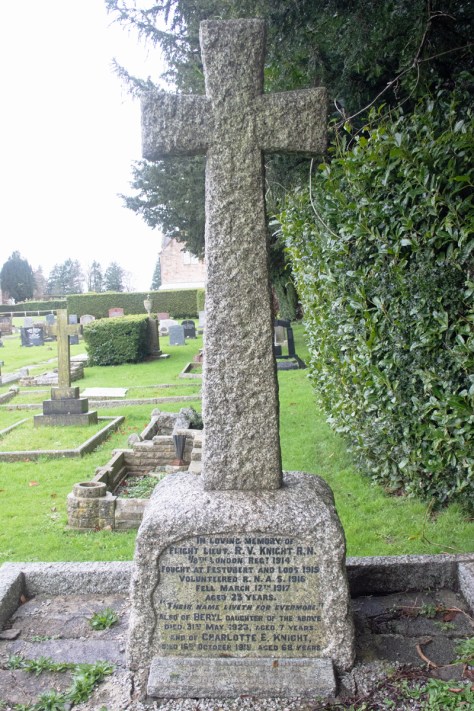
Flight Lieutenant Ronald Knight

Flight Lieutenant Ronald Knight

Ronald Victor Knight was born in March 1894, the youngest of two children – both sons – to John Knight, an Ironmonger from London, and his Swiss wife, Marie.

Ronald was well educated – being taught at Wells and Bedford Grammar Schools in the UK and Neuchatel in Switzerland, not far from where his mother was born. After studying at Bristol University, he went to work at Guys Hospital in London, training as a dental student.

When war broke out, he volunteered at once, being enlisted in the 8th Battalion London Regiment. Lieutenant Knight went with his regiment to France, and was involved in the Battle of Festubert and the fighting at Loos.

Returning home towards the end of 1915, Ronald married Gwendoline Dawkes, in a ceremony overseen by the Bishop of Bath & Wells.

Rather than returning to the front line, Lieutenant Knight accepted a commission to lead a section of the London Cyclist Corps, a position he held for a year or do. While in this service, Ronald and Gwendoline had their one and only child, a little girl they called Beryl.

In 1916, Ronald accepted a further move to the Royal Naval Air Service, becoming involved in flying as a Flight Lieutenant. It was while he was based at RNAS Cranwell that he was involved in the accident that led to his death.

An inquest was held into the incident, and evidence was taken.

Air Mechanic Charles Deboo [said] that the machine had been recently inspected, and that it was alright. He did not see the deceased flying, but saw the machine come down, nose first, in corkscrew fashion. He saw it at a height of 400ft. He went to the machine after it had fallen and found the officer was dead. The machine struck the ground and smashed up, but he could not say how the accident happened.

Charles Barrett, air mechanic, said he saw the accident. The deceased seemed as if he was going to turn towards the wind to land, and, as he turned, he banked, but he never righted himself. He nose-dived and spun round to the earth. He thought he lost control as he was turning, or the wind might have caught him. The machine was smashed, except for the tail.

The jury returned a verdict that deceased accidentally met his death while flying.

Retford and Workshop Herald and North Notts Advertiser: Tuesday 20th March 1917.

Flight Lieutenant Knight died in an aeroplane crash on 12th March 1917. He was 22 years old.

Ronald Victor Knight lies at rest in Wells Cemetery, Somerset.


Sadly, Ronald’s daughter, Beryl, died in the spring of 1923, when she was only 7 years old. She is buried with her father.

Gwendoline went on to marry Henri Booth in months after the death of her daughter. The couple went on to have two children, Elizabeth and William. She requested that her late husband’s war medals be given to his father, John.


Second Lieutenant Victor Bracey

Second Lieutenant Victor Bracey

Victor Charles Edelsten Bracey was born in October 1897, the only child of William and Florence Bracey. William was a physician and surgeon, practicing in Lancashire when Victor was born. The young family soon moved south, however, and by the time of the 1901 census, they were living in Wedmore, Somerset, where William had taken up as the village’s general practitioner.

Military records for Victor are not available, but his life can readily be pieced together from newspaper reports of his death and the de Ruvigny’s Roll of Honour, published after the war.


TWO PILOTS KILLED IN THE NEW FOREST

Two air fatalities have occurred within twenty-four hours of each other in the New Forest. On Saturday [22nd September 1917] Second Lieutenant Ernest Hargrave’s machine nose-dived from the height of 200ft, and crashed to earth.

Second Lieutenant Victor Bracey was flying on Sunday morning at a height of 300ft, when his machine turned and came down in a spinning nose-dive.

At the inquests verdicts of “Death by misadventure” were returned.

Western Gazette: Friday 28th September 1917

BRACEY, VICTOR CHARLES EDELSTEN, 2nd Lieut., RFC, only child of William Edelsten Bracey, LRCP [Licentiate of the Royal College of Physicians], Lieut. (Hon.) RAMC (retired), by his wife, Florence Marion, dau. of the late James Canning Gould.

[Victor was] educated St Peter’s School, Weston-super-Mare, and Blundell’s School, Tiverton, where he was a member of the OTC [Officers’ Training Corps]; passed into the Royal Military Academy in April 1915; joined the Inns of Court OTC in December 1916; was gazetted 2nd Lieut. RFC [Royal Flying Corps] 27 April 1917, obtaining his wings in July, and was killed in an aerial accident at the Beaulieu Aerodrome, Hampshire, 23 September, while testing a new machine.

A brother officer wrote that he was a gallant gentleman and a most skilful pilot.” He was a keen cricketer and footballer, and while at Blundell’s played in the First Cricket XI and the Second Football XV, and was also captain of the First Hockey XI; later played for the Royal Military Academy, Woolwich, and the RFC Rugby Football XV at Oxford.

de Ruvigny’s Roll of Honour, 1914-1919

A note on Second Lieutenant Bracey’s Roll of Honour states that he was ineligible for medals as he saw no overseas service; this seems to have been challenged by Victor’s father in 1921, but nothing confirms whether this anything was subsequently awarded.

Victor Charles Edelsten Bracey lies at rest in the churchyard of St Mary’s in Wedmore, where his father continued to practice. He died, aged just 19 years of age.


William’s prominence in the village played a big part in Victor’s legacy. A Memorial Fund was set up; this helped fund “necessitous cases for medical requirements and for conveying patients to hospitals“. The Victor Bracey Cup was also awarded into the 1940s for sporting achievement in the schools he had attended.


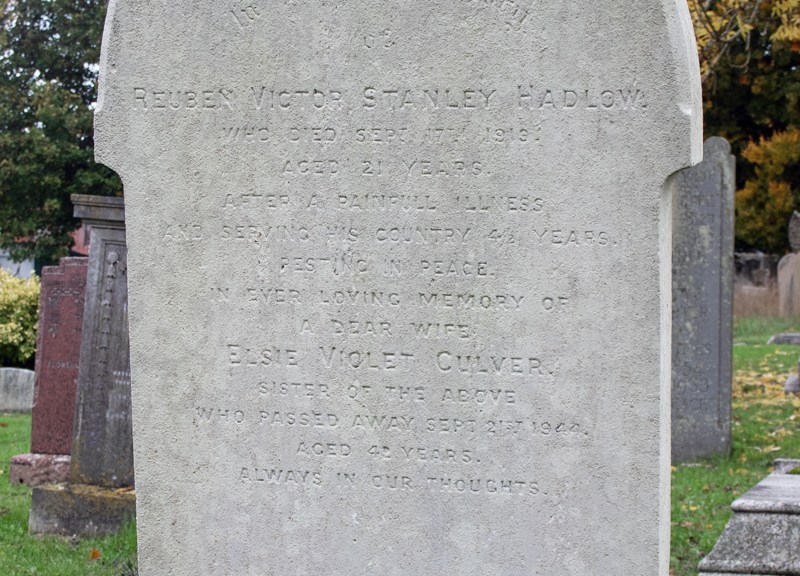
Air Mechanic Reuben Hadlow

Air Mechanic Reuben Hadlow

Reuben Victor Stanley Hadlow was born in the spring of 1898. He was one of thirteen children to John Charles Tarpe Hadlow and his wife Gertrude, publicans at the Star pub in Whitstable, Kent.

When war broke out, Reuben was working as a blacksmith; he enlisted in the army in the summer of 1914, serving on the home front.

In February 1916 Private Hadlow transferred to the Royal Flying Corps as a Air Mechanic 2nd Class, and was assigned to the 65 Training Squadron in Croydon. He was promoted to Air Mechanic 1st Class six months later.

When the RFC became the Royal Air Force, Air Mechanic Hadlow moved across to the new institution. He moved to support 156 Squadron in November 1918, then the 35 Training Depot Station shortly after.

Air Mechanic Hadlow contracted phthisis (tuberculosis) towards the end of that year, which led to his being discharged from the RAF on 22nd January 1919.

Reuben’s health did not recover after returning home – his parents were running the King’s Arms pub in Boxley near Maidstone by this point. He passed away on 17th September 1919, aged twenty-one.

He lies at rest in the churchyard of St Mary and All Saints, in his parent’s village.

Poignantly, his gravestone is not a traditional war grave. Instead it states that he died “after a painful illness and serving his country 4 1/2 years”.

Serjeant Nicholas Leadbetter

Serjeant Nicholas Leadbetter

Born in Lancashire in 1877, Nicholas Leadbetter was the eldest of the four children of fisherman and merchant Isaac and his wife Elizabeth. He was quick to follow in his father’s line of work and set up his own fish shop in St Anne’s-on-the-Sea (nowadays known as Lytham St Anne’s).

Nicholas married Alice Griffiths in 1900, and their first child – Isaac – was born that Christmas.

Living near the station in Lytham, the young couple took on boarders to supplement Nicholas’ work. By the time of the 1901 census they had Dionysius Howarth, a chemist’s assistant, and Edgar Charles Randolph Jones, a grocer’s assistant, staying with them.

The Leadbetters don’t appear on the 1911 census, but from later records it is evident that they moved from Lancashire to the South West, where Nicholas ran a fish, game and poultry store in Yeovil. By this time, they were a family of four, as a daughter – Alice – was born in 1906.

Nicholas moved his family across the border to Sherborne, where he continued to ply his trade as a fishmonger and poultry dealer.

War broke out and, at the age of 39, he enlisted in the fledgling Royal Air Force, serving in France for the remainder of the fighting.

Serjeant Nicholas Leadbetter was demobbed in February 1919 and returned home to his family on Valentine’s Day. A local newspaper picks up his story from there.

He was feeling unwell at the time and immediately went to bed. Double pneumonia set in, and, despite the best medical aid, he passed away on Tuesday, leaving a widow, one son, and one daughter to mourn their loss.

Western Gazette: Friday 21st February 1919.

Serjeant Leadbetter’s funeral was a fitting one:

[It] was of military character, members of the Sherborne detachment of the 1st Volunteer Battalion Dorset Regiment being present. The coffin, which was covered with the Union Jack, was borne by members of the detachment, and at the Cemetery a firing party fired three volleys over the grave, and the buglers of the Church Lads’ Brigade sounded the last post.

There were many floral tributes. Mrs Leadbetter wishes to return thanks for the many letters of sympathy received from kind friends, and which she finds it impossible to answer individually.

Western Gazette: Friday 28th February 1919.

Serjeant Nicholas Leadbetter’s records confirm he was 42 years old. He lies at peace in Sherborne Cemetery.

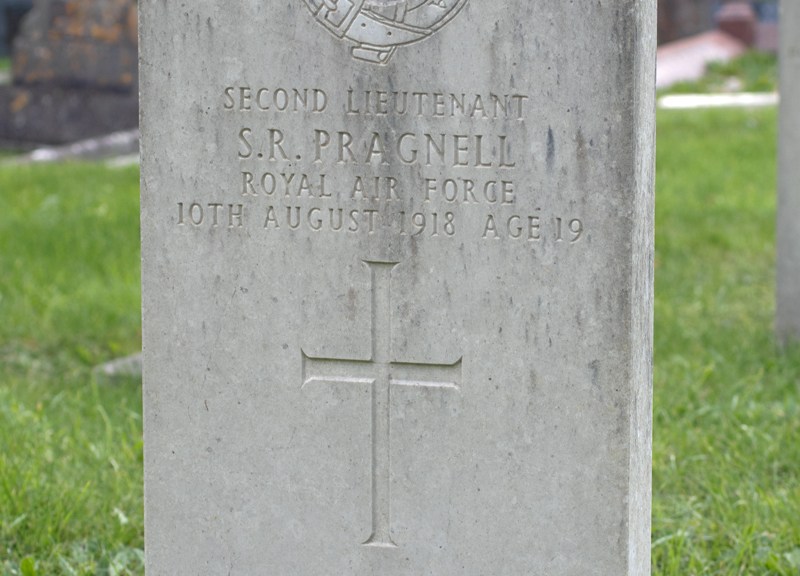
Second Lieutenant Sidney Pragnell

Second Lieutenant Sidney Pragnell

Sidney Ralph Pragnell was the eldest of two children of Edward and Ellen Pragnell. Edward grew up in Sherborne, before moving to London to work as a chef; he found employment as a cook in an officer’s mess, which took him and his wife first to Ireland – where Sidney was born – and then to the barracks at Aldershot.

By the time of the 1911 census, Edward had brought his family back to Dorset, and was running the Half Moon Hotel, opposite the Abbey in Sherborne. Sidney, aged 12, was still at school.

When war broke out, Sidney was eager to play his part, even though he was underage. An article in the local newspaper highlights his keenness and how he progressed.

…he was keen to serve his country and joined every local organisation his age would allow him to. He was an early member of the Sherborne VTC and Red Cross Detachment, and was actually the youngest member of the Volunteers to wear the uniform. Whilst still under age, he enlisted in the Royal Naval Division at the Crystal Palace and after a period of training was drafted as a qualified naval gunner to a merchant steamer carrying His Majesty’s mails and in this capacity went practically round the world. In February he joined the RNAS and after some air training in England went to France to an air station, where he passed all the tests with honours and gained the ‘wings’ of the qualified pilot. Lieutenant Pragnell then decided to go in for scouting and came back to England for advanced training in the special flying necessary for this qualification and it was whilst engaged in this that he met with the accident which resulted in his death.

Western Chronicle: Friday 16th August 1918.

The esteem in which Second Lieutenant Pragnell was held continues in the article, which quotes the condolence letter sent to his parents by his commander, Major Kelly.

It is with deep regret that I have to write you of the death of your son, Second-Lieutenant SR Pragnell. Your boy was one of the keenest young officers I have ever had under my command and was extremely popular with us all and his place will be extremely hard to fill.

The service can ill afford to lose officers of the type of which Lieutenant Pragnell was an excellent example and it seems such a pity this promising career was cut short when he had practically finished his training. May I convey the heartfelt sympathy of all officers and men in my command to you in this your hour of sorrow.

Western Chronical: Friday 16th August 1918.

What I find most interesting about this article is that the letter from Major Kelly detail how Edward and Ellen’s son died, and this this too is quoted by the newspaper.

Your son had been sent up to practice formation flying and was flying around the aerodrome at about 500 feet with his engine throttled down waiting for his instruction to ‘take off’. Whiles waiting your boy tried to turn when his machine had little forward speed. This caused him to ‘stall’ and spin and from this low altitude he had no chance to recover control and his machine fell to earth just on the edge of the aerodrome and was completely wrecked. A doctor was there within a minute, but your boy had been killed instantaneously.

Western Chronicle: Friday 16th August 1918.

Further research shows that the aerodrome Second Lieutenant Pragnell was training at was RAF Freiston in Lincolnshire, which had been designated Number 4 Fighting School with the specific task of training pilots for fighting scout squadrons. He had been flying a Sopwith Camel when he died.

Second Lieutenant Sidney Ralph Pragnell lies at rest in the cemetery of his Dorset home, Sherborne.

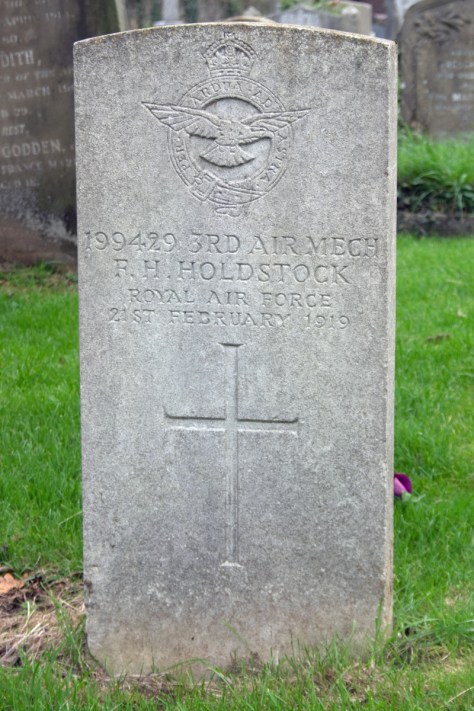
Air Mechanic Herbert Holdstock

Air Mechanic Herbert Holdstock

The year is 1897, and Edwin Holdstock has crammed a lot into his 38 years. Born in North Kent, he has travelled well, working as a grocer’s manager in south London. His first wife, Kate, gave him five beautiful children, four girls and a boy, before she died, aged only 35. Edwin married again, to Louisa, and they have already had their first child, a boy.

A new birth is on its way, though, and his third son – Herbert Frederick Victor Holdstock is born. They are living in Thornton Heath, Surrey.

The family up and move again, this time to Grimsbury, near Banbury, Oxfordshire. Edwin has new employment, as a superintendent for Kingsley Sewing Machines in the town.

Edwin appears to be an ambitious man; by the time of the 1911 census, he has moved the family from Oxfordshire back to Kent. He and Louisa have four children now and they live in Rainham, where Edwin works as a Political Agent.

Herbert was keen to make his own way in the world, however, and worked as an apprentice watchmaker and jeweller in both Rainham and nearby Sittingbourne.

He enlisted relatively late into the war; his service records show that Air Mechanic Holdstock started his Royal Air Force service on 20th June 1918. He was stationed in South London.

While there, he contracted pneumonia and was hospitalised. Within a week, Herbert had passed away. He was just 21 years old.

The local newspaper reported on his funeral:

Only so recently as November Mr EC Holsdtock of Orchard-street, Rainham, the Secretary of the Sittingbourne District War Pensions Committee, sustained a sad bereavement in the death of his wife [Louisa], who succumbed to an attack of influenza and pneumonia. Mr Holdstock has now suffered another bereavement in the death of his second son, Herbert Frederick Victor Holdstock, who died in the Royal Herbert Hospital, Woolwich… A little over eight months ago he joined the Royal Air Force, as a mechanic, as was stationed at Kidbrook, near Woolwich. Never robust, he contracted pneumonia, and after a week’s illness succumbed. He was a bright, cheery young man, and much liked.

East Kent Gazette: Saturday 1st March 1919.

Air Mechanic Herbert Holdstock lies at rest in the graveyard of St Margaret’s Church in Rainham, Kent.