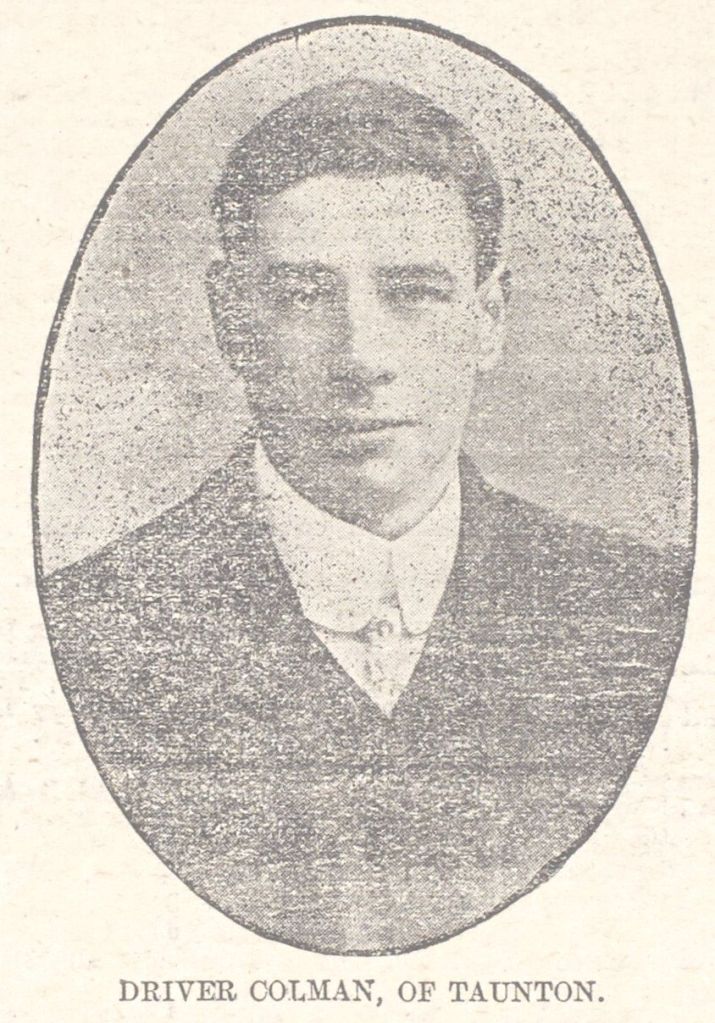
Walter Coleman was born in the spring of 1887, one of seven children to James and Emily Coleman. James was a hairdresser and the family lives in the Somerset town of Taunton.
Walter didn’t follow his father’s trade; instead, after a spell working at a collar factory when he left school, he was soon employed as a groom.
On Christmas Day 1910, he married Kate Norris, and the couple set up in a two-up, two-down in the middle of the town.
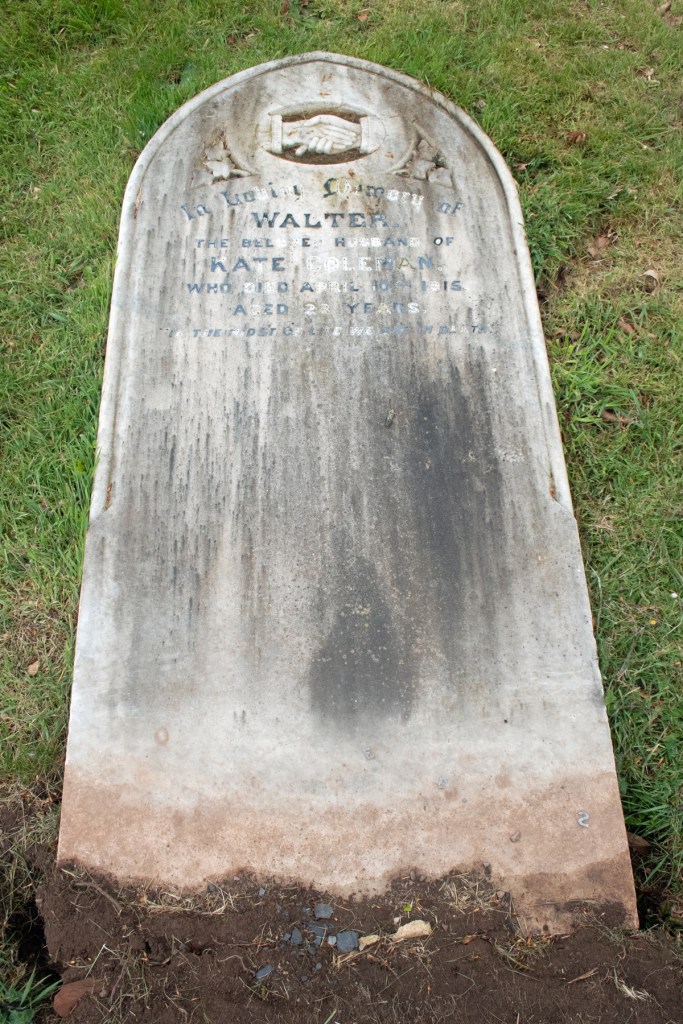
War was on the horizon, however, and when it broke out, Walter signed up straight away. He joined the 72nd Brigade of the Royal Field Artillery as a Driver and trained at the Bulford Camp on Salisbury Plain. It was while he was here on 10th April 1915 that he had an accident and fell off his horse. Sadly, Driver Coleman fractured his skull and died of his injuries that day. He was just 28 years old.
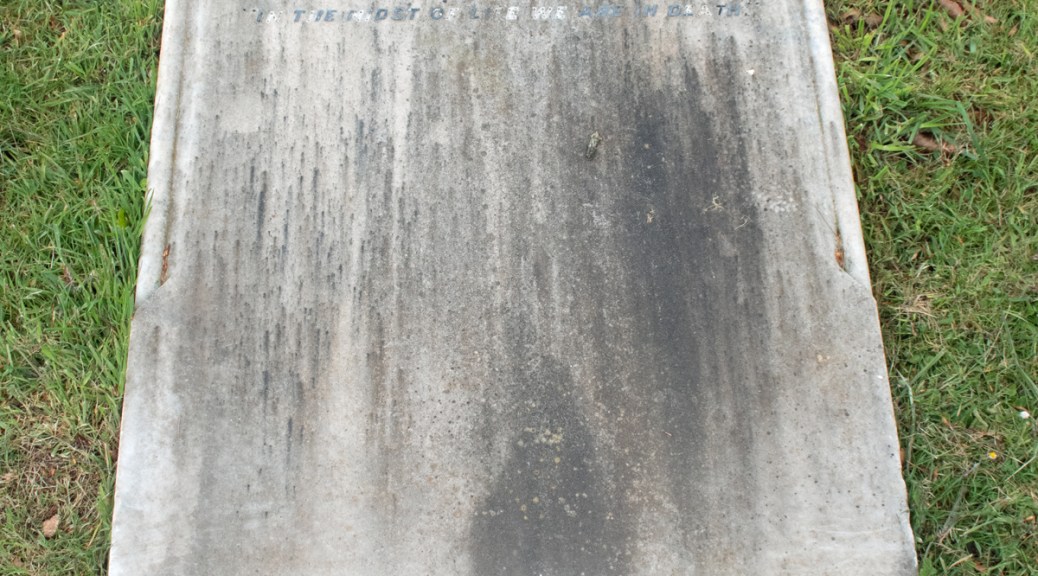
Walter Coleman lies at rest in the St James’ Cemetery in his home town of Taunton.
Walter Coleman (from findagrave.com)
Walter’s older brother Henry James Coleman also served in the Great War. Posted to France as part of the Labour Corps, he died of wounds on 12th April 1918. He was 33 years old, and left behind a widow and four children. He is buried at the Longuenesse Souvenir Cemetery in France.
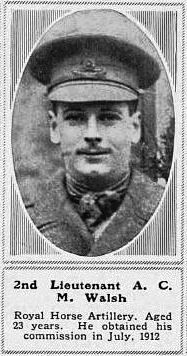
Archibald Charles Mark Walsh was born on 3rd February 1892, the youngest of three children to Henry Alfred Walsh and his wife Ann. Henry had a distinguished military career, and his sons – Archibald and his older brother Theobald – seemed destined to do the same.
Henry’s service took him around the world, and, by the time Archibald was born, the family had settled in Devon. In tracing the family’s life, however, an unusual quirk arises around the turn of the century.
In 1901, the majority of the Walsh family disappear from census records. For someone like Henry, this would not be unusual; his career took him overseas, and it is likely that records were lost or destroyed.
However, Archibald and his sister Gwladys do appear in the records. They are set up in a seafront villa in the Kent town of Hythe, Gwladys is listed as both a school pupil and the head of the household – at the age of 14 – and the two siblings are living there with a governess, Mary Porter.
By the time of the next census, Cadet Walsh had followed his father into the military. He was a student at the Military Academy in Woolwich, and the following year achieved his commission, becoming a Second Lieutenant in the Royal Horse Artillery.
When war broke out, Archibald’s regiment were shipped off to the Western Front. In March 1915, he was caught up in the Battle of Neuve Chapelle, and was badly wounded.
Shipped back to England for treatment, he was admitted to the Hall-Walker Hospital for Officers in Regents Park, London. Sadly, Second Lieutenant Walsh’s injuries were too severe, and he passed away on 18th March 1915. He was just 23 years old.
Brought back to Taunton, near his family home, Archibald Charles Mark Walsh lies at rest in St Mary’s Cemetery.
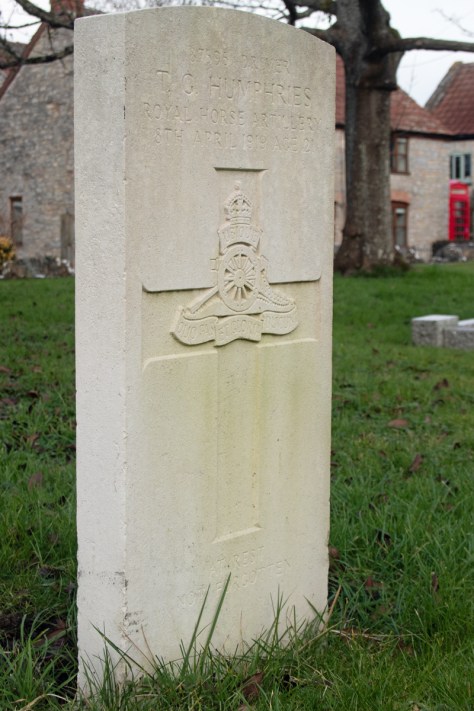
Thomas George Edward Humphries was born in November 1897, one of six children to George and Annie Humphries, from North Wootton in Somerset. George was a farm labourer, and had been married to his wife for 19 years before her untimely death in at the age of 40.
When war came, Thomas was just 16 years old. He enlisted quickly, though, joining the Royal Horse Artillery as early as the summer of 1915. Driver Humphries joined the 120 Brigade of the Royal Field Artillery, which was one of the many Howitzer brigades moving the large long-barrelled field guns along the front line.
Given the high use of horses during the way, and that Thomas was a Driver, it is likely that his role would have been guiding the animals in his care – this may also account for why his gravestone gives his troop as the Royal Horse Artillery.
Little remains of Thomas’ service records; he was awarded the Victory and British Medals and well as the 1915 Star, so would have been in the thick of the fighting and seen action on the Western Front.
When it comes to his passing, again details are scant. His pension records simply state that he died of ‘disease’, and he passed in the military hospital in Southwark, South London. Again, given when he died and the lack of any contemporary media report on his passing, it seems likely that the cause was a lung condition – influenza, pneumonia or tuberculosis – but that is a presumption on my part,
Whatever the cause, Driver Humphries died on 8th April 1919, aged just 21 years old.
Thomas George Edward Humphries lies at rest in the quiet graveyard of St Peter’s Church in his home village of North Wootton.
Alfred Henry Richards was born in 1891, the oldest of five children to William Henry Richards and his wife Jane. William (who was known as Henry) worked in the local paper mill, and this is a trade that his two sons – Alfred and Leslie – were to follow as well.
Paper making was a driving force in this part of Somerset during the Victorian era, employing a large number of people in Wells and the nearby village of Wookey, which is where Alfred and his siblings were born.
Details of Alfred’s military service are sketchy. He enlisted as a Gunner in the Royal Horse Artillery, although when during the war this happened is unknown.
His troop – the 18th Brigade, 1st Somerset Royal Horse Artillery – was stationed in the UK for the first couple of years of the war, before serving in the Middle East. Again, I have not been able to confirm how much of this service Gunner Richards was involved in.
Alfred returned to Somerset after being demobbed, but within a few months of the end of the war, he succumbed to double pneumonia. He passed away on 1st March 1919, aged just 28 years old.
Alfred Henry Richards lies at rest in the cemetery in Wells, Somerset, not far from his home.
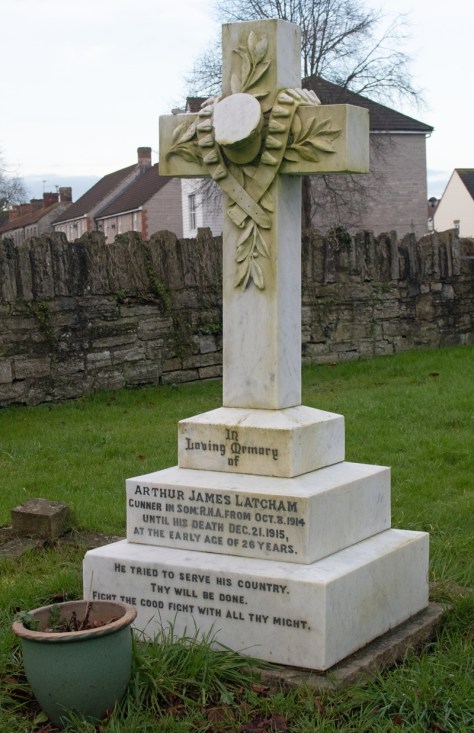
Arthur James Latcham was born in 1889, the oldest of five children – all boys – to Walter and Matilda Latcham. The family lived in Street, Somerset, where Walter worked as a carpenter in the Clark’s shoe factory.
Initially following his father into shoemaking, Arthur was quick to enlist when war broke out. Details of Gunner Latcham’s military service is scarce, but documents confirm that he joined the Somerset Royal Horse Artillery on 8th October 1914. He did not see active service abroad, but had been stationed on the east coast for his training.
While little remains of his service records, contemporary media of the day includes a lot of information about both his passing and his subsequent funeral.
On Sunday, December 5th, having a few hours’ leave, he visited his parents at Street, and while at home complained that he was feeling unwell. On the following Wednesday, December 8th (which, by a coincidence, was his twenty-sixth birthday) Mr and Mrs Latcham received a post-card from him from Taunton [where the Somerset RHA was based] stating that he was very ill. They immediately engaged a motor car, and went to Taunton, where they found him in an extremely weak state, and on the point of collapse, he having had to walk to a hospital nearly a mile away three times a day for his medicine. Having obtained the captain’s permission, they brought him home in the motor car, and at once put him under the care of Dr MacVicker. He was then found to be suffering from pneumonia and congestion of the lungs… In spite of the greatest care, and best of nursing, however, he gradually grew worse, and never rallied.
Central Somerset Gazette: Friday 24th December 1915.
The following week’s newspaper included nearly a whole column on Gunner Latcham’s funeral, including two tributes, one from his captain and another from the local MP.
I am writing to tell you how very sorry all the officers of this battery are at your loss. Your son was the first member of the Somerset RHA to give his life for his country, and although he did not have the satisfaction of being killed in action, the honour is the same. I’m afraid the last few months he was in this battery were not very happy ones for him, owing to his trouble with his finger; but he bore the trouble and pain well. I had him with me for more than a year, so I can fully appreciate what a good fellow he was and how great your loss is.
Captain M Clowes (Central Somerset Gazette: Friday 31st December 1915)
I am very sorry indeed to learn of the sad loss you have suffered through the death of your son. I know that he was a fine fellow, an example of what an Englishman should be, and respected by all who knew him. I am sure you must feel proud to know that he has done all that a man can do, and has died serving his country.
Ernest Jardine MP (Central Somerset Gazette: Friday 31st December 1915)
Arthur James Latcham lies at rest in the graveyard of Holy Trinity Church in his home town of Street.
Arthur was the third son Walter and Matilda had lost. Their second-born, Herbert, passed when a little over a year old. Their third son, William, died a year before Arthur, when he was just 15 years old.






 Death and Service