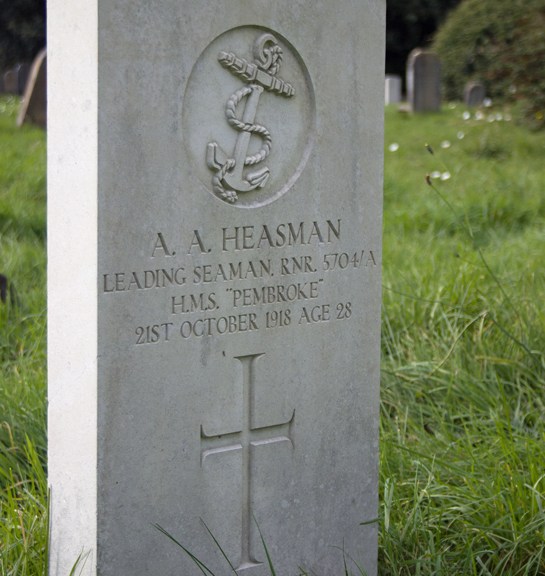
Albert Andrew Heasman was born in 1890 or 1891, and, like his date of birth, much of his life remains a mystery. He was one of five children to William and Kate Heasman, who brought their family up in the West Sussex town of Worthing.
Documentation on Albert is scarce. He does not appear on census records until 1911, by which time he is working as a mate on a fishing boat, based out of Ramsgate, Kent.
Naval records are also patchy; he certainly enlisted during the war, and, by 1918 had joined the Royal Naval Reserve. He was assigned to HMS President III, a training ship based at the Royal India Dock in London.
The only other concrete information available on Leading Seaman Heasman is that he passed away from pneumonia on 21st October 1918. He was just 28 years old. His pension record confirms that his sister, Ethel, was listed as a dependent.
Albert Andrew Heasman’s body was brought back to Worthing, where he lies buried in the Broadwater Cemetery, to the north of the town.
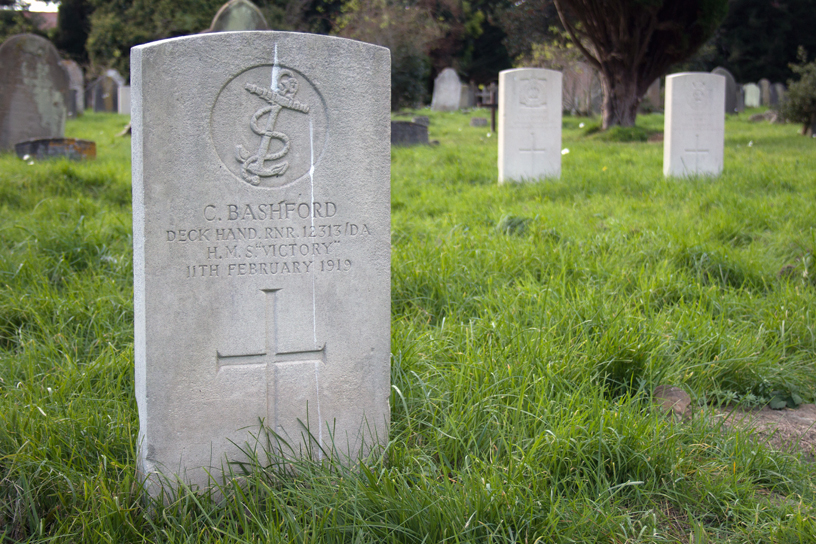
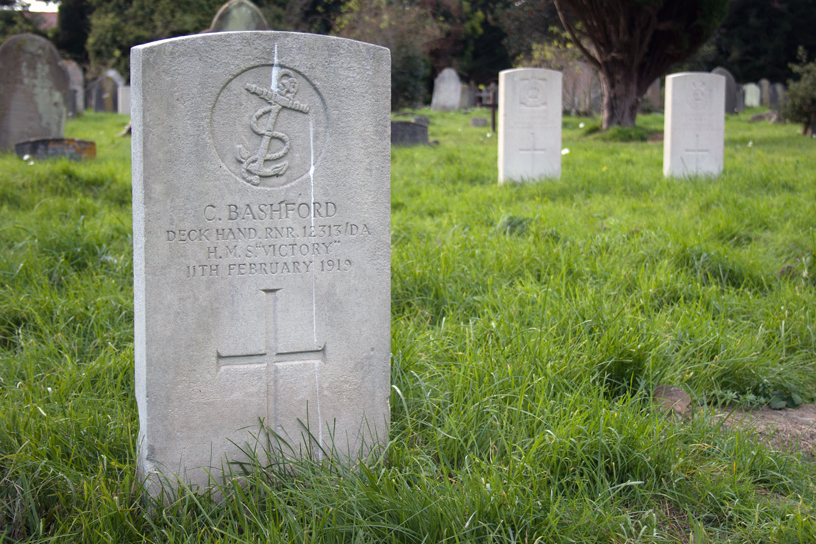
Charles Bashford was born on 10th August 1890, one of fifteen children to James and Mary Ann Bashford. James was a fisherman, and the family lived in Field Row, a narrow lane in the centre of Worthing, West Sussex.
The seaside town was a centre of fishing activity, so it is no surprise that most of James and Mary Ann’s children went into it in some way, and Charles was no exception. The 1911 census list him as the youngest of four siblings still living at home, and three of those gave their trade as fisherman, as well as James. Charles’ older brother William was the only sibling not to, and he was working as a printer.
War was coming to Europe, and, given his seafaring experience, it is no surprise that Charles sought to enlist in the Royal Navy. He joined up on 12th August 1916 and, after six weeks’ training, was assigned to the Royal Navy Reserve (Trawler Section). During his service he would have been involved in minesweeping and anti-submarine activities, using his own boat – or his family’s one – to do so.
Little further information is available for Deck Hand Bashford. He survived the war, but passed away on 11th August 1919 at the Royal Haslar Hospital, where he had been admitted, suffering from pneumonia. He was 28 years old.
Charles Bashford was brought back to his home town of Worthing; he was laid to rest in the Broadwater Cemetery there.
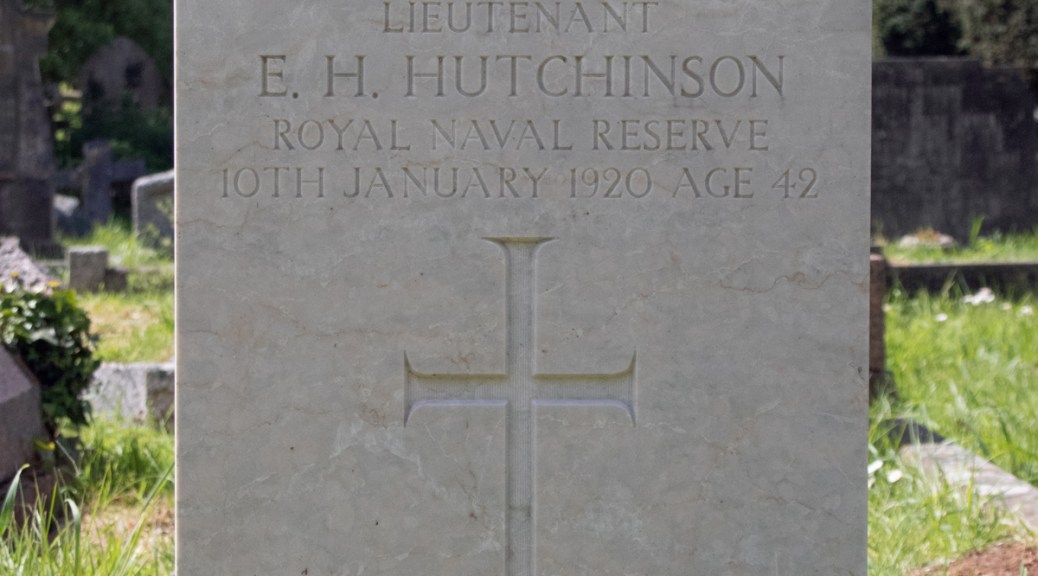
Ernest Henry Hutchinson was born in January 1878, one of four children to Dorothy Hutchinson, from Blyth, Northumberland. Details of Ernest’s father are sketchy and, by the time of the 1891 census, Dorothy seems to have been widowed and remarried, as her surname was now Alexander.
By this time Ernest was at school, and boarding with his aunt and uncle, but his siblings were all living with Dorothy and listed as ‘step-children’. Dorothy gave her employment as ‘housewife; husband at sea’, and it seems that this was likely her first husband’s job and, in fact, it would turn out to be her eldest son’s as well.
Ernest disappears from the census records for a while, but had readily taken to a life at sea. Over the next few years, he became certified as a Second Mate of a Foreign-Going Ship (1897), First Mate of a Foreign-Going Ship (1899) and Master of a Foreign-Going Ship (1904).
When war broke out, Ernest was seconded into the Merchant Navy. Sadly, his military records no longer exist, but during his time he attained the rank of Lieutenant. Ernest survived the war, and was retained as part of the Royal Naval Reserve, while continuing with his own sailing work.
At some point, Ernest married a woman called Emma Jane; documentation on the couple is scarce, so the date of the marriage is lost to time. The couple settled, however, in Weston-super-Mare, Somerset, but do not appear to have had any children.
Ernest’s maritime career continued after the war. One of his commissions was as First Mate aboard the SS Treveal. This was a new vessel in 1919, making its maiden voyage from Glasgow to the Middle East. It then sailed on to Calcutta, and was on its way back to Dundee by the beginning of 1920.
A local Cornish newspaper took up the story.
The terrible toll of 36 lives were levied by the wreck of the St Ives steamer Treveal, off the Dorset Coast on Saturday morning. The crew totalled 43, only seven surviving.
The Treveal, 5,200 tons, one of the Hain fleet of steamers, was caught by a fierce gale during Friday night and was firmly wedged on the Kimmeridge Ledge, near St Alban’s Head.
A Portland tug and Swanage lifeboat came to her assistance, but were unable to lend any practical aid, and on Saturday morning the Treveal was abandoned in favour of the ship’s boats. The latter were soon capsized and only seven of the crew succeeded in reaching the shore.
West Briton and Cornwall Advertiser: Monday 12th January 1920.
The report went into much more detail about the tragedy, including “a warm tribute to the vicar of a parish nearby, the Revd. Pearce, who stood up to his neck helping to pull the men in. The vicar tried for an hour to resuscitate the First Mate [Ernest Hutchinson], but without success.“
Another newspaper gave further information about Ernest’s funeral, and the impact of the shipwreck on his widow.
There was a simple but affecting scene in Weston-super-Mare Cemetery on Saturday afternoon, when the body of Chief Officer EH Hutchinson, one of the 35 victims in the wreck of the SS Treveal… was laid to rest.
It will be recollected that… the first tidings of his tragic fate reached the widow… through the columns of a Sunday newspaper. Only on the previous morning she had received a letter notifying the date on which the Treveal was due to reach Dundee – whither the major portion of her cargo has been consigned from Calcutta – asking him to meet her there.
Western Daily Press: Monday 19th January 1920
Ernest Henry Hutchinson drowned at the age of 42 years old. He was buried in the Milton Cemetery in his adopted home town of Weston-super-Mare in Somerset.
Leonard Francis Tucker was born in 1898, the middle of three children to Arthur and Frances Tucker. Arthur was a tailor from Taunton, Somerset, and this is where he brought his young family up.
Sadly, little documentation remains of Leonard’s life. His grave confirms that, when war came, he served in the Royal Navy, and, at the time of his death, he was a Deck Hand on HMS Vivid.
His Commonwealth War Graves Records confirm that his parents were living in Melbourne – his pension ledger confirms Arthur as his next of kin, with an Australian address. There is nothing to confirm their emigration, or whether Leonard emigrated as well.
Leonard’s young life is summed up in a short notice in the local newspaper, which has the simple comment “Tucker – Sept. 28th, at 10 Westgate-street, Taunton, Leonard Francis Tucker, aged 20.” [Taunton Courier and Western Advertiser: Wednesday 9th October 1918]
Slightly more confusing is the next name on that list: “Tucker – Sept. 29, at 10 Westgate-street, Taunton, Frances Ellen Tucker, aged 44.” It would seem that Leonard’s mother was in England, not Australia, at the time of his death, and that she passed away a day after him.
Combined with when Leonard died, it would suggest both he and his mother died from one of the respiratory conditions running rampant through England at the time, possibly influenza or pneumonia. There is nothing to confirm this outright, but it seems the likeliest outcome for the poor mother and son.
Leonard Francis Tucker lies at rest in St Mary’s Cemetery in his home town of Taunton.
As an aside to this, there is no record of where Frances was buried, but it is likely that she too was laid to rest in St Mary’s Cemetery.
Harry Sidney Cook was born in April 1892, the youngest of six children. His parents John, a clay digger, and Ann lived in Rainham, Kent, and had two other boys and three girls.
By the 1911 census, the family seem to have gone their separate ways. John and his youngest son were boarding away from the rest of the family, and Harry listed himself as a fisherman. There is no immediate record of his mother, Ann, while his oldest brother Arthur had passed away, and his closest sibling Albert was working as a labourer in Essex.
Shortly after the census was taken, he married Alice Pearce. They lived in a house by Rainham Station and soon had a son, Frank Sidney.
Harry enrolled in the Royal Navy in March 1916, and served on a number of vessels during the war and in the months afterwards. Shortly after enrolling, he and Alice had twins, Daisy and Edith.
Deck Hand Cook was serving on HMS Hermione in February 1919. A guard ship in Southampton, towards the end of the war, she became the HQ Ship for motor launches and coastal motor boats serving the Solent.
It was while he was working there that Harry contracted pneumonia. He was admitted to the Haslar Royal Naval Hospital in Gosport, but passed away on 14th March 1919. At 26 years old, he had become a father for the fourth time just three weeks before; it is likely that he never got to meet his youngest daughter, Alice.
Deck Hand Harry Cook was brought back to his home town of Rainham to be buried. He lies at rest in the St Margaret’s Churchyard, Rainham.




 Death and Service