Category Archives: Royal Sussex Regiment

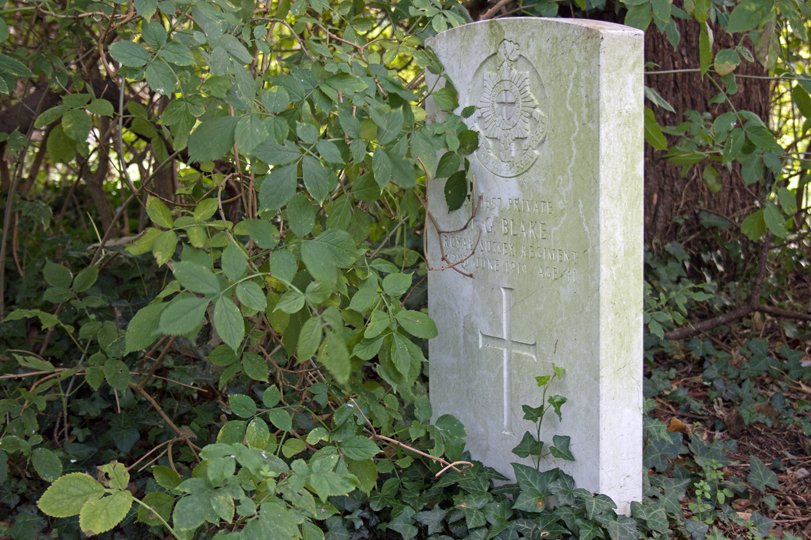
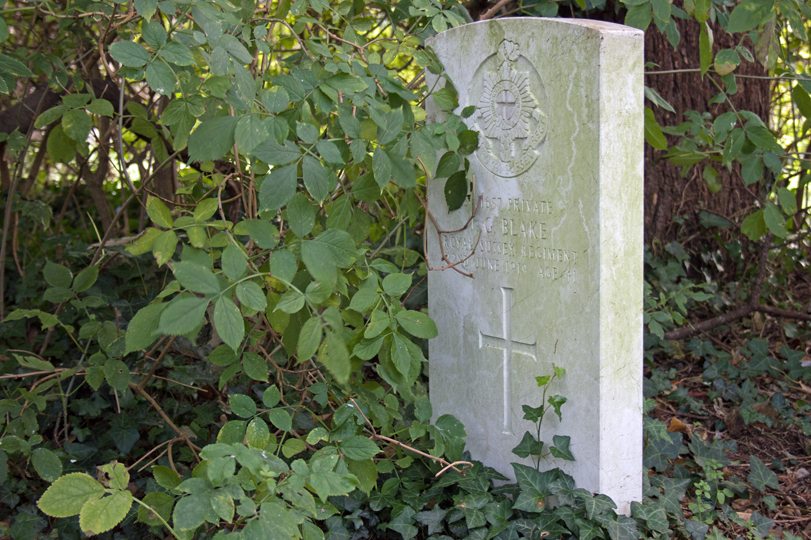
Private John Blake

Private John Blake

John George Blake was born early in 1878, and was the oldest of seven children. His father, Job, was a general labourer, and, with Eliza, John’s mother, brought the young family up in the West Sussex town of Worthing.

Job died in 1898, ages just 36 years old; Eliza found work as a housekeeper, while John was employed as a carter for the railway. By the 1901 census, the family were living in a terraced house near the centre of town, Eliza living there with her three sons, two daughters, son-in-law and granddaughter.

In October 1904, John married Alice Attwater, a labourer’s daughter from mid-Sussex. The couple moved into a house close to the station and went on to have four children; John Jr, Ernest, Bertha and Dorothy. John was by now working as a porter for the railway, a role he continued through to the outbreak of war.

John enlisted in November 1914; he joined the Royal Sussex Regiment, working as a member of the depot staff. Private Blake was shipped overseas, arriving in France in March 1916.

Almost exactly a year after landing in France, John was injured in the line of duty. The medical report confirmed that a “scald on the left arm and neck [had] occurred while on duty on March 1st 1917, in France. He was preparing hot soup for his company in the front line at midnight. He was not to blame. Injury caused by enemy shelling the company kitchen“.

Private Blake was shipped back to England for treatment, and admitted to Netley Hospital near Southampton. While there, he contracted phthisis (tuberculosis), which left his totally incapacitated. He was medically discharged from military service in August 1917.

Further details of John’s life are scarce. He returned home to his family, although whether he took up his job again is unknown. He passed away on 22nd June 1919 at the age of 41. The cause of his death is unknown, although it seems likely to have been related to the tuberculosis.

John George Blake lies at rest in the Broadwater Cemetery of his home town, Worthing.


Private Raymond Champ

Private Raymond Champ

Raymond Champ was born on 30th March 1880, one of eight children to coachman William Champ and his wife Eliza. While Raymond was born in the West Sussex village of Cowfold, within a year, the family had moved to Worthing, settling in the Broadwater area of the town.

The 1901 census gives more of an insight into Champ family life. William by now is listed as unable to work and gives his infirmity as paralysed. There are no newspaper records evident to highlight an accident of any sort, so the cause of his paralysis, and his inability to work, are destined to remain a mystery. The document does show, however, that the other members of the family stepped up to fill in the shortfall of money; Eliza was working as a laundress, Raymond was a bricklayer’s labourer, and his younger brother Francis (or Frank) was employed as a milk boy.

Fast forward ten years, and the next census give further information. It confirms that William was paralysed when he was 45 years old (in around 1894/1895). Raymond, now aged 30, was still working as a bricklayer, Frank was an iron founder, and the youngest brother, George, was a baker.

Raymond was a keen footballer, and went on to captain the Silverdale Football Club. By the time war broke out, he had found work at Wenban Smith, a renowned timber supplier in the town. The call to arms came, however, and, in September 1914, he enlisted.

Private Champ joined the Royal Sussex Regiment, and was assigned to the 2nd Battalion. Shipped overseas in February 1915, he served on the Western Front, but his time there was not to be a lengthy one. A local newspaper report picked up Raymond’s story:

The wretched conditions which our Troops had to contend with during February and March proved too much for his constitution, and having the misfortune to contract bronchitis, he was invalided home in April, being taken to one of the Military Hospitals in Manchester.

His recovery was regarded as hopeless from the first, but the careful nursing and attention which he received there brought about a temporary improvement, and he was eventually discharged in order that he might return to his home, where his death occurred on Sunday week.

The funeral on Thursday afternoon was of a very impressive character, and despite a heavy deluge of rain, there was a large number of sympathising friends at the Cemetery to pay the last tribute of respect.

Worthing Gazette: Wednesday 14th July 1915

Private Raymond Champ passed away on 4th July 1915 and just 35 years old. His body was laid to rest in Broadwater Cemetery, Worthing, not far from where his family were living.


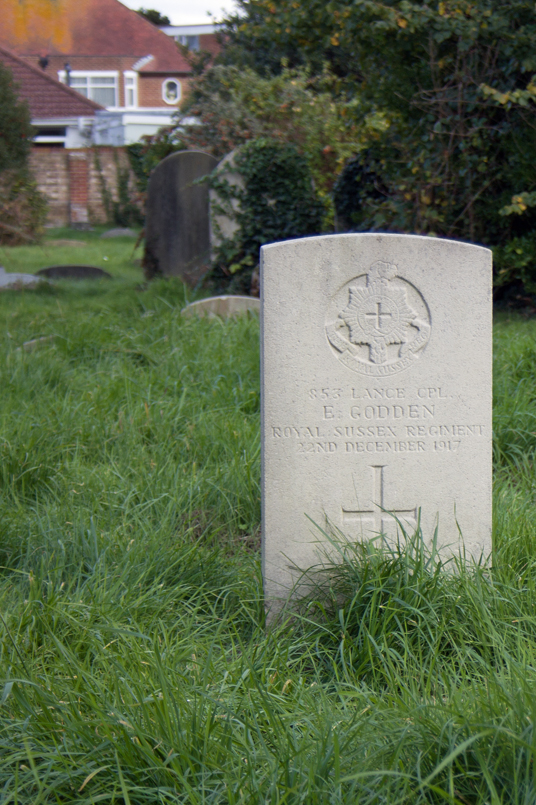
Lance Corporal Edgar Godden

Lance Corporal Edgar Godden

Edgar Godden was born in the summer of 1892, one of eight children to John and Alice Godden. John came from Littlehampton, and Alice from Worthing, and this is where they raised their family.

John was a bricklayer, and it was this trade that Edgar went into when he left school. War was coming to Europe, however, and, within weeks of the conflict breaking out, he had volunteered his services.

Edgar joined the Royal Sussex Regiment, and was assigned to the 7th (Service) Battalion. Details of his military service are a little sketchy, but a newspaper article, written after his death, gives a hint about what happened to him.

Mr Edgar Godden… who was twenty-five years of age and leave a widow and a little child, enlisted on the 1st September 1914, and was wounded in the arm in September of the following year. In October 1916 he was blown up and buried by an enemy mine. Last February he was taken out of the trenches and sent to a hospital in France, and last April he came home to England and had an arm amputated. Since his discharge from the Seventh Royal Sussex Regiment, he had been a member of the staff of the Post Office, and was known as “The One-armed Postman”.

Worthing Gazette: Wednesday 10th January 1918.

In the autumn of 1916, and recovering from his injuries Lance Corporal Godden married Emily Owers. They lived with John and Alice, but I have been unable to find details of the child mentioned in the newspaper report.

It seems that his injuries had left Edgar in a weakened state, and, after a ‘short and painful illness’ [Worthing Gazette: 2nd January 1918], he passed away on 22nd December 1917. He was just 25 years of age.

Edgar Godden was laid to rest, finally at peace, in the Broadwater Cemetery in his home town of Worthing, West Sussex.


The newspaper report above gave a little more information about a couple of Edgar’s siblings.

Mr & Mrs [John] Godden had one son killed in action in November 1916; and still another – the eldest – is now in France, as a member of the Royal Engineers.

Worthing Gazette: Wednesday 10th January 1918

Edgar’s oldest brother – also called John – survived the war, but it was his younger brother, Charles, who was killed in action.

A Corporal in the 11th Battalion of the Royal Sussex Regiment, Charles was caught up in the Battle of the Somme. It was while fighting in the Battle of the Ancre on 13th November 1916, that he was killed. He is remembered at the Thiepval Memorial in Northern France, and is also commemorated on Edgar’s own headstone.


One last aside to Edgar’s story is his address in the last few years of his life. John and Alice were living in Worthing, specifically at a house called “Chiswick” in Tarring Road, to the west of the town.

Coincidentally, when researching another soldier, Private Ernest Parsons, this turns out to be the address where he also died, just ten months later on 4th October 1918. There is no apparent other link between the two men.


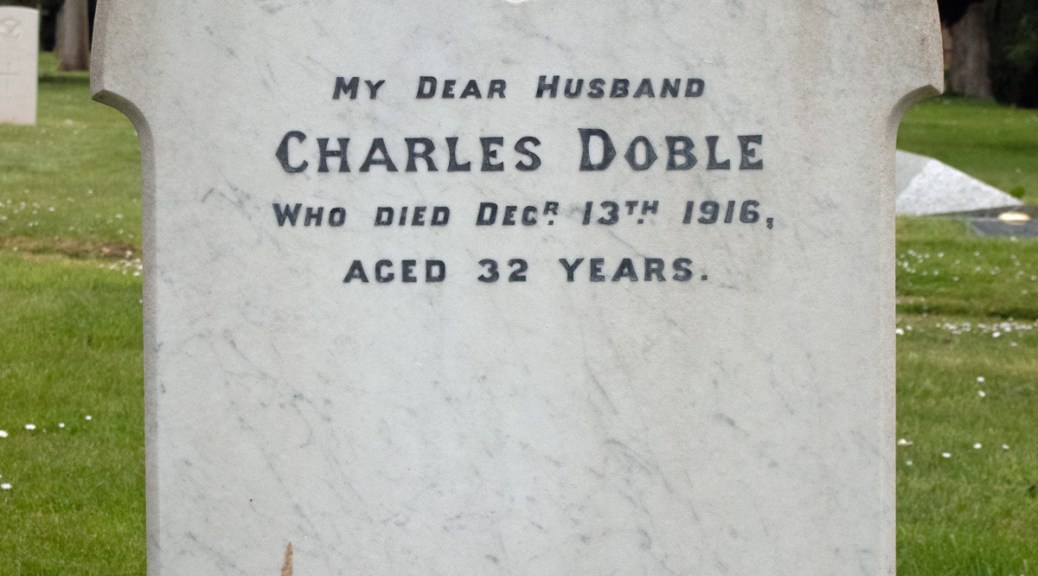
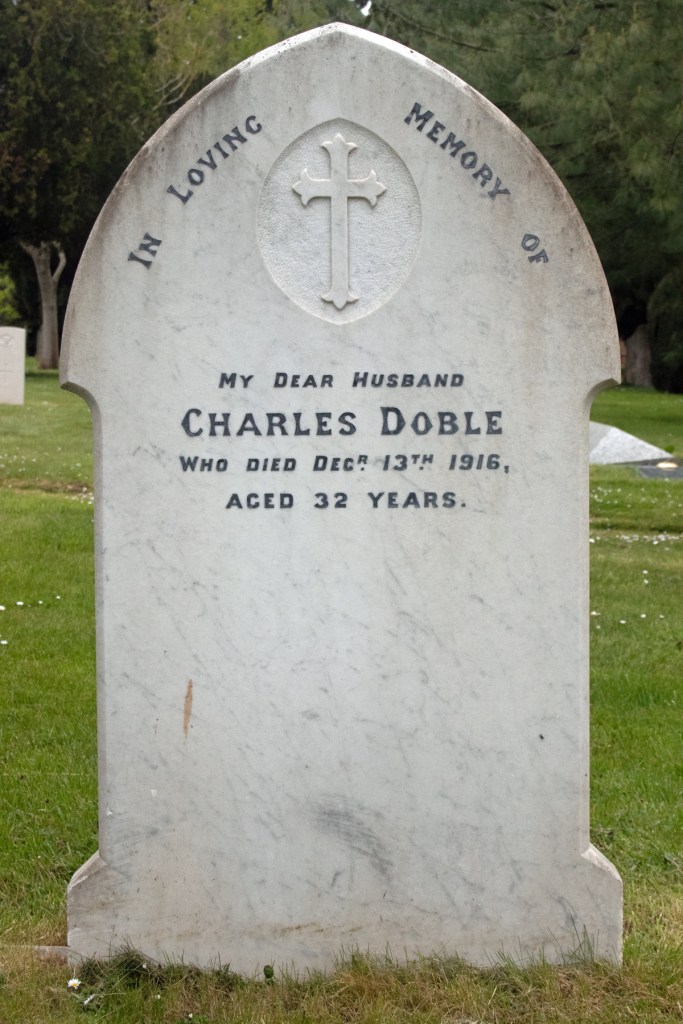
Private Charles Doble

Taunton St James

Charles Doble – also known as Charlie – was born 12th September 1884, the second of seven children to James and Mary Ann Doble from Dunkeswell in Devon. James was a carpenter, but on leaving school, Charles initially found work as an errand boy, before becoming employed as a porter at the Taunton and Somerset Hospital.

The 1911 census found Charles in the village of Cotford St Luke, working as an attendant at the Somerset and Bath Asylum. Housing more than 800 patients at the time, it is reasonable to assume that his duties would have been wide and varied.

Details of Charles’ military service are scarce. He enlisted in the Hertfordshire Regiment as a Private in April 1916, but soon transferred over to the 13th Battalion of the Royal Sussex Regiment.

In the spring of that year, Charles married Ethel Willmott; presumably this was before he was sent abroad, because he soon found himself on the Western Front.

His battalion was caught up in the Battle of the Boar’s Head, during with the Royal Sussex Regiment succeeded in capturing a section of the German front line trench and second line trench, before being pushed back because of mounting casualties and a lack of ammunition.

It seems likely that Private Doble was one of those injured on what became known as The Day Sussex Died, as he was evacuated back to England for treatment. Admitted to a military hospital in Stourbridge, sadly his wounds proved too much for Charles to bear; he passed away on 13th December 1916, at the age of 32 years old.

Charles Doble’s body was brought back to Taunton, and he was buried in the St James’ Cemetery in the town.


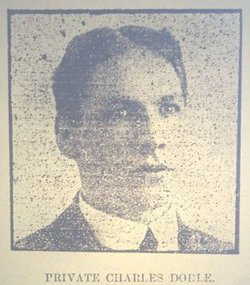
Charles Doble (from findagrave.com)