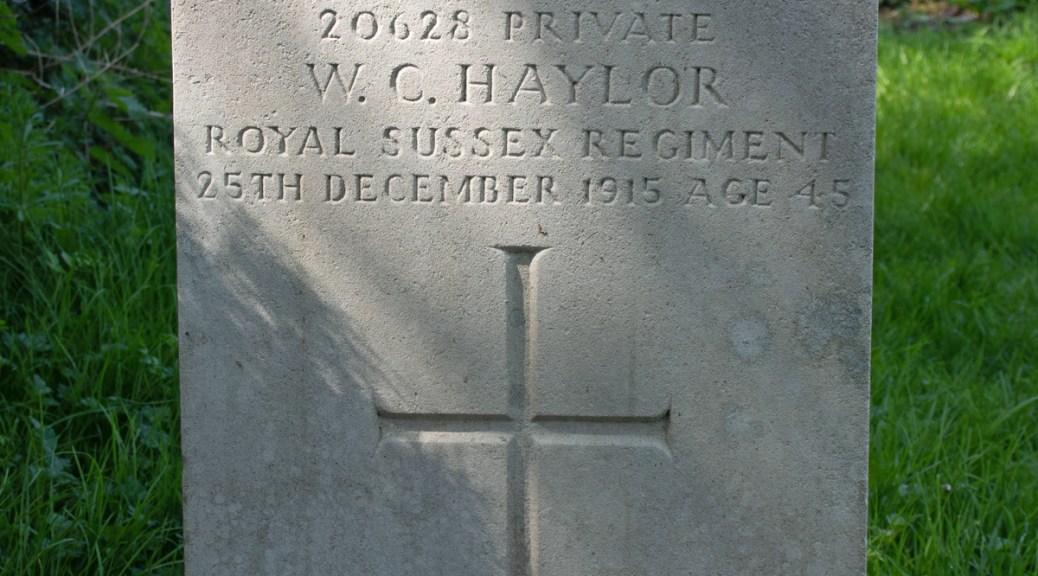
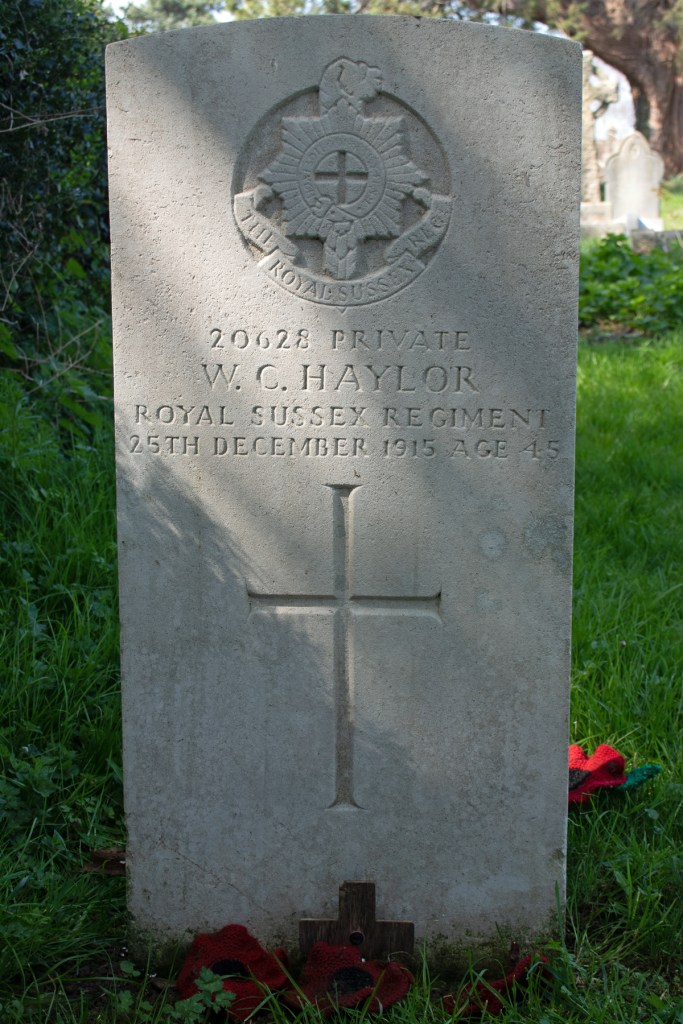
William Charles Haylor was born in the summer of 1870, in the West Sussex village of Cuckfield. He was one of eight children to agricultural labour Michael Haylor and his wife, Betsy. Michael passed away in 1886 and, with children to raise, his widow took in washing to earn money.
William found work as a farm labourer and, by the time of the 1901 census was living in a cottage at Beech Farm in the village, with his mother, younger sisters, one brother-in-law and six nieces and nephews.
On 25th October 1905, William married Florence Linstead. She was a carter’s daughter from South London, and it is not exactly clear how they met. It seems likely, though, that Florence had taken work on one of the estates in the Cuckfield area. The couple exchanged vows at St Antony’s Church in Florence’s home town, Nunhead, before settling down back in West Sussex.
When war came to Europe, William was keen to play his part. He enlisted in the Royal Sussex Regiment on 9th November 1914 and was assigned to the No.6 Supernumerary Company of the 2nd/4th Battalion. This was a territorial force, set in place for those older volunteers keen to serve King and Country.
Private Haylor’s time in the army was to be brief, however, as at his medical he was found to be medically unfit for military service. No further details are available, but it meant that William had spent just 82 days in the army.
At this point, William’s trail goes cold. He returned home, and presumably continued in his previous line of work. Again, however, the status quo was not to continue for long. He passed away at home, through causes unknown, on Christmas Day, 25th December 1915. He was 45 years of age.
William Charles Haylor was laid to rest in the cemetery in his home village, Cuckfield. He was accorded a military funeral.
Harry Etherton was born in Ansty, near Cuckfield, West Sussex on 3rd April 1872. The oldest of five children, his parents were Edwin and Louisa Etherton. Edwin was an agricultural labourer, and this was work in which his son followed his father.
On 29th April 1899, Harry married Annie Eliza Pennifold, a labourer’s daughter who was also from Ansty. The couple set up home in Cuckfield, and went on to have five children. Harry was, by this point, working as a road labourer for the local council, and this was a job he was to continue doing until the outbreak of the war.
Harry enlisted in 1915, joining the Royal Sussex Regiment as part of the National Reserve. As Private Etherton, he was then transferred across to the Labour Corps, and was assigned to the 409th Labour Coy. which was based at the Infantry Depot in Lincoln.
It was while Private Etherton was here, in the spring of 1918, that he contracted meningitis, and was admitted to the Northern General Hospital in the city. Sadly, he was to succumb to the disease, passing away on 30th June 1918, at the age of 46 years old.
Harry Etherton’s body was brought back to West Sussex for burial. He was laid to rest in Cuckfield Cemetery, not far from where his widow and children still lived.
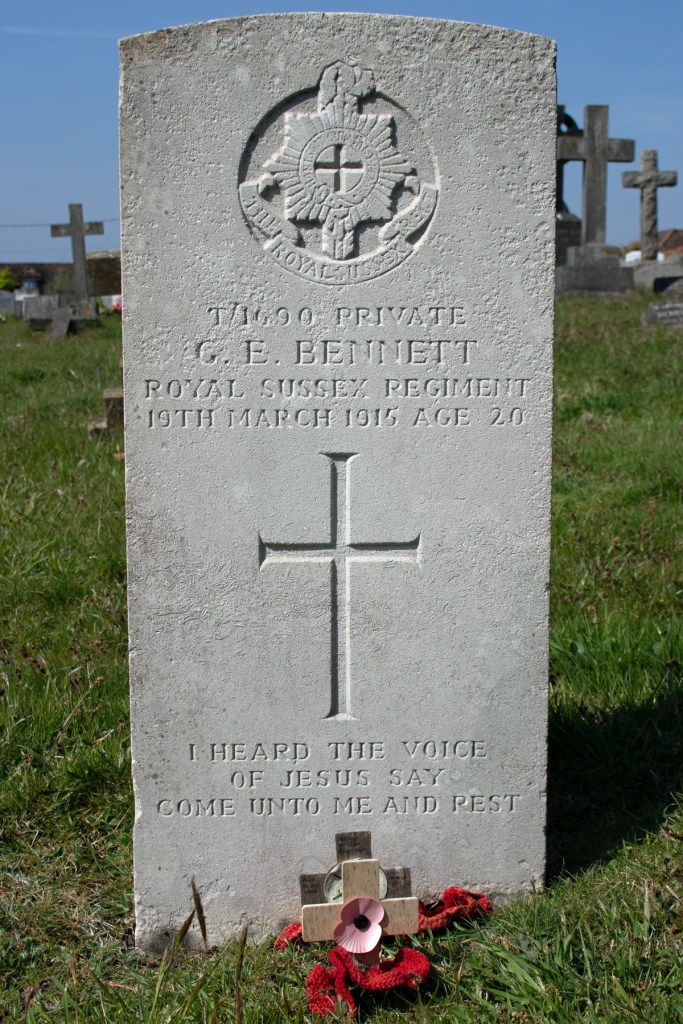
George Ernest Bennett was born in 1895 in Cuckfield, West Sussex, the oldest of four children to Alfred and Annie Bennett. Much of his early life is a mystery – within eighteen months, his parents had moved to Kent, leaving George with his widowed paternal grandmother.
By the time of the 1911 census, both Alfred and Annie were dead, along with their only daughter. George’s two younger brothers were in a poor school back in Sussex, while George was living with one of his father’s sisters and her family, and working as an errand boy.
By the time war broke out, it seems that George had plans for an army career. He had certainly enlisted by September 1914, and joined the 1st/4th Battalion of the Royal Sussex Regiment. This was a primarily territorial force, and Private Bennett initially received his training on the East Sussex coast.
Full details of George’s military service aren’t available, but what is clear is that he was admitted to the Military Hospital in Newhaven in the spring of 1915, and this is where he died on 19th March. The cause of his passing is not known, but he was just 20 years old.
Brought back to Cuckfield, where his father’s family still lived, George Ernest Bennett was laid to rest in the village’s cemetery, within sight of Holy Trinity Church.
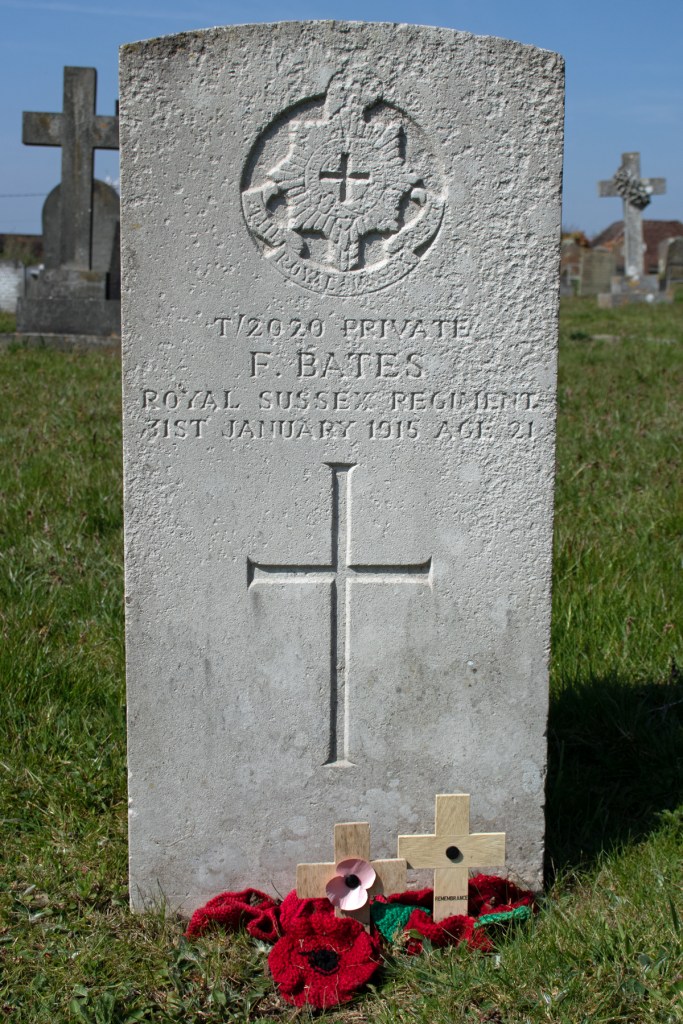
Frank Bates was born on 29th June 1893, in Cuckfield, West Sussex and was the fourth of five children. His parents were tailor William Bates and his wife, Sarah.
Tragedy was to be a constant companion to the Bates family. Frank’s older brother, William, died in November 1907 after a protracted illness, at the tender age of just 19 years old. Four years later, his younger sister, Maggie, also passed away after an illness. She was just 21 years of age.
When he left school, Frank went into the service of the Messel family, who owned the Nyman’s estate close to where Frank and his family lived. When war was declared, however, he was keen to play his part, enlisting soon after hostilities were announced in August 1914.
Private Bates joined the 4th (Home Service) Battalion of the Royal Sussex Regiment and was sent to Newhaven for training. It was while he was here that he fell ill, and, having caught a chill, he returned to Cuckfield to recuperate. Sadly, his condition worsened, and he passed away at his family home on 31st January 1915. He was just 21 years old.
Frank Bates was laid to rest in Cuckfield cemetery, resting not far from his siblings.
Tragedy was to strike one more time for William and Sarah. Frank’s older brother Jack served as a Private in the 2nd/4th Battalion of the London Regiment. In the spring of 1918, he was caught up in that year’s Battles of the Somme, including fighting at St Quentin and Avre.
In May 1918, Private Bates was officially reported as missing, but it was later confirmed that he had died of injuries sustained in the fighting. He passed away on 16th April 1918, at the age of 29 years old.
Jack was laid to rest at the Chauny Communal Cemetery in Picardie, France, and is also commemorated in Cuckfield Cemetery.
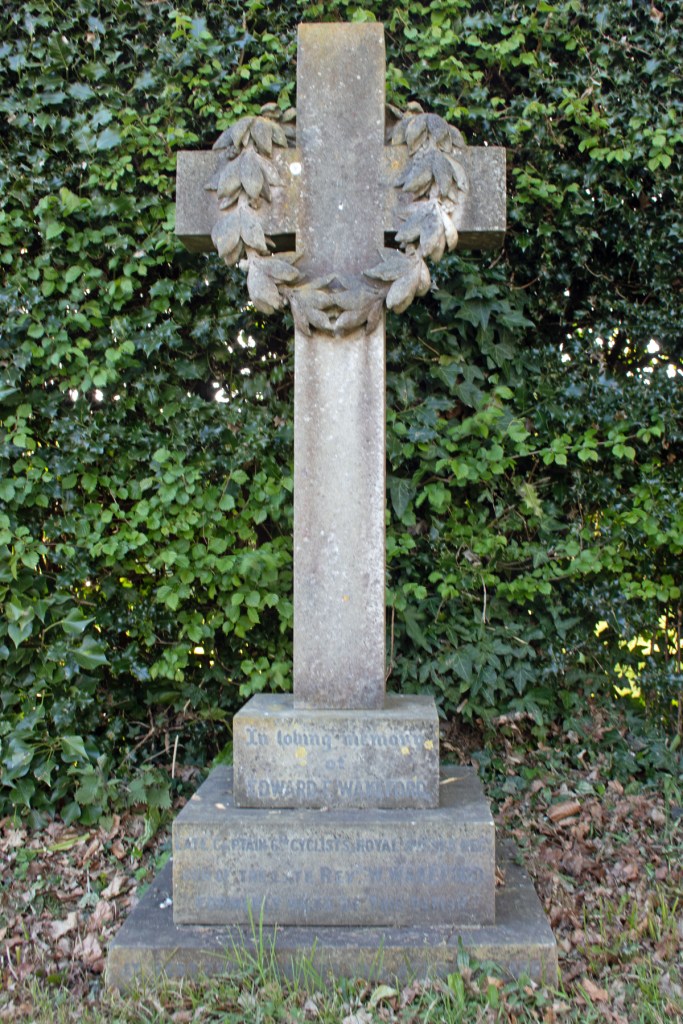
Edward Francis Wakeford was born in Rottingdean, near Brighton, Sussex, in February 1881. He was the younger of two children to curate William Wakeford and his wife, Eliza.
The family home was always a busy one; the 1881 census records one visitor, four boarders and a servant. Ten years later, confirms one boarder and two servants.
By 1901, William had taken up a post in St Peter’s Church, Henfield. This seems to have been a step up: helping look after the family and a visitor were four servants – a gardener, a cook, a housemaid and a kitchenmaid.
In March 1907, Edward married Annie West Thornton; she was the daughter of a well-to-do family – the census records show that her father, William West Thornton, lived by private means, while Annie was sent to Surrey to attend a boarding school.
Edward and Annie couple set up home on the Sussex coast, and, when William passed away in 1912, were soon also living by private means. They went on to have three children: two girls, Olive and Iris, and a boy, who they named William after both of their fathers.
War was coming to Europe by this point. While full details of Edwards military service are not available, he appears to have given a commission in the Royal Sussex Regiment. Initially serving as a Lieutenant, but October 1914, he was promoted to Captain.
Edward was assigned to the 6th (Cyclist) Battalion, and served in East Anglia. It seems that he fell ill while there, and was admitted to the Norfolk and Norwich Military Hospital, suffering with appendicitis. Sadly the condition proved too much, and Captain Wakeford passed away following the operation. He died on 23rd February 1915, not long after his 34th birthday.
Edward Francis Wakeford’s body was brought back to Sussex. He was laid to rest in Henfield Cemetery, not far from the church where his father had served for so long.
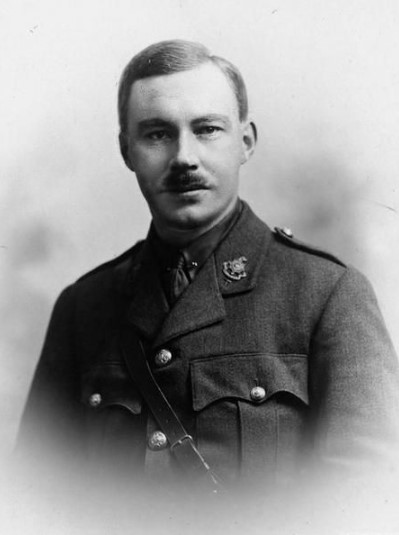
Captain Edward Wakeford (from findagrave.com)
The now widowed Annie wed again, marrying Reverend John Gurney in October 1917. Tragedy was to strike again, though, when she passed away just a year later, on 20th October 1918. She was laid to rest Henfield Cemetery, in the plot next to her late husband, Edward.
John Gurney went on to live a full live. He never married again, and settled in Buxted, near Uckfield. He passed away in November 1956, at the age of 76 years old. He was also laid to rest in Henfield Cemetery, where he was buried in the same plot as Annie.
Edward and Annie’s children also went on to have full lives, despite the early loss of their parents.
Olive never married, and passed away in Nottingham in 1986, aged 78 years old.
Iris married in Liverpool in 1934, and went on to have two children. When the marriage failed in the 1940s, she got wed again in 1949. She passed away in Cheltenham in 1965, at the age of 54.
William got married in 1940, at which point he was serving as a Lieutenant in the 1st King’s Shropshire Light Infantry. He saw action in Italy towards the end of the war, and was awarded a Military Cross for his service. When peace came to Europe again, he and his wife settled into a normal life, before emigrating to Australia. William passed away in May 1967, at the age of 54 years old.
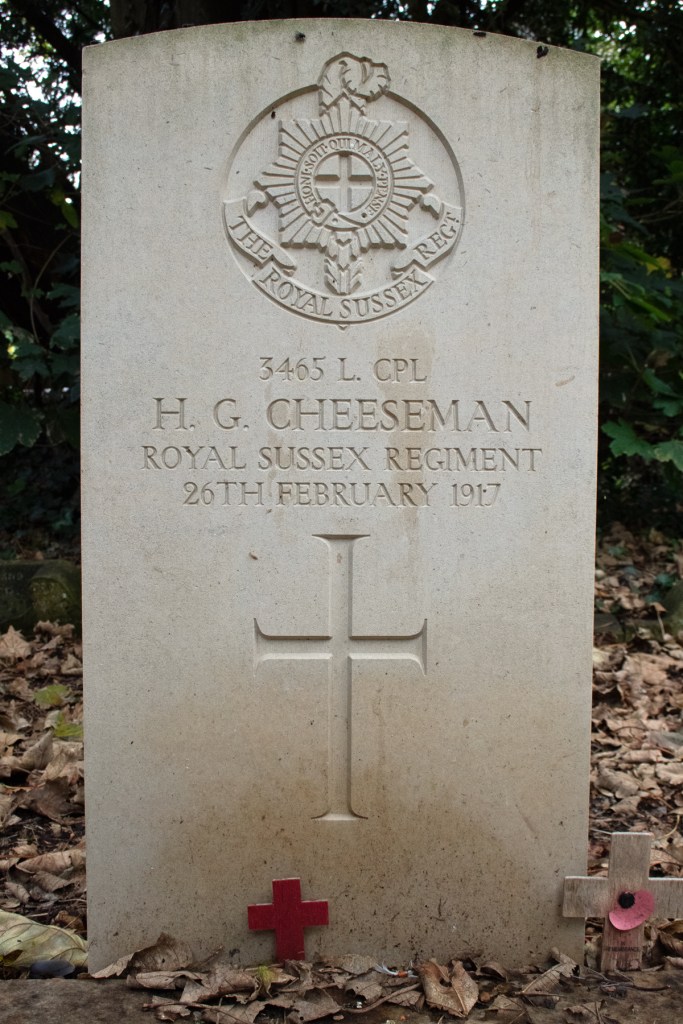
Harry George Cheeseman was born in the summer of 1893, one of eleven children to Charles and Sarah Cheeseman. Charles was an innkeeper, and ran the now-closed Red Lion Inn in Angmering, West Sussex for more than twenty years.
Harry did not follow in his father’s footsteps when he left school. Instead, he moved in with his older sister and her family in Horsham, where he worked as a roundsman on his brother-in-law’s dairy farm.
When war broke out, Harry was eager to enlist. He joined the Royal Sussex Regiment on 16th September 1914, and was assigned as a Private to the 9th (Service) Battalion.
Initially formed in Chichester, Private Cheeseman found himself moved to Portslade, then Shoreham, then Woking in Surrey, before eventually being sent to France at the beginning of September 1915. By this point, he had proved his worth and had been promoted to Lance Corporal.
Harry’s bravery shone through; in November 1915, while battle was raging, he brought an injured colleague into a field hospital and was about to rescue another when he himself was injured. His wound – a gun shot wound to the spine – was initially treated on site, but he was soon evacuated back to England.
Lance Corporal Cheeseman’s injuries proved to be life-changing. A later newspaper report stated that he had been “physically helpless” [Worthing Gazette: Wednesday 5th March 1917], so paralysis seems likely. Awarded the British and Victory Medals and the 1914 Star, he was medically discharged from the army in May 1916.
Harry returned home, but never really recovered from his injuries. He died on 26th February 1917, at the tender age of 23 years old. His funeral “which was of a most impressive character, was witnessed by five hundred people” [Worthing Gazette: Wednesday 5th March 1917], and he was laid to rest in the graveyard of St Margaret’s Church in his home town.
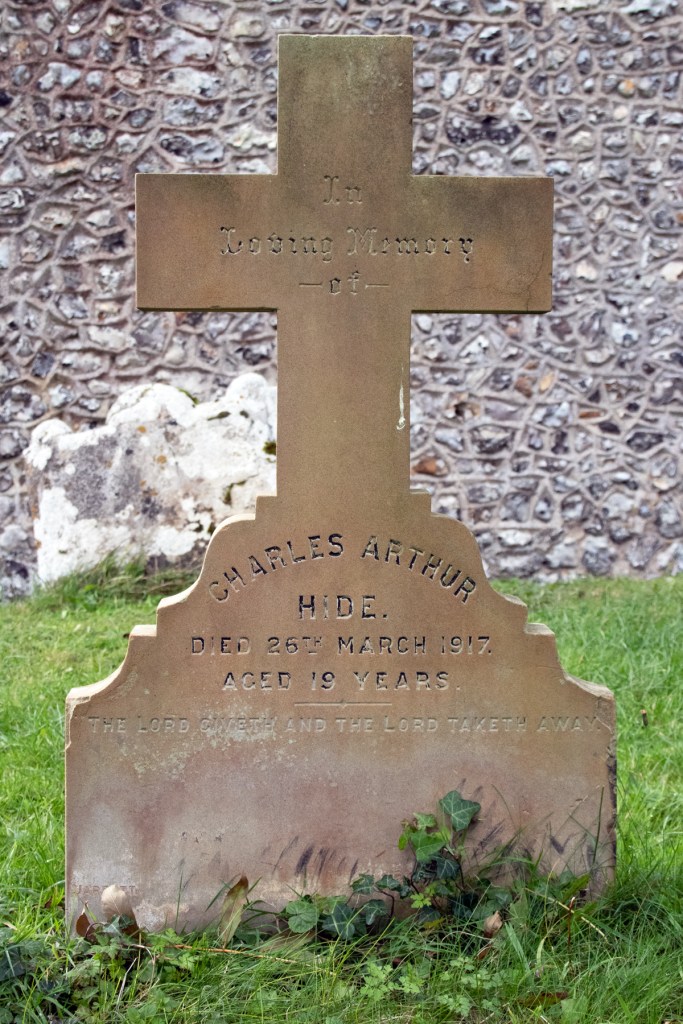
Charles Arthur Hide was born on 14th July 1897 and was the son of Ellen Edith Hide. The 1901 census found Charles living with his mother and her parents in the West Sussex village of Clapham. When Ellen’s father James died in 1909, local hurdle maker Alfred Daniels took her, Charles and her mother in as lodgers. Ellen subsequently married Alfred in 1916.
Charles, by this time, had left school and found employment with the railways. He started work on 22nd April 1913, earning 14s per week (around £55 a week in today’s money) as a porter at the station in Hove.
When war broke out, however, Charles felt the need to do his duty. He resigned from his job on 13th November 1914, and enlisted in the Royal Sussex Regiment as a Private. Charles was not alone in this: the employment records for Hove Station show that a number of other porters also handed in their notice around the same time.
Assigned to the 11th (Service) Battalion (also known as the 1st South Downs), Private Hide was initially based near Bexhill. His troop was then moved on, first to Maidstone in Kent, then to Aldershot, Hampshire. Whilst the battalion as a whole were shipped to France in 1916, there is no evidence that Charles went with them, and it seems that he may have served his time on home soil. Wherever he was based, he was awarded the Victory and British Medals for his time in the army.
At this point, details of Private Hide’s life become sketchy. He is only mentioned in one further document – the Army Register of Soldiers’ Effects – which confirms that he passed away at a military hospital in Epsom, Surrey, on 26th March 1917, although no cause is given. He was just 19 years of age.
Charles Arthur Hide’s body was brought back to Sussex for burial. He lies at rest in the quiet graveyard of St Mary the Virgin Church in his home village of Clapham.
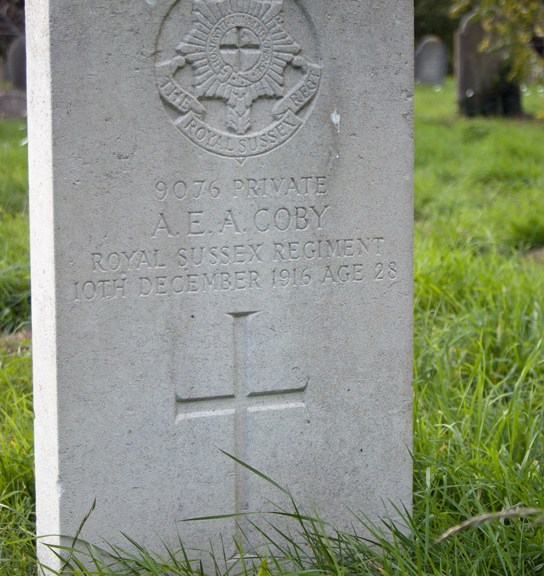
There are some mysteries that are just destined not to be solved, no matter how much digging you do. One gravestone in Worthing’s Broadwater Cemetery, dated 10th December 1916, proved to be one of those.
Research across the standard platforms revealed very little. There was no AEA Coby on Ancestry, the service number 9076 did not reveal anything on the Fold3 website. The name Coby did not feature in any contemporary newspaper article in December 1916 or January 1917.
One lead suggested that Private Coby’s first names are Albert Ernest, but again, this drew a blank. Another gave the surname with the spelling Cobby, and this seemed to fit better.
The birth of an Albert Ernest Cobby was registered in Sussex at the start of 1888, but the parents’ names are missing. The Commonwealth War Graves Commission website gives these as Alfred and Ellen Coby, but there is no concrete documentation to back this up.
The combination of Cobby and the service number did identify a military record on Fold3, but even here the information was limited. The document confirmed that Albert was nearly 29 when he enlisted in the Royal Sussex Regiment on 3rd December 1915, and that he was a motor cleaner in Worthing by trade. It gave his mother as Mrs A Cobby, but this does not fit with the Ellen suggested elsewhere.
Crucially, it confirmed that Private Cobby served on the home front for a matter of weeks – from 29th February 1916 to 4th May 1916. No reason is given for the end of his service.
Sadly, much of Private AEA Cobby’s life is destined to remain a mystery, with no definite links between the various pieces of evidence.
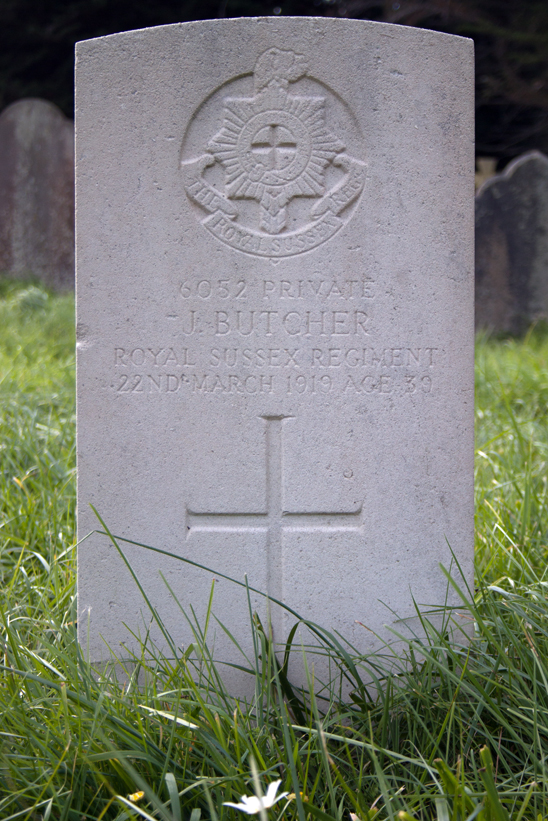
James Butcher was born in the village of Durrington, West Sussex, on 12th April 1880. He was one of seven children to agricultural labourer Henry Butcher and his laundress wife, Sarah. The family were dedicated to the countryside life; by the time of the 1891 census, James was listed as a cowboy, as was his older brother, so at 10 years old, his time would have been spent up on the South Downs, tending a farmer’s bovine herd.
In 1904, James married Eleanor Andrews, the daughter of a publisher’s packer from London. The couple would go on to have six children: William, Thomas, George, Walter, Ernest and Gladys. By the time of the 1911 census, the family were living in Broadwater, to the north of Worthing, and James was listed as a general labourer for the town council.
When war arrived on England’s shores, James was keen to to his bit. He initially joined the Royal Sussex Regiment, although subsequently moved to the Agricultural Company of the Labour Corps. Sadly, Private Butcher’s military service records are no longer available, so it’s impossible to confirm exact dates for his time in the army.
James survived the conflict, but the next record for him is the Army Register of Soldiers’ Effects. This confirms that he was admitted to the Swandean Isolation Hospital on the outskirts of Worthing, and subsequently passed away there. There’s nothing to confirm his cause of death, although, based on the nature of the hospital, it is likely to have been one of the lung conditions prevalent at the close of the war.
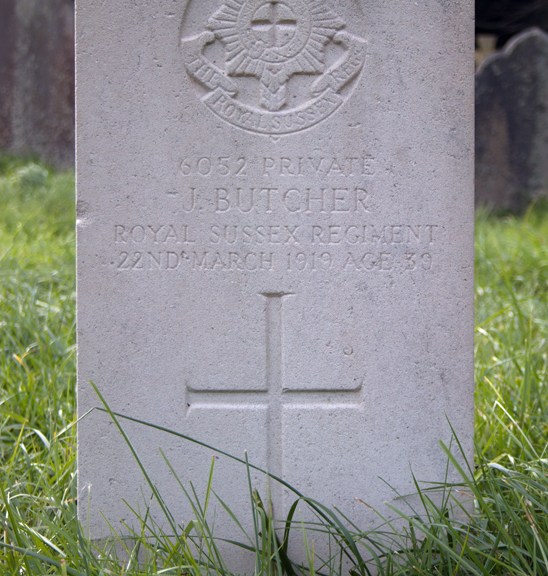
James Butcher died on the 22nd March 1919, at the age of 38 years old. He was laid to rest in the Broadwater Cemetery, not far from his home.
Frederick John Slaughter was born in around 1878, one of eight children to Stephen and Frances (who was better known as Fanny) Slaughter. Stephen was a brewer’s drayman, who had gotten himself in trouble with the law the year before Frederick was born.
Stephen Slaughter charged with feloniously embezzling five several sums of 10s each, which he had received for and on account of his masters, Octavius Coope and others, at Worthing, on the 7th September 1876, was sentenced to six calendar months’ hard labour.
Sussex Advertiser: Saturday 14th April 1877
Stephen was imprisoned in Petworth Jail, but took ill there. Two months later, a further newspaper report shed further light on him:
ANOTHER DEATH IN THE GAOL
On Thursday another inquest – the second within a week – was held at Petworth Gaol… on the body of Stephen Slaughter.
Mr Linton, the governor, said the deceased was about 36 years of age, was a brewer’s drayman and was sentenced at the April Quarter Sessions to six months’ imprisonment with hard labour for embezzlement. He was a very quiet, industrious, and well-conducted prisoner.
On admission he was put to a labour machine, which consists of turning a handle, weighted to 10lbs, and making 14,000 revolutions daily as a maximum. About a fortnight after he was reported to the surgeon. He was looking pale, and was put in the open air to work at the pumps.
About the middle of June he was put to spinning wool, a very light description of work, and on the 18th June witness again reported him to the surgeon. He continued wool spinning until taken ill on Sunday morning last. Warder Daughtery then reported his illness and witness at once sent for Dr Wilmot, and at that gentleman’s request Dr Hope was also called in consultation.
From that time till his death, early on Wednesday, he was under the care of the surgeons, in his cell, which was a roomy, airy one. The Infirmary was occupied by another case.
On Sunday witness wrote to deceased’s brother, and two of them visited him on Monday. (Witness produced a letter, since received from one of deceased’s brothers, in which he said “In conclusion I beg to thank you and all the officials connected with the prison for your kindness to my brother during his illness, as he told me on Monday when I saw him he was treated with the greatest kindness.”)
The evidence of Mr Wilmot and Mr Hope, surgeon, showed that the nature of deceased’s illness necessitated an operation, which was performed with his consent, but that after it he gradually sank and died of exhaustion.
Horsham, Petworth, Midhurst and Steyning Express: 24th July 1877
Stephen died before Frederick was born, leaving Fanny, to bring him and the youngest of his siblings up alone. Fanny found work as a dressmaker and, according to the 1881 census, she lived in a small cottage just off Worthing seafront with her 15 year old daughter, Emily, and her three youngest boys, Walter (who was 8), Arthur (5) and Frederick (3).
When he left school, Frederick found work as a errand boy for the local fishermen; his two older brothers we employed by a local dairy, and the three of them were living with their mother, a paternal uncle and lodger in a cottage in the centre of the town.
Fanny died in 1902, at the age of 62. Seven years later Frederick, now working as a carman for a grocer, married Gertrude Lawrence, who had been born in Kent. The couple went on to have a son – also called Frederick – the following year.
When war came to European shores, Frederick was quick to enlist. He joined the Royal Sussex Regiment on 9th October 1914, and was assigned to the 7th (Service) Battalion as a Private. Full service details are not readily available, but he certainly served in France, having been posted there in June 1915.
While Private Slaughter’s military records are scarce, his medical ones are very detailed. In June 1916 he was treated in the field for scabies, in December that year, he received treatment for pediculosis, an infestation of lice. Eight months later, he was admitted to a hospital in Camiens with an inflamed knee, something which subsequently recurred two months later, when he was admitted for treatment in Etaples. Frederick was received treatment for a fifth time in January 1918, this time for a deformed toe, but after this, his overall health seemed to stabilise.
Private Slaughter was demobbed in March 1919, and returned to England. Sadly, it seemed that his health wasn’t as good as it might have seemed; on 17th July 1919, he died at home from heart failure, which was subsequently attributed to his was service. He was 41 years old.
Frederick Slaughter was laid to rest in the Broadwater Cemetery in his home town of Worthing, West Sussex.
The war years were particularly tragic for Stephen and Fanny’s children. Along with Frederick’s passing in 1919, his oldest brother Harry had died in 1914, two other brothers – Henry and William – had died in 1916, while a fourth brother, Walter, passed away in 1920.