Category Archives: Gunner

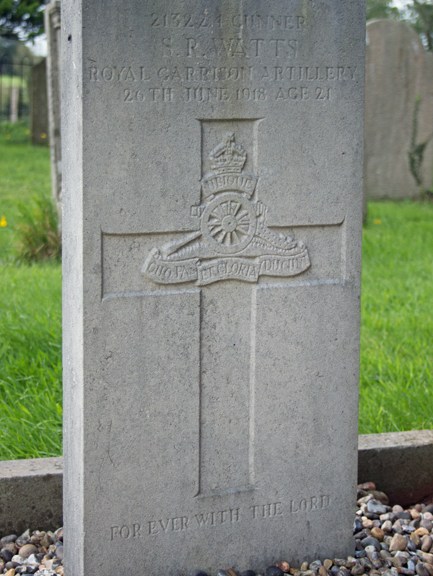
Gunner Samuel Watts

Gunner Samuel Watts

Samuel Reginald Watts was born in 1897, the seventh of eight children of Samuel and Augusta Watts.

He followed his father and brothers into the main industry in the area – coal mining – and was certainly working down the pits by the time of the 1911 census.

Samuel enlisted on 21st April 1918, and joined the Royal Garrison Artillery, which focused on heavy, large-calibre guns and howitzers that were positioned some way behind the front line. He was 5’5″ (1.65m) tall and weighed 144lbs (65kg). According to his war records, he had brown hair, hazel eyes and a fresh complexion.

His service started the very next day, when he was transferred to the Citadel in Plymouth for training.

After feeling unwell, complaining of headaches and a sensitivity to light, Gunner Watts was admitted to the Netley Hospital in Southampton on 18th June 1918. He was diagnosed with cerebrospinal fever, more commonly known as meningitis, and was treated over the next week.

Sadly, the treatment did not work, and Gunner Samuel Watts passed away on the evening of 26th June 1918. He had been in the army for a little over two months and had not seen active service.

Samuel Watts lies at peace in the graveyard of St John’s Church, Farrington Gurney.


Gunner Samuel Hayes

This image has an empty alt attribute; its file name is img_4069s.jpg
Gunner Samuel James Hayes

Samuel James Hayes was born in the Somerset village of Milverton in May 1879. He was the eldest son of James and Harriet.

James was an agricultural labourer, but Samuel wanted more than this; he enlisted in the Royal Marine Artillery in February 1897, three months before his 18th birthday.

The 1901 census finds Gunner Hayes in the Eastney Barracks in Portsmouth, while ten years later, he was on board the HMS Swiftsure in the Mediterranean.

In May 1912, he married Annie Thorne, also from Milverton, in his home village. Two years later, just before Christmas 1914, their first – and only – child, Lionel, was born.

I have struggles to find anything specific relating to Gunner Hayes’ wartime service. He certainly continued to serve, and by the time of his death had clocked up more than twenty years’ service in the Royal Marine Artillery.

Samuel passed away on 6th July 1919, at the age of 38. One record I have located suggests that he died in a military hospital in Malta, but whether he passed there or in the UK, he was buried back in Somerset.

Gunner Samuel James Hayes lies at rest in St Michael & All Angel’s churchyard in Milverton.

Gunner Thomas Holloway

Gunner Thomas Holloway

Thomas Charles Holloway was born in Chatham, Kent in 1893. The fourth of five children, his parents were Joseph, a domestic coachman, and Caroline Holloway.

By the time of the 1911 census, Thomas had left school and was working in a corn warehouse.

Thomas presented a bit of a challenge when I was researching his history.

His military records show that he enlisted on 31st December 1914, signing up to the Royal Field Artillery. However, Gunner Holloway’s service records show that he was posted on 9th January 1915, before being discharged as medically unfit just a week later. The records confirm that he served for 16 days.

The medical attestation states that he was discharged because of cardiac dilation and hypertrophy, a systolic murmur and dyspnoea, all heart-related conditions.

Despite only serving for just over a fortnight, he was afforded a Commonwealth War Grave when he died.

Searching the local newspapers of the time, a bigger story was unveiled.

The death of Bombardier Thomas Holloway, aged 24, of the RFA… occurred in a hospital at Cambridge. He was kicked by a horse in the course of his training, nearly two years ago, and had practically been on the sick list ever since. On recovering from the effects of the accident, he was seized with spotted fever at Seal, and ultimately succumbed to paralysis of the brain.

East Kent Gazette: Saturday 21st July 1917

The discrepancies between the original discharge and the newspaper report are intriguing. Either way, this was a young life cut far too short: he was 24 years old.

Gunner Thomas Holloway lies at rest in St Margaret’s Churchyard, in his home town of Rainham in Kent.

Gunner Frederick Brooks

Gunner Frederick Brooks

Frederick Brooks was born in the spring of 1897, the ninth of eleven children to Stephen and Grace Brooks. Stephen worked as a woodsman in Bredhurst, Kent, a trade his eldest sons followed him into.

Yewtree Cottages in Bredhurst, home to the Brooks Family

Frederick’s service records show that, when he enlisted in nearby Rainham, he was working as a fence maker. He was 5ft 6ins (168cm) tall, weighed 143lbs (65kg) and had fair physical development. He joined up in September 1915 and was assigned to the 2/1 Company Kent Royal Garrison Artillery.

Gunner Brooks’ early service was on home soil as part of the Territorial Force. However, he was transferred overseas as part of the British Expeditionary Force on 10th March 1917, where he served for nearly two years.

Frederick fell ill in January 1919, and was brought back to the UK for treatment. He was admitted to the Weir Red Cross Hospital in Balham, London, with bronchial pneumonia. He succumbed to heart failure just a few days later, on 4th February 1919. He was just 21 years old.

Gunner Frederick Brooks lies at rest in a peaceful corner of the secluded graveyard of St Peter’s Church in his home village of Bredhurst.


Frederick’s life throws a couple of coincidences my way. I used to live within spitting distance of his village, Bredhurst, and, indeed, have driven past his family home countless times. I also happened to have been born in the same hospital – the Weir in Balham – where Frederick had passed away 53 years earlier.

Gunner Thomas Kelly

Gunner Thomas Kelly

It is often a challenge to find details of the fallen soldiers whose graves pepper the churchyards of the UK.

Sadly, Gunner Thomas Kelly is one of those names lost to time.

Born in 1893, he lived in Alsager, Cheshire and enlisted in the Royal Field Artillery. He served in the Balkans during the war and was wounded. Brought back home to the Yeatman Hospital in Sherborne, Dorset, he died of his wounds on 11th January 1918.

He was buried in the town’s cemetery on 16th January 1918; he was just 25.