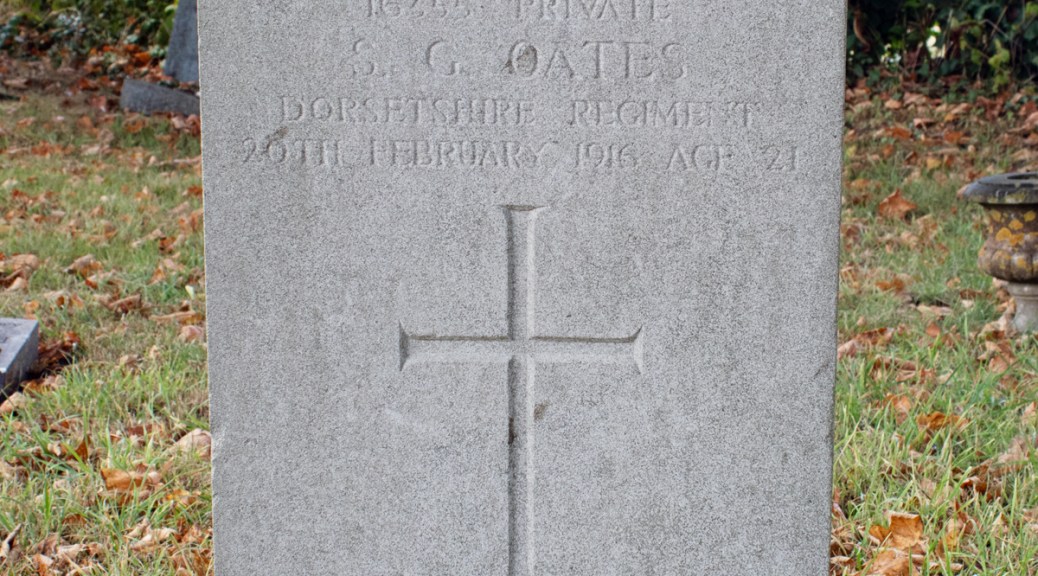
Sidney George Oates was born in the spring of 1895, and was the oldest of three children – all boys – to John and Eliza Oates. John was a general labourer from Parkstone, Dorset, but it was in the village of Odcombe in Somerset that the family were born and raised.
Eliza died in 1899, and John was left to raise three young children on his own. He re-married, to a Lucy Moores, but the a split of the family followed the wedding. Sidney’s younger brothers stayed with their father and his new wife, while Sidney himself was looked after by his maternal grandparents. Job and Elizabeth Green lived in Buckhorn Weston, a village to the west of Gillingham, Dorset.
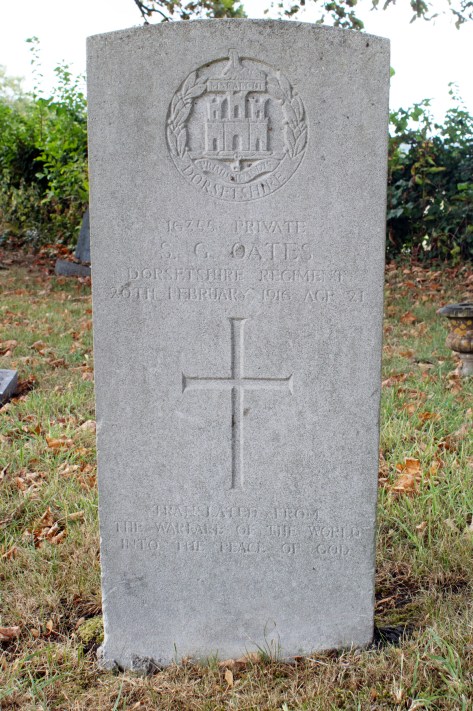
When he finished his schooling, Sidney was apprenticed to a carpenter. War was on the horizon, however, and he soon stepped up to play his part. As with many others, his service papers have been lost to time, but it is clear that he had enlisted in the Dorsetshire Regiment no earlier than August 1915.
Private Oates was assigned to the 7th (Reserve) Battalion and sent to a training camp near Wool, Dorset. While there, however, he caught pneumonia, and was admitted to a military hospital in the village. The condition was to prove fatal: he passed away on 20th February 1916, aged just 21 years old.
The body of Sidney George Oates was taken back to Buckhorn Weston for burial. He was laid to rest in the village’s cemetery.
Sidney’s younger brother Edward also served in the First World War. A Pioneer in the Royal Engineers, he was killed in action in northern France on 12th April 1917. He was buried in Mory Abbey Military Cemetery to the north of Bapaume.
Wilfred Clarence Ansfield was born in the spring of 1899, and was the youngest of eleven children to Frederick and Frances Ashfield. Frederick was an innkeeper from West Tarring in Sussex, and the family were living in the public house he ran – possible the Vine Brewery on the Hight Street.
Frederick died at the start of 1904, and by the time of the next census, taken seven years later, Frances had moved the family to Salvington. They settled at 1 Beaconsfield Terrace, with six of the Ansfield children sharing the home with their mother. Three of Wilfred’s brothers were employed as gardeners – possibly at one of the many nurseries in the area – while he was still at school.
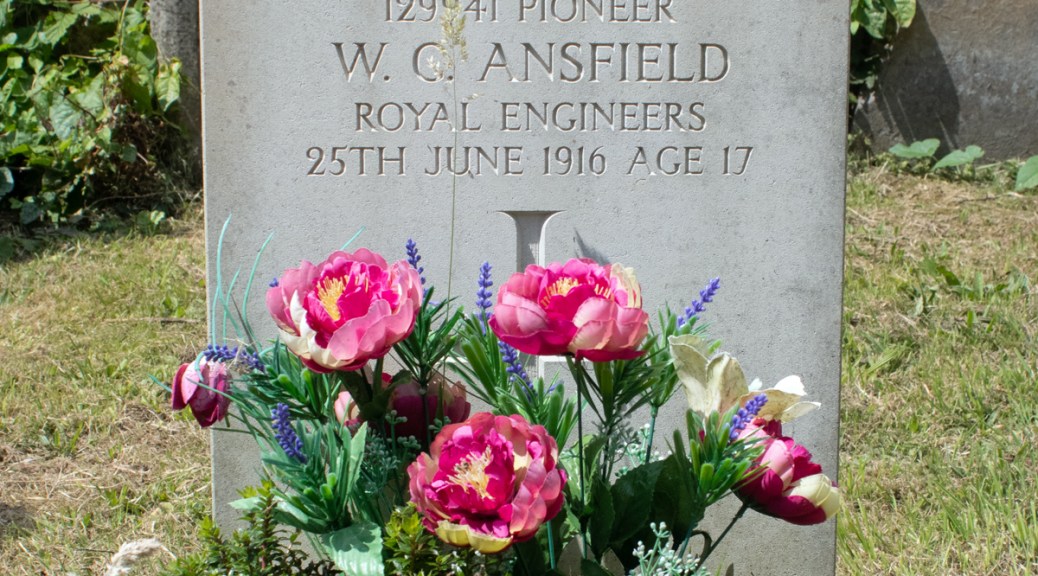
When war came to Europe, Wilfred was keen to serve his King and Country. Full service details have been lost to time, but it is clear that he enlisted in the Royal Engineers and, as a Pioneer, was assigned to the 3rd Provisional Company (later renamed the 642nd (London) Field Company). This was a territorial force, and it is unlikely that Wilfred saw any action overseas.
The only other document that can definitely connected to Pioneer Ansfield is the record of who his pension was assigned to. This confirmed Frances’ name and address, but also gives the cause of her son’s death, noted as ‘acute paralysis’. This could have been as a result of a tetanus infection, but nothing remains to confirm either way. Wilfred died on 25th June 1916: he was just 17 years of age.
Wilfred Clarence Ansfield was laid to rest in the graveyard of St Andrew’s Church in West Tarring, He was buried alongside Frederick, father and son reunited after twelve years.
Richard Crook was born in the spring of 1883 in the Devon village of Locksbeare. The youngest of three children, his parents were Richard and Ann Crook. Richard Sr was a general labourer, and his son followed suit when he completed his schooling.
On 5th November 1904, Richard married farmer’s daughter Elizabeth May. The couple went on to have four children, and moved around Devon to wherever his farm work took them. Ann died in 1910, and by the time of the following year’s census, they had settled in Burlescombe, near Sampford Peverell.
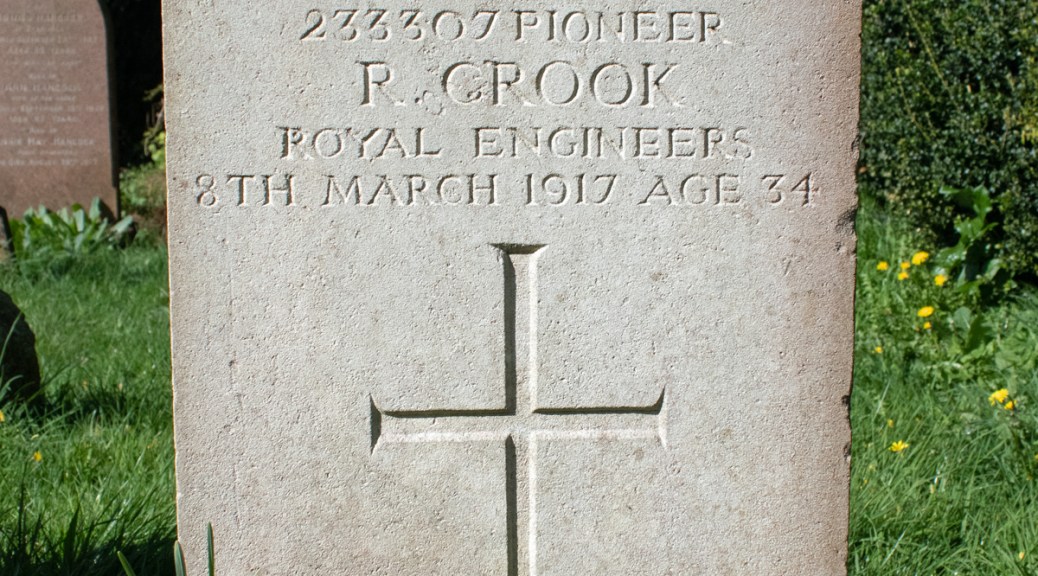
By the start of 1917, Richard was called upon to serve his King and Country. He enlisted on 30th January and joined the Royal Engineers. His service records show that he was attached to the Inland Water Transport Corps, and given the rank of Pioneer.
Richard was sent to Kent for training, but within a matter of weeks he was admitted to a military hospital in Canterbury. He had contracted German measles, and it was so severe that he quickly succumbed to it. He passed away on 8th March 1917, at the age of 34 years old. He had been in the army for less than five weeks.
Richard Crook’s body was brought back to Somerset for burial. He was laid to rest in the graveyard of St Peter’s Church, Uplowman, Devon, not far from where his widow and children were living.
Arthur Edward Naile was born in the summer of 1888, the youngest of ten children to James and Mary Naile. Both of his parents were born in Bath, Somerset, and this is where they raised their growing family.
The Nailes lived in the Camden area of the city, consecutive census returns showing different addresses, as the children grew and then left home. In 1891, they lived at 11 Malvern Buildings, a small terraced house on a steep hill. Ten years later, they had moved to 3 George’s Road, to another terraced cottage close to their old home. By 1911, only Arthur was still living at home, which was now the four-roomed terrace at 51 Brooklyn Road, in the more built up Larkhall area no the northern outskirts of the city.
During all of this time, James had worked as a printer’s compositor. By 1911 he was 64 years of age, and was employed by a newspaper in the area. Arthur, meanwhile, was working as a grocer’s assistant.
On 9th August 1914, he married soldier’s daughter Bessie Brine. She was working as a dressmaker, and lodging with Charles and Eleanor Richman, in a small cottage in Dover Place. Their marriage certificate shows that Arthur was living three doors down, so it is likely she caught his eye not long after he moved in. They went on to have a son, Leslie, in November 1916.
War was raging across Europe by this point, and Arthur had stepped up to serve his country. He joined the Royal Engineers as a Sapper, but there is little concrete information about his time in the army. He was awarded the Silver War Badge, which was given to men medically discharged from military service during the conflict, which would suggest that he was badly wounded at some point. He died in a hospital in Hastings, East Sussex, an annexe of which was dedicated to personnel who had been blinded during the war.
Sapper Arthur Edward Naile passed away from a combination of influenza and diabetes on 31st October 1918: he was 30 years of age. His body was taken back to Somerset for burial, and he lies at rest in a peaceful corner of Bath’s sweeping Locksbrook Cemetery.
After Arthur’s death, Bessie was left to bring up their young son. In the autumn of 1923, she married again, to John Forman, and not long afterwards the three of them emigrated to Australia, in search of a better life. They settled in Bunbury, Western Australia, and went on to have two children, Ron and Nan.
When war broke out again, Leslie was old enough to step up, and joined the Royal Australian Air Force. By 1943, he found himself as a Flight Sergeant in Waltham, Lincolnshire. He had joined 100 Squadron of Bomber Command and, on the night of 25th June 1943, was piloting a Lancaster over the Netherlands. His plane was hit and destroyed, killing all those on board. Father and son both lost to war, Flight Sergeant Naile was just 26 years of age when he passed. He was buried in Westbeemster, and commemorated on memorials in Runnymede, Surrey, and Canberra, Australia.
Bessie lived on until her early 70s. She died on 8th December 1960, and is buried in the family plot in Bunbury Cemetery.
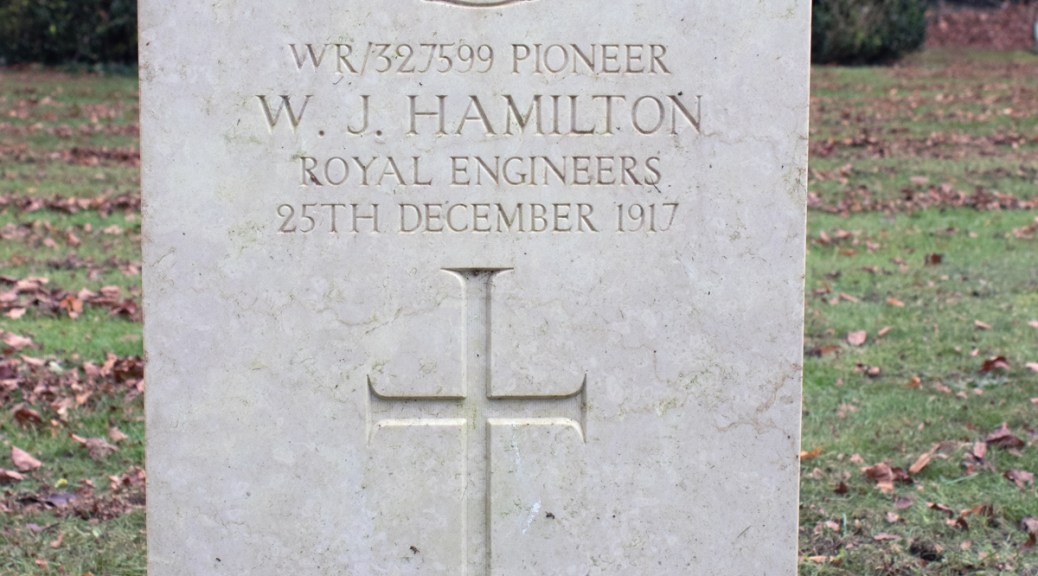
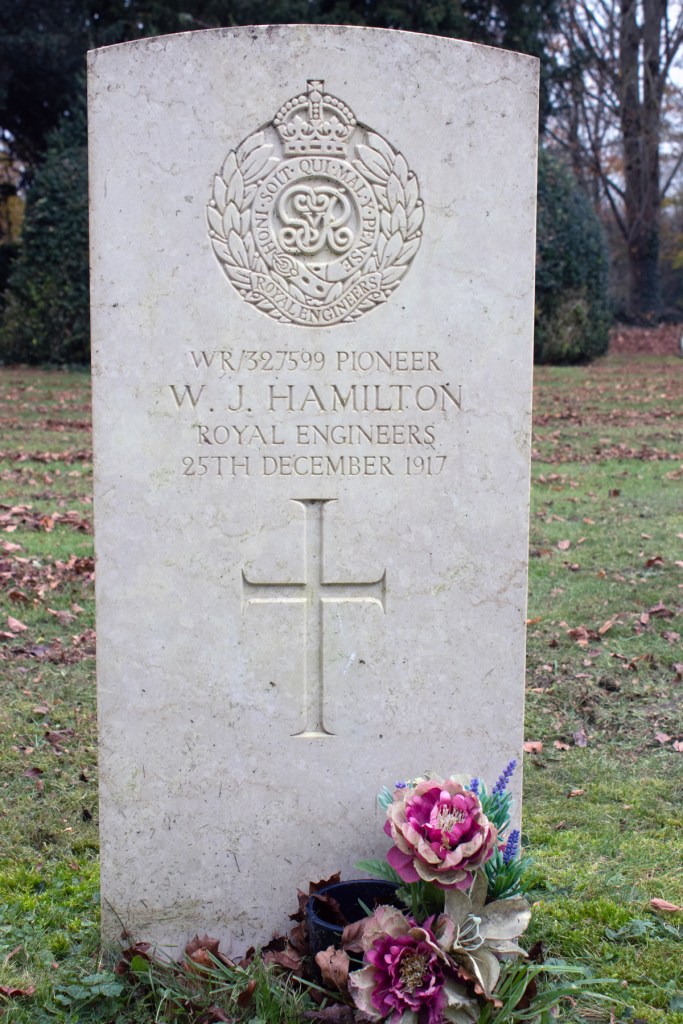
William John Hamilton was born in Urney, County Tyrone, in 1870. One of ten children, his parents of John and Bella. Little further information is available about his early life, but on 29th September 1895, William married Sarah McLaughlin.
The couple set up home in Ballycolman Lane, Strabane, and had at least six children. William worked as a shop porter, while Sarah kept house for the family.
By the time of the 1911 census, William was working as a general labourer. War was brewing over the continent by this point, however, and when hostilities were declared, he stepped up to play his part.
Full details of William’s service are lost to time. What documents remain, however, confirm that he enlisted no earlier than June 1917, and that he joined the Royal Engineers as a Pioneer. He was attached to an Inland Water Transport unit and sent to Salisbury Plain, Wiltshire, for training.
Pioneer Hamilton’s Pension Ledger Card provides a tantalising insight into his passing. On 25th December 1917, he died from “suffocation from submersion accidentally drowned while on active service.” There is no other documentation to expand on what happened, and no contemporary newspaper report on his passing. William was 47 years of age.
It would appear that Sarah was unable to afford the cost of bringing her late husband’s body back to Ireland for burial. Instead, William John Hamilton was laid to rest in Amesbury Cemetery, close to where he had passed away.
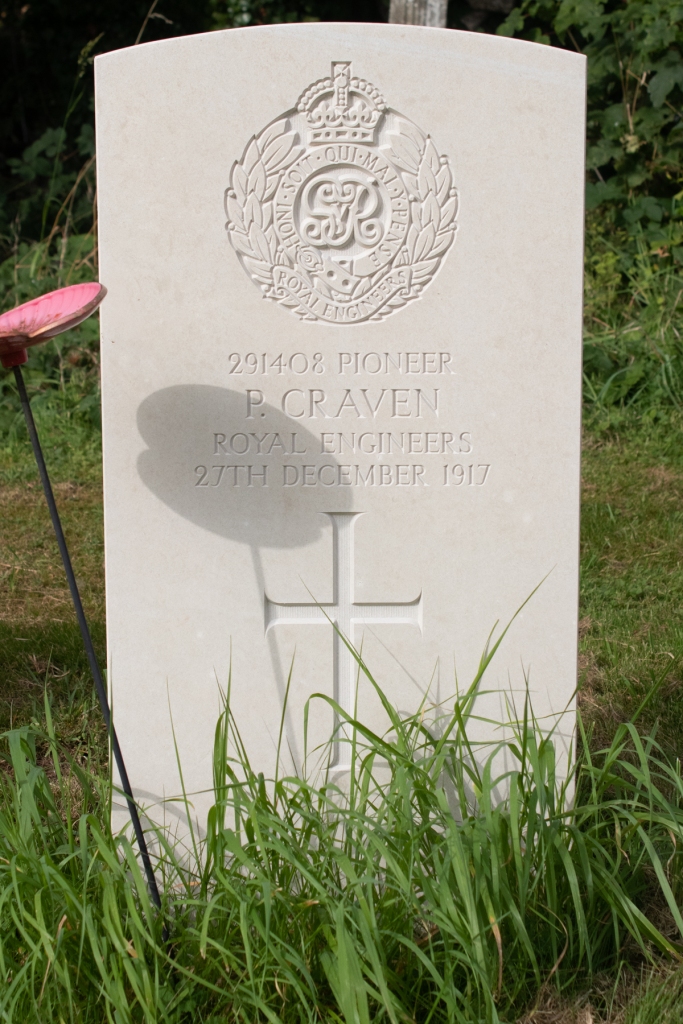
Patrick Craven was born in the summer of 1898 in Drogheda, County Louth. The oldest of three children, his parents were Francis (or Frank) and Mary Craven. Mary died in 1909, and the following year Patrick’s father remarried, to widow Kate Devin. The 1911 census found the extended family living in a cottage on North Road, Frank, Kate and their seven children.
Frank was a farm labourer, and this is work that Patrick also went into when he finished his schooling. War came to Europe in 1914, and he was to be called upon to play his part.
Patrick enlisted in the Royal Engineers on 6th June 1917. His service records confirm that he was 5ft 6ins (1.68m) tall, and weighed 127lbs (57.6kg). Pioneer Craven was assigned to the Inland Waterways Transport Division, and sent to Henbury, on the outskirts of Bristol, Gloucestershire, for training.
There was one blip on Patrick’s otherwise spotless service when, on 1st October 1917, he was confined to barracks for two days for ‘conduct to the prejudice of good order and military discipline, leaving the ranks without permission‘. Shortly after this, Pioneer Craven was assigned to a unit in Portbury, Somerset.
The wet summer of 1917 had given way to a cold, harsh winter, and the conditions were to lead to Pioneer Craven’s tragic demise on 27th December. The detailed report from the Medical Officer explained what had happened:
This man was found dead… in a small harness room at the Lodway Brewery, Pill, a room occupied by the IW&D, Portbury. I was called in to see him and pronounced him dead, the body was quite stiff and cold and death had probably taken place several hours before. When first discovered the body was fully pronated, with the mouth flattened against the floor, the hands were gripping the Army greatcoat which he had pulled over himself.
The harness room was heated by a coke stove the flue of which passed through the room to the ceiling and was cracked, allowing the fumes of the burning coke to emanate into the room. There was no ventilation except through a door communicating with the stables, which was found shut at the time the cadavre [sic] was found. The stove was situate[d] between the position where the body lay and the door, in a cul-de-sac.
One other man slept in the same room the same night, the deceased man having evidently entered the place after the former had fallen asleep. The second man was not affected by the fumes to any degree, but was lying between the stove and the door under which there was a certain amount of draught.
Sheltering himself from the cold winter night, Private Craven had passed away in his sleep from carbon monoxide poisoning. He was just 19 years of age.
Patrick Craven’s family were unable to afford to bring him back to Ireland for burial. Instead, he was laid to rest in the peaceful graveyard of St George’s Church in Easton-in-Gordano, not far from the brewery stables where he had passed.
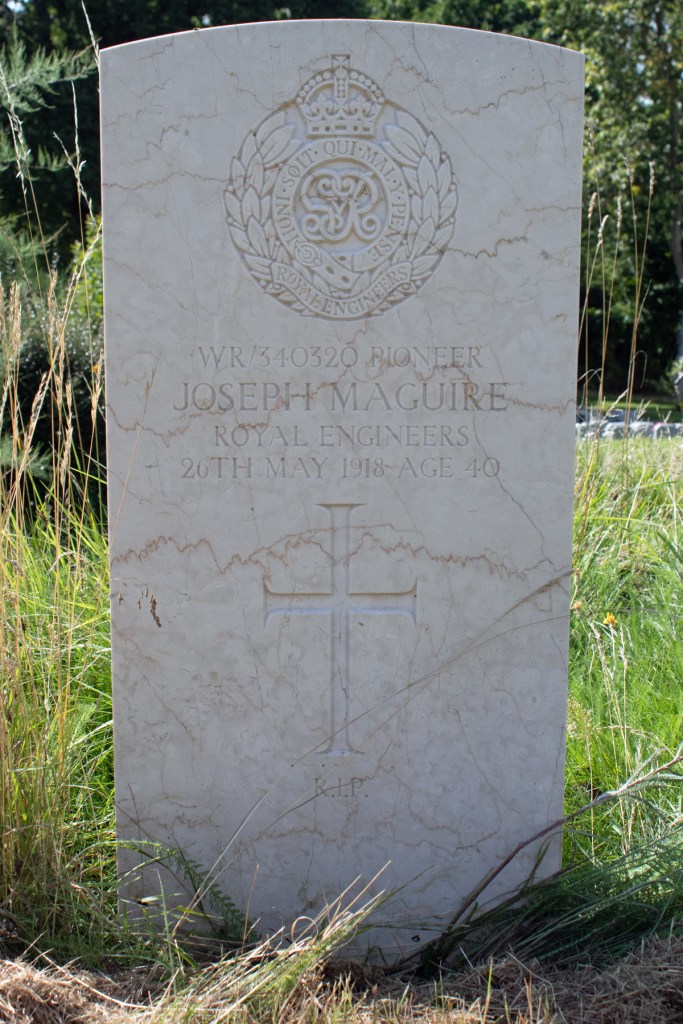
The early life of Joseph Maguire is challenging to decipher. Born in Dublin in 1878, his name is sadly too common to pin down any specific family relationships. Later records suggest that he had a sister, Jane, but again, this does not help narrow down documentation.
It would appear that he had moved to England for work by the time war broke out: he enlisted in the Royal Engineers in Carlisle by November 1917. As a Pioneer, he was attached to the Inland Water Transport Battalion, although it is not possible to ascertain whether he served on the Home or Western Fronts.
Pioneer Maguire died at the Second Southern General Auxiliary Hospital in Weston-super-Mare, Somerset. The cause of his passing is not freely documented, but it seems likely to have been the result of an illness. He was 40 years of age.
Joseph Maguire was laid to rest in the sweeping ground of Minehead Cemetery. Commonwealth War Grave Commission records note that he is interred in the Roman Catholic section of the grounds, and that, when it was erected, his CWGC headstone was paid for by the Honourable Secretary of the British Legion.
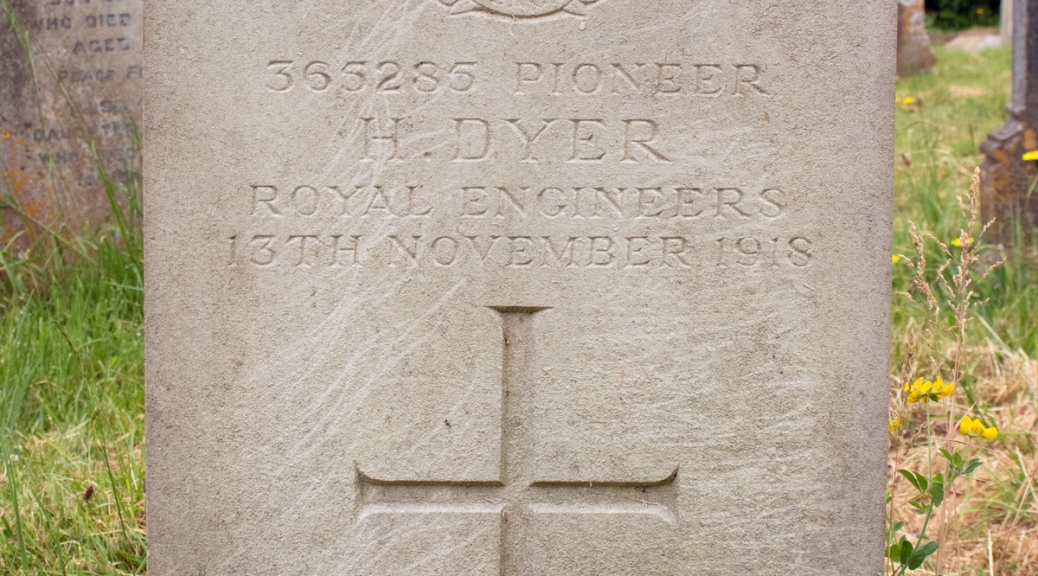
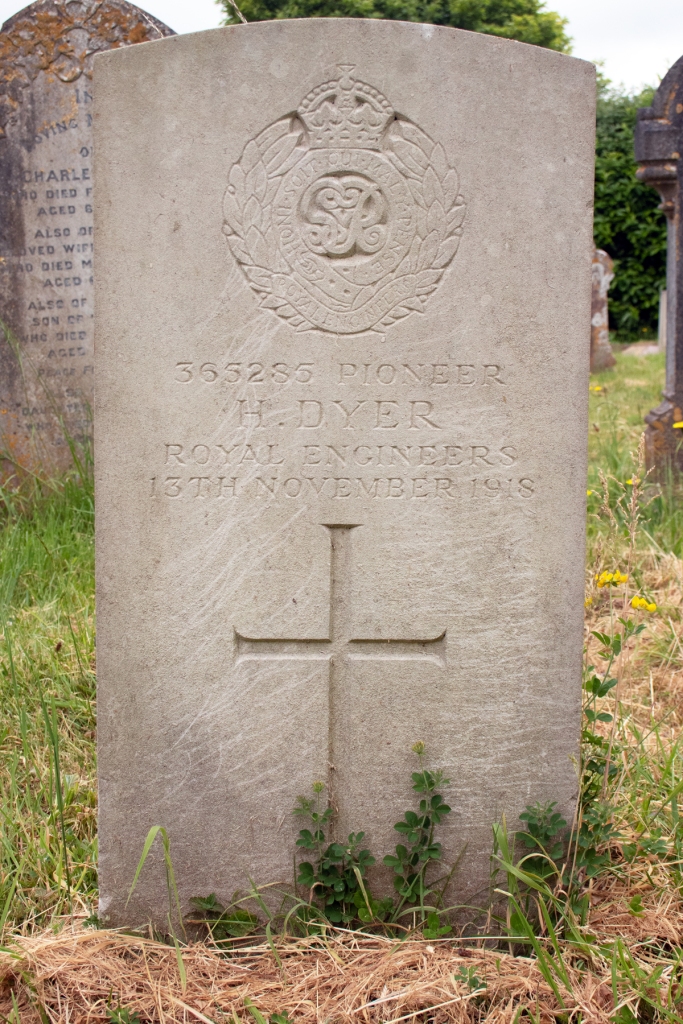
Charles Herbert Dyer was born in the Somerset village of West Monkton in the spring of 1890. One of eight children, his parents were farm labourer Charles Dyer and his wife Mary.
By the time of the 1911 census, Charles Jr had set out on his own, settling in Briton Ferry, near Port Talbot, Glamorganshire. He found work as a gardener and, from this point on, he went by his middle name, Herbert.
Over the next few years, Herbert continued his employment in Wales, although he did make a move to Newport, Monmouthshire. When war came to Britain, Herbert stepped up to serve King and Country, enlisting in the South Wales Borderers on 10th January 1916. Less than two weeks later, he married Ethel May Andrews, in All Saints’ Church, Newport.
Private Dyer was formally mobilised on 2nd March 1916. His service records show that he was 5ft 10ins (1.78m) tall and weighed 141lbs (64kg). Details of his service are a little scrambled, but it appears that Herbert was initially assigned to the 3rd (Reserve) Battalion, and remained on home soil throughout the conflict.
Herbert was based in Bottesford, Leicestershire, in December 1916, where he was put on report and docked 14 days’ pay for being absent from his post, and refusing to obey a superior’s order. Six months later, he had moved camp, and was confined to barracks for two weeks, and docked two days’ pay for being absent without leave for a day and ten hours.
By the summer of 1918, Herbert had transferred across to the Royal Engineers where, with the rank of Pioneer, he was assigned to the 15th Anti-Aircraft Company. Full details of his time in his new regiment have been lost, but he was certainly based in Essex as the war came to a close.
Pioneer Dyer’s health was, however, beginning to suffer by this point. He had a bout of influenza, which developed into pneumonia. He was admitted to the Warley Military Hospital in Brentwood, on 10th November 1918, but, by this point, his body had seemingly had enough. He passed away at 11:20am on 13th November 1918, at the age of 28 years old.
The body of Herbert Dyer was brought back to Somerset for burial. Ethel had moved in with her in-laws in West Monkton by this point, and was a couple of months’ pregnant. Herbert was laid to rest in the peaceful graveyard of St Augustine’s Church. His son – who Ethel named Herbert – was born on 6th June 1919, never to know his father.
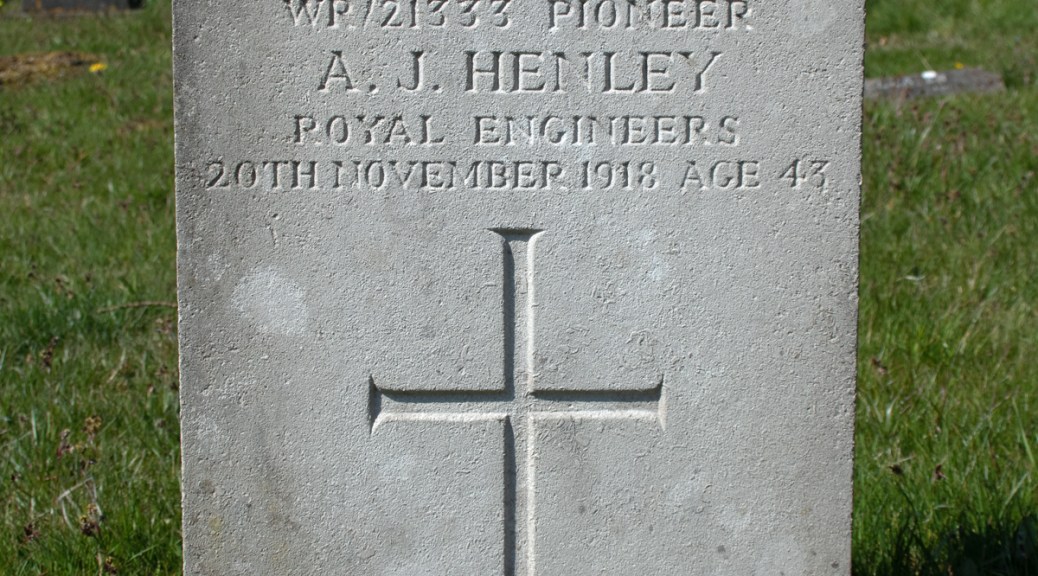
Albert James Henley was born in the spring of 1875, the youngest of nine children to Caleb and Ann Henley. Caleb was an agricultural labourer from Cuckfield, and it was in this West Sussex village that the Henley siblings were born and raised.
Albert found work on a farm when he left school, but soon found other employment as a bricklayer. On 15th August 1896 he married Sophia Leney: the couple went on to have four children – Kate, Minnie, Albert and William.
War came to Europe, but Albert was not initially called on to serve king and country because of his age. He did enlist, however, joining the Royal Engineers in January 1917. His service records suggest that he was a month short of his 45th birthday (which does not tie up with his baptism records) and stood 5ft 10.5ins (1.79m) tall. He is noted to have been of good physical development, weighing in at 159lbs (72.1kg).
Pioneer Henley was assigned to the 307th Road Construction Company and, after a month’s training was dispatched to France. He spent more than eighteen months overseas, before being medically evacuated to England in the autumn of 1918, having contracted bronchitis. Albert was admitted to hospital in Dover as soon as he had crossed the Channel, but died there the following day. He passed away on 20th November 1918 and was 43 years of age.
Albert James Henley was brought back to West Sussex for burial: he was laid to rest in the cemetery of his home village, Cuckfield.
A sad epilogue to Albert’s story is that his widow, Sophia, had to wait for his belongings to be returned to her. In a letter to the regiment on 14th December 1918, she wrote:
…it is nearly a month since he passed away, and I have not heard anything. When I came there on the 20th [November] they said his personal belongings would be sent on in a few days.
The Royal Engineers office responded that they were unable to forward his personal effects on until authority had been received from the War Office. It was to be another six months before Sophia finally got her late husband’s items – a purse, knife, notebook, letters, photo, gloves, watch (with case and chain), handkerchief, muffler and four coins – back.
James Valentine McDowell was born in Ashburton, Devon, on 2nd January 1865. He was one of eight children to William and Louisa McDowell. William was a labourer, and this was a trade that James also took up when he left school.
In the summer of 1884, James was brought up to the Devon Assizes in Exeter, on the charge of attempted suicide. A local newspaper reported that:
It appeared that on June 13th the prisoner, fully dressed, was seen lying at full length in the Yeo, his head resting on a stone, but the remainder of his body was under water. The stream, however, was but three feet deep and six feet wide at this particular point, so the actual danger was not very great.
A witness seeing the position of the prisoner called upon him to come out of the water. He did so. He was very drunk. On leaving the Yeo, the prisoner proceeded towards the Dart, and on his way wished the witness to bid his father and mother good bye. Arrived at the Dart the prisoner attempted to throw himself into the water, but was prevented and handed over to the police.
When in custody the prisoner said this was the second time he had been in the water: next time should be more lucky. Subsequently, however, he stated that he only went to the Yeo for a wash, and this statement he now repeated.
The jury returned a verdict of not guilty, and his Lordship, in discharging the prisoner, advised him next time he wanted a bath not to get drunk beforehand, or he might find himself in deeper water than that in which he was discovered on the present occasion.
Western Times: Saturday 26th July 1884
The same Assizes saw trials for embezzlement, horse stealing, larceny, stack-burning and endeavouring to conceal the birth of a child. The alleged perpetrator of a count of buggery was found not guilty (his alleged offence not named in the same newspaper), while a Henry Davy, 51, was sentenced to 18 months’ hard labour for indecently assaulting a 6 year old girl.
The following year found James back on track. He married local woman Mary Ellen Ellery; the couple set up home in Ashburton and went on to have seven children. The family settled into a routine – James worked as a mason’s labourer; in his spare time, he joined the 3rd Devon Militia. His and Mary’s daughters found work as wool spinners, while their sons also got into labouring work.
War came to Europe in 1914; despite his age, James wanted to play his part. He enlisted when the call came, joining the Royal Engineers as a Pioneer on 19th August 1915. Within a week he was sent to France, and this is where he stayed for the duration of the war.
Pioneer McDowell returned to England on furlough on 2nd February 1919, and was waiting to be demobbed. However, tragedy struck before that became a reality, the same newspaper picking up the story some thirty-five years later:
An Ashburton man named James McDowell, aged about 56 years, a private in the Royal Engineers Labour Battalion, who joined up in August 1915, and had been in France continuously since that time, was found drowned in the mill leat of the the River Yeo at the rear of the cottages in Kingsbridge-lane early on Saturday morning.
He left his home at Great Bridge about 8:30 on Friday night for a short time. To get to the town he had to pass along by the river, which was running very high through the recent heavy rain, and it is supposed that he must have fallen in and had been washed down to where he was found, which was a considerable distance.
He had been demobilised, and was on furlough, and every sympathy is expressed for the family on their sad loss. Dowell [sic] who was well known and was of a jovial disposition, leaves a widow and grown up family.
Western Times: Monday 24th February 1919
Later that week, a summary of the inquest was printed:
Dr EA Ellis said he found a ragged cut over deceased’s left eyebrow, but otherwise there was no sign of violence. The cut was inflicted before death. A post mortem revealed that the cause of death was drowning. His theory was that deceased fell into the river, his head coming into contact with a stone, which inflicted the wound and caused unconsciousness. The spot where the accident was supposed to have happened, he thought, was unsafe and dangerous.
…the jury returned a verdict that the deceased was found drowned, caused by accidentally falling over the wall at the top of North Street… and they wished… to call the attention of the responsible authorities to the danger at this spot, and to the unsatisfactory state of the lighting there.
Western Times: Friday 28th February 1919.
Pioneer James Valentine McDowell drowned on 21st February 1919: he was 56 years of age. His body was laid to rest in the graveyard of St Andrew’s Church in his home village.










 Death and Service