Tag Archives: Armistice

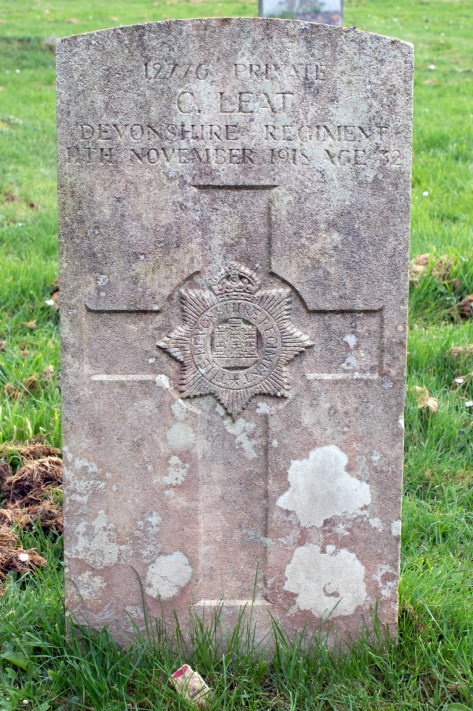
Private Charles Leat

Private Charles Leat

Charles Leat was born at the start of 1888 in Tiverton, Devon. One of thirteen children, his parents were Sidney and Ann Leat. Sidney worked as a lace maker, and the family lived in a crowded cottage on St Andrew Street to the south of the town centre.

When Charles left school, he found work as a grocer’s errand boy. Sidney died in 1897, Ann had to take on lace work herself. The house was too small for the growing family, and so the 1901 census found Charles and his brother Arthur living with his maternal aunt, Mary.

Things had moved on as the new century progressed. By 1911, Charles had moved to South Wales, and was living with his older brother, James, and his family in Glamorgan. James was a house painter, but his sibling had taken on work as a railway porter, and the family lived in terraced house at 57 Tydfil Street, Barry.

When war hit Europe, Charles seemed keen to play his part. Sadly, full details of his military service have been lost to time, but it is clear that he initially enlisted in the opening weeks of the conflict. Joining the Devonshire Regiment, he was assigned to the 11th Battalion.

A later newspaper report suggests that he “had been through most of the fighting on the Western Front… [and] was seriously wounded in 1915.” [Western Times – Friday 15 November 1918] It was after he had recuperated that Private Leat was reassigned to the regiment’s Labour Corps.

By the summer of 1918, Private Leat was serving on Salisbury Plain, Wiltshire. While here, he fell ill, and was eventually admitted to the Amesbury Military Hospital. His condition, pneumonia, was to prove too severe for his body to take, however, and he passed away from the condition on 11th November 1918, Armistice Day. He was 30 years of age.

Charles Leat’s body was taken back to Devon for burial. He was laid to rest in Tiverton Cemetery, not far from where his family still lived.

Private Alfred Daymond

Private Alfred Daymond

Alfred Daymond was born on 9th July 1891, in Porlock, Somerset. The second youngest of seven children, his parents were wall mason Albert Daymond and his wife, Maria. By the time of the 1901 census, Albert’s work had moved the family to the sleepy village of Luccombe.

When Alfred finished his schooling, he followed his father into wall building. This was the career he was still following when, in 1914, war broke out.

Alfred was quick to play his part for King and Country. He enlisted on 4th November 1914, joining the Somerset Light Infantry. Private Daymond’s service records show that he was 5ft 10ins (1.78m) tall, with good vision and a fair physical development.

Initially serving as part of a territorial force, Alfred remained on home soil until September 1916. At this point he was transferred over to the Duke of Cornwall’s Light Infantry, and became attached to the 7th (Service) Battalion. Details of his time in the army are sketchy, but his troop certainly fought at the Somme in 1916, and at Ypres the following year.

In May 1917, Alfred returned to British shores. His health appears to have been suffering, although it is not clear from what ailment. On 8th February 1918, Private Daymond was discharged from army service as being no longer physically fit.

Alfred’s trail goes cold at this point. It is likely that he returned home to Luccombe, and this is where he passed away, on 11th November 1918, Armistice Day. He was 27 years of age.

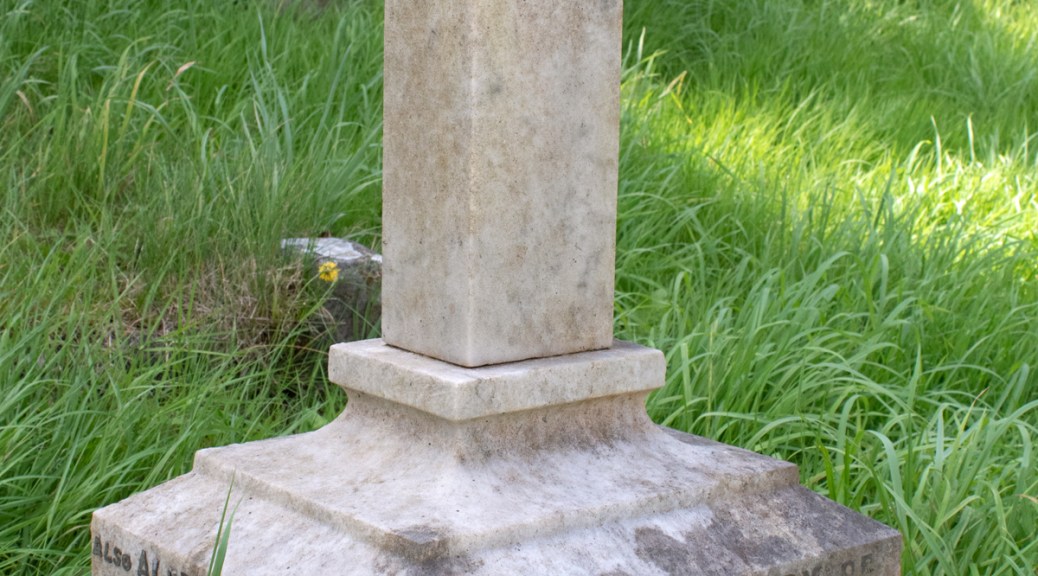
Alfred Daymond was laid to rest in the family plot of St Mary’s Church, Luccombe. He was interred alongside his younger brother, Albert.


Alfred’s younger brother, Albert, also enlisted for war service. Read his story here.

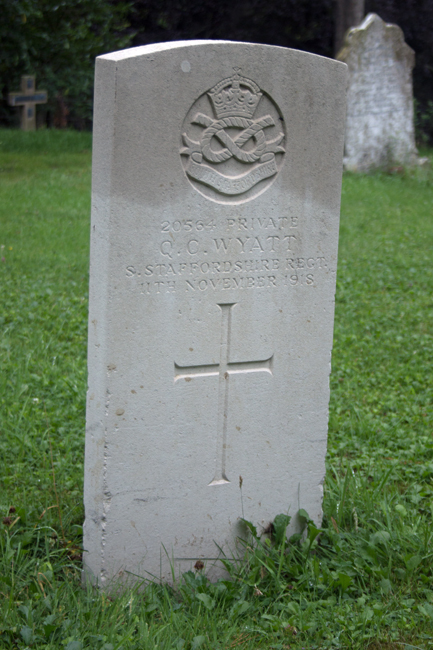
Private Quinton Wyatt

Private Quinton Wyatt

Quinton Charles Wyatt was born in the Gloucestershire town of Northleach in 1893 to William and Elizabeth. His mother died when he was a toddler, leaving William to look after Quinton and his older sister Agnes.

By the time war was declared, Quinton was working as a farm labourer and waggoner in the Gloucestershire village of Hampnett.

Quinton enlisted in the 8th Battalion of the South Staffordshire Regiment on 22nd November 1915. Appointed Lance Corporal just two months later, he was posted to France in March 1916.

Neglect of duty in June meant that Lance Corporal Wyatt was demoted to Private four months later. His battalion was caught up in a German gas attack in the autumn of 1917, and he was injured; ultimately, he was medically discharged from the Army on Boxing Day 1917.

Quinton Charles Wyatt finally succumbed to his injuries on 11th November 1918 – Armistice Day. He was 25 years old.

He is buried in St Mary’s churchyard in the village of Charlton Mackrell in Somerset.

Driver Harry Austin

Driver Harry Austin

Harry Austin was born in the small Kent village of Bobbing in 1890. One of nine children to Richard and Emma Austin, his father was the village blacksmith, a trade two of his brothers followed after leaving school. Harry, however, became a general labourer in the coal industry.

Sadly, most of Harry’s wartime service is lost to time; we know that he enlisted in the Royal Field Artillery and served as a driver. The RFA was responsible for the medium-calibre guns and howitzers deployed close to the front line; Harry’s role, therefore, was likely to have involved driving the horses to and from the sites where the guns were needed.

Again, Driver Austin’s military records are somewhat lacking when it comes to his passing. However, where they mark him as ‘dead from disease’, a contemporary newspaper in memoriam gives a little more detail.

In ever loving memory of Driver Harry Austin, RFA… who passed away November 10th 1918, in the 1st Southern General Hospital, Birmingham, from influenza following Gun Shot wounds, aged 29 years.

East Kent Gazette – Saturday 23rd November 1918.

An untimely death for Harry, but particularly poignant, given that he passed the day before the Armistice was signed.

Driver Harry Austin lies at peace in the graveyard of St Bartholomew’s Church in his home village of Bobbing, Kent.