Tag Archives: Battle of the Somme

Lance Corporal William Neads

Lance Corporal William Neads

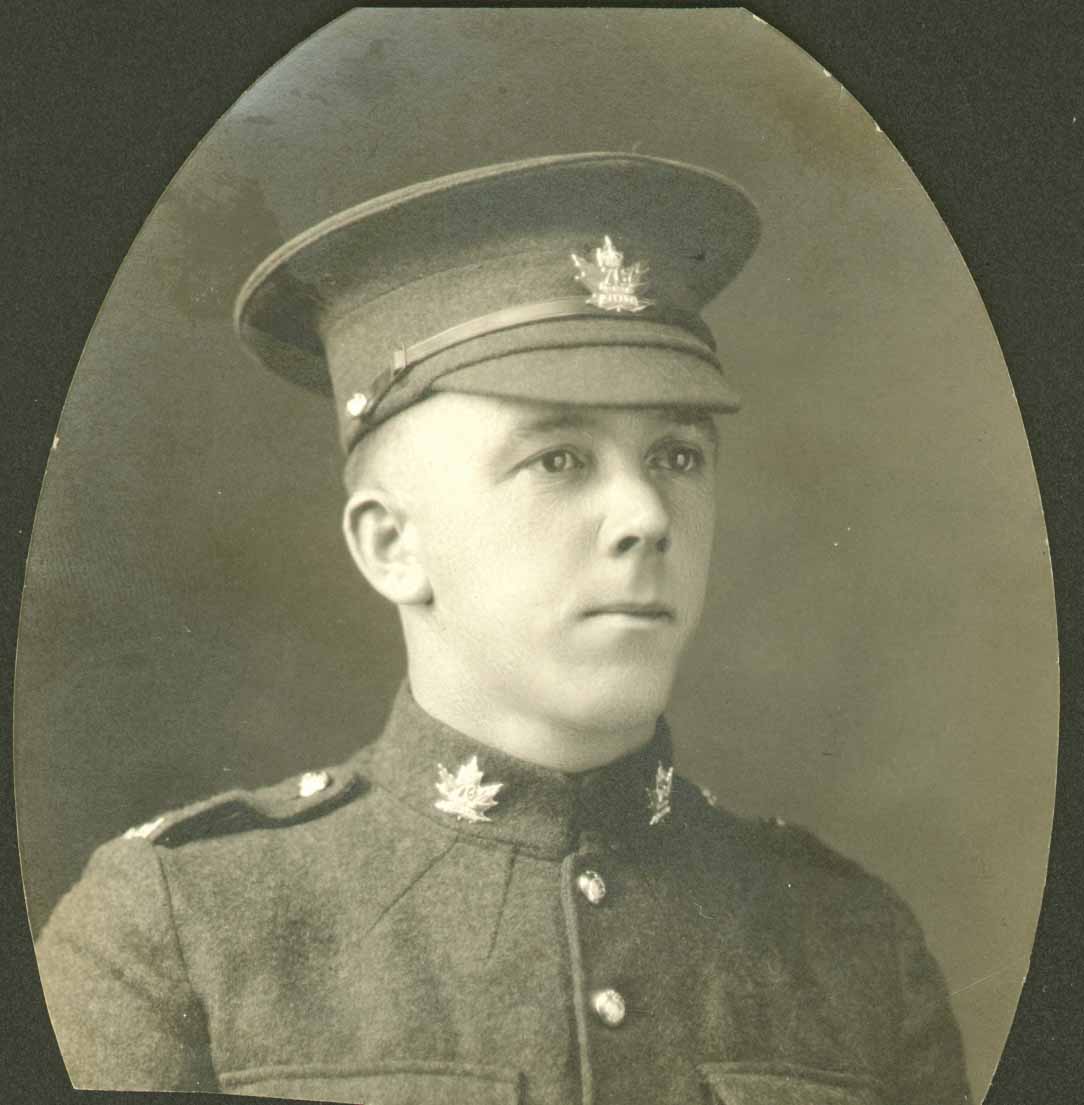
William John Neads was born on 16th December 1892, the middle of three children to cab driver and groom William Neads and his wife Ellen. Both William Sr and Ellen were from Somerset, although William Jr and his brother Charles – who was eleven months older – were both born in the Monmouthshire village of Cwmcarn.

William’s parents soon moved the family back to Clevedon in Somerset, and, when he left school, he found work as a farm labourer. He was eager to see more of the world, however and, in April 1913, he emigrated to Canada.

After working as a labourer there for a year or so, back in Europe war was declared. Keen to do his bit for King and Country, William enlisted in the 1st Battalion of the Canadian Infantry in January 1915. He soon found himself caught up on the Front Line.

In October 1916, he was involved in the Battle of the Somme – either at Le Transloy or The Battle of the Ancre Heights – and received a shrapnel wound to his left shoulder. Initially admitted to the Canadian General Hospital in Etaples, he was subsequently evacuated to England and the Northern General Hospital in Leeds. He spent three months recovering from his injuries, and was back on the Western Front in January 1917.

Later that year, William – now a Lance Corporal – was involved in the fighting at the Second Battle of Passchendaele (part of the Third Battle of Ypres). He was wounded again, this time receiving a rather unceremonious gunshot wound to the right buttock. Treated at the scene, he was evacuated back to England and admitted to the Fusehill War Hospital in Carlisle on 17th November.

Sadly, despite treatment, Lance Corporal Neads’ health deteriorated, and he passed away from his injuries on 16th December 1917, his 25th birthday.

William John Neads was brought back to his family’s home of Clevedon, and buried in the clifftop churchyard of St Andrew’s, overlooking the sea.


Tragically, William’s father had died in May 1917, at the age of 51. While no details of his passing are recorded, it meant that Ellen had, in just over a year, seen her son wounded, her husband die and her son wounded again and die as a result.


Private William Baber

Private William Baber

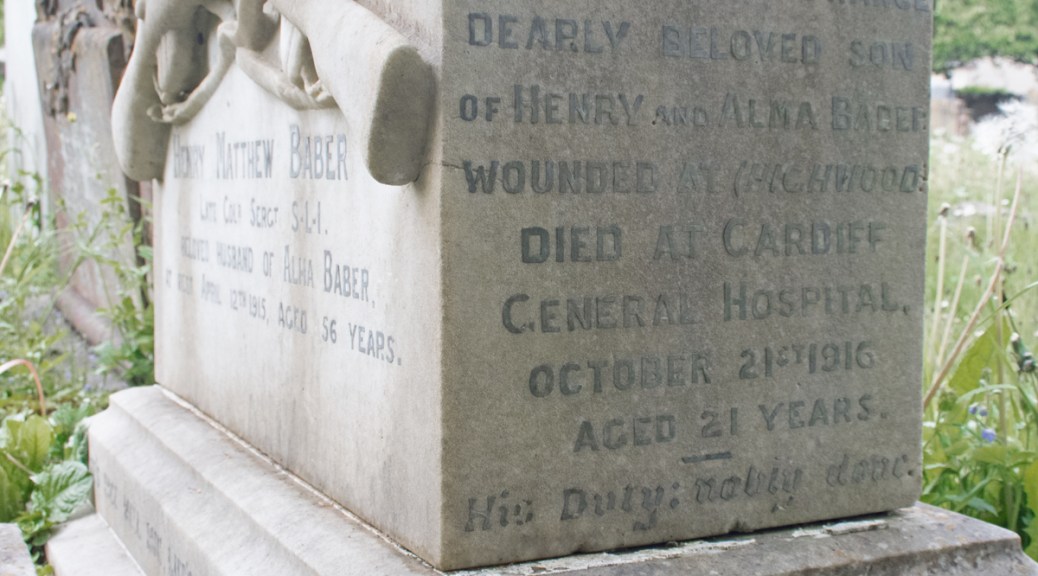
William Herbert Baber was born in May 1895, the oldest of six children to Henry and Alma Baber. By the time of William’s birth, Henry was an insurance agent for the Prudential insurance company and brought his family up in the Somerset village of Yatton. William’s father had been widowed early on, and so, in addition to his five younger siblings, he also had an older half-brother, also called Henry.

By the time of the 1911 census, William was working as a clerk in a coal office, and the family were living in a five room house not far from the village centre.

Little remains documented about William’s military service. He enlisted in the Somerset Light Infantry, but transferred to the 24th Battalion of the London Regiment. He was involved in the Battle of High Wood – part of the Somme offensive – and was wounded during the skirmish.

Evacuated back to home soil, Private Baber was treated in one of the military hospitals in Cardiff. Sadly, he was to succumb to his wounds, and passed away on 16th October 1916. He was just 21 years old.

William Herbert Baber lies at rest in the family grave in the churchyard of St Mary’s in Yatton.


William’s father Henry was also called up for war duty. You can read more about his story here.


Private William Woodbury

Private William Woodbury

William Alfred Woodbury was born in the Somerset village of Nether Stowey in April 1899, the oldest of four children to Alfred and Nellie Woodbury. Alfred was a farm labourer, and, by the time William was a couple of years old, he had moved the family to the town of Bridgwater to work as a carter.

After leaving school, William found work at Barham Brothers’ Brickworks in the town. When war broke out, he enlisted in the Somerset Light Infantry almost as soon as he was able to, at the beginning of 1916.

Assigned to the 6th (Service) Battalion and Private Woodbury was sent out to the Western Front in April. He would almost certainly have seen action at the Battle of Delville Wood – part of the Somme offensive – and was wounded in the shoulder and arm on 18th August 1916.

Shipped back to the UK for treatment, William was admitted to the Western General Hospital in Cardiff, but tragically died from his wounds less than a fortnight later on 30th August 1916. He was just 17 years old.

His funeral was reported in both the Shepton Mallet Journal and the Central Somerset Gazette; his father, who had been serving in France as part of the Army Veterinary Corps, managed to return home for his son’s funeral.

William Alfred Woodbury lies at rest in the St John’s Cemetery in his home town of Bridgwater.


Private Walter Roman

Private Walter Roman

Walter James ‘Rattler’ Roman was born in July 1880, one of six children to George and Betsy Roman. George was a labourer in a brickyard, and the family lived in Bridgwater in Somerset.

Walter’s passion was rugby football, and he made the Bridgwater & Albion first team at the age of 15. Two years later had reached county level, and was playing for Somerset.

Walter enlisted in the army in around 1897, joining the Somerset Light Infantry. He spent several years abroad, serving as a Private in India and South Africa and fighting at Cawnpore and in the Second Boer War.

When Walter’s service ended, he returned to England, and continued his rugby career. He was a regular for the Bridgwater and Somerset teams, gaining the nickname ‘Rattler’, before being signed up by Rochdale Hornets in 1910.

Walter married Henriette Washer in Bridgwater in April 1911, and the couple had two children, Edna – born in 1912 – and Leonard – who was born a year later.

Continuing with rugby union, Walter was called to county level, where he joined Lancashire for a number of games. Walter also played for England, receiving a cap in the international match against Wales in February 1914, and he toured Australia and New Zealand the same year.

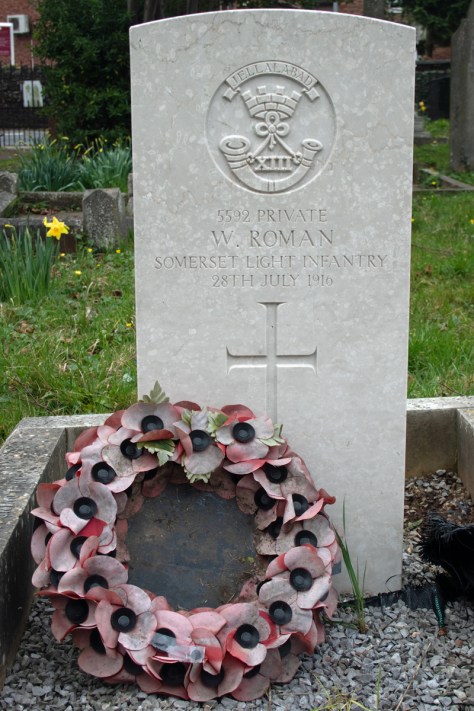
War broke out, and Private Roman was re-enlisted, one of twenty-five Hornets players to enlist. He served on the Western Front with the 1st Battalion of the Somerset Light Infantry and was caught up in the engagements at Ypres and Armentieres. Fighting at in the Battle of the Somme, he went over the top at Beaumont-Hamel at the start or fighting, on 1st July 1916 – his 36th birthday.

In that initial charge, he was shot several times, in both arms, a leg and the torso. Initially treated at a local field hospital, he was evacuated to England and admitted to the Voluntary Aid Hospital in Cheltenham. His condition initially improved, and he wrote letters to Henrietta, who was living back in Rochdale.

Sadly, Walter’s contracted sepsis and his health deteriorated; Henrietta was called to the hospital in Cheltenham on 27th July 1916. It is likely that she didn’t make it in time, as Walter passed away at 1pm the following day. He was just 36 years old.

Walter James Roman lies at rest in the Wembdon Road Cemetery in his home town of Bridgwater, Somerset, one of may sporting heroes to perish in the First World War.


Walter Roman (courtesy of findagrave.com)

Walter was one of 25 Rochdale Hornets players to enlist when war broke out. Of those men, five did not return: Private Walter Roman; Sergeant John Twigg; Private Archie Field; Private Tom West and Private CJ Burton.


Corporal John Welch

Corporal John Welch

John Milton Welch was born in Yeovil on 19th February 1866, one of five children to William and Anne Welch. William was a chemist by trade, but John’s calling was elsewhere. He became a clerk, initially for a brewery, but by the time of the 1911 census, he was working for a political agency.

In that census, John can be found living with his parents – who were in their 80s by this point – and his two sisters, both school governesses. He is listed as single; although an earlier census suggests he had married a lady from the Isle of Wight called Sarah, I have found nothing to corroborate this, beyond the fact that she had wed a John M Welch, a brewery clerk from Yeovil.

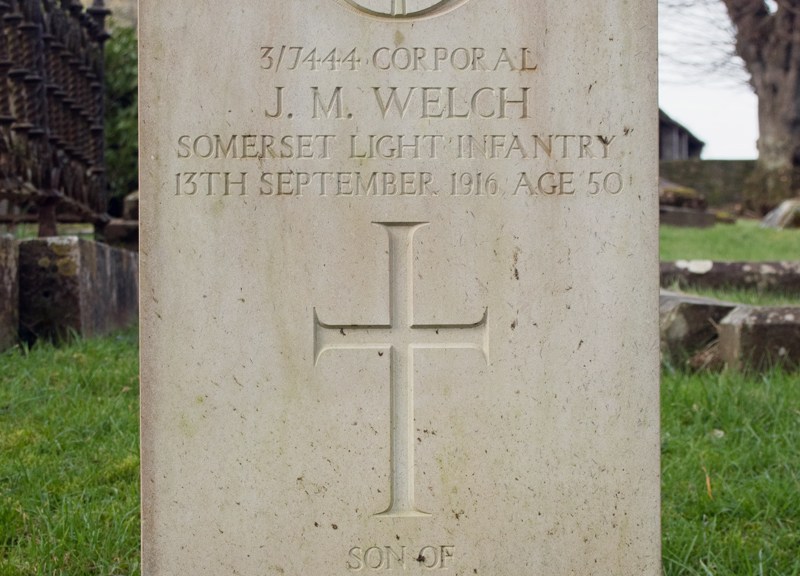
War beckoned and even though he was 48 when the conflict broke out, John enlisted. Private Welch joined the Somerset Light Infantry; his service record no longer exists, but his medal record show that he arrived in France in May 1915, and was subsequently awarded the Victory and British Medals and the 1915 Star. His service obviously warranted promotion, and he was elevated to Corporal.

His troop – the 6th (Service) Battalion – was involved in several of the skirmishes of the Battle of Somme, and it is likely that Corporal Welch was injured during one of these – probably either the Battle of Delville Wood or the Battle of Flers-Courcelette. Wherever it happened, he was shipped back to England, and was treated for his injuries at the Royal Victoria Hospital in Netley, Hampshire

Sadly, Corporal Welch was not to recover; he passed away on 13th September 1916, at the age of 50.

John Milton Welch lies at rest in the graveyard of St James’ Church, in the quiet Somerset village of Milton Clevedon.


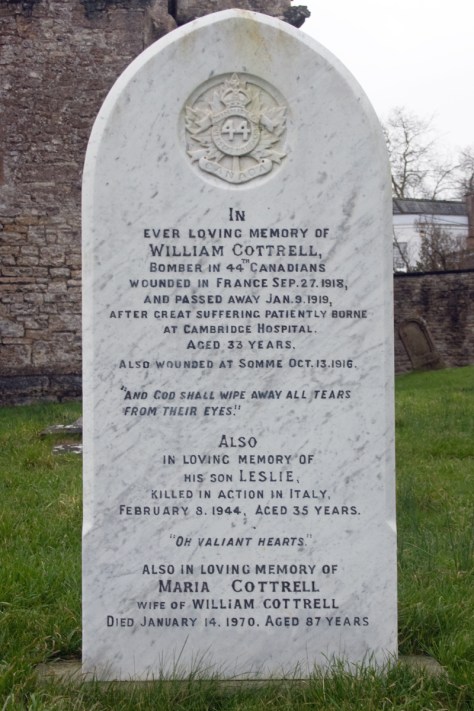
Private William Cottrell

Private William Cottrell

William Cottrell was born in April 1885, the third of twelve children to Henry and Annie Cottrell from Bampton, Devon. When William left school, he became an assistant to the village baker, but new opportunities lay ahead.

In May 1907, William married Maria Wall, the daughter of a stonemason from Wedmore in Somerset. With weeks, the young couple had embarked for a new life, boarding the Empress of Britain in Liverpool, setting sail for Canada.

Emigrating to Manitoba, William became a labourer, and he and Maria had three children – Leslie, Ronald and Kathleen.

War came, and William enlisted in the Canadian Expeditionary Force in August 1915. Shipped to England in the spring of the following year, Annie followed suit, returning to Somerset with the three children.

Private Cottrell was assigned to the 44th Battalion Canadian Infantry, setting off for France in August 1916, just weeks before his fourth child – Ruby – was born.

The battalion was involved in some of the fiercest fighting of the war, and it was during the Somme Offensive that William was shot in the left arm. Initially treated in the field, he was soon shipped back to England to recover in a military hospital in Epsom. Discharged after three months, he was returned to his battalion in early 1917.

The fierce fighting continued, and Private Cottrell was wounded again in October 1918. Further treatment back in the UK was needed, and he was admitted to the 1st Eastern General Hospital in Cambridge.

Details of the William’s injuries at the Somme are readily available, but information on his second lot of injuries is scarcer. They must have been pretty severe, however, as he was not discharged. He lost his final battle after four months, succumbing to his wounds on 9th January 1919. He was 33 years old.

William Cottrell lies at rest in the graveyard of St Mary’s Church in his widow’s home village of Wedmore, Somerset.


William’s gravestone is also a memorial to his eldest son, Leslie, who was killed during the Second World War.

Details of his military service are sketchy, but he enlisted in the Queen’s Own Royal West Kent Regiment. His battalion – the 1st – was involved in the fighting in Italy, and it was here that he lost his life. He was killed on 8th February 1944 and is buried in the Sangro River War Cemetery, in Abruzzo.


Corporal Sidney Hornby

This image has an empty alt attribute; its file name is photo-01-11-2020-12-01-50-e1605266325697.jpg

Sidney Horace Hornby was born to John and Emily in March 1880. John was a tailor’s assistant from Paddington, and the family – Sidney was the eldest of six siblings – initially lived in the Greenwich.

Sidney enlisted in the army in 1898. He joined the East Kent Regiment for a short service of seven years and was sent to South Africa. In March 1900 he was wounded at the Battle of Driefontein. His service, though, saw him promoted through the ranks from Private to Sergeant.

Something must have happened during his enlistment, however, as on 2nd September 1901 Sergeant Hornby’s military record marks him as having deserted.

Sidney’s records pick him up again on 24th April 1908, when he is put on court martial. Found guilty of desertion, he is reduced to the ranks and sentenced to three years’ penal servitude (later reduced to two years’ hard labour).

His attitude seems to continue, however, as within a matter of months he was discharged due to misconduct and denied any pension for his previous service.

Sidney’s family had moved from Greenwich to Kent at some point before the 1901 census, and his father died three years later. By the 1911 census, he had moved back in with his mother, and worked as a labourer to help look after them.

The Great War called, however, and it seems that Sidney’s previous misdemeanours did not excluding him from fighting again. He joined the Royal West Kent Regiment although his full service for the 1914-18 campaign are not accessible. Again, his service seems to have been good, as he was elevated to the rank of Sergeant for a second time.

Hints of Sergeant Hornby’s rebellious nature remain, however, as he was court marshalled again in February 1916. He was convicted of drunkenness, and reduced to the rank of Corporal.

That was the summer of the Battle of the Somme, and by the autumn Hornby was one of the many who fell during that time. He died on 4th October 1916 and was 36 years old.

Corporal Sidney Hornby is commemorated on the Thiepval Memorial.


Sidney Horace Hornby was my 1st cousin, four times removed.