Tag Archives: Denbighshire

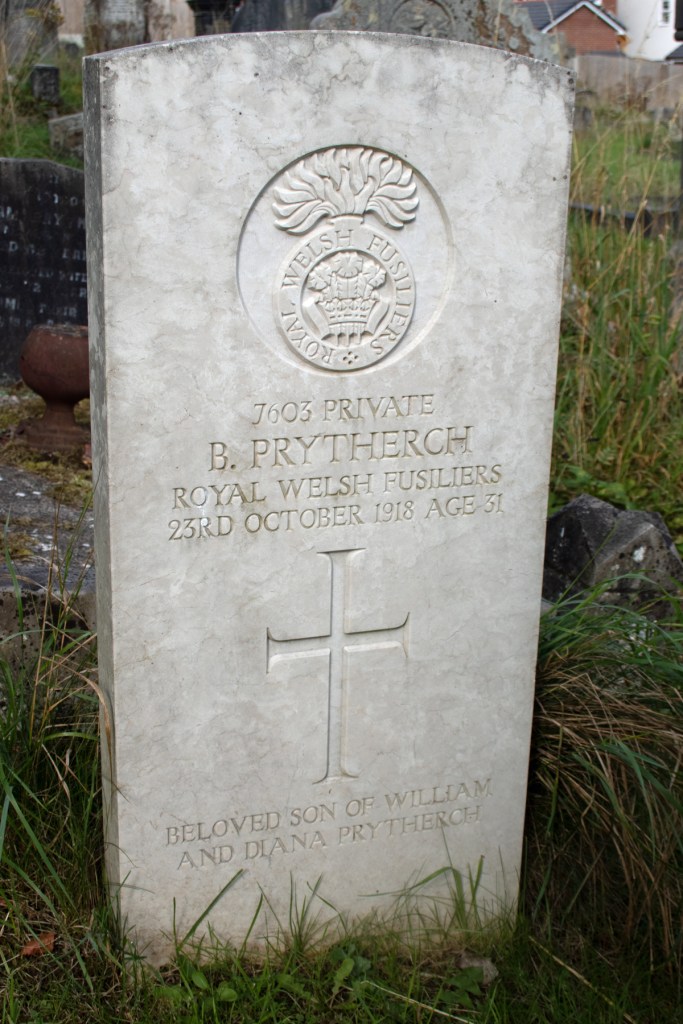
Private Benjamin Prytherch

Private Benjamin Prytherch

Benjamin Prytherch was born in the summer of 1887 in Cefn Mawr, to the east of Llangollen, Denbighshire. One of eight children, his parents were local blacksmith William and his wife, Diana. The family moved around a little while young Benjamin was growing up, but by 1901 had settled in Llangollen itself.

By the time of the 1901 census, Benjamin was the only one of the Prytherch siblings to still be living with his parents and was employed as a cabinet maker.

When war broke out, Benjamin was quick to enlist. He joined the Royal Welch Fusiliers and was assigned to the 1/4th (Denbighshire) Battalion. His service records show that he was 5ft 3.75ins (1.62m) tall and of good physical development.

While his battalion was part of the regiment’s Territorial Force, by February 1915, Private Prytherch found himself in France. He was caught up in the fighting almost immediately, and was injured during an explosion in a trench in May that year.

Sent to the No. 3 British General Hospital at Le Tréport in Normandy, Private Prytherch remained there for a little over a month to recover. However, when he returned to the front line, his health was impacted and he was unable to perform his duties without his breathing becoming affected. Further assessment revealed a heart murmur and he was sent back to Britain in July 1915.

Benjamin’s condition did not improve, and by October 1916, he was medically discharged as a direct result of the injuries he had sustained in the trench blast.

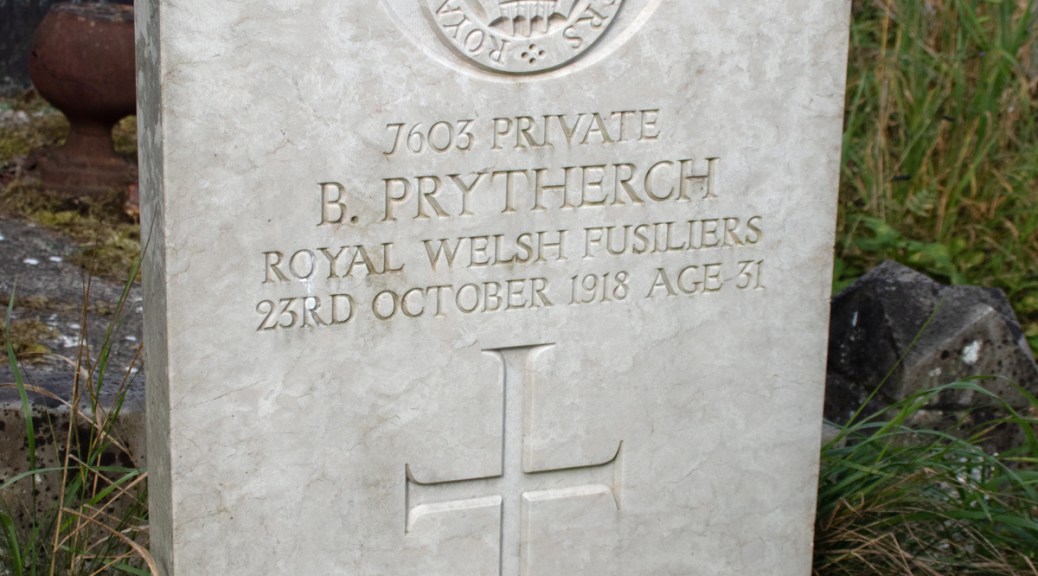
At this point, Benjamin’s trail goes cold. He returned home, but it is unclear whether he was able to work again. All that can be confirmed is that by October 1918 he had contracted pulmonary tuberculosis. He died on the 23rd of that month in the town of Corwen, ten miles to the west of Llangollen. He may have been in respite care of some sort, as his parents were still living in Llangollen itself. He was just 31 years of age when he passed away.

Benjamin Prytherch was brought back to Llangollen for burial: he was laid to rest in what became the family plot in the town’s Fron Cemetery.


Driver James Roberts

Driver James Roberts

James Roberts was born in 1885 in Llangollen, Denbighshire. The youngest of three children, he was the son of Elias and Winifred Roberts. Elias was a builder’s labourer and, while James initially went into this line of work when he left school, by the time of the 1911 census, he was listed as being employed as a gamekeeper.

War broke out across Europe, and James was there to play his part for King and Country. Full details of his military service are not available, but he enlisted in the Royal Field Artillery, and was assigned to C Battery of the 161st Brigade. This was a Howitzer unit, and, as a Driver, James would have been involved in leading the horses pulling the cannons to where they needed to be.

There is no actual confirmation that James served overseas. He was, however, awarded the Victory and British Medals for his service. Driver Roberts survived the war, but again, details of what actually happened to him are lost to time.

What can be confirmed is that, by 1919, James had been admitted to the Wharncliffe War Hospital in Sheffield, and this is where, on 27th November that year, he passed away. He was just 34 years of age.

James Roberts was brought back to Llangollen for burial. He was laid to rest in the town’s Fron Cemetery.


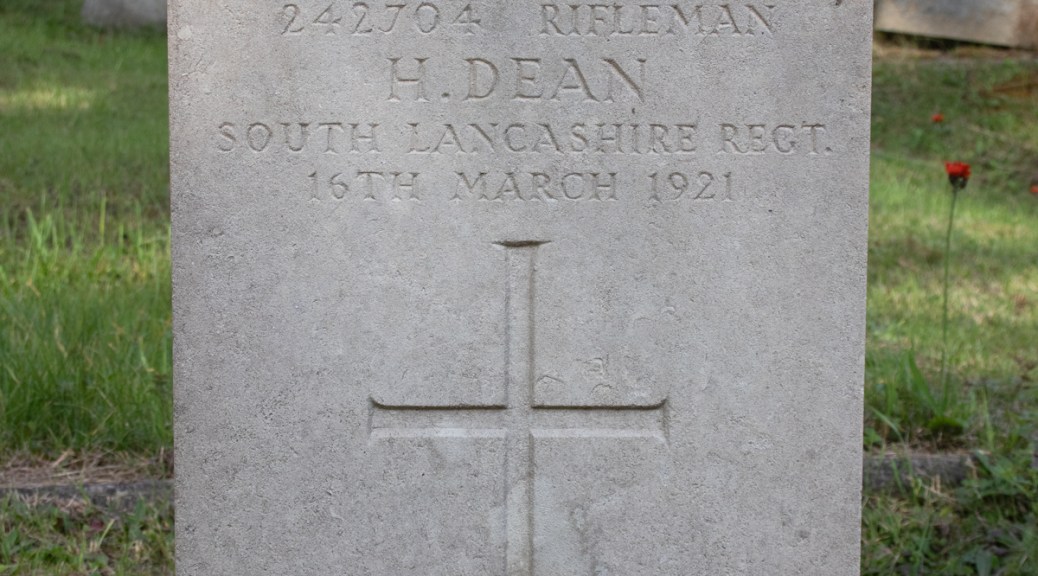
Rifleman Harold Dean

Rifleman Harold Dean

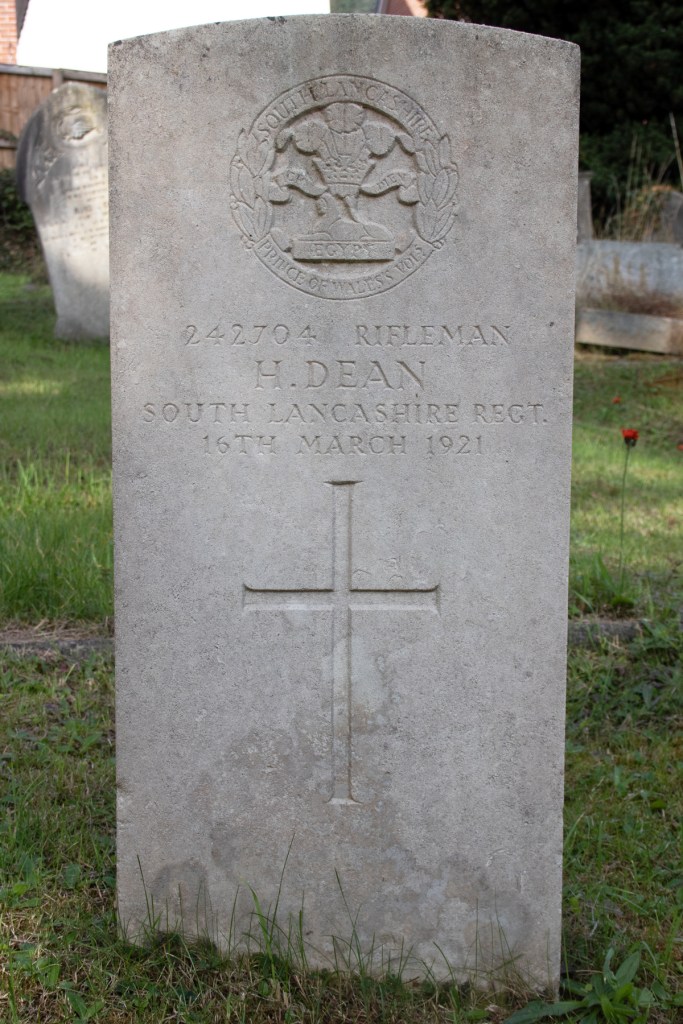
Harold Dean was born in the spring of 1888 in Llangollen, Denbighshire. One of four children to John and Sarah Dean, his father was a waiter at the Hand Hotel in the town until his death in 1905. When Harold left school, he was taken on by the hotel, and, by the time of the 1911 census, was recorded as working as a billiard marker.

War was coming to Europe by this point and, on 24th October 1916, Harold enlisted. He joined the South Lancashire Regiment (also known as The Prince of Wales’s Volunteers) and was assigned to the 2nd/5th Battalion.

After an initial few months’ training, Private Dean was sent to France, and was soon ensconced on the Western Front. Caught up in the fighting, he received a gun shot wound to his left wrist on 7th June 1917 and, after some initial treatment in a camp hospital, he was evacuated to Britain for full recuperation.

Harold remained on home soil for the remainder of the year, He contracted tuberculosis that winter and was medically discharged from the army because of it on 5th December 1917.

At this point, Harold’s trail goes cold. He returned to Llangollen, and remained there after his mother passed away in 1919. It appears that his lung condition continued to dog him, however, and this was probably the cause of his untimely passing. He died on 16th March 1921, at the age of 33 years old.

Harold Dean was laid to rest in Fron Cemetery, in his home town of Llangollen.


Rifleman Joseph Collins

Rifleman Joseph Collins

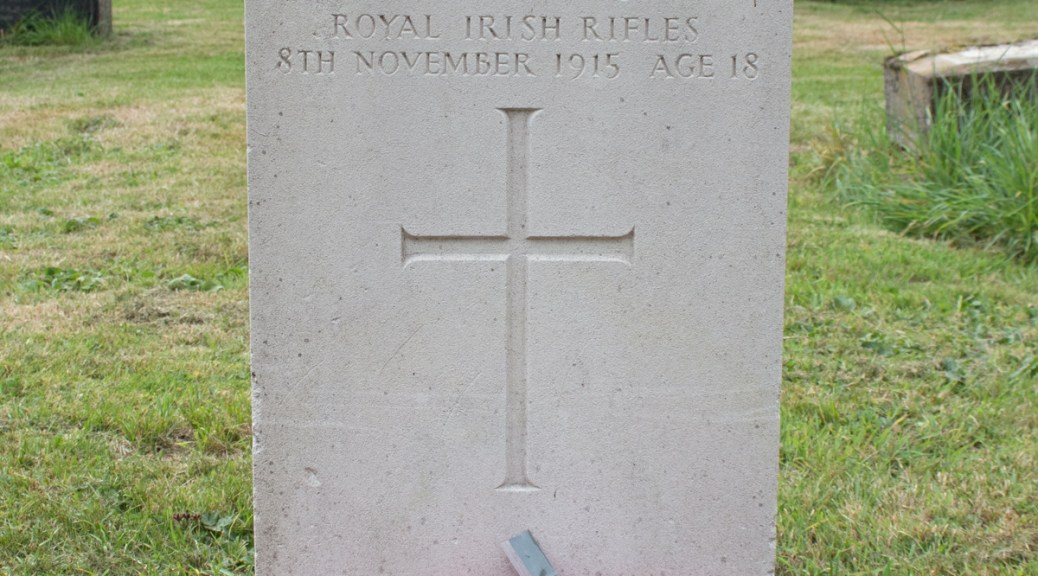
Much of Joseph Collins’ life is destined to remain a mystery. He was born in Northern Ireland on 8th November 1897, and was the son of William and Minnie Collins, who lived near Lurgan, in Armargh.

When war broke out, Joseph enlisted, joining the 16th (Service) Battalion – the 2nd County Down Pioneers – of the Royal Irish Rifles. Formed in Lurgan, the regiment moved from Northern Ireland to Seaford in East Sussex in July 1915. By that October, Rifleman Collins found himself on the Front Line in Northern France.

Joseph was invalided on 26th October, and medically evacuated to Britain for treatment. Admitted to the Brynkinalt Hospital in Chirk, Denbighshire, he was operated on, but this was to prove insufficient, and he passed away from his injuries on 8th November 1915 – his eighteenth birthday.

Rifleman Collins was well thought of in his regiment, as the comments in the Lurgan Mail [Saturday 20th November 1915] confirmed. Captain HF Sheppard, who commanded Joseph’s Company, noted “I need hardly say I was shocked, as I thought when he left us that the operation necessary for his complaint was certain to prove successful. I had always been attracted by his cheerful temperament, and I was always keenly interested in him as he was one of the first to join my Company.

Lieutenant E Somerfield noted that Joseph “was a great favourite with the rest of his platoon, and a boy I had great regard for. I can assure you we all feel his loss very keenly.

The most touching comments, however, come from one of Joseph’s colleagues, Rifleman R McKeown: “I am sending you these few lines to let you know I got a letter today which Joe wrote before he died. The nurse found it in his locker and sent it on to me I am sending you a copy of it and the nurse’s letter. I was never so badly struck in my life as when I heard of his death, for his could not have grieved me more has it been my own brother. The day he went away I never got bidding him good-bye, for the morning he went on the sick list I was on parade, and when I came in he was away. The boys in the platoon and company he was in were all greatly grieved at hearing about his death. You have my sincerest sympathy in your trouble. I don’t know how I am ever going to go home – if I ever do – without him. He was like a brother to me.

Unable to bring their son back to Ireland, William and Minnie had to be content with the fact that their son was given a military funeral in the town where he died. Joseph Collins was laid to rest in the graveyard of St Mary’s Church in Chirk.


Sapper James Tod

Sapper James Tod

James Tod was born in the spring of 1891 in Chirk, Denbighshire, and was one of nine children. His parents were builder John Tod, who was from Scotland, and Margaret Tod, who had been born in Llangollen.

John passed away when James was in his teens and, when he left school, James found work as a joiner to help support his mother financially.

When war came to Europe, James was called upon to play his part. Full details of his military service are not available, but he had enlisted by the beginning of 1917. James joined the Royal Engineers as a Sapper, and was assigned to the London Electrical Engineers.

It is unclear whether Sapper Tod served overseas, but he certainly would have been based in the London area, carrying out repair works as needed. The London Electrical Engineers were also pioneers in the use of searchlights to spot enemy aircraft and Zeppelins raiding the capital. A detachment was also sent to France to position and man searchlights on the Western Front, although, again, it is not clear whether James was one of those involved.

It is clear that James was back in Wales at the start of 1917, however, as, on 18th January, he married his sweetheart, Emily Mary Edwards, at the parish church in his home town. Emily was the daughter of a gamekeeper from nearby Pontfadog, but it was in Chirk that the coupler were to make their home.

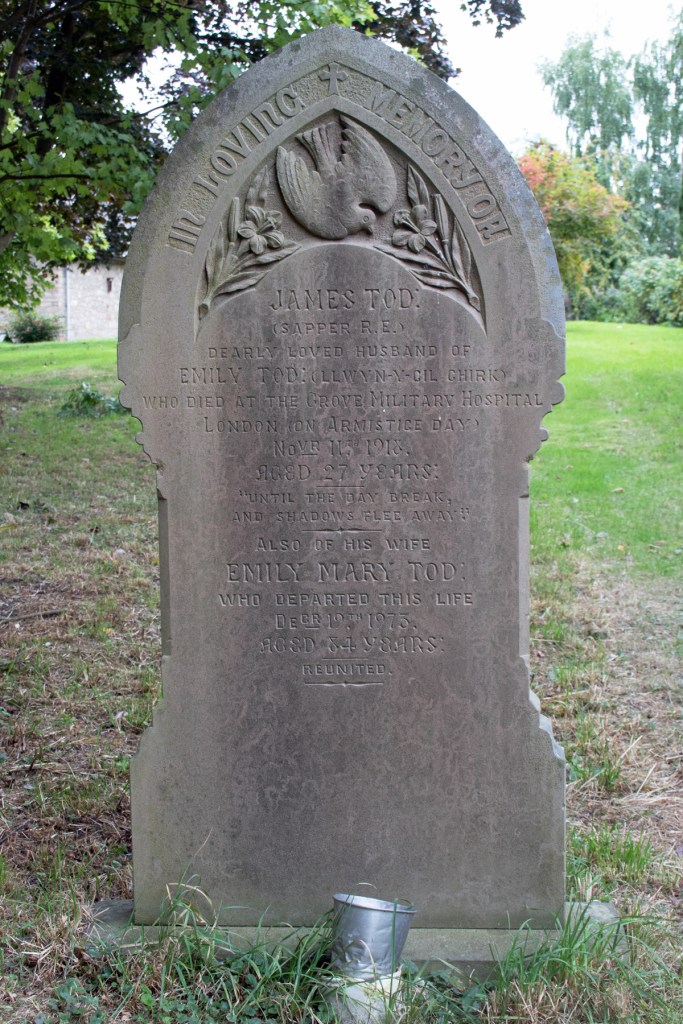
Sapper Tod was soon back on duty, however, and the next evidence available for him is that of his admission to the Grove Military Hospital in Tooting, South London. He had contracted a combination of influenza and pneumonia, and these lung conditions were sadly to get the better of him: he passed away on Armistice Day, the 11th November 1918. He was just 27 years of age.

James Tod was brought back to Wales for burial. He was laid to rest in the family plot in the graveyard of St Mary’s Church in the town.


It seems that James had been in some debt when he passed, as some of his war pension was held over to cover those costs.

Tragically, Emily was five months pregnant when James died. She gave birth to a son, who she named after his father, on 9th March 1919.

Emily never remarried, and, by the time of the 1939 Register for England and Wales, was recorded as the Lodgekeeper for Deer Park Lodge, which was attached to Chirk Castle. She passed away on 19th December 1973, at the age of 84 years old. She was laid to rest with her late husband, a couple reunited at last after more than five decades.

James Jr lived a long life, passing away in the spring of 1999, in his eightieth year.