Tag Archives: India

Major Thomas Clark

Major Thomas Clark

Thomas James Clark was born in Worcester at the beginning of 1853, the oldest of two children to James Clark and his wife Sarah. James was an engine smith and gas fitter, and moved the family with his work, initially to London, then on to the Kent coast.

Documentation relating to Thomas’ early life is difficult to track down; the 1871 census has him listed as a gas fitter like his father, but it is likely that he enlisted in the army fairly shortly after this date.

In 1875, he married a woman called Emily Ann. There life was to take on a grand new adventure as their first child, a boy named after his father, was born in Bombay, India, later that year.

It seems likely that it was Thomas’ military service that took the young family overseas. This was to be the case for at least a decade, as Emily gave birth to four further children in India. James, their fifth child, was born in Bombay in 1884. Their sixth, and last child, Ellen, was born in Gillingham, Kent, ten years later.

Given that the standard time for military service was twelve years, it is possible that Thomas served all of that time overseas, returning to England in around 1887.

Back home in Kent, Thomas is given the commission of Quartermaster in November 1897. By this point, he has been in the Royal Engineers for just under 21 years. He and his family are living in central Gillingham, within easy walking distance of the Royal Engineers Barracks and School of Engineering.

The 1901 census also lists Thomas as Quartermaster for the regiment, while three of his sons are by this time working in the Naval Dockyard as shipwrights and engine fitters.

Ten years later and the family are still living in the same house. By now, and aged 57, Thomas is recorded as a Retired Captain and Quartermaster for the Royal Engineers. He and Emily have been married 36 years, and their three youngest children (now aged 29, 26 and 17) are still living with them.

War was looming by now, although, age 61 when it broke out, it is unlikely that Retired Quartermaster Clark would have been involved in any front line activity. While no military records survive for Thomas, it seems possible that he may have been recalled for a training or administrative role at the barracks nearby.

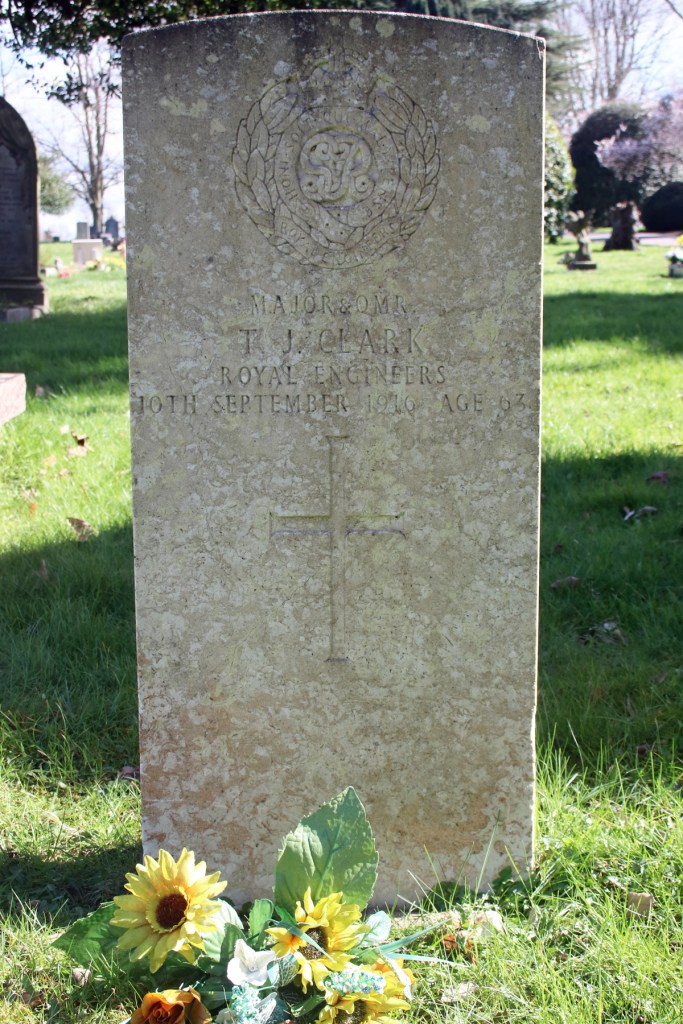
Any re-commission would not have lasted for long, however, as Quartermaster Clark passed away at home on 10th September 1916. He was 63 years old.

Thomas James Clark lies at peace in the Woodlands Cemetery in Gillingham, Kent.


Thomas’ widow, Emily, passed away just two years after her husband. She was also laid to rest in the Woodlands Cemetery.

Thomas left his estate in the hands of his youngest son, James, who was still living at his parents’ home when they passed away.


Private Albert Bellringer

Private Albert Bellringer

Albert George Bellringer was born in April 1889, the youngest of three children to Charles and Sarah. Charles was a sawyer in a local timber yard, and his son followed suit.

Little detail of Albert’s early life remains, but he married Elizabeth Burge in December 1909, and the couple went on to have three children – Albert Jr, Cecil and Charles.

Albert enlisted when war appeared inevitable, joining the Somerset Light Infantry in June 1914. When his training was complete, his troop – the 2nd Battalion – were shipped off to India, and this is where Private Bellringer spent the majority of the war.

Distance from home and family made some soldiers act in ways they otherwise wouldn’t. On 15th August 1917, Albert was admitted to hospital with a venereal sore. He was then admitted to the Dinapore (now Danapur) Station Hospital on 2nd December 1917, “in a very excited condition. He was childish, silly and had grandiose delusions”.

Things were not going well for Private Bellringer’s health. He was transferred back to England for treatment on the Hospital Ship Wandilla – this was torpedoed on the journey home, although the device failed to explode. While on board, he was seen to be “exalted in his ideas, and to have physical signs of GPI [General Paresis (or Paralysis) of the Insane]”.

The ship arrived back in England on 25th April, and Albert was admitted to the Royal Victoria Hospital in Netley, Hampshire. The medical report again showed that “he was foolish, demented and [that] the physical signs of GPI were marked.”

Moved to Dykebar Hospital in Paisley – a mental health institution – for specialist attention, Private Bellringer was eventually discharged from the army. Medical grounds were the reason for his dismissal, and his last day of service was 5th July 1918.

Sadly, however, Albert’s health faltered; he was transferred again, this time to the Somerset and Bath Asylum in Somerset, and it was there that he passed away. Albert George Bellringer died on 5th December 1918; he was 30 years old.

Albert lies at rest in the Wembdon Road Cemetery in his home town of Bridgwater.


So, what was the cause of Albert’s illness and death? His initial hospital admission identified a venereal sore, and, based on his subsequent decline, it is likely that this was syphilis. One of the last symptoms of the disease is mental illness – insanity – and so this underlines the probably diagnosis.

However, mental illness only usually appears on average 10 to 30 years after the STI is first contracted, and then only if it is not treated (which, given that this would have been Victorian England, is it likely not to have been).

What this suggests, therefore, is that Albert contracted syphilis before the war, probably before his marriage to Elizabeth, and he may not have been unfaithful while serving in India.


Private Ernest Austin

Private Ernest Austin

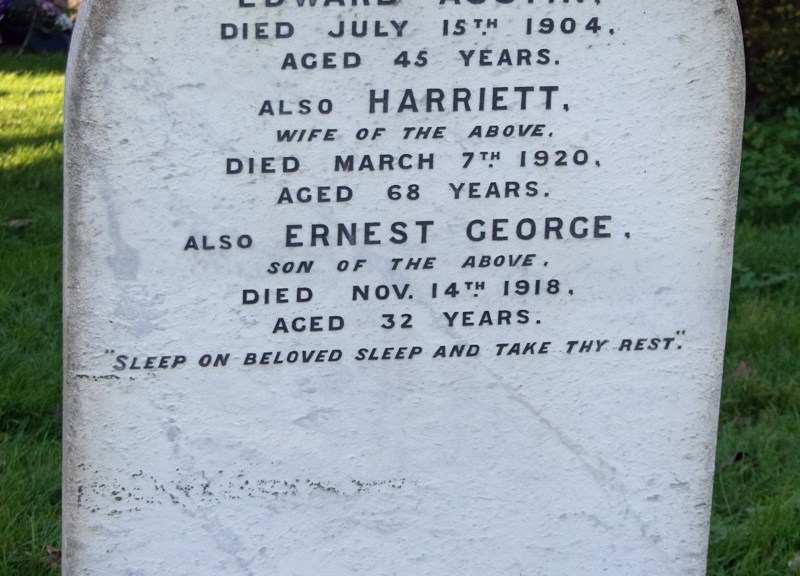
Ernest George Austin was born in early 1888, one of four children – all boys – to Edward Austin and his wife Harriett. The Austin family lived in the village of Cliffe, in the North Kent countryside, where Edward was a carpenter.

Ernest’s older brother Edward worked as a telegram messenger when he left school, and Ernest followed suit, becoming a postman by the time of the 1911 census. The four boys all lived with their now-widowed mother, their father having died seven years earlier.

Duty soon called, however, and Ernest enlisted in July 1916, joining the Army Service Corps. After training in England, he was shipped overseas that autumn.

Private Austin was discharged from the army just over a year later, and the medical report from that time sheds a lot more light onto this young man’s life:

Father [Edward] died of “consumption”.

Has had a chronic cough since a boy. Developed tubercle of lung in 1907. Went to Chile same year, where all symptoms disappeared. Put on weight and lost his cough completely. Returned to England and joined Army July 1916.

Has been in Mesopotamia three months. Cough has returned. Lost weight. Night sweats. Admitted to [military hospital] with sore throat; TB found present.

Admitted to this hospital 14th June 1917 with above symptoms. High temperature, evidence of infection.

In my opinion, the relighting of a latent infection is entirely attributable to active service in Mesopotamia.

Private Ernest Austin’s medical board record, 23rd Jun 1917

Ernest had been hospitalised in the Cumballa War Hospital, Bombay. He was sent home and ultimately discharged from active service on 8th October 1917.

Demobbed, Ernest married Antoinette Gurton at the start of 1918. The marriage was to be short-lived, however, as Ernest appears to have finally succumbed to his illness less than a year later.

Private Ernest Austin passed away on 14th November 1918. He was 31 years old. He lies at rest in the graveyard of St Helen’s Church in his home village of Cliffe, Kent.