Tag Archives: Iraq

Private Walter Lane

Private Walter Lane

Walter Frederick Lane was born in Sidcup, Kent, in the early part of 1893. The younger of two children, his parents were Frederick and Caroline Lane. Frederick was a carman and the transient nature of his work meant that the family moved on a regular basis.

The 1901 census found them in Eltham, Kent, while ten years later the family of three – Walter’s older sister having moved on – were boarding in Harton Street, Deptford. By this point, Walter was 17 years of age, and he was also working as a carman. (It is interesting to note that the earlier census recorded Walter’s parents by their first names, while the 1911 document used their middle names – Walter and Kate: transient work allowing for reinvention, perhaps?)

Walter sought a more permanent career, and, on 17th March 1913, he enlisted in the army. Full details of his military career have been lost to time and, in fact, most of his service details come from his discharge papers.

Walter enlisted in the Queen’s Own (Royal West Kent Regiment), although, as Private Lane, he was not formally mobilised until March 1914. When war broke out, his battalion, the 1st/5th, was sent to India, and he remained there for the duration of the war.

Private Lane’s time in the army was not without incident. He contracted malaria in 1915, and while he initially recovered, the condition was to continue to dog him over the following years.

By 1917 Walter’s troop was based in Jabalpur, Madhya Pradesh, but in December that year, the battalion set sail from Bombay for Basra, Mesopotamia.

While in Iraq, he had a couple of run-ins with his superiors. On 22nd December 1917 he was stopped a week’s pay for ‘disobeying an order: putting his equipment on a transport waggon’ and ‘losing by neglect his equipment.’ On 18th February 1918, a further 28 days’ pay was deducted for ‘making away with regimental necessaries (1 towel)’ and ‘neglecting to obey an order.’

During this time, though, Walter’s health was regularly impacted when malaria caught up with him. His discharge documents recorded that he had an attack about once a month, which lasted four or five days each time. In the end, he was released from active service, and left the army on 19th February 1919.

Walter had been discharged while admitted to the Dispersal Hospital in Brighton. His health did not improve, however, and he was soon moved to Somerset for respite care. It was here that he passed away on 7th August 1919. He was 26 years of age.

Walter Frederick Lane was laid to rest in the Holy Trinity Churchyard, Newton St Loe, Somerset.


My thanks go to Liz at the local parish office for her help in unpicking the details of Walter’s passing.

Thanks also go to Tim Hill, who has been researching the graves in the Newton St Loe churchyard.


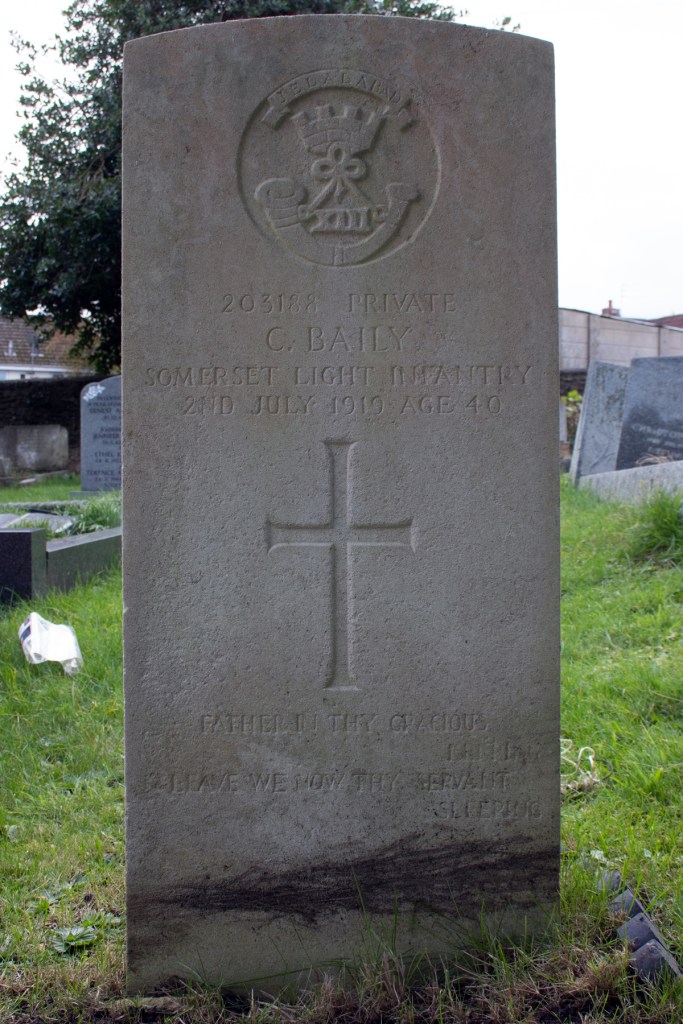
Private Charles Baily

Charles Baily

Charles Baily was born in Frome, Somerset, in March 1879; he was the middle of three children to Charles and Sarah Baily. Charles Sr was a plasterer, and the family were raised in a small cottage to the south of the town centre.

When Charles Jr left school, he found work as a carpenter and, on 17th March 1902, he married local woman Fanny Howell. Her father was a carter and she had not long returned from South Wales, where she had found employment as a parlour maid. Charles and Fanny set up home just three doors down from his parents, and went on to have five children.

War was coming to Europe, but the details of most of Charles’ military service are lost. He enlisted as a Private in the Somerset Light Infantry, and was assigned to B Company of the 1st/4th Battalion. The troop was sent to Bombay in the autumn of 1914; it then moved to Basra in the spring of 1916, remaining in Mesopotamia for the remainder of the conflict. Sadly, it’s not possible to know how much of this travel Private Baily undertook himself.

Charles survived the war, and was demobbed soon after the Armistice. He returned home, but his time back with his family was to be short: Private Baily died at home through causes lost to time on 2nd July 1919. He was 40 years old.

Charles Baily was laid to rest in the graveyard of Holy Trinity Church in his home town of Frome.


One sad aside to the story is that Charles and Fanny’s oldest child, daughter Frances Baily, had passed away in the summer of 1917. The cause of her passing is also lost to history, but she was just 16 years old when she died.


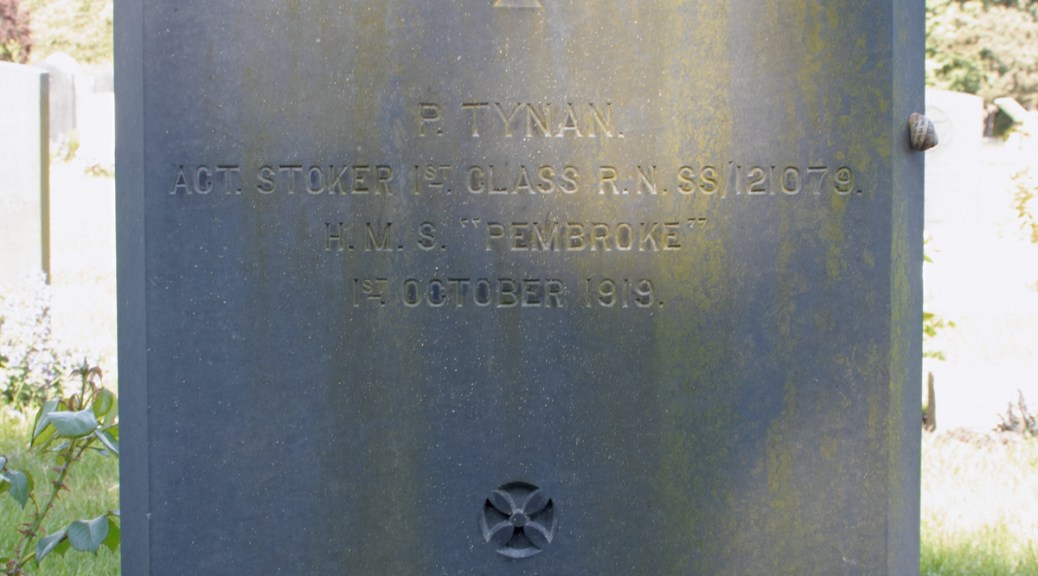
Stoker 1st Class Patrick Tynan

Stoker 1st Class Patrick Tynan

Patrick Tynan was born in Roscrea, Southern Ireland, on 9th June 1893. He was the eldest of four children to John and Anne Tynan, but sadly, there is no further information available for his early years.

Patrick’s story really picks up on 14th December 1915, when he joined the Royal Engineers as a Private. His service record states that he was living in Bangor, Gwynedd, and that he was a stall keeper at a fairground – a subsequent document noted his trade as a showman. He was noted to be 5ft 8ins (1.72m) tall, weighed 151lbs (68.5kg), and had numerous scars on his back.

Private Tynan did not stay in the UK for long. Assigned the new role of Driver, he was attached to the GHQ Signal Company and sailed from Devonport on 30th June 1916, bound for Mesopotamia. Arriving in Margil – the port connected to Basra – he was based here for more than a year, before moving north to Baghdad.

By this time, Patrick had risen to the rank of Lance Corporal, and was obviously a trustworthy member of the company. Towards the end of 1917, he had again been promoted, this time to Corporal.

During his time in modern day Iraq, Patrick was admitted to hospital a handful of times; there is little information on the conditions he suffered, but none appear to have been life threatening, as they were only for short periods. It’s also interesting to find that his service records confirm a month’s leave in May 1918, spent in India.

When the war came to a close, Corporal Tynan was still in the Middle East. Ready to be demobbed, his company moved to India and boarded the SS Chupra in Calcutta on 26th February 1919, bound for home.

Back in the UK, however, Patrick was not ready to give up the formal military life. Having returned to Gillingham in Kent, where the Royal Engineers were based, he initially found work as a tram conductor, but soon signed up for a five year term with the Royal Navy as a stoker.

He was based on HMS Pembroke II, the shore-based establishment at Chatham Dockyard, but sadly, his time in the navy was to be a short one. Admitted to the Royal Naval Hospital in the town with pneumonia, he passed away form the condition on 1st October 1919. He was just 26 years old.

Patrick Tynan was laid to rest in the Woodlands Cemetery in Gillingham. He had a short but full life, something his modest gravestone doesn’t begin to hint at.