Tag Archives: Spanish Flu

Lance Corporal Charles Stubbles

Charles Frederick Stubbles was born in Tottenham in 1892. One of eleven children to Richard and Mary Ann Stubbles, by the time of the 1911 census, the family were living in Edmonton. Charlie and his brother had found employment painting gas stoves, while his father was a building foreman.

Charles enlisted in the army in 1916, aged 25 years and 11 months. His service records show that he stood at 5ft 2ins, weighed in at 69lbs; his health was classified as C2 – Free from serious organic diseases, able to stand service in garrisons at home, able to walk 5 miles, see and hear sufficiently for ordinary purposes.

Joining the Labour Corps of the West Surrey Regiment, Private Stubbles initially served on the home front, before being transferred to France as part of the British Expeditionary Force in March 1917.

Charlie seems to have been a bit of a character and was pulled up a few times during his service. On 10th April, he was charged with “committing a nuisance in the barrack room”, for which he was confined to camp for eight days. On 21st August he went AWOL for nearly a day; he was docked eight days’ pay. On 28th October he appeared unshaven and dirty for the 7:15am parade; he was confined to barracks for seven days.

On 4th January 1918, Charles was admitted to a field hospital with diarrhoea; while there he was diagnosed with tuberculosis; he succumbed to this two days later, dying on 7th January 1918. He was 26 years old.

Lance Corporal Charles Stubbles is buried at the Haringhe Bandaghem Military Cemetery in Poperinge, Belgium.


Charles Frederick Stubbles was my great great uncle.

Boy 2nd Class Sidney Stagg

Boy 2nd Class Sidney Stagg

Sidney Herbert Stagg was born in 1901. The eldest child of bootmaker Sidney Stagg and his wife Frances, Sidney Jr was too young to fight in the when war broke out.

He enlisted in the Royal Navy at the beginning of 1919, and was assigned to HMS Powerful, a training vessel based in Plymouth.

Boy Petty Officer Stagg’s time in the navy was heartbreakingly short. Within a few weeks he had contracted pneumonia and succumbed to the disease on 27th February 1919. He was just 17 years old, and had been in service for 36 days.

The Western Gazette reported on his funeral:

[He] left Sherborne just over a month ago to join the Royal Navy, a career for which he had expressed a great liking, and was attached to HMS Powerful, being made Boy PO within a fortnight of his joining that ship. A short time afterwards he contracted influenza, and pneumonia supervening, he died on Thursday at the Royal Naval Hospital, at Plymouth.

A service was held in the Congregational Church, and continued at the graveside, where three volleys were fired by a firing party of the Volunteers [the Sherborne Detachment 1st Volunteer Battalion, Dorset Regiment], and buglers sounded the last post. The Rev. W Melville Harris (uncle of the deceased) officiated, and the principal mourners were Mr Stagg (father), Miss Joyce Stagg (sister), Mr H Hounsell (uncle), and members of the business establishment.

Western Gazette: Friday 7th March 1919.

Sidney Herbert Stagg lies at peace in the cemetery in his home town of Sherborne.

Petty Officer Stoker Frederick Cheal

Petty Officer Stoker Frederick Cheal

Frederick James Cheal was born in Reigate, Surrey in July 1880. One of six children, his father Francis was an agricultural labourer and cowman, while his mother Ann looked after their children.

While born in the landlocked Home Counties, Frederick appeared to be drawn to a life on the open seas. He enlisted in the Royal Navy on 26th October 1897, for a period of 12 years.

Stoker Cheal served his time on a number of vessels over that time, ships with names like Hannibal, Warrior and Furious. Having completed his service, Frederick was discharged on 28th October 1910.

Frederick’s wanderlust remained, though, and it appears that his discharge was more of transfer. He immediately enrolled in the fledgling Canadian Navy for a period of five years, dividing his time between land-based instruction and service on the HMS Niobe.

War broke out, and Stoker Cheal’s service was extended beyond the initial five-year term. Again, rather than his service coming to an end, he transferred back to the Royal Navy in August 1916.

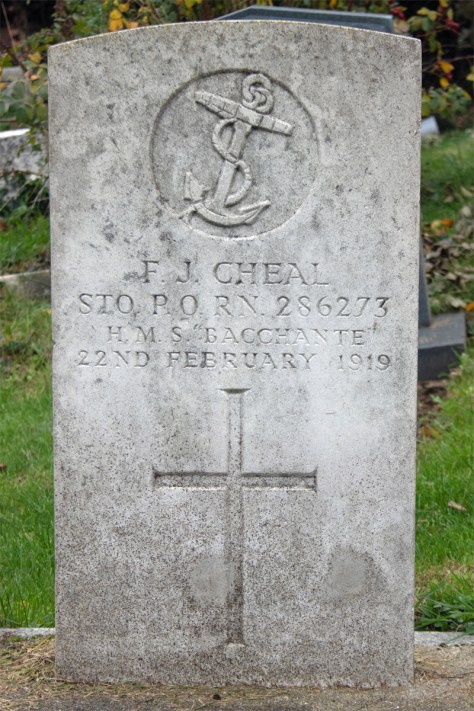
Promoted, Petty Officer Stoker Cheal was assigned to the HMS Bacchante, an armoured cruiser that served as an escort to the British convoys off the African coast.

Frederick was admitted to the Royal Naval Hospital in Chatham, Kent, in early 1919 with influenza and pneumonia. He passed away on 22nd February, aged 38.

He lies at rest in the graveyard of St Margaret’s Church in Rainham, Kent.


Here is where a mystery lies. There is no discernible link between Frederick Cheal and Rainham, other than that is where his widow lives.

A lot of Rose Anne Cheal’s life is sadly lost to time. There are no marriage records to link her to Frederick, and I have been unable to identify her maiden name or whether she was even English (the couple could easily have met during Frederick’s time in Canada).

From her later records, it is evident that she lived in Rainham, just around the corner from the church where her husband is buried. The 1939 register confirms that she was a couple of years older than Frederick; she was born on Christmas Eve 1878. The register also confirms that the couple had two children, Francis, who was born in 1914, and Kathleen, born two years later.

Some mysteries are not meant to be solved; Frederick lived a full life on the open seas, spending 22 years serving two navies. He died in the same way as many other returning soldiers and sailors, a victim of the Spanish Flu pandemic. He left a wife and two young children, a sad tale repeated countless times across the continent.

Stoker Wilfrid Baker

Stoker Wilfrid Baker

Wilfrid David Baker was born in 1889 in Upchurch, Kent. One of ten children, to Charles and Margaret Baker, he followed his father into the brickmaking industry.

When the Great War came, Wilfrid signed up, enlisting in the Royal Navy in March 1917, as Stoker 2nd Class. During his training in Woolwich, he was promoted to Stoker 1st Class, before being assigned to the HMS Columbine naval base in Scotland.

During his work there, Stoker Baker came down with influenza and was transferred to the HMHS Garth Castle hospital ship. Wilfrid’s illness developed into pneumonia, and he passed away on 20th October 1918. He was 29 years of age.

Stoker 1st Class Wilfrid Baker is buried in the churchyard of St Mary the Virgin in his home village, Upchurch.

Driver Harry Austin

Driver Harry Austin

Harry Austin was born in the small Kent village of Bobbing in 1890. One of nine children to Richard and Emma Austin, his father was the village blacksmith, a trade two of his brothers followed after leaving school. Harry, however, became a general labourer in the coal industry.

Sadly, most of Harry’s wartime service is lost to time; we know that he enlisted in the Royal Field Artillery and served as a driver. The RFA was responsible for the medium-calibre guns and howitzers deployed close to the front line; Harry’s role, therefore, was likely to have involved driving the horses to and from the sites where the guns were needed.

Again, Driver Austin’s military records are somewhat lacking when it comes to his passing. However, where they mark him as ‘dead from disease’, a contemporary newspaper in memoriam gives a little more detail.

In ever loving memory of Driver Harry Austin, RFA… who passed away November 10th 1918, in the 1st Southern General Hospital, Birmingham, from influenza following Gun Shot wounds, aged 29 years.

East Kent Gazette – Saturday 23rd November 1918.

An untimely death for Harry, but particularly poignant, given that he passed the day before the Armistice was signed.

Driver Harry Austin lies at peace in the graveyard of St Bartholomew’s Church in his home village of Bobbing, Kent.