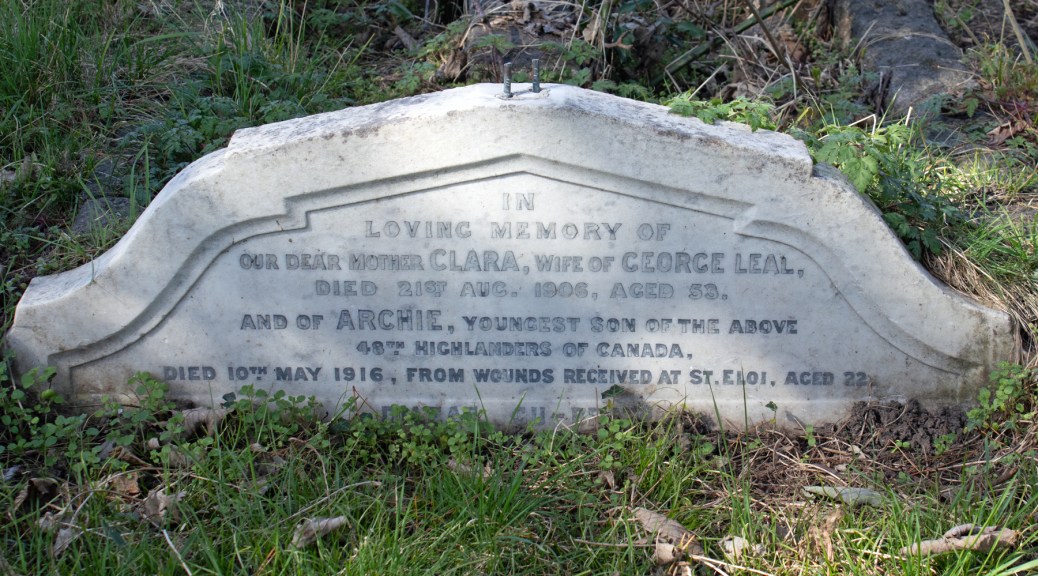
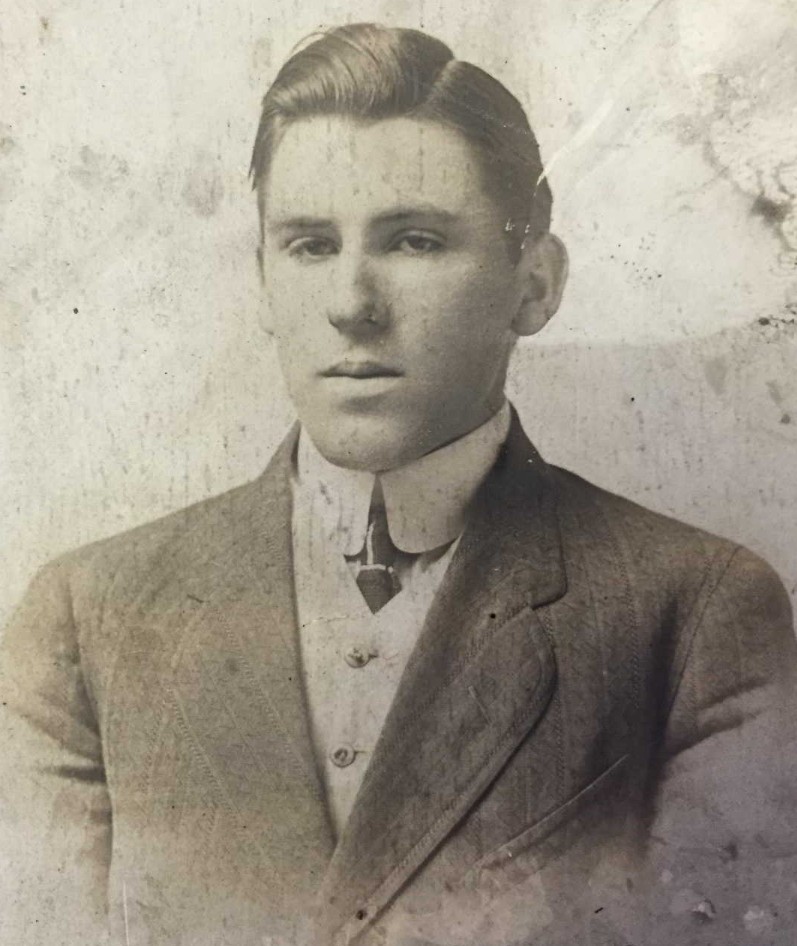
Archibald Edmund Leal was born in Tinwood, West Sussex on 13th September 1894. The youngest of six children, his parents were George and Clara Leal. George was a dairyman, and, by the time of the 1901 census, the family had moved to a terraced cottage at 66 Newland Road in Worthing.
Clara died in 1906, and Archibald – who was better known as Archie – and two of his siblings took the opportunity to seek a better life across the Atlantic. In 1910, the three of them – Archie, brother Phillip and sister Winifred – emigrated to Canada, settling in Breakeyville, to the south of Quebec.
Archie found work as a chauffeur, but when war was declared, he was quick to step up and serve his King and Empire. He enlisted on 10th September 1914, joining the Canadian Expeditionary Force as a Private. His service records show that he was 5ft 6in (1.67m) tall, with fair hair, brown eyes and a dark complexion. He was also noted as having “very many [acne] scars over [his] chest and back.”
Assigned to the 15th Battalion of the Canadian Infantry, Private Leal sailed to Britain, arriving at Tidworth Camp in Wiltshire on 12th February 1915. By April he was in France, and, on 28th July he was in a front line trench near the town of Ypres. A shell exploded nearby and, in seeking shelter, he badly twisted his ankle and back. Medically evacuated to Britain, Archie spent a month recuperating at the Royal Herbert Hospital in Woolwich, Kent, before returning to his unit in Wiltshire.
By December 1915, Private Leal was back on the Western Front and remained there for the next five months. In April his unit was on the front line, and he was injured in his right leg when a rifle grenade exploded. Archie was initially treated by a field ambulance, but his injury was such that evacuation to Britain was again necessary. He was admitted to the County of London War Hospital in Epsom, Surrey, but had contracted tetanus by this point. This was to prove fatal, and his body succumbed on 10th May 1916: he was 21 years of age.
The body of Archibald Edmund Leal was taken back to Worthing for burial. He was laid to rest with full military honours in the town’s Broadwater Cemetery. A local newspaper reported that “Private Leal, although not a Canadian, was possessed of true Colonial grit, and had had his full share of active service.” [Sussex Daily News: Wednesday 17th May 1916]
Reginald Cuthbert Langford was born in Frome, Somerset, in the spring of 1899, the youngest of thirteen children to Albert and Charlotte Langford. Albert was a chalk seller turned jobbing gardener, who, by the time of the 1911 census, had moved the family to Bath.
Reginald appears to have helped his father with his work when he finished his schooling, but, during the First World War, he enlisted in the Royal Engineers as a Driver. His service records no longer remain, but a later newspaper report shed some light onto his time in the army: “[He] enlisted when he was just over 16, and went to the Wessex Engineers to Salonica. He returned to England and then went to France with the Glamorgan Engineers.” [Bath Chronicle and Weekly Gazette: Saturday 16th October 1920]
All did not fare well for Driver Langford: he contracted malaria and dysentery, and a combination of the conditions led to his ultimate discharge from the army. He left the Royal Engineers on 24th June 1919, and returned home to Somerset.
When he had recovered his health, Reginald took up employment as a gardener once more. On September 1920, he was in the employ of a Mr J Milburn, in Bath, when he felt a nail drive through his boot, scratching his foot. The following Tuesday, he visited his doctor – a Mr John Jarvis – complaining that his malaria had returned. According to a later inquest:
[He] did not make any mention of a wound in the foot. On Thursday, at about 10 o’clock, [Jarvis] was asked to go and see Langford, who was in bed. He was covered with a cold sweat, he could speak only with difficulty, and complained that he could not swallow anything, especially the medicine… His limbs were rigid, but he had not all the symptoms of tetanus. [Jarvis] decided to send Langford to the hospital at once, suspecting that he was suffering from tetanus. He did not know till later that there was an injury to [Reginald’s] foot.
Bath Chronicle and Weekly Gazette: Saturday 16th October 1920
Reginald’s landlady, Amelia Baily, also gave evidence at the inquest:
Langford had lodged with her for about nine months. His inly complaint was of his head when he had malaria… He came home saying his foot was sore and that he had thought it was gathering. He had hot water to soak it, and he did the same the next night, an afterwards sad it was alright… he went to work, but returned at dinner time again complaining of his head and perspiring terribly. He was ill and witness looked after him during the night. He complained of pains in the stomach and aid they were going up to the throat. Next morning [Amelia] sent for the doctor.
Questioned as to the injury to Langford’s foot, [she] said he told her he had a nail enter the toe while he was in the army, and that it was festering again. He wad worn the army boots up to just before he became ill, when he bought new ones.
Bath Chronicle and Weekly Gazette: Saturday 16th October 1920
Admitted to the Pensions Hospital, Bath, Reginald was to be there only one day. He passed away on 8th October 1920, aged just 21 years old. Medical evidence at the inquest diagnosed tetanus as the cause of his death, but Reginald’s older brother, George, contested this.
George’s challenge was that, having some medical background, he felt that his brother’s death was caused not by tetanus, but by malaria. He was a sufferer himself, and he knew the symptoms. He had examined Reginald’s body, and could not see how the small scratch on his foot could have induced tetanus to the extent of causing his brother’s passing.
The Coroner at the inquest, a Mr F Shum, declined George’s assertion, on the basis that separate medics had determined tetanus as the cause:
“It may not have been from the foot, but the evidence is clear. Dr Jarvis said he formed the opinion before any suggestion was made to him, that the man was suffering from tetanus. He saw the symptoms, and the man was brought here [to the Pensioner’s Hospital]. Two doctors saw him here and came to the same conclusion, and a medical specialist confirmed the diagnosis. Therefore, it is quite clear to me, and my verdict will be that he died from tetanus. It is a very unfortunate thing, and I am sorry for you.
Bath Chronicle and Weekly Gazette: Saturday 16th October 1920
George’s challenge was as much about the financial aspect as it was his late brother’s wellbeing. Had Reginald’s death been the result of malaria, it could have been attributable to his military service, and therefore any funeral costs – or at least a proportion of them – would have been paid for by the army. As the inquest had identified tetanus as the cause of his passing, however, the family would have to pay for the burial themselves.
Following the inquest, Reginald’s funeral was held: he was laid to rest in the sweeping Locksbrook Cemetery, Bath, not far from where his bereaved family still lived.
There are two other intriguing aspects of Reginald’s case.
The first is that of his being awarded a war grave. Amongst other criteria, which can be seen here, the Commonwealth War Graves Commission (CWGC) are responsible for the commemoration of personal who died after they were discharged from a Commonwealth military force, if their death was caused by their wartime service.
Based on the inquest, Reginald’s passing was clearly not – the tetanus having come on after his medical discharge for malaria and dysentery. Technically, therefore, his should not be designated a war grave.
The second confusing thing is that of the date on Reginald’s headstone. The CWGC headstone gives the date of his death as 13th October 1920, as do his grave registration documents. While newspaper reports are not always a reliable source of information, the first media report of the inquest came on Tuesday 12th October.
The Bath Chronicle and Weekly Gazette article confirms that Dr Jarvis’ visit to Reginald was on Thursday 7th October. He was admitted to hospital straight away, “where he died the following day” [Bath Chronicle and Weekly Gazette: Saturday 16th October 1920]. This would suggest that Reginald died on Friday 8th October.
While the newspapers do not confirm the date of the inquest, it is likely to have been held soon after Reginald’s passing. The date provided by the CWGC, therefore, looks to be either that of the conclusion of the inquest, or of Reginald’s burial.
William George MacPherson was born in the township of Greenway, Huron County, Ontario, on 24th September 1893. The eighth of nine children, his parents were farmer Edmund Macpherson and his wife, Sarah, who was better known by her middle name, Keren (short for Kerenhappuch).
Edmund was the fourth generation of the family to be born in Canada, his maternal great grandfather having emigrated from Scotland to Nova Scotia in the late 1770s. Sarah was the first generation of her family to be born in North America, her parents having moved there in the 1850s.
After he finished his schooling, William followed his father into farming. When war broke out in Europe, the Empire was called upon to serve their King. On 7th January 1916, William enlisted in the Canadian Expeditionary Force. His service records show that he was 5ft 6.5ins (1.69m) tall and weighed 150lbs (68kg). He was noted a having dark hair, brown eyes and a dark complexion.
Private MacPherson set sail from Halifax on 22nd August 1916, and arrived in Liverpool eight days later. His troop was based in Witley, Surrey, and it was here, while attached to the 125 Battalion of the Canadian Infantry, that William spent the winter.
On 23rd May 1917, Private MacPherson was transferred to the 4th Battalion, and set sail for France. He was to spend the summer at Ypres, where he encountered some of the bloodiest fighting of the conflict. William was not to be unscathed, and was wounded in his shoulder and neck on 6th November 1917.
William was initially treated at the No. 2 State Hospital at Abbeville. Dangerously ill, though, he was medically evacuated to Britain, on board the Hospital Ship Essequibo, from Le Havre to Shornescliffe. Private MacPherson was quickly moved to Somerset, and was admitted to the Bath War Hospital. Tetanus set in, and he died of his wounds on 21st December 1917. He was 24 years of age.
With his family thousands of miles away, William George MacPherson was laid to rest in the Locksbrook Cemetery in Bath, not far from the hospital in which he had breathed his last.
Bert Mayled was born in the autumn of 1889, the fourth of four children – all boys – to Benjamin and Anna Mayled. Benjamin was a butcher from Somerset, who raised his young family in the seaside town of Weston-super-Mare.
The whole family followed in Benjamin’s trade, with all four siblings supporting in one way or another, either through farm work or, in Bert’s case, becoming a butcher as well.
On 6th July 1914, Bert married Catherine Swearse, a builder’s daughter from nearby Axbridge. They married in Catherine’s local church, but settled – albeit briefly – back on the coast.
Bert may even have enlisted by the time of the wedding. While he is noted as a butcher on the marriage banns, within weeks war had broken out across Europe, and he found himself in the North Somerset Yeomanry.
Private Mayled’s regiment was one of the first into the fray – he was soon on the Front Line at Ypres. He was wounded early on, and medically evacuated to England for treatment. Admitted to the 2nd Western General Hospital in Manchester, he succumbed to tetanus, contracted from his wounds. He died on 25th November 1914, at just 25 years of age.
Bert Mayled was brought back to Weston-super-Mare for burial. He lies at rest in the Milton Road Cemetery there.
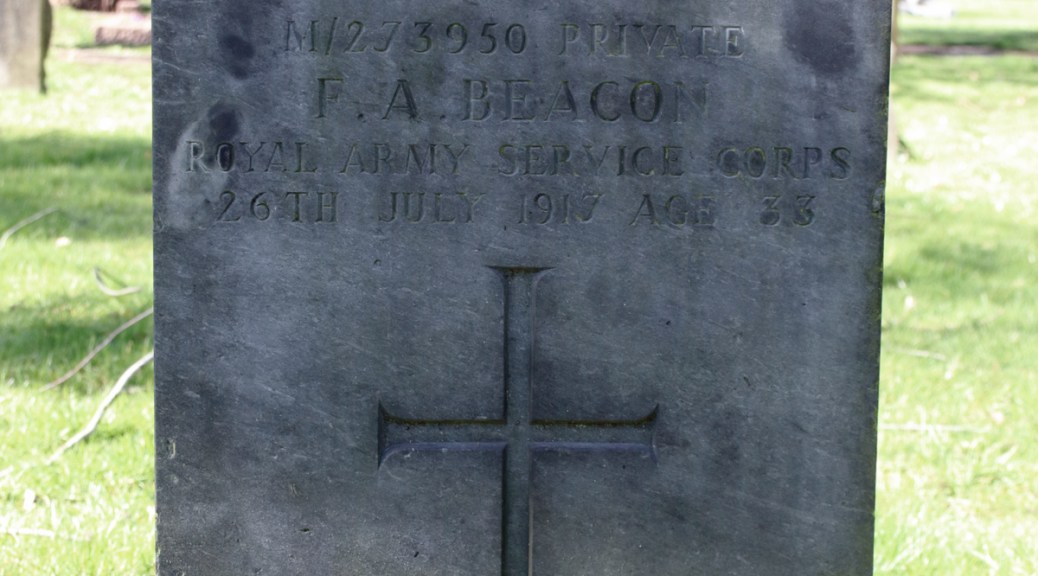
Frank Archibald Beacon was born in 27th April 1884, one of five children to William and Frances Beacon. William was a bargeman and the family lived in the village of Barrow Green near the North Kent marshes.
Tragically, William died at the age of only 36, leaving Frank without a father from the age of 2 years old. Frances found work as a charwoman, before finding love again. She married James Seager in 1895, who took in Frank and his siblings as his own.
After leaving school, Frank found work both as a builder and farm labourer and this was to stand him in good stead until the outset of war.
In January 1909, Frank married Kate Amelia Smart; she was the daughter of a victualler, and was born on Kent’s east coast, in Sandwich. The couple settled down to live in Newington, a village close to where Frank grew up, and had two children, Annie and Frank.
War was looming, and Frank enlisted. He joined the Royal Army Service Corps, working as a Private for the Mechanical Transport Company. Full details of his military service are not evident, but he was awarded the Victory and British Medals, which suggest that he service overseas at some point.
In the summer of 1917, Private Beacon fell ill, and was admitted to the Military Hospital in Boscombe. He was suffering from pleurisy and tetanus, and is was to these illnesses that he was to succumb. He passed away on 26th July 1917. He was 33 years old.
Frank Archibald Beacon was laid to rest in the Woodlands Cemetery in Gillingham, Kent, close to where he had made a new home with Kate.
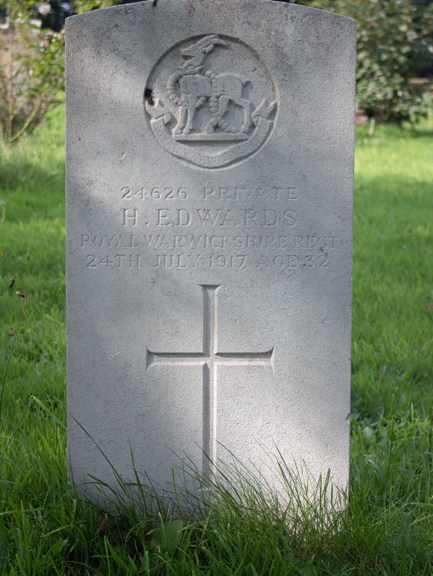
Henry Charles Edwards was born in 1883, the eldest of four children for Joseph and Elizabeth.
Joseph was an agricultural labourer, and Henry (or Harry) followed his father in the farming life, continuing in the role after Joseph died, and up until at least the 1911 census.
I was unable to find much regarding Harry’s military service. He signed up the Royal Warwickshire Regiment, and subsequently transferred to the Somerset Light Infantry.
He died from tetanus on 24th July 1917, aged 34. His pension records give his mother, Elizabeth, as his beneficiary.
Private Henry Edwards lies at rest in the churchyard of Lydeard St Lawrence, Somerset.





 Death and Service