Alfred Fear was born towards the end of 1898, the youngest of nine children to Charles and Eliza Fear. Charles was a mason from Weston-super-Mare in Somerset, who raised his family in the town of his birth.
Sadly, given his youth, there is little documented about Alfred’s early life. He was still at school at the time of the 1911 census and, while he would have found some sort of employment after leaving, there is no record of what that would have been.
Alfred’s military service records are also sparse. He enlisted in the Royal Field Artillery and was assigned the role of Driver in the 321st Brigade. While dates cannot be confirmed, he would have enlisted before the spring of 1918.
The next two documents relating to Driver Fear are his Pension Ledger record and the Army Register of Personal Effects. These confirms that he passed away on 22nd October 1918 at the Norfolk War Hospital. The cause of death given was infirmation of the brain, (or possibly inflammation of the brain). He was just 20 years old.
Alfred Fear’s body was brought back to Weston-super-Mare for burial. He lies at rest in the town’s Milton Cemetery.
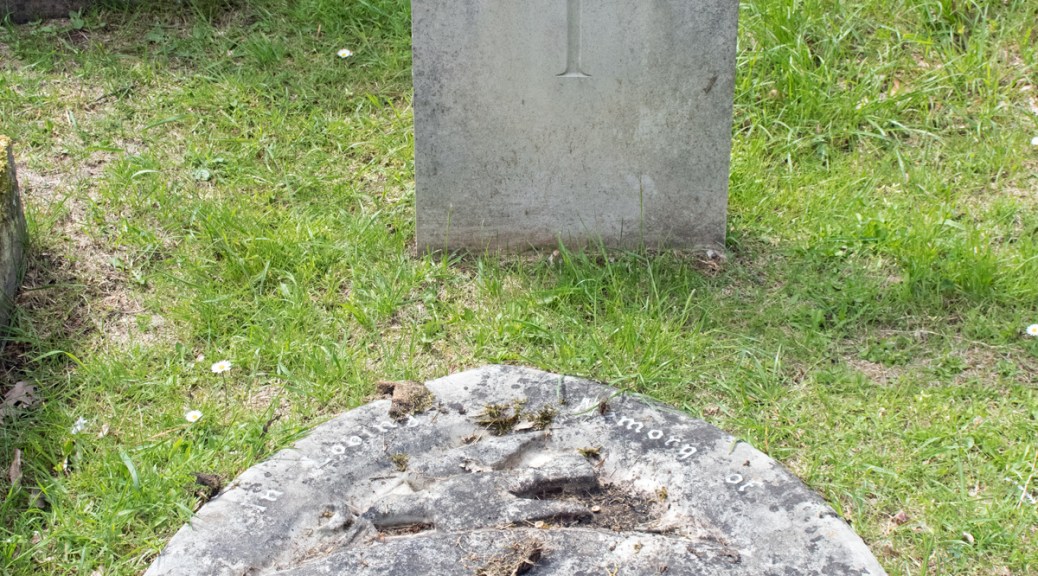
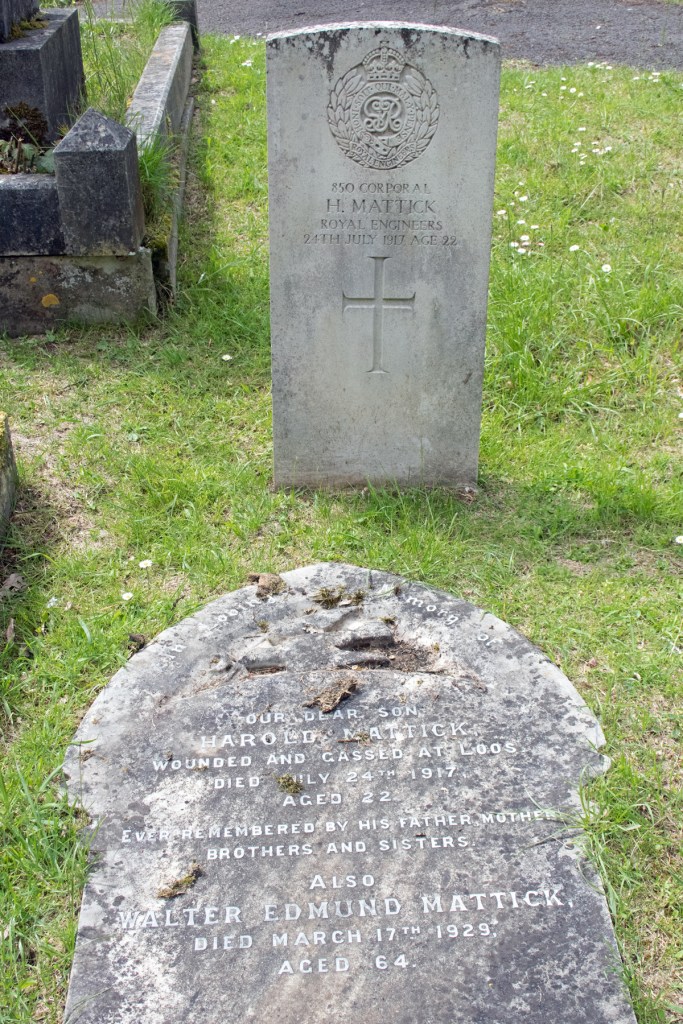
Harold Mattick was born in the spring of 1895, the youngest of four children to Walter and Augusta. Walter was a harness maker and brought the family up in his home town of Weston-super-Mare, Somerset.
When he left school, Harold found work as a plumber. He seemed to had sought a life of adventure, however, and, in 1908, aged just 14, enlisted in the Wessex Division of the Royal Engineers as a Bugler. He served for five years, fulfilling his duties at the same time as carrying out his plumbing work.
When war broke out, Harold immediately re-enlisted. As a Sapper, he was assigned to the 1st/2nd (Wessex) Field Company. After initial training, he was sent to the front as part of the British Expeditionary Force just before Christmas in 1914.
Sapper Mattick was caught up in some of the fiercest fighting on the Wester Front, including the First and Second Battles of Ypres. On 30th September 1915, at Loos, he received a gunshot wound in his right leg, which fractured his tibia. The Germans were also using gas to attack the Allied front lines, which also affected Harold.
Medically evacuated to England for treatment on 9th October, his condition was such that he was discharged from the army on health grounds six months later, on 30th March 1916.
Sadly, while Harold’s leg healed, the injuries he sustained in the gas attack were too severe for him to recover from. He died at home from a lung condition on 24th July 1917, aged just 22 years old.
Harold Mattick was laid to rest in the Milton Cemetery of his home town, Weston-super-Mare.
Stanley James Payne was born towards the end of 1882, one of eleven children to Stephen and Elizabeth Payne. Stephen was a leather salesman from Essex, who had moved his family to Weston-super-Mare in Somerset in around 1880.
Stanley seems to have been drawn in to a military life from an early age. In January 1900, he enlisted as a Private in the Somerset Light Infantry, and the 1901 census listed him as living at the Raglan Barracks in Devonport, near Plymouth.
Military service took Private Payne to India, where he served for six years. His success and ambition were clear; in 1906 he was promoted to first to Corporal and then to Sergeant. By 1911 – and now back in England – as a Lance Sergeant, Stanley was working as a military clerk at the Royal Horse Artillery Barracks in Dorchester, although he was still attached to the Somerset Light Infantry.
Stanley’s ambition and sense of adventure continued; by July 1912 he had made the transfer over to the newly-formed Royal Flying Corps, as a Sergeant.
It was while he was based in Dorchester that he met Winifred Bell. She was the daughter of a local council worker, and the couple married in the town in September 1912. Stanley and Winifred went on to have a daughter, Doris, who was born in July 1914.
War had arrived in Europe, and on 7th October, the now Warrant Officer Payne was shipped to France. During his nine months on the Western Front, he was mentioned in despatches and received the Croix de Guerre for his gallantry. The local newspaper also reported that he:
…had also the honour of being presented to the King on the occasion of His Majesty’s last visit to the front, and at a home station had also been presented to Queen Mary.
Western Daily Press: Saturday 8th March 1919
Returning to England on 1st June 1915, he was again promoted to Lieutenant and Quartermaster, although here his military records dry up. By this time, he had been in the armed forces for more than fifteen years, but his military records seem to confirm this as the last day of his service.
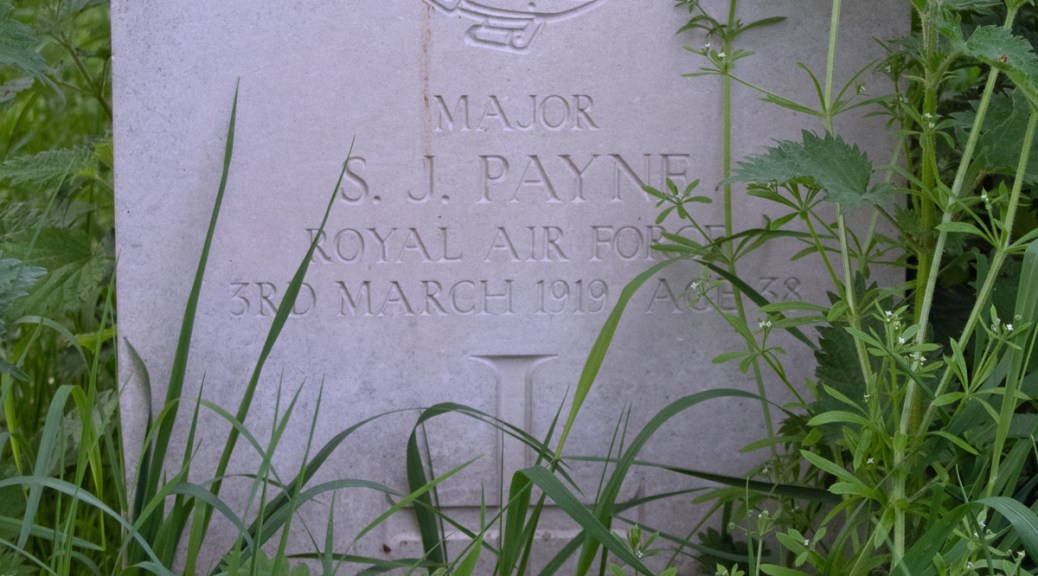
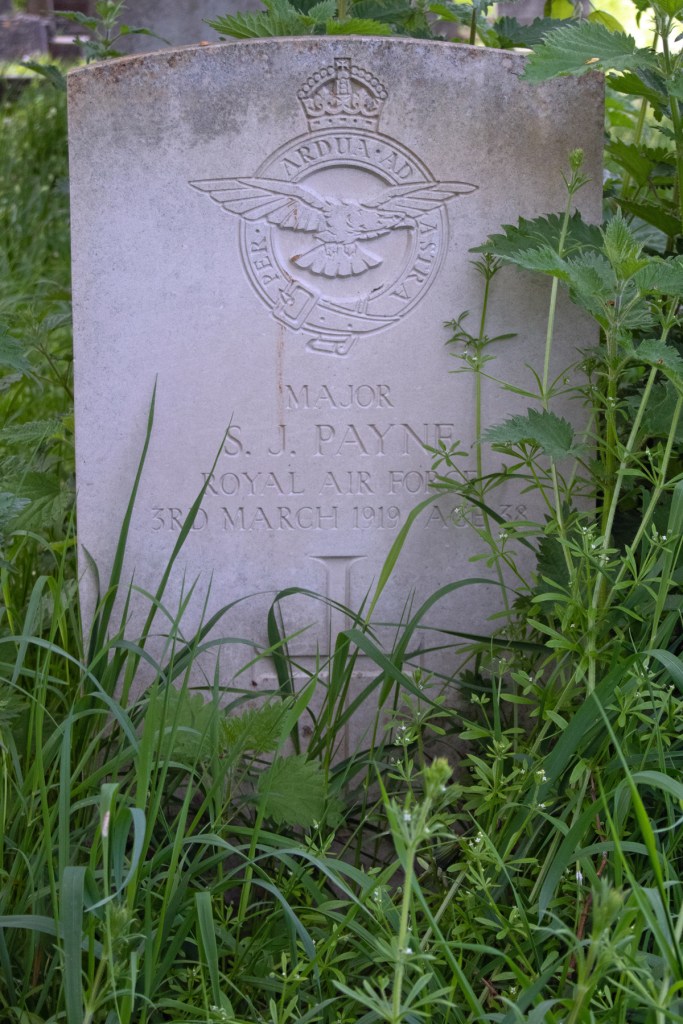
The next record for Stanley confirms his passing. Admitted to the Central Air Force Hospital in Hampstead with a combination of influenza and pneumonia, he died on 3rd March 1919. He was just 36 years of age.
Brought back to Weston-super-Mare, where his now widowed father was still living, Stanley James Payne was laid to rest in the Milton Cemetery in his home town.
Stanley’s gravestone gives his rank as Major. While there is no documented evidence of any additional promotions after June 1915, the rank is the equivalent of Quartermaster in the Army Reserve. It seems likely, therefore, that the end date of his military service marked the start of his time in the reserves.
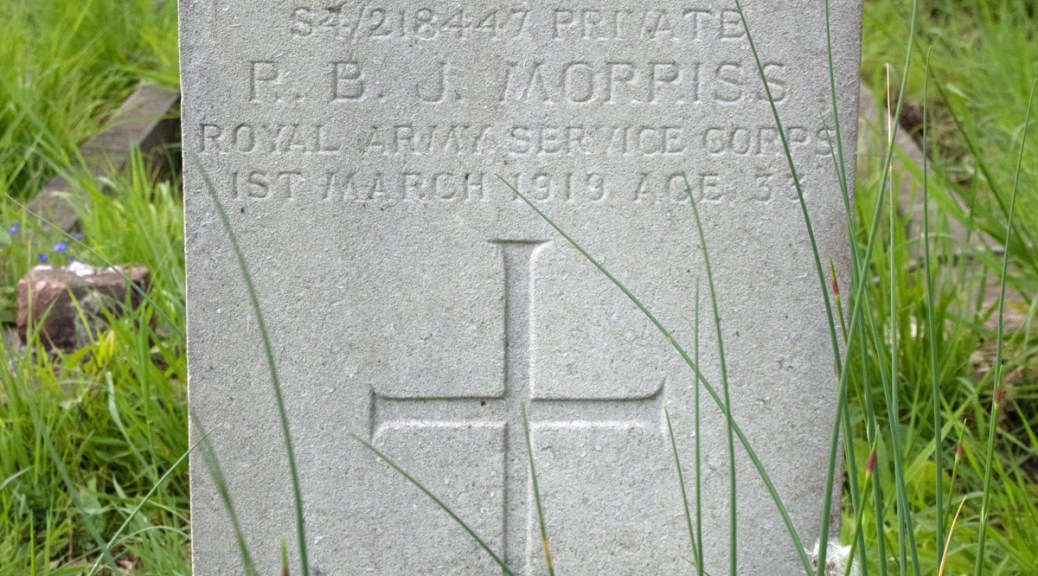
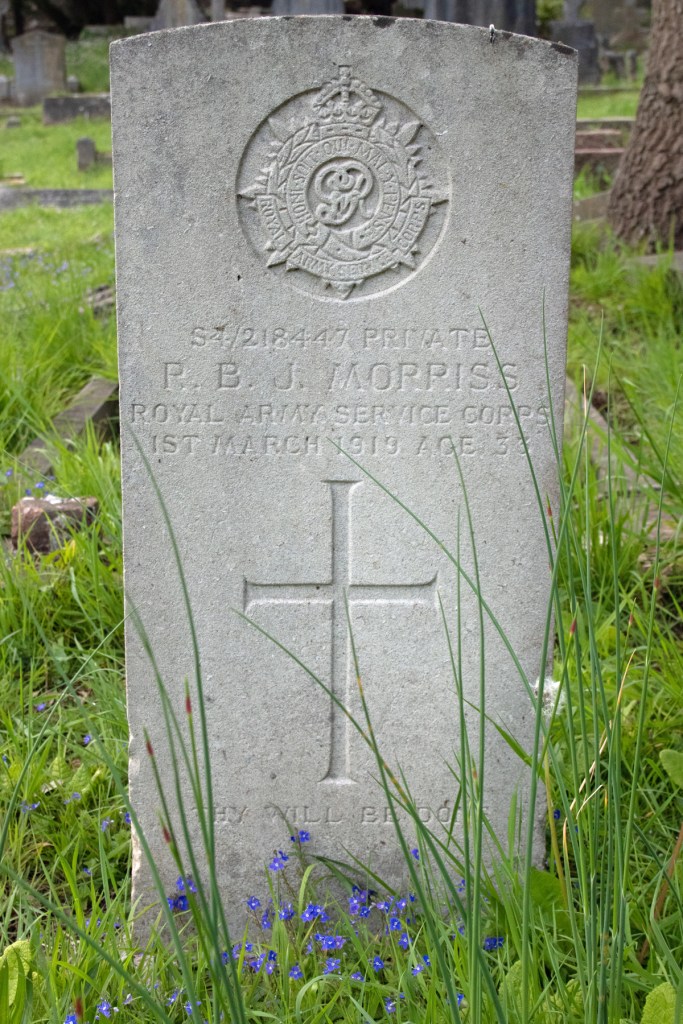
Reginald Benjamin James Morriss was born in the spring of 1886 and was the youngest of twelve children. His father, Thomas, was a bootmaker from Leeds, who had moved to Somerset and married Mary Ann Pennell. The couple brought their family up in her home town of Weston-super-Mare.
Thomas died in 1901, when Reginald was just 14 years old. Mary Ann, by this point, still had a lot of her family with her, including Reginald, three of his sisters, his brother-in-law and four nieces.
Reginald was about to leave school, and found work as a French polisher in Bristol, eventually moving in with his employer as a lodger. This may not have suited him, however, as, by the time he enlisted, he gave his trade as baker and confectioner, and he was living back with his mother in Weston-super-Mare.
Private Morriss was 30 when he joined up in 1916, and stood 5ft 7ins (1.7m) tall. He joined the Army Service Corps as a baker, and was initially based in Aldershot. He was moved to Kent in September 1918, having been assigned to the 351st Horse Transport Company. The war was drawing to an end, but a new threat was on the horizon.
The following February, Private Morriss was admitted to St John’s Hospital in Hastings, suffering from influenza and pneumonia. Sadly, he was to succumb to the lung conditions, and he passed away on 3rd March 1919. He was just 32 years old.
Reginald Benjamin James Morriss’ body was brought back to Weston-super-Mare, and he was laid to rest in the Milton Cemetery in his home town.
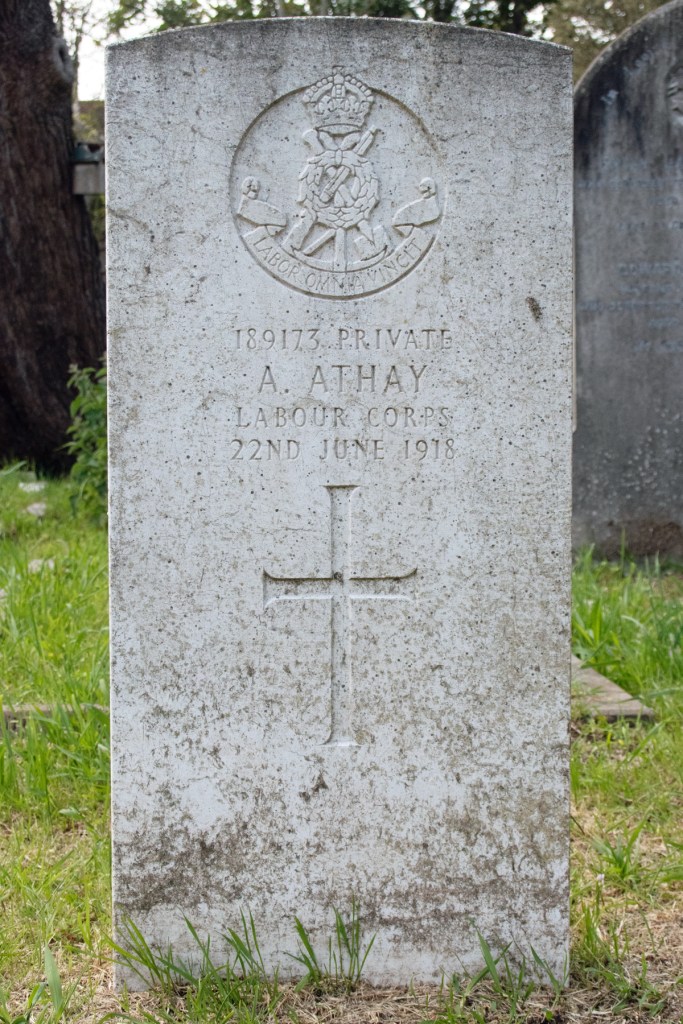
Albert Athay was born in 1887, one of eight children to Thomas and Emily. Thomas was a labourer for the local council in Weston-super-Mare, and the family lived in a small house on a road leading inland from the seafront.
Thomas died when Albert was only 14 years old, and, having left school, he found labouring work to help support his now widowed mother and younger siblings.
In August 1910, Albert married Mable Dunstone, a cowherd’s daughter from Somerset. The couple continued to live with Albert’s mother and brother right up until the outbreak of war. They went on to have three children, Milicent, Freda and Charles.
Albert, by this time, has been volunteering with the local Labour Battalion; he formalised his military service in June 1917, officially enlisting in the Labour Corps. He served as part of the territorial force, in and around Salisbury Plain.
Private Athay fell ill in the summer of 1918, and was admitted to hospital on 11th June with pneumonia. Sadly, as the days progressed, so did the condition, and he passed away from it just eleven days later. He was just 31 years old.
Brought back to Weston-super-Mare, Albert Athay was laid to rest in the Milton Cemetery in his home town.
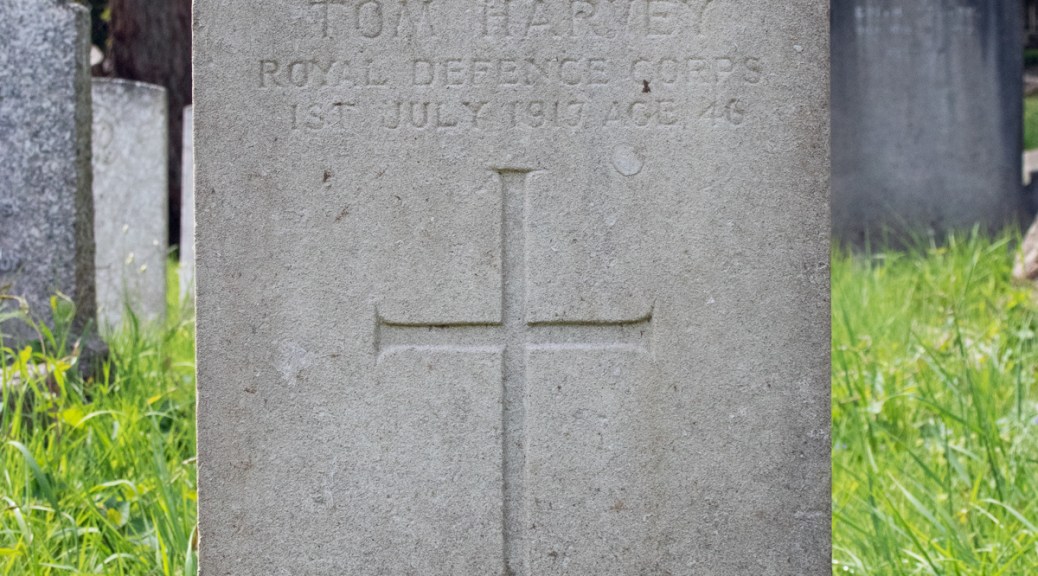
Tom Harvey was born in the spring of 1871, one of four children to John and Caroline. John was a fly driver, hiring out a pony and trap for a fee, while his wife brought in extra money working as a laundress. The family lived in Weston-super-Mare, on the Somerset coast, in a town house they shared with another family, the Painters.
Details of Tom’s early life is a bit sketchy. The 1891 census lists him as a Private in the Royal Marine Light Infantry, with his address as the Royal Naval Hospital in East Stonehouse, Plymouth, where he was ‘receiving treatment’. Sadly, none of his military records survive, so there is nothing to confirm his dates of service.
In 1894, demobbed and working as a cab driver in his home town, Tom married a woman called Sarah. Little other information exists about her, but what is known is that she worked as a dressmaker to supplement her husband’s income, and the couple did not go on to have any children. The couple lived in Hopkins Street, near the centre of Weston-super-Mare, and initially took in boarders to help finances.
By the time war broke out in 1914, Tom was in his forties. Eventually called back into service, he joined the 261st Company of the Royal Defence Corps and, with the role of Serjeant, he would have had men under his command. The 261st was part of Southern Command, which provided a territorial defence force, or Home Guard, and a lot of his time was spent in Birmingham.
It was while he was home on leave that Tom fell ill. The local media picked up the story:
The death occurred on Sunday under sudden circumstances of Sergeant Tom Harvey, Royal Defence Corps… The deceased was proceeding to his residence… when he fell, and was only able to give his address and to state that he was suffering from chronic indigestion before he expired. Prior to joining up as a National Volunteer, the deceased has been engaged as an omnibus driver.
Western Daily Press: Tuesday 3rd July 1917
Tom Harvey was 46 years old when he died. He was laid to rest in the Milton Cemetery in his home town of Weston-super-Mare.
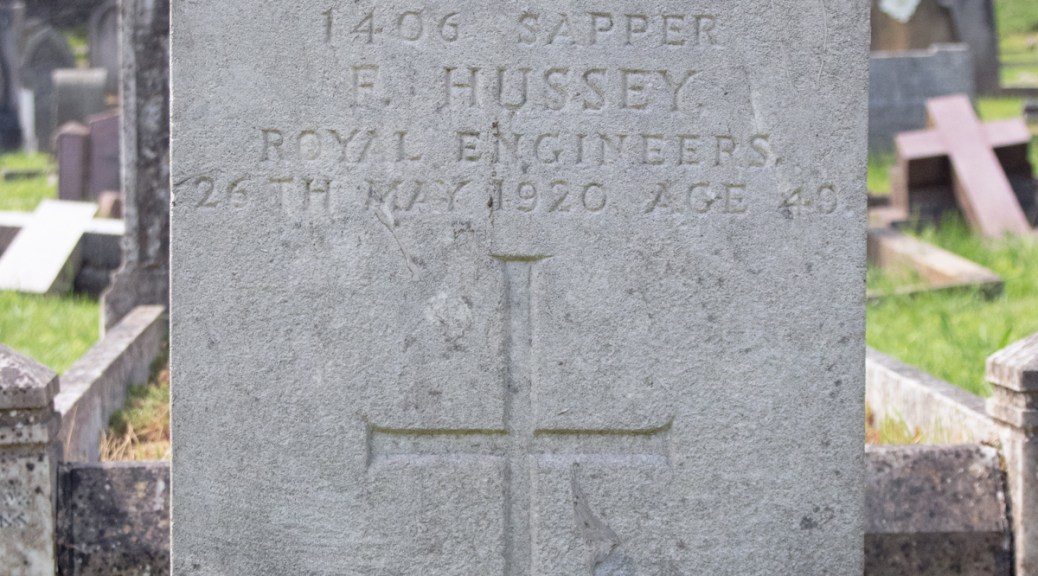
Frank Hussey was born in the autumn of 1870, one of eight children to William and Ann Hussey. William was a mason, and raised his family in Weston-super-Mare in his home county of Somerset. When he left school, Frank found employment as a general labourer, initially in Somerset, but then in South Wales with his older brother Samuel.
By 1889, Frank has moved back to Somerset, where he married Elizabeth Webber in December. Work was obviously more available in South Wales, however, as the couple moved back to Glamorgan, and had their first four children – Beatrice, William, Edith and Hubert – there.
The turn of the century saw the Hussey family return to Somerset. Frank, by now, was working as a bricklayer, and they settled in a small house near the centre of Weston. Life continued on, with building work helping to support the family. Frank and Elizabeth had two more children – James and Marion – and, by the time of the 1911 census, the couple were living with their five youngest children in a two-up-two-down house on the then outskirts of the town.
Storm clouds were gathering over in Europe, and Frank was more than willing to do his bit for King and country. Having already been a volunteer with the Royal Engineers, he formally enlisted with the regiment on 5th May 1915.
Sapper Hussey was assigned to the 2nd (Wessex) Field Company, which was a territorial force. He was mobilised for fourteen months, before being discharged from the army as he was no longer physically fit for war service. Unfortunately, his military records give no further indication as to his ailment or condition.
Frank’s trail goes cold for a few years. Released from service in July 1916, the next identifiable record is from four years later. This confirms that he died from tuberculosis on 26th May 1920, aged 49 years old. Given the debilitating effect of the condition, it seems likely that Sapper Hussey contracted it during the war, and this is what had led to his dismissal.
Frank Hussey had died at home, and it was in the Milton Cemetery in Weston-super-Mare that he was laid to rest.
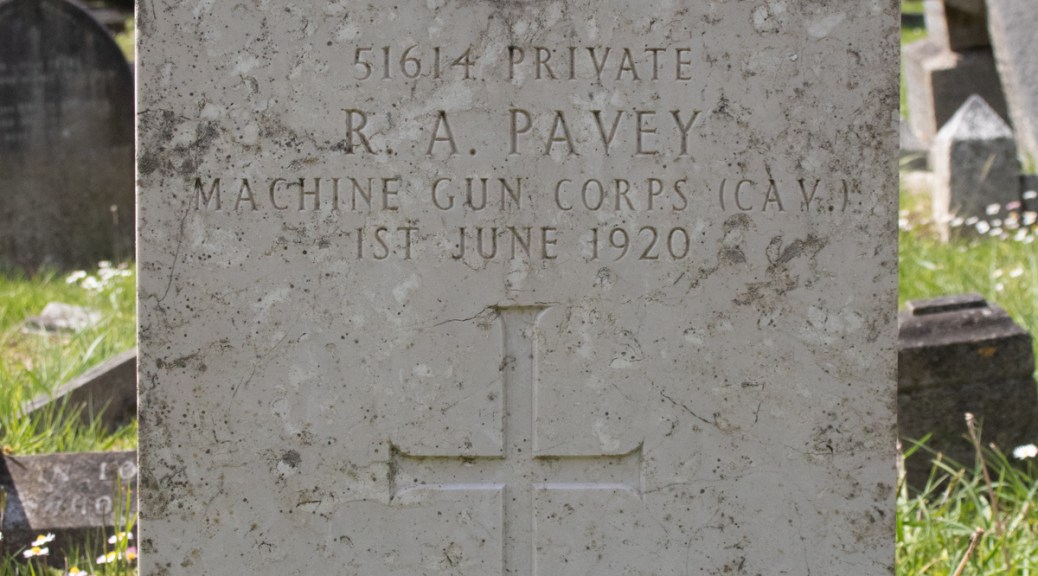
Roland Adams Pavey was born in the summer of 1891, the youngest of three children to Anthony Pavey and his wife, Mary. Anthony was a painter, and both he and his wife were born in the Somerset town of Cheddar. Their life took them travelling, though, with their first child, Edward being born in Cheddar, while their middle child, Ada, was born in Oxford, and Roland born in Bath .
Anthony passed away in 1910, leaving Roland living with his widowed mother, earning a living as a draper’s clerk. War was coming, however, and new opportunities lie in store.
Roland enlisted in the army in January 1915. Initially joining the North Somerset Yeomanry, he soon transferred across to the Cavalry Division of the Machine Gun Corps. Sadly, Private Pavey’s military records are lost to time, but he definitely saw action on the Western Front, gaining the Victory and British Medals and the 1915 Star for his efforts.
The next record for Roland comes in the form of a newspaper article from South Wales.
SAD CASE OF NANTYGLO GIRL
Behind the untimely death of Mr Roland A Pavey, a popular young ex-Service man, and secretary of the Weston-super-Mare Federation of Discharged Soldiers and Sailors, lies a pathetic story of the double bereavement of a pretty Welsh girl, Miss Dorothy Morgan of Nantyglo.
Prior to the war, Miss Morgan was engaged to a compatriot of her own, who answered his country’s call and, like so many thousands of others, made the great sacrifice. Time rolled on and the old wound was eventually healed. Then Miss Morgan went on a visit to Weston last year, and there met young Roland Pavey, just demobilised from the Army.
A mutual attraction soon ripened into affection, and the couple became engaged, and they were to have been married towards the end of the present month, but Fate intervened.
Pavey’s long war service impaired his constitution, though how seriously was probably not realised until the damage was done. Returning from a Whitsuntide visit to Exeter, Mr Pavey was so ill that he was compelled to take to his bed. He rapidly became worse, and though his fiancée was hurriedly summoned, he passed away before she arrived at Weston.
Thus, within a short time, Miss Morgan has been twice bereaved as a result of the war.
Merthyr Express: Saturday 12th June 1920
Roland Adams Pavey was just 29 years old when he died. He was laid to rest in the Milton Cemetery in Weston-super-Mare, where his mother then lived.
Sadly, Dorothy Morgan is too common a name in South Wales to confirm much more information on her life. We are unlikely ever to discover if she ever found a lasting love.
Arthur Reginald Lavender was born in Bath on 17th January 1889, the second of two children to George Charles (or Charles George) Lavender and his wife, Elizabeth. George raised the family in Bath and seems to have been a jack of all trades, finding work where he could, as a porter in a warehouse according to the 1891 census and a stationary engine driver ten years later.
On 1st December 1907, at the age of just 18, Arthur married Kate Pearce, a painter’s daughter from Weston-super-Mare. The young couple went on to have a son, Sidney, who was born the following year.
By 1911, Arthur was working in Weston-super-Mare as a warehouseman at a local laundry and, on the day of that year’s census, was staying with his father-in-law. Kate, meanwhile, had taken Sidney to see her brother, Frank, who lived in Bristol.
War was coming to Europe, and, in November 1915, Arthur signed up, joining the Royal Army Medical Corps as a Private. After initial training – including a course on First Aid, he was sent overseas on 11th April 1916, where he was assigned to the 27th Casualty Clearing Station.
Private Lavender’s time in the RAMC seems to have been a complicated one. He was admitted to a field hospital within a month of arriving in France with a double inguinal hernia, a condition that continued to dog him over the coming months.
Arthur was eventually shipped to England in March 1917 for an operation at the Metropolitan Hospital in London. The operation itself seemed to have been a success, but, while admitted, he contracted pneumonia, and it was this lung condition that was to end his life. Private Lavender passed away on 7th May 1917, aged just 28 years old.
Arthur Reginald Lavender was laid to rest in the Milton Cemetery in Weston-super-Mare.
Charles William Dyer was born on 12th May 1895, the youngest of seven children to Harry and Mary Dyer.
Harry was a farmer, who brought his family up in the village of Kewstoke, just to the north of Weston-super-Mare, Somerset. He seems to have been keen to try new things because he and Mary lived for a while in Australia, and their first two children were born there. They then moved back to the UK in around 1887, settling back in Somerset.
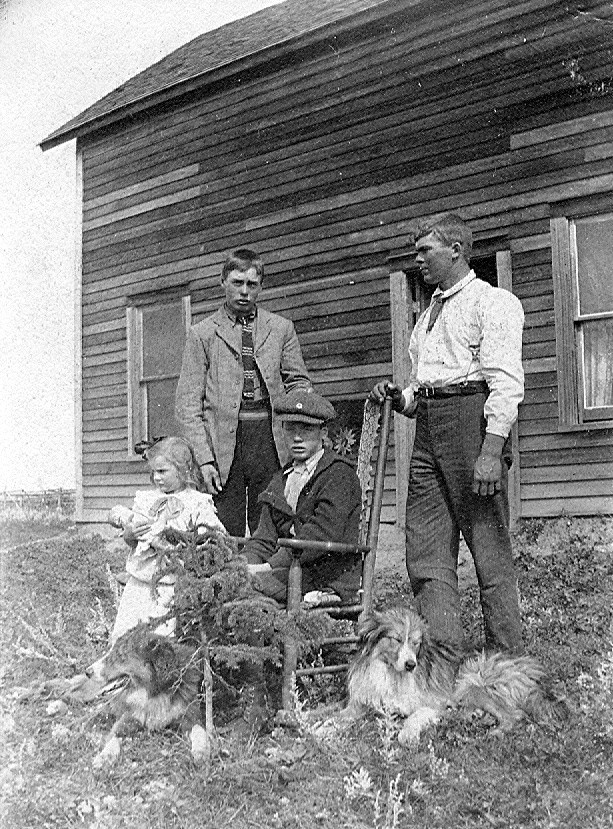
By the time of the 1911 census, Charles was 16 years old, and all of the family were helping out on the farm. He seemed to share his father’s sense of adventure; in 1913, he emigrated to Canada, setting himself up as a farmhand in Winnipeg.
War was coming to Europe, however, and Charles joined up. He enlisted in October 1917, joining the Canadian Infantry. Leaving Canada on a troop ship on 19th February 1918, he arrived back in England on 4th March.
Private Dyer was soon installed at the Canadian Infantry camp at Bramshott in Hampshire. Within weeks of arriving in England, however, he had contracted influenza; this developed into pneumonia, and was admitted to the camp’s Military Hospital on 22nd May. Sadly, a week later, Private Dyer was dead. He was just 23 years old.
Charles William Dyer was taken back to Weston-super-Mare and laid to rest in the Milton Cemetery there.
Charles Dyer (on right) in Canada (Courtesy of ancestry.co.uk)







 Death and Service