Albert William Stockley was born in the spring of 1897, the youngest of twelve children to Frank and Mary Ann Stockley. Frank was a clay cutter from Dorset, and he and his wife raised their family in the picturesque village of Corfe Castle.
Sadly, much of Albert’s life is lost to time. He would have been 17 years old when war broke out, so it seems likely that he would not have been in the first wave of men to enlist.
Albert joined the Dorsetshire Regiment and, as a Private, was assigned to the 1st/4th Battalion. His troop was based in India for the first part of the war, before moving to Mesopotamia in 1916. There is nothing to confirm, however, whether Private Stockley served abroad, or if he remained as part of a territorial force.
Private Stockley was demobbed on 22nd May 1919, and awarded the Victory and British Medals for his service. He returned to Dorset, but is it at this point that his trail goes cold.
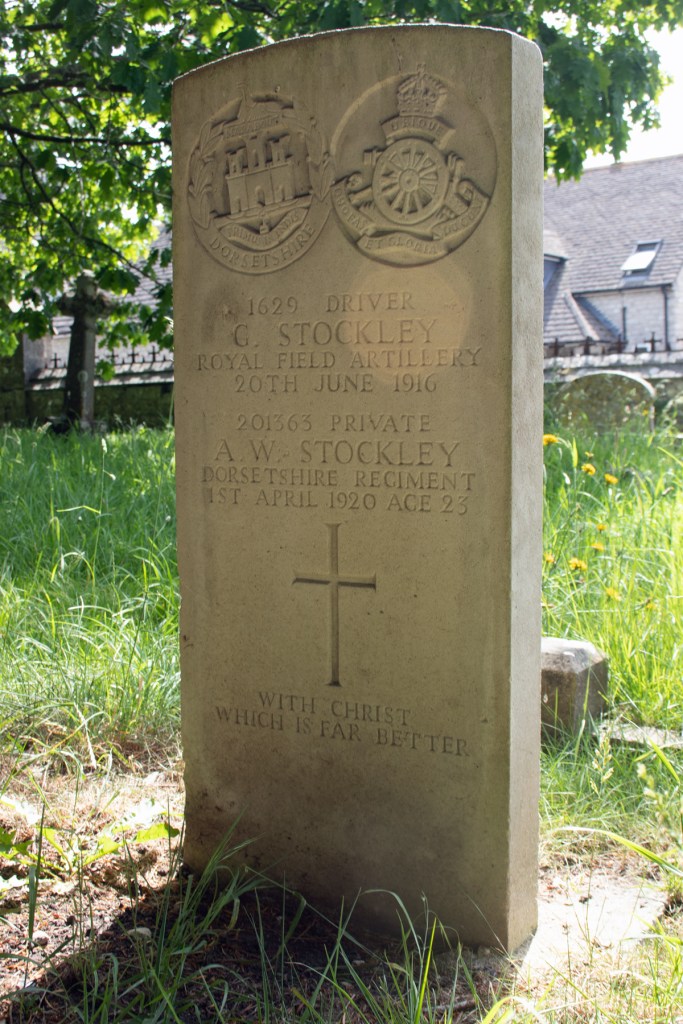
All that is evident is that Albert William Stockley passed away on 1st April 1920, ages just 23 years old. was laid to rest in the Old Church Cemetery in his home town of Corfe Castle.
Albert shares his grave with his older sibling, George Stockley, who died in June 1916. The brothers are commemorated on the same headstone.
George Stockley was born in December 1888, one of twelve children to Frank and Mary Ann Stockley. Frank was a clay cutter from Dorset, and he and his wife raised their family in the picturesque village of Corfe Castle.
When he left school, George found work as a house painter but it seemed this was not to be a career. In March 1913, he married Lillian May Stockley, who had been born in Frome, Somerset, but who was working as a barmaid in nearby Weymouth. Later that year, the couple had a daughter, Georgina, and, by the time he enlisted two years later, George was working as a barman, and the young family were living in Bournemouth.
George had joined up on 10th February 1915, and was assigned to the 3rd/6th Hampshire Battery of the Royal Field Artillery. His service records show that he was 5ft 4ins (1.63m) tall, but they also confirm that, when he had his medical examination on 30th May, he was deemed as medically unfit for military service.
Sadly, there is no further information to confirm why Driver Stockley’s military career was cut so short. His trail goes for a year, until, on 20th June 1916, he passed away, aged just 27 years old. The cause of his passing is also lost to time
George Stockley was laid to rest in the Old Church Cemetery in his home town of Corfe Castle.
George shares his grave with his youngest sibling, Albert William Stockley, who died in April 1920. The brothers are commemorated on the same headstone.
Walter Stanley Chapman was born in the summer of 1897, the younger of two boys to William and Sarah (known as Annie) Chapman. William was a carter on a farm in North Cadbury, near Yeovil, Somerset, and this is where the young family grew up.
When he left school, Walter became apprenticed to a local carpenter, but war was on the horizon. His older brother Frederick was quick to enlist, joining the Royal Marine Light Infantry as a Private. He served on HMS Hood during the Battle of Jutland in the spring of 1916, and was killed during the fighting. He was buried at sea, and was just 23 years old when he died.
The loss of his brother may have spurred Walter into action. He enlisted as well, joining the 1/4th Battalion of the Somerset Light Infantry as a Private. Details of his service are limited, but his battalion served in Mesopotamia during the conflict, and it is likely that he spent some time in the region.
Private Chapman survived the war, and returned to Somerset on furlough, waiting to be demobbed. Sadly, he passed away during this time, breathing his last on 19th April 1919, at the age of just 21 years old. William and Annie had lost both of their sons because of the conflict.
Walter Stanley Chapman was laid to rest in the graveyard of St Michael’s Church in his home village of North Cadbury. His gravestone also commemorates the passing of his older brother.
George Dove was born in Wincanton, Somerset, on 4th December 1883. One of five children, his parents were farm labourer George Dove and his wife, Jane.
George Jr did not follow his father into farm work: the 1901 census found him boarding with a family in Radstock, working in one of the coal mines in the area. Ten years later, he was living back with his family, employed as a groom.
His work with horses stood him in good stead when war was declared. George enlisted early on, and was assigned to the 19th (Queen Alexandra’s Own Royal) Hussars as a Private. By October 1914, he was in France, returning to England with his squadron the following spring.
At some point during the conflict, Private Dove transferred to the Reserve Regiment of Cavalry. He was posted to the 5th Regiment, which trained men for the Northumberland Hussars and Yorkshire Dragoons, amongst others.
Further details of George’s life are scarce; at some point, he married a woman called Emily, although records of the couple’s wedding no longer exist. The only thing that can be confirmed is that George was admitted to the Bermondsey Military Hospital in Surrey, where he passed away on 24th October 1918. He was 34 years old.
The body of George Dove was brought back to Somerset for burial. He lies at rest in the cemetery in his home town, Wincanton.
Frederick Jacob Harris was born in Wadeford, near Chard in Somerset, on 28th August 1887. The fourth of eleven children, his parents were William and Grace Harris. William was an agricultural labourer and carter, but the busy lace and weaving industry in the area is what provided Frederick and his siblings with work when they finished school.
It may have been through his work in the factory that Frederick met Alice Dowell: she was the daughter of a lace hand from Chard. The couple married on 20th October 1906, and settled in a house near the centre of the town. They went on to have four children, two boys and two girls.
War was closing in on Europe by this point, although there is little specific information about Frederick’s service. He initially joined the Somerset Light Infantry, although he soon made the move to the Royal Fusiliers. He received the Victory and British Medals, as did everyone else who served in the Great War, but there is no confirmation of whether he saw action overseas or not.
However and wherever Private Harris served, he survived the conflict, and was demobbed on 25th May 1919. His discharge record suggests that, at the point of being released from duty, he had no injuries or disabilities, and nothing that could be attributed to his time in the army.
Frederick appears to have returned to Chard, and spent the next six months adjusting to civilian life. However, something changed, as, on 10th December 1919, he passed away at home. No cause of death is evident, and nothing in the contemporary local media suggests that he died of anything other than natural causes. Whatever led to his passing, he was taken early, as he was only 32 years of age.
Frederick Jacob Harris was laid to rest in Chard Cemetery.
Edgar Albert Boyland (known as Albert) was born in the summer of 1894, the third of eight children to John and Sarah Boyland. John was a farm labourer from Chaffcombe in Somerset, but it was in nearby Chard that the family were born and raised.
Albert followed in his father’s footsteps and, when he finished school, he found work on a local farm. The 1911 census recorded him boarding with the Boait family in Winsham, to the south-east of Chard. He was living there along with another boarder, a baker called Fred Baker, and his influence seems to have paid off, as, by the time war was declared in 1914, baking was the trade that he had taken up.
With the conflict declared, Albert was called upon to play his part. In April 1915, he enlisted in the Army Service Corps. His records show that he stood 5ft 5.5ins (1.66m) tall and he gave his trade as baker. This was the trade that served him well, as it is the one for which he was employed.
Private Boyland was sent to France within a few weeks of enlisting. In November 1915, he was sent to Salonika, Greece, and spent the next couple of years in the Eastern Mediterranean providing food for the troops.
In December 1917, Albert returned to England where, within a couple of months, he was medically discharged from active duty. Sadly, there is nothing documented to confirm the condition that led to him leaving the army, but it seems likely to have been an illness of some description.
At this point, Albert’s trail goes cold. He passed away on 19th February 1919; again the cause of his death is lost to time. He was just 24 years of age.
Edgar Albert Boyland was laid to rest in Chard Cemetery, not far from where his family still lived.
Private Arthur Boyland
Two rows back from Private Albert Boyland’s headstone is another Commonwealth War Grave, dedicated to another Boyland. This is from the Second World War, and identifies the resting place of Albert’s cousin.
Arthur James Boyland was born on 21st October 1908, one of nine children to Arthur’s uncle and aunt, Joseph and Julia Boyland. Joseph worked at an iron foundry, but it seems that Arthur was destined for other things. While a lot of his life is lost to time, by the time of the 1939 Register, he was working as a dental mechanic in Chard.
Arthur had married Bessie Hopkins in 1936; the couple went on to have three children.
When the Second World War was declared, Arthur had a role to play; he enlisted as a Private in the Royal Army Dental Corps. Sadly, details of his service are not available; he survived the war, however, and returned to Chard afterwards.
Arthur James Boyland passed away at home on 14th December 1947, at just 39 years of age. He was laid to rest in Chard Cemetery.
Charles – known as Charlie – Hooper was born on 22nd August 1898, the second youngest of nine children to Sidney and Sarah Hooper. Sidney was a carter from the village of Chillington in Somerset, but it was in nearby Cudworth that the family were born and raised.
Charlie, attended the local school like his older siblings, joining on 2nd June 1902, and remaining there until 28th August 1911. The following month his older sister died, and the next year his mother also passed away.
War was coming to Europe, and, while Charlie was too young to enlist when it first broke out, he seemed keen to play his part as early on as he could. He enlisted with the Royal Field Artillery at the start of 1917, and was assigned to the 23rd Reserve Battery.
Gunner Hooper was sent to Wiltshire for training. The next record for him is that of his passing. He died in Salisbury on 29th April 1917, the cause unrecorded. He was just 18 years of age.
Charlie Hooper’s body was brought back to Somerset for burial. He was laid to rest in the graveyard of St Michael’s Church in his home village, Cudworth.
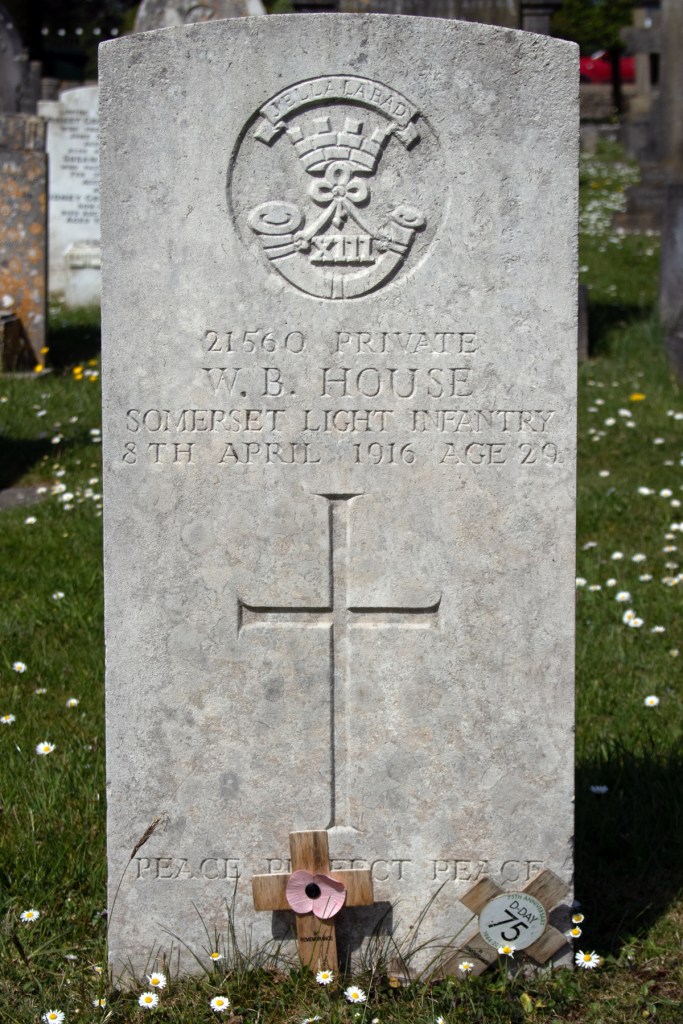
William Brewer House was born in Chard, Somerset, in the spring of 1888, one of eleven children to William and Minna House. William Sr was a farm labourer, and it was dairy work that William went into when he left school.
Little of William Jr’s life is documented. When war broke out, he stepped forward to play his part, enlisting in the 3rd (Reserve) Battalion of the Somerset Light Infantry at some point after October 1915. This particular troop was a territorial force, based primarily in Devon, and it is unlikely that Private House saw service overseas.
Sadly, the only other detail about his life is that relating to his passing. He was noted as having died on 8th April 1916 in the Military Hospital in Plymouth, although no cause is evident. He was just 28 years of age.
William Brewer House was brought back to Somerset for burial. He lies at rest in the Tatworth Cemetery near his home town of Chard.
William’s younger brother Frederick (known as Gordon) House also fought with the Somerset Light Infantry. He was killed in Mesopotamia in the spring of 1917.
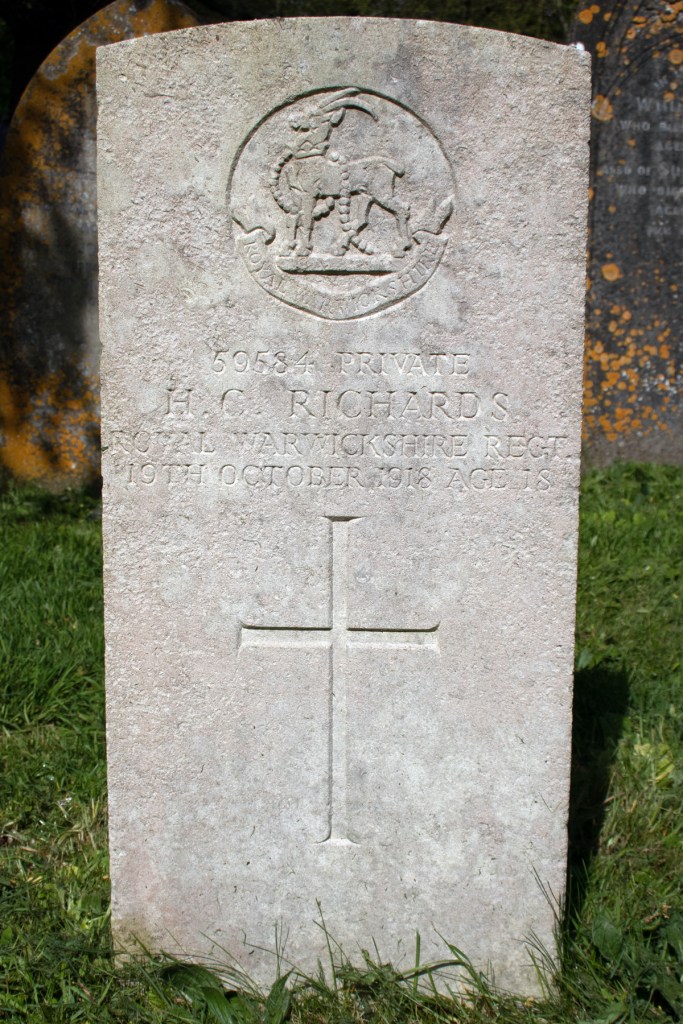
Howard Charles Richards was born in the summer of 1900, the youngest of seven children to George and Henrietta Richards. George was a sewing machine salesman from Combe St Nicholas in Somerset, and this was where the family were raised.
Howard was too young to join up when war was declared, but it seems to have been important to him. He enlisted in the 5th Battalion of the Royal Warwickshire Regiment soon after his eighteenth birthday and was sent for training.
Tragically, Private Richards’ time in the army was to be a short one. The next record for him confirms that he was admitted to the 1st Northern General Hospital in Newcastle-upon-Tyne, and that he passed away on 19th October 1918. The cause of his passing is not recorded, but he was just 18 years of age.
Howard Charles Richards’ body was brought back to Somerset for burial. He lies at rest in the graveyard of St Nicholas’ Church in his home town.
Leslie Vines was born on 16th September 1898, and was one of seventeen children to John and Emma. John was an elastic web maker or braider from Stroud, Gloucestershire, and it was in nearby Wotton-under-Edge that he and Emma raised their growing family.
Braiding and weaving ran in the family: the 1911 census recorded six of the Vines’ children who were over school age were employed in the local mill. When he finished school, Leslie also found work there.
When war came to Europe, Leslie was eager to play his part. He enlisted in the Gloucestershire Regiment on 18th June 1915, just a month after his older brother, Wilfred, had joined up. His service records confirm that he was 5ft 2ins (1.57m) tall: Keen as he was to follow his older brothers into glory, he gave his age as 19 (two years older than he actually was) in order to be accepted for duty.
Private Vines’ eagerness, however, was to be thwarted. On 29th June, less than two weeks after joining up, he was discharged from service. Details are scant, but this seems to have been on the basis that, following his medical examination, he was considered to be unfit for duty.
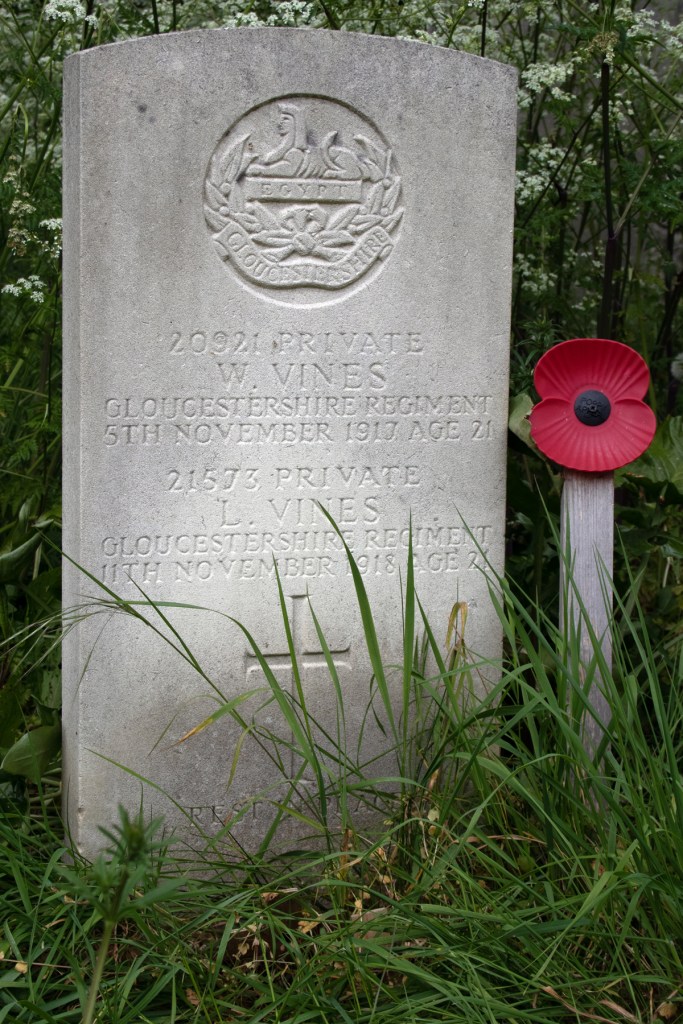
At this point, Leslie’s trail goes cold and the next available record is that for his death on Armistice Day, 11th November 1918. He was just 20 years of age. While the cause of his passing is not readily available, it was not reported on in any of the contemporary newspapers, so is likely to have been of natural causes.
Leslie Vines was laid to rest alongside his brother, Private Wilfred Vines, in the graveyard of St Mary the Virgin Church in his home town, Wotton-under-Edge.






 Death and Service