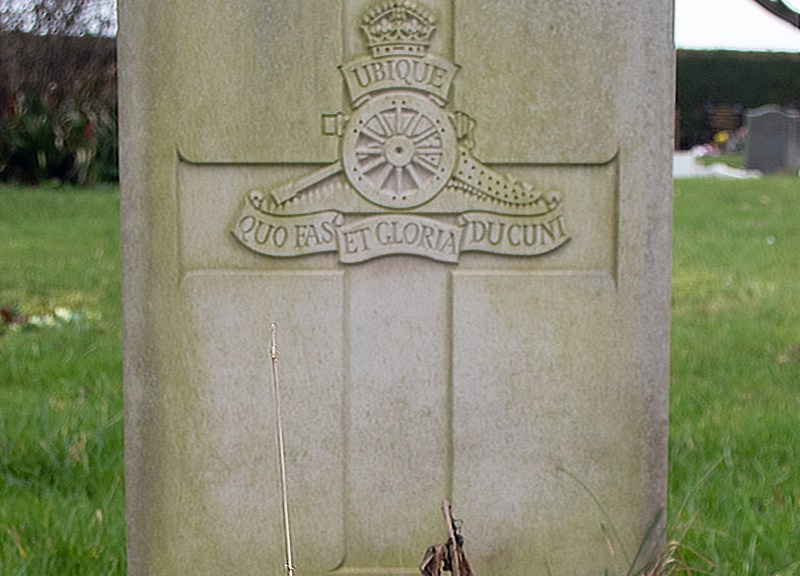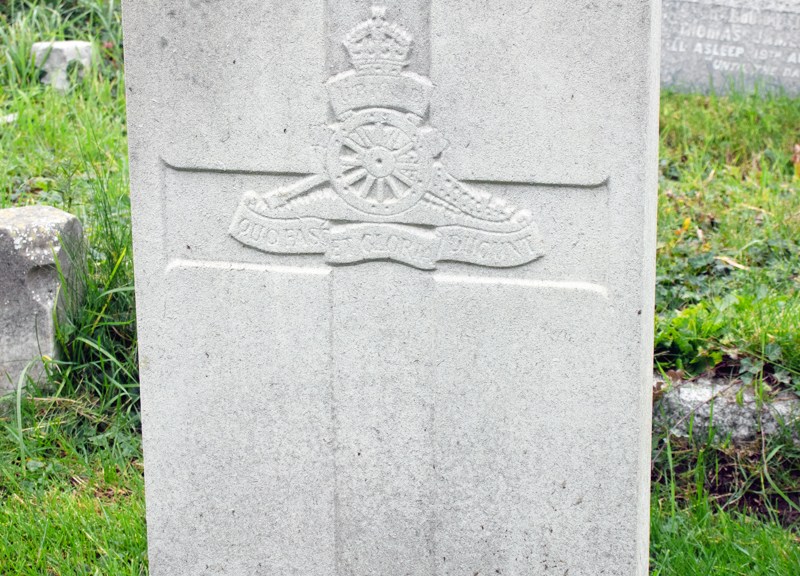
Category Archives: Royal Field Artillery

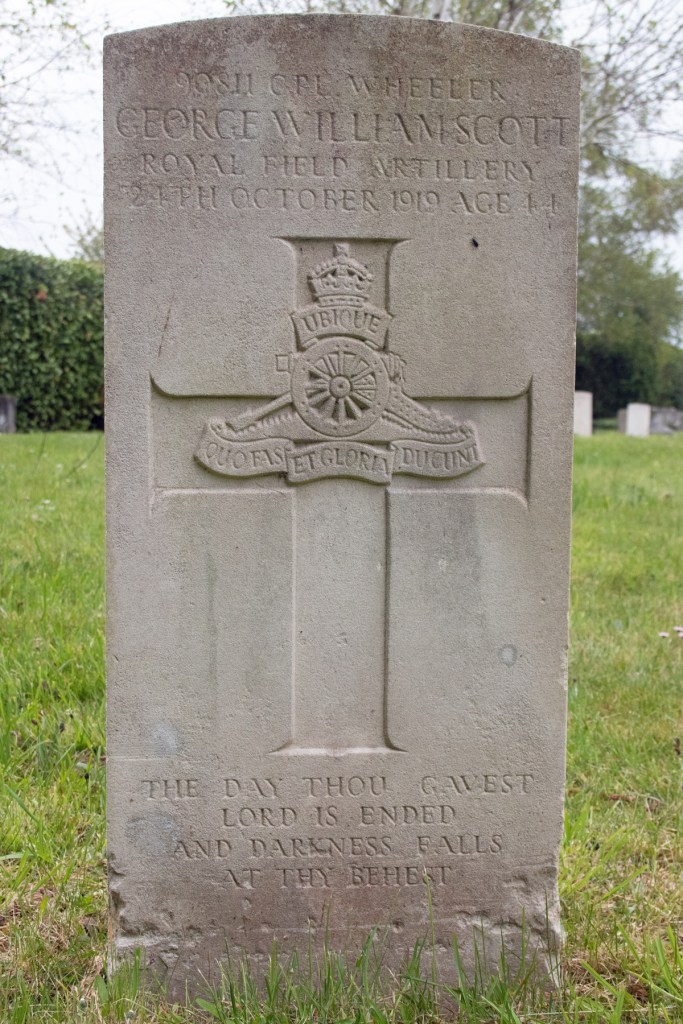
Corporal Wheeler George Scott

Corporal Wheeler George Scott

George William Scott is destined to be one of those names who is sadly lost to time. While there is information relating to him, there is not enough detail to flesh out a concrete history around him.

The facts that we do know about George are that his parents were John and Mary who, at the time that his grave was commemorated, were living in County Tyrone in Northern Ireland.

George enlisted in the Royal Field Artillery in November 1914. He was assigned to the 5th Battery of the 45th Brigade, and given the rank of Wheeler – one of the positions in a team of horses, pulling the artillery.

During his service, George was awarded the 1914 Star, as well as the Victory and British Medals. He seems to have been in a bit of trouble to begin with, however, as he was reverted down to Gunner because of misconduct. This may only have been temporary, as he ended with the rank of Corporal Wheeler.

And that is it, that is all the concrete information available for George Scott. How he died is a mystery, lost to time.

George William Scott lies at rest in St Mary’s Cemetery in Taunton, Somerset.


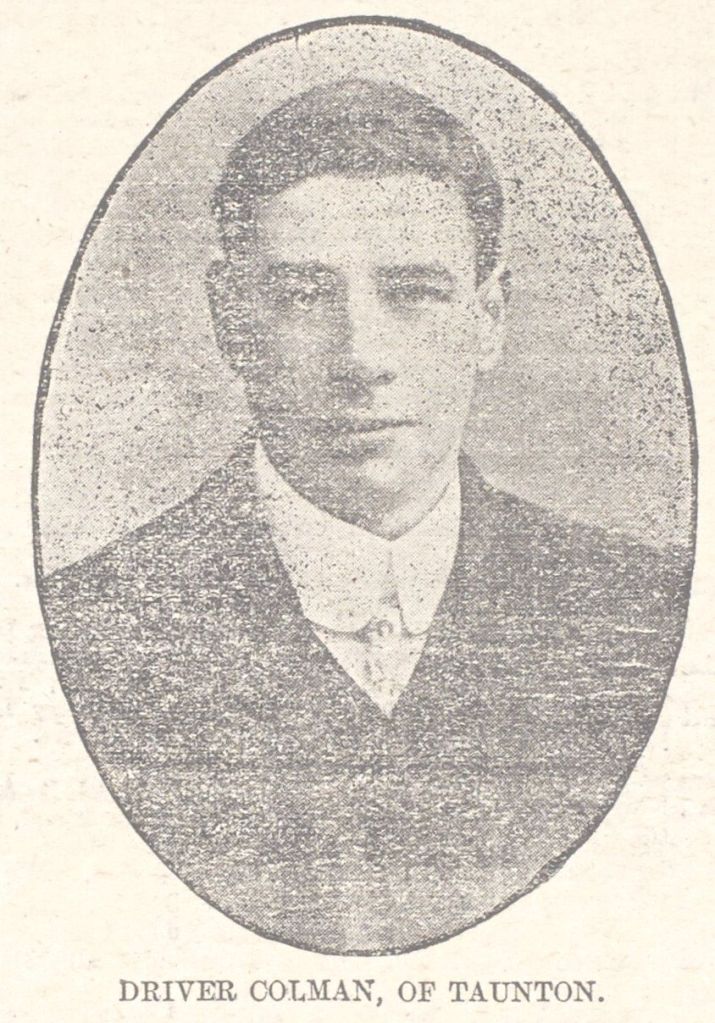
Driver Frederick Virgin

Driver Frederick Virgin

Frederick Henry Virgin was born in 1888, the second eldest of ten children. His parents were carter Thomas Virgin and his wife, Ellen, and the family lived in Taunton, Somerset.

Frederick craved adventure and this came in the form of military service. In August 1906, he enlisted in the Royal Field Artillery, and was assigned as a driver. Initially serving at home, he was shipped to India for four years, returning to England in December 1912.

Driver Virgin met and married Alice Shattock in April 1914, but had been shipped off to France within months, when war broke out. He served overseas for eighteen months, before transferring back to England again. By this point he was suffering with sciatica, and this is what saw him assigned lighter duties in the Reserve Brigade on the home front.

Alice fell pregnant, and the couple had a little boy in February 1917; sadly, his life was brief, and he passed away at the age of just two days. One can only imagine the impact this had on his parents.

Frederick’s health issues continued to be a problem, and he was medically discharged from the army later that year. While the sciatica was not solely attributed to his military service, his discharge report confirmed that his time in the army contributed to the issue. Driver Virgin’s time with the Royal Field Artillery came to an end in December 1917.

Sadly, it is at this point that Frederick’s trail goes cold. His records confirm that he passed away nearly a year later, on 26th November 1918, but there is no record as to the cause of his death. He was 30 years of age.

Frederick Henry Virgin lies at rest in St Mary’s Cemetery in his home town of Taunton, Somerset.


Gunner William Pearn

Gunner William Pearn

William Henry Pearn was born in January 1896, one of two children to Richard and Selina Pearn from Bridgwater in Somerset. Selina had been married previously, and had been widowed, and so William had a further four half-siblings. Richard was a lath renderer – a plasterer in today’s terms – and he was not the only one of the household to be working. According to the 1901 census, Selina was a collar maker and William ‘s two older half-brothers were a landscape gardener and a bookshop assistant.

When William left school, he went to work for a local coal yard as a porter. The next census finds him living with his mother and his older brother, Wallace, who was a labourer in a brickyard. Richard is noticeable in his absence, but Selina is having been married for 18 years.

Sadly, though, at this point William’s trail goes cold. His military records are sparse, but we know that he enlisted as a Gunner in the Royal Field Artillery, although I have been unable to identify when he enrolled. The only other information I have I have been able to locate for him are his pension records, that confirm that he passed away from pneumonia on 19th October 1918. Gunner Pearn was just 24 years old.

William Henry Pearn lies at rest in St John’s Cemetery in his home town of Bridgwater in Somerset.


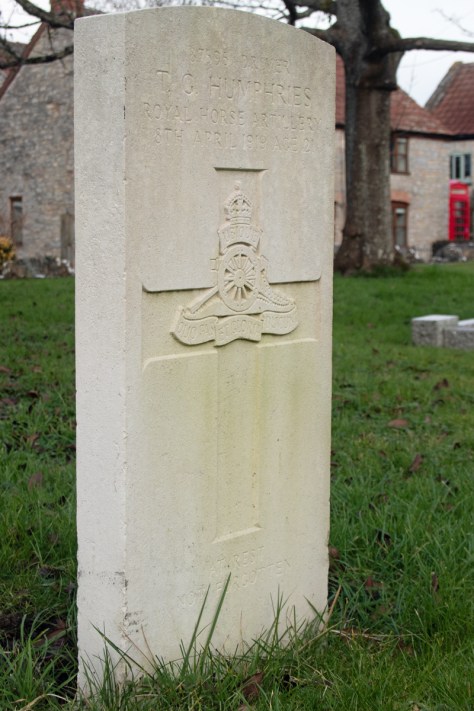
Driver Thomas Humphries

Driver Thomas Humphries

Thomas George Edward Humphries was born in November 1897, one of six children to George and Annie Humphries, from North Wootton in Somerset. George was a farm labourer, and had been married to his wife for 19 years before her untimely death in at the age of 40.

When war came, Thomas was just 16 years old. He enlisted quickly, though, joining the Royal Horse Artillery as early as the summer of 1915. Driver Humphries joined the 120 Brigade of the Royal Field Artillery, which was one of the many Howitzer brigades moving the large long-barrelled field guns along the front line.

Given the high use of horses during the way, and that Thomas was a Driver, it is likely that his role would have been guiding the animals in his care – this may also account for why his gravestone gives his troop as the Royal Horse Artillery.

Little remains of Thomas’ service records; he was awarded the Victory and British Medals and well as the 1915 Star, so would have been in the thick of the fighting and seen action on the Western Front.

When it comes to his passing, again details are scant. His pension records simply state that he died of ‘disease’, and he passed in the military hospital in Southwark, South London. Again, given when he died and the lack of any contemporary media report on his passing, it seems likely that the cause was a lung condition – influenza, pneumonia or tuberculosis – but that is a presumption on my part,

Whatever the cause, Driver Humphries died on 8th April 1919, aged just 21 years old.

Thomas George Edward Humphries lies at rest in the quiet graveyard of St Peter’s Church in his home village of North Wootton.


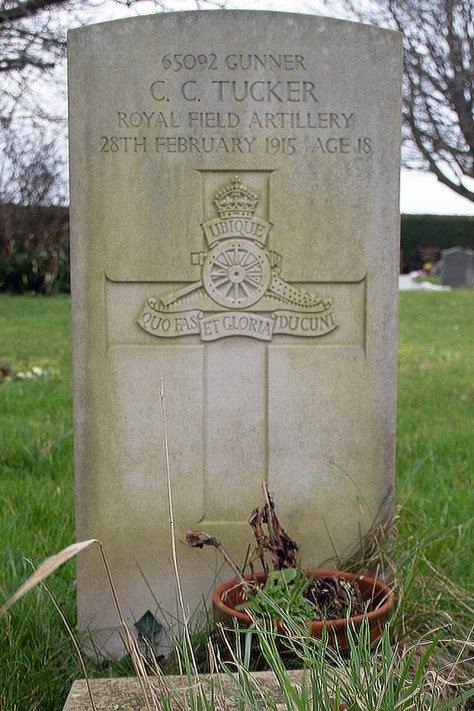
Gunner Clifford Tucker

Gunner Clifford Tucker

Clifford Charles Tucker was born in 1896, one of five children to John and Ellen Tucker. John was a shoemaker in the Somerset village of Othery, while Clifford became a farm labourer when he left school.

There is little documented of Clifford’s life, and what I have been able to identify about his military career has come from a newspaper article.

Much regret is felt in Othery at the new of the death of Clifford Tucker, one of the young fellows who volunteered for the service of their King and Country. Deceased, who was only 18 years of age… enlisted in the Royal Artillery about six weeks ago and was stationed at Brighton.

He was taken ill with pneumonia and died, his father arriving in time to see him before he breathed his last.

Taunton Courier and Western Advertiser: Wednesday 17th March 1915.

Gunner Tucker passed away on 28th February 1915, aged just 18 years old.

He lies at rest in the cemetery of his home village of Othery.


Corporal William Stevens

Corporal William Stevens

William Charles Stevens was born in Wells in 1884. The eldest child of Alfred and Susan, William was one of eleven children. Alfred worked at the local paper mill, while William became a labourer, and found work as a stonemason.

William seemed keen to improve his prospects, however; he enlisted in the army at the start of 1903, serving in the Royal Field Artillery for a period of four years, before being demobbed to the reserves.

On Christmas Day 1907, William married Minnie Bailey; the census four years later gives the young couple as living in their home city. William, by now, was labouring on the railway, and the census shows, they had had a child, who had sadly passed away.

War was looming, and Gunner Stevens was recalled to duty in August 1914. Quickly posted overseas with the 23rd Brigade, he fell ill with myalgia and was shipped home to recover towards the end of the year.

Sent back to the front in 1915, William was promoted to Corporal and transferred to the 51st (Howitzer) Brigade. Sadly, his ‘tremble’ returned and he was sent back to England in October 1915. By this point, Minnie had given birth to their second child, a little girl they called Lilian.

Corporal Stevens’ condition continued, and he was medically discharged in March 1916. No further records exist, but it seems that he finally succumbed to the condition later that year. He passed away on 2nd November 1916, aged 32 years old.

William Charles Stevens lies at peace in the cemetery of his home town, Wells in Somerset.


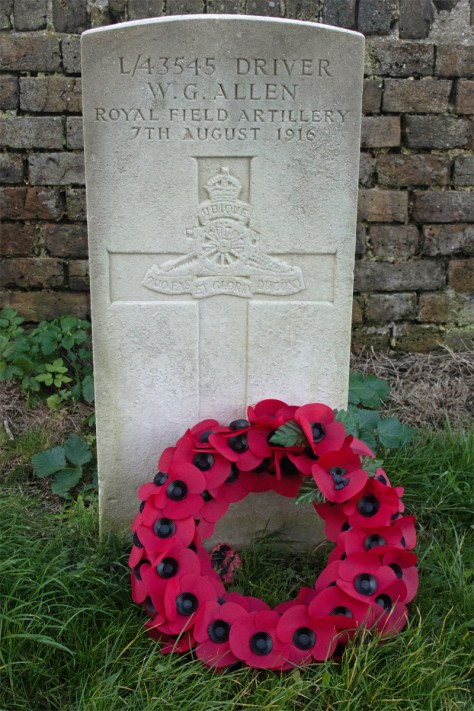
Driver William Allen

Driver William Allen

There are some times where no amount of research on a person will reveal their information.

William George Allen is one such person.


The only details I have been able to uncover for this man is his gravestone and the Army Register of Soldier’s Effects.

William Allen was a driver for the Royal Field Artillery. His troop – the 156th Camberwell Brigade – was raised in South London in early 1915, although I have no record of when Driver Allen enlisted.

At some point, the 156th Brigade were stationed at Port Victoria – the fort on the Isle of Grain in Kent.

It was during their time at the fort that William died. He passed on 7th August 1916 and there is no cause of death recorded, and he does not appear in any contemporary newspapers. This might suggest that his death was not out of the ordinary or unexpected.

Unusually for the Register of Soldier’s Effects, nobody is listed for the war gratuity payments to be made (this would normally be a next of kin – father, mother or spouse). In total a payment of £6 19s 2d was paid out, not an extravagant amount for that regiment.

So Driver Allen remains a mystery. A (presumably) young life lost too soon, and lost to time.

William George Allen lies at peace in the graveyard of St James’ Church in Grain, North Kent, metres from the fort in which he passed.


Gunner Thomas Holloway

Gunner Thomas Holloway

Thomas Charles Holloway was born in Chatham, Kent in 1893. The fourth of five children, his parents were Joseph, a domestic coachman, and Caroline Holloway.

By the time of the 1911 census, Thomas had left school and was working in a corn warehouse.

Thomas presented a bit of a challenge when I was researching his history.

His military records show that he enlisted on 31st December 1914, signing up to the Royal Field Artillery. However, Gunner Holloway’s service records show that he was posted on 9th January 1915, before being discharged as medically unfit just a week later. The records confirm that he served for 16 days.

The medical attestation states that he was discharged because of cardiac dilation and hypertrophy, a systolic murmur and dyspnoea, all heart-related conditions.

Despite only serving for just over a fortnight, he was afforded a Commonwealth War Grave when he died.

Searching the local newspapers of the time, a bigger story was unveiled.

The death of Bombardier Thomas Holloway, aged 24, of the RFA… occurred in a hospital at Cambridge. He was kicked by a horse in the course of his training, nearly two years ago, and had practically been on the sick list ever since. On recovering from the effects of the accident, he was seized with spotted fever at Seal, and ultimately succumbed to paralysis of the brain.

East Kent Gazette: Saturday 21st July 1917

The discrepancies between the original discharge and the newspaper report are intriguing. Either way, this was a young life cut far too short: he was 24 years old.

Gunner Thomas Holloway lies at rest in St Margaret’s Churchyard, in his home town of Rainham in Kent.

Gunner Thomas Kelly

Gunner Thomas Kelly

It is often a challenge to find details of the fallen soldiers whose graves pepper the churchyards of the UK.

Sadly, Gunner Thomas Kelly is one of those names lost to time.

Born in 1893, he lived in Alsager, Cheshire and enlisted in the Royal Field Artillery. He served in the Balkans during the war and was wounded. Brought back home to the Yeatman Hospital in Sherborne, Dorset, he died of his wounds on 11th January 1918.

He was buried in the town’s cemetery on 16th January 1918; he was just 25.

Driver Harry Austin

Driver Harry Austin

Harry Austin was born in the small Kent village of Bobbing in 1890. One of nine children to Richard and Emma Austin, his father was the village blacksmith, a trade two of his brothers followed after leaving school. Harry, however, became a general labourer in the coal industry.

Sadly, most of Harry’s wartime service is lost to time; we know that he enlisted in the Royal Field Artillery and served as a driver. The RFA was responsible for the medium-calibre guns and howitzers deployed close to the front line; Harry’s role, therefore, was likely to have involved driving the horses to and from the sites where the guns were needed.

Again, Driver Austin’s military records are somewhat lacking when it comes to his passing. However, where they mark him as ‘dead from disease’, a contemporary newspaper in memoriam gives a little more detail.

In ever loving memory of Driver Harry Austin, RFA… who passed away November 10th 1918, in the 1st Southern General Hospital, Birmingham, from influenza following Gun Shot wounds, aged 29 years.

East Kent Gazette – Saturday 23rd November 1918.

An untimely death for Harry, but particularly poignant, given that he passed the day before the Armistice was signed.

Driver Harry Austin lies at peace in the graveyard of St Bartholomew’s Church in his home village of Bobbing, Kent.