Category Archives: Uncategorized

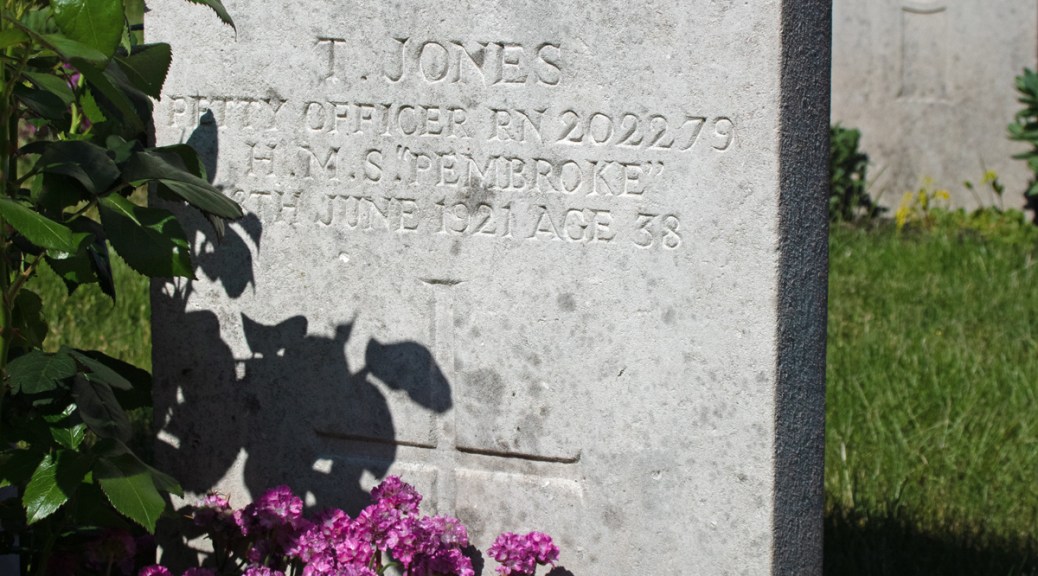
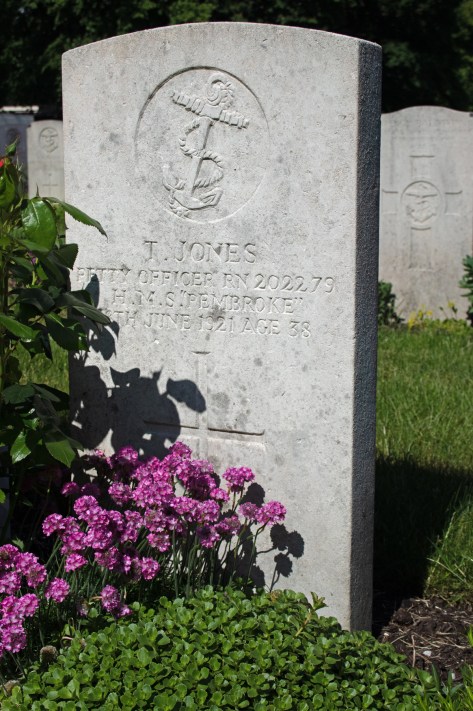
Petty Officer Tom Jones

Petty Office Tom Jones

Thomas Jones (known as Tom) was born in Wednesbury on 7th September 1882 and was the middle of seven children. His father, also called Thomas, was a grocer and, with his mother Mary, they raised their family first in the Staffordshire town and then in Blackpool, Lancashire.

When he left school Tom helped his dad in the shop, primarily dealing with meat. His mind was on greater adventures, however, and in November 1898, he enlisted in the Royal Navy. Due to his age, he was initially given the rank of Boy, but was officially signed up as an Ordinary Seaman on the day after his 18th birthday.

Over the time of his initial twelve years’ service, Tom rose through the ranks, from Able Seaman to Leading Seaman and Petty Officer. In May 1912, however, he was ‘disrated’ back to Able Seaman, but there is no evidence to confirm why this was done. By this time, he had served on nine ships, as well as having time in shore-based establishments, and had completed his twelve years as a mariner.

Meanwhile, in the autumn of 1904, Tom had married Hannah Kennedy, a dockyard labourer’s daughter from Gillingham, Kent. The couple went on to have four children and set up home in the centre of the town, not far from the Naval Dockyard where Tom was sometimes based.

With war in Europe on the horizon, Tom immediately volunteered to continue his duty when he term of service came to an end. Working hard, he soon regained the rank of Leading Seaman and, by April 1915, was back up to Petty Officer once more.

During the remainder of his time in the Royal Navy, Petty Officer Jones served on a further seven vessels. In October 1920, after more than two decades’ service, he was invalided out, having contracted tuberculosis, rendering him unfit to continue.

At this point Tom’s trail goes cold. It seems likely that his lung condition got the better of him; he passed away on 20th June 1921, at the age of 38 years old.

Petty Officer Tom Jones was laid to rest in the Woodlands Cemetery in Gillingham, Kent.


Tom Jones II
Petty Officer Tom Jones
(courtesy of ancestry.co.uk)

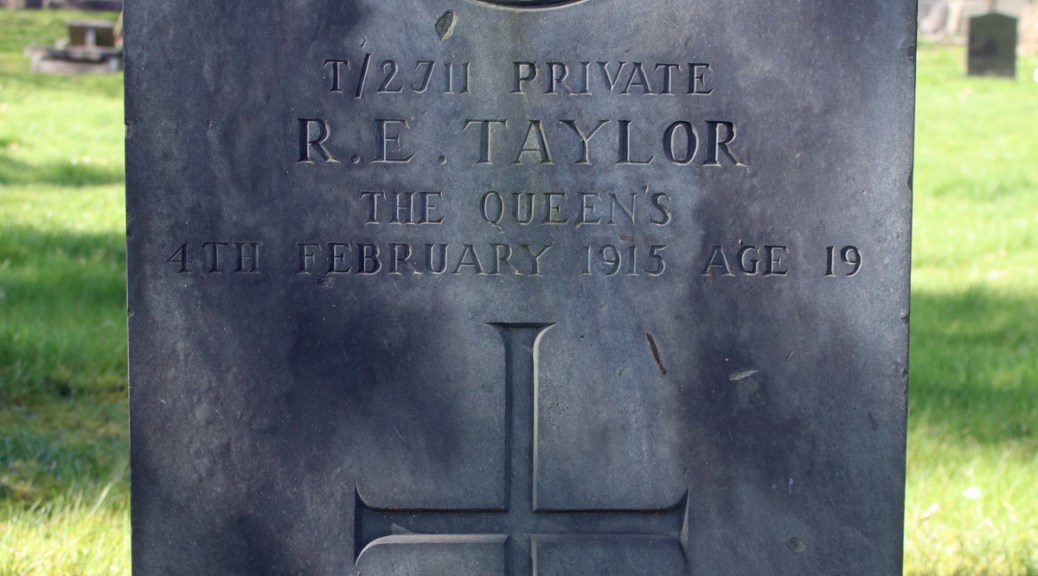
Private Richard Taylor

Private Richard Taylor

Richard Edmundson Taylor was born in 1895, one of nine children to Frederick and Emma Taylor. Frederick was from Portsmouth, Emma from Blackburn, but the couple had settled their family in Kent, where Frederick worked as an engineer and pattern maker at the Naval Dockyard in Chatham.

When he left school, Richard took work as an apprentice photographer – his older sister Mildred worked as a re-toucher in the same studio. The 1911 census reveals that his eldest sister, Alice, was working as a governess; the family of eleven were living in a small terraced house in Seaview Road, Gillingham – a road that, ironically, had no view of the nearby River Medway or Thames Estuary.

At this point, Richard’s trail goes cold. He enlisted in the Royal West Surrey Regiment – also known as the Queen’s – but there is no documentation to confirm when this was.

Private Taylor’s battalion, the 2/4th, would go on to fight at Gallipoli, but he would not have been involved, and, more than likely, did not see any overseas service. The prefix to his service number (T/2711) may well have indicated he was in training when he passed away, although, again, there is no physical evidence to confirm this.

Nor is there any indication of the cause of Private Taylor’s death. His name does not appear on any contemporary newspaper reports, so it is unlikely that it was due to any misadventure; more probably, he passed away from one of the many communicable diseases that became common in the training camps of the 1910s.

Whatever the cause, Private Taylor died at home on 4th February 1915. He was just 19 years old.

Richard Edmundson Taylor lies at rest in the Woodlands Cemetery in his home town of Gillingham, Kent.


Private Frank Woods

Frank Ernest Woods was born in 1885, one of seven children to Thomas and Alice. Thomas was a labourer and he raised his family in Worcestershire.

Frank left home early – by the time of the 1901 census, he was living as a gardener for the Cornforth family, who were grain merchants in South Claines, near Worcester.

Frank’s work with the family continued; the 1911 census show that they had relocated to Kensington. The Cornforth family were now running the Eaton Court Hotel, a boarding house with nineteen rooms; the 25-year-old Frank had been elevated to the role of waiter.

Another of the Cornforths’ staff was a housemaid, 20-year-old Ethel Elizabeth James; within a matter of years, the couple were courting, and Frank and Ethel married in November 1915.

The Great War was already being waged across the Channel, and Frank enlisted, joining the Rifle Brigade in June 1916. Within three months, he was fighting on the Western Front.

Private Frank Woods was killed in action in Belgium on 10th October 1918. He was 33 years old. He is remembered on the Tyne Cot Memorial in Zonnebeke.


Frank Ernest Woods was the first husband of my Great Great Great Aunt, Ethel Elizabeth James.

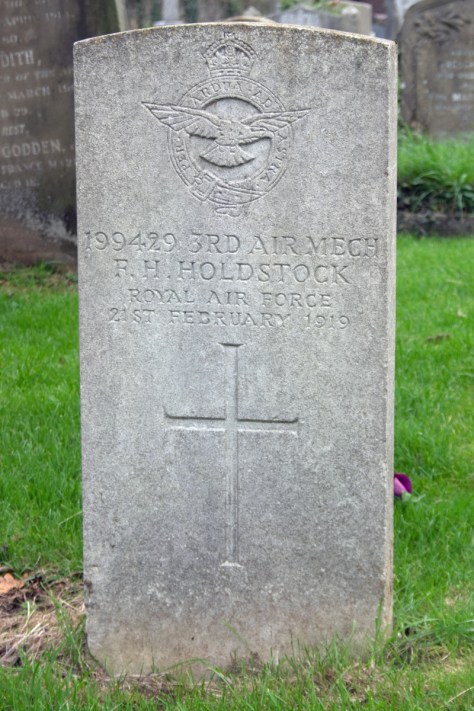
Air Mechanic Herbert Holdstock

Air Mechanic Herbert Holdstock

The year is 1897, and Edwin Holdstock has crammed a lot into his 38 years. Born in North Kent, he has travelled well, working as a grocer’s manager in south London. His first wife, Kate, gave him five beautiful children, four girls and a boy, before she died, aged only 35. Edwin married again, to Louisa, and they have already had their first child, a boy.

A new birth is on its way, though, and his third son – Herbert Frederick Victor Holdstock is born. They are living in Thornton Heath, Surrey.

The family up and move again, this time to Grimsbury, near Banbury, Oxfordshire. Edwin has new employment, as a superintendent for Kingsley Sewing Machines in the town.

Edwin appears to be an ambitious man; by the time of the 1911 census, he has moved the family from Oxfordshire back to Kent. He and Louisa have four children now and they live in Rainham, where Edwin works as a Political Agent.

Herbert was keen to make his own way in the world, however, and worked as an apprentice watchmaker and jeweller in both Rainham and nearby Sittingbourne.

He enlisted relatively late into the war; his service records show that Air Mechanic Holdstock started his Royal Air Force service on 20th June 1918. He was stationed in South London.

While there, he contracted pneumonia and was hospitalised. Within a week, Herbert had passed away. He was just 21 years old.

The local newspaper reported on his funeral:

Only so recently as November Mr EC Holsdtock of Orchard-street, Rainham, the Secretary of the Sittingbourne District War Pensions Committee, sustained a sad bereavement in the death of his wife [Louisa], who succumbed to an attack of influenza and pneumonia. Mr Holdstock has now suffered another bereavement in the death of his second son, Herbert Frederick Victor Holdstock, who died in the Royal Herbert Hospital, Woolwich… A little over eight months ago he joined the Royal Air Force, as a mechanic, as was stationed at Kidbrook, near Woolwich. Never robust, he contracted pneumonia, and after a week’s illness succumbed. He was a bright, cheery young man, and much liked.

East Kent Gazette: Saturday 1st March 1919.

Air Mechanic Herbert Holdstock lies at rest in the graveyard of St Margaret’s Church in Rainham, Kent.

Serjeant Leonard Paul

Serjeant Leonard Paul

Leonard Paul was born in Chesham, Hertfordshire. One of six children, he was the second son PC Harry Paul and his wife Mary Martha.

By the time of the 1901 census, Harry had been promoted and had moved his young family – William, Ivy, Leonard and Stuart – to Harmondsworth, where he worked as the Station Sergeant.

It’s clear than Leonard wanted to better himself, as in August 1908 he enlisted in the Royal Field Artillery. After training, he was posted overseas, arriving in India in March 1910. He is listed as a driver in the barracks at Ambala on the 1911 census.

When war broke out, his battalion was moved to the Western Front and he arrived in France in November 1914. Leonard was appointed a Shoeing Smith at the start of 1915, before being promoted to Farrier Serjeant later that year.

Serjeant Paul’s battallion, the 110th Brigade, fought in some of the bloodiest battles of the war – Somme, Pozieres, Third Ypres – and it is almost certain that he was involved in this battles in some respect.

Leonard’s records show that he was admitted hospital in St Omer on 16th March 1917 with Trench Fever, before being invalided back to the UK a few weeks later.

Serjeant Paul was medically discharged from the RFA at the end of April; his release notes show that he was “physically unfit with tubercle of the lung”. His father having retired from the police force, his parents has moved to Kent by this point, and were living in Rainham, where Leonard joined them.

A contemporary newspaper picks up Serjeant Paul’s story from there.

The young man… joined the Army, and had served in France, where he was gassed. This undermined his health, and he fell into a decline, and after lingering for a year at home, died on Saturday [25th May 1918].

East Kent Gazette: Saturday 1st June 1918

A century on, the cause of Leonard’s lung affliction (a gas attack or trench fever) is neither here nor there. Either way, he suffered for a long time before finally succumbing. He was 29 years old.

Serjeant Leonard Paul lies at peace in the St Margaret’s Churchyard, Rainham.