Tag Archives: 1918

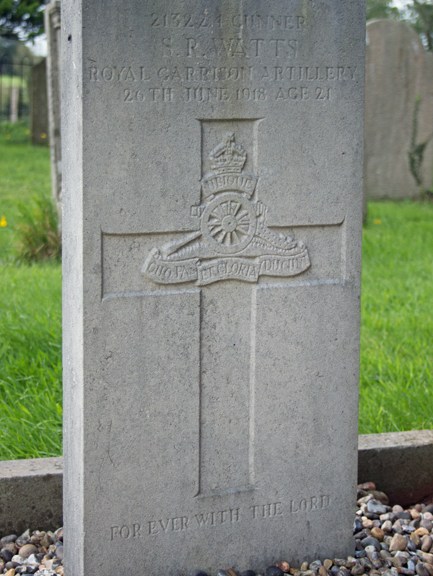
Gunner Samuel Watts

Gunner Samuel Watts

Samuel Reginald Watts was born in 1897, the seventh of eight children of Samuel and Augusta Watts.

He followed his father and brothers into the main industry in the area – coal mining – and was certainly working down the pits by the time of the 1911 census.

Samuel enlisted on 21st April 1918, and joined the Royal Garrison Artillery, which focused on heavy, large-calibre guns and howitzers that were positioned some way behind the front line. He was 5’5″ (1.65m) tall and weighed 144lbs (65kg). According to his war records, he had brown hair, hazel eyes and a fresh complexion.

His service started the very next day, when he was transferred to the Citadel in Plymouth for training.

After feeling unwell, complaining of headaches and a sensitivity to light, Gunner Watts was admitted to the Netley Hospital in Southampton on 18th June 1918. He was diagnosed with cerebrospinal fever, more commonly known as meningitis, and was treated over the next week.

Sadly, the treatment did not work, and Gunner Samuel Watts passed away on the evening of 26th June 1918. He had been in the army for a little over two months and had not seen active service.

Samuel Watts lies at peace in the graveyard of St John’s Church, Farrington Gurney.

Private Stephen Rawle

Private Stephen John Rawle

Stephen John Rawle was born in 1894, the second of four sons of George Rawle, a sailor, and Louisa, his wife.

By the time war broke out, Stephen was working as a groom in Wheddon Cross, just south of Minehead.

As the Great War loomed, he enlisted and Private Rawle serving on the home front. His record show that he stood at 5ft 9.5ins (1.76m) and was of good enough health to be enrolled for the Territorial Force. He was assigned to the West Somerset Yeomanry.

He was medically discharged from service on 29th March 1915, having served for one year and 31 days.

The records show no signs of injury or wounds, and newspapers of the period do not link him with any misadventure. I can only assume, therefore, that he died of natural causes, possibly linked to the Spanish Flu Pandemic. Stephen died on 5th September 1918. He was 25 years old.

Private Stephen John Rawle lies at rest in the churchyard of Lydeard St Lawrence, alongside two of his brothers, Ernest and William.


George and Louisa’s other son – Edward – also served, enlisting in the Somerset Light Infantry and fighting in the Balkans. Private Edward Rawle survived the war, returning home in March 1919.

It should be noted that, by June 1921, George and Louisa had lost three of her four sons to the Great War. Their daughter, Norah, had also passed away in 1918.

The 1921 census found Louisa living in East Town, in the parish of Tolland, not far from Lydeard St Lawrence. Edward was living with her, as were her three-year-old granddaughter, Lorna, and her eighteen-month-old grandson Beatty. It is unclear whose children they were. George, at this point, was helping his younger brother out on the family farm in Williton.


Private George Symons

Private George Symons

George Symons was born in 1895 to Charles and Rosa Symons. He was the third of five sons.

Charles worked as a carter on a farm, and his son became a cowman as soon as he could leave school.

Military records for George Symons are pretty sparse. From his gravestone we know he had joined the Somerset Light Infantry by the end of 1917. Assigned to the 4th Battalion, Private Symons’ unit served in India and the Middle East throughout the war, and it was while he was overseas that he was caught up on the fighting.

In the confusion of battle, George was initially recorded as ‘presumed dead’. Subsequently identified as badly injured, he was medically repatriated to Britain for treatment. Admitted to hospital, his wounds were to prove too severe: Private Symons passed away on 23rd June 1918: he was 23 years old.

George Symons’ body was taken back to Somerset for burial. He lies at rest in the churchyard of St Michael and All Angels in Milverton.


Shoeing Smith George Stone

Shoeing Smith George Henry Stone

George Henry Stone was born in 1872, son of Milverton’s blacksmith James Stone and his wife Mary Ann. He followed in his father’s footsteps and, by the time he married Mary Florence Paul in 1894, he was also working in the forge in Milverton.

George and Mary had eight children – seven girls and one boy; by the time he signed up in 1915, he listed himself as a blacksmith.

His military records show that he was medically certified as Category B2 (suitable to serve in France, and able to walk 5 miles, see and hear sufficiently for ordinary purposes). He was assigned to the Remount Depot in Swaythling, Southhampton, which was built specifically to supply horses and mules for war service. (In the years it was operating, Swaythling processed some 400,000 animals, as well as channelling 25,000 servicemen to the Front.)

While serving George contracted pneumonia. He was treated in Netley Military Hospital, but passed away on 19th November 1918, aged 47.

Shoeing Smith George Henry Stone lies at peace in a quiet corner of St Michael & All Angel’s churchyard in his home village of Milverton.

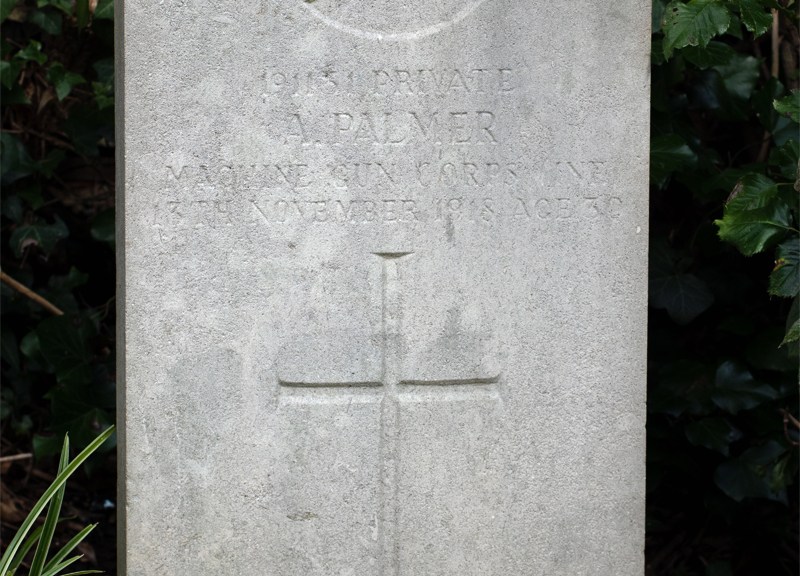
Private Arthur Palmer

Private Arthur Palmer

Arthur Palmer was born in Bicester in 1889 to groomsman George Palmer and his wife Annie. Arthur was the eldest of five children, five boys and one girl.

By 1911, the family had moved to Dorset, where George continued to work as a groom. His son, Arthur, had also gone into domestic service, and was a footman. Presumably this was under the same employ as his father, although the records do not confirm this.

This is where the trail for Arthur Palmer dries up.

From his gravestone, we know he served in the Machine Gun Corps (MGC). The Register of Soldiers’ Effects confirms he was in the 3rd Company; this was formed in January 1916, so Private Palmer can only have enlisted after that date.

Online research only brings up MGC military service records for an Arthur George Palmer, who lived in Kettering. However, this Private survived the war, so could not be the one buried in Dorset. There is nothing in contemporary newspapers to suggest that there was anything untoward or unusual about his passing.

All I can say for certain is that Private Arthur Palmer died at the Cannock Chase Military Hospital on 13th November 1918.

He lies at rest in Sherborne Cemetery, Dorset. He was 30 years old.

Rifleman Frederick Batson

Rifleman Frederick Batson

Frederick Batson was born in Sherborne in 1888, the eighth child of Cornelius and Mary Ann Batson.

Far too young, Frederick was an orphan as Cornelius died when he was just a year old; Mary Ann passed away in 1906, when he was 18.

There was positive news on the horizon, however; in January 1909, Fred married Elsie Frances Marshallsea and by the time of the 1911 census, the couple were living in Sherborne and had a year old daughter, Eveline. Fred was working as a carpenter and journeyman and the young couple went on to have three further children.

Rifleman Batson enlisted in the Prince of Wales Volunteers (South Lancashire Regiment) in 1916. This battalion fought on the Western Front during the Great War, and was involved in both Ypres, the Somme and Passchendaele.

It is not clear whether Frederick was involved in these battles. Back on home soil, he was admitted to a military hospital in Newport, South Wales, and passed away on 22nd March 1918, following an illness.

Rifleman Frederick Batson lies at rest in Sherborne Cemetery, reunited with his parents.

Lance Corporal William Warne

Lance Corporal William Warne

William Henry Warne was born in Walworth, South London, in March 1892. His father is not named, but his mother was Ellen Warne (or Gould), who was “living on her own means”. He had two older siblings, Fred – whose surname is listed as Gould – and Gertie Warne.

By the time of the 1911 census, William was a law clerk in West Coker, near Yeovil in Somerset. The record shows him living with his mother and sharing her surname – which was now listed as Gould. Again, Ellen’s occupation was “private means”.

William’s full military service records are not available, but various sources produce a little information.

Private William Warne had enlisted in the Dorset (Queen’s Own) Yeomanry by April 1915, as this is when he was dispatched to Egypt. August 1915 saw his battalion shipped to Gallipoli; William survived this horrendous battle and returned to Egypt by the end of that year. As a result, he earned the 1915 Star medal.

When the Dorset Yeomanry was retitled, Private Warne became part of the Corps of Hussars. After Egypt, the battalion moved to Palestine, where they saw out the war. He was appointed Lance Corporal at some point during this time.

The exact details of his passing are lost to time; he passed away on 9th October 1918 at the British Red Cross Hospital in Netley, and his records suggest that he died of wounds. He was 26 years old.

Lance Corporal Warne’s life was an intriguing one from start to finish.

The Army Register of Soldiers’ Effects is a document that shows how much was paid out to the relatives of soldiers who have passed away in service; in the research I have carried out over the last few months, this amount has generally ranged between £2 and £8, rarely reaching double figures.

William’s mother and sister, however, received a significant amount. The initial payment was £31 13s 8d, and this was followed by a second figure of £19 10s. There may be various reasons for this – the campaigns William fought in, the prestigious regiment, the appointment to Lance Corporal – but again this is another mystery that will remain such.

Lance Corporal William Warne lies at rest in Sherborne Cemetery.

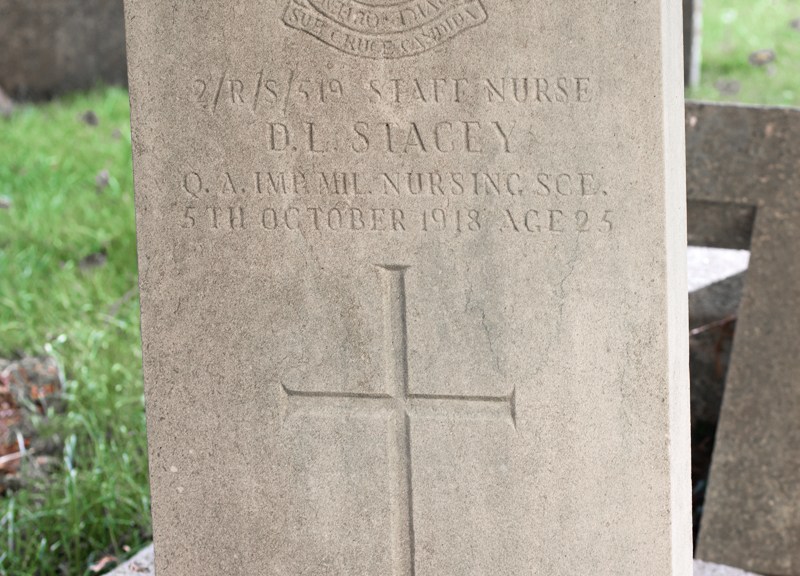
Staff Nurse Dorothy Stacey

Staff Nurse Dorothy Stacey

Dorothy Louise Stacey was born in 1893, the eldest child of Alfred Stacey, a farmer, and his wife Mary.

The family lived at Middle Farm in Charlton Horethorne, a small village midway between Sherborne and Wincanton. Alfred Stacey ran the farm, and by the time of the 1901 census, the family of four had a live-in domestic servant, Beatrice Baker.

Things had moved on by the next census return of 1911. Alfred and Mary had moved the young family 150 miles east, where they were now running Buttons Farm in Wadhurst, East Sussex. I can find no familial link for what would have been a significant move in the early 1900s, but it may be that Alfred was headhunted. The records show that Mary and Dorothy were assisting Alfred in running the farm, along with new domestic servant Mary Hide. The family were joined by Marjorie Anderson, a live-in governess for younger daughter Mollie.

Dorothy Stacey joined the Queen Alexandra’s Imperial Military Nursing Service Reserves (QAIMNS) during the war. The official female unit for medical services in the British Army, those joining had to come from ‘good families’ and be qualified nurses. It can only be assumed, therefore, that Dorothy undertook additional training after 1911, presumably in order for her to be able to join up.

Staff Nurse Stacey was based at Worgret Camp, on the outskirts of Wareham, Dorset. Full details of her time there are no longer available, but she would have been exposed to a variety of illnesses while attending the soldiers under her care. Sadly, this was to prove to be her undoing. She passed away in the facility where she worked on 5th October 1918, having contracted a combination of bronchitis and nephritis. She was just 25 years of age.

When the family had been living near Sherborne, Dorothy had attended the Convent of St Anthony’s school. It was to the convent’s chapel that she was taken following her passing.

After the funeral service was held there, Dorothy Louise Stacey was laid to rest in Roman Catholic section of Sherborne Cemetery.


Gunner Thomas Kelly

Gunner Thomas Kelly

It is often a challenge to find details of the fallen soldiers whose graves pepper the churchyards of the UK.

Sadly, Gunner Thomas Kelly is one of those names lost to time.

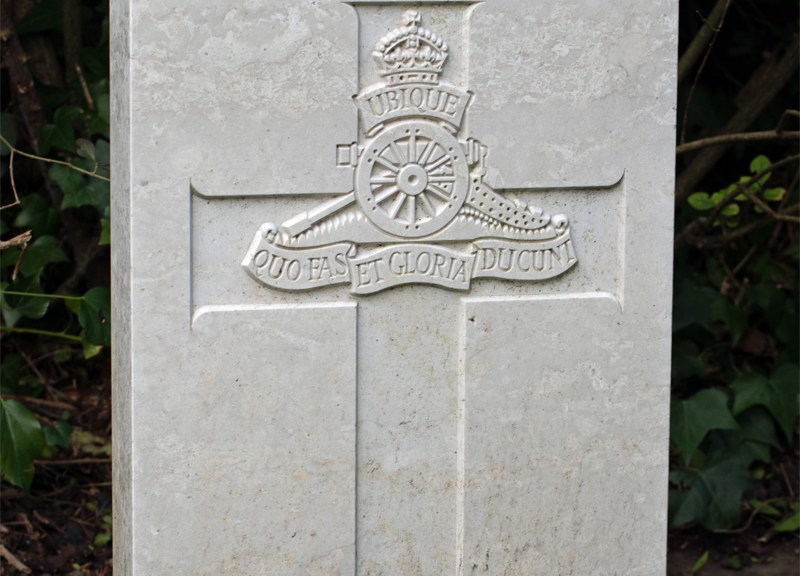
Born in 1893, he lived in Alsager, Cheshire and enlisted in the Royal Field Artillery. He served in the Balkans during the war and was wounded. Brought back home to the Yeatman Hospital in Sherborne, Dorset, he died of his wounds on 11th January 1918.

He was buried in the town’s cemetery on 16th January 1918; he was just 25.

Private Samuel Cook

Private Samuel Cook

Samuel Cook was born in Bedfordshire, the eldest of two children to Alfred and Phoebe Cook.

Alfred was a forester, which saw the family move around the country; the 1881 census found them living in Rutland, ten years later the family was recorded in Northamptonshire and by the 1911 census, they were in Dorset.

Samuel was quick to follow in his father’s footsteps, supporting his mother and sister after Alfred died in 1906.

The war was underway when Samuel was called up. His Devonshire Regiment service records show that he enlisted on 11th December 1915. His fitness seemed to have determined the path his military career would take.

Initially Private Cook was classified as C1 (free from serious organic diseases and able to serve in garrisons at home, able to walk 5 miles, see to shoot with glasses, and hear well), but was upgraded to B2 within six months. This identified that he was free from serious organic diseases, able to stand service on lines of communication in France, or in garrisons in the tropics and able to walk 5 miles, see and hear sufficiently for ordinary purposes.

Samuel was first enrolled in 13th (Works) Battalion of the Devonshire Regiment, before being transferred to the 311th (HS) Labour Company in Plymouth.

Private Cook was one of the thousands of soldiers who contracted influenza and subsequently died of pneumonia on 1st November 1918.

There seems to be some dispute over how and when Samuel fell ill. A request for a detailed medical report was sent, “as he appeared to have contracted the disease from which he died whilst on leave for the purpose of getting married”. The same request confirms that he was never admitted to hospital while in the company. (There are no records oh Samuel having married, so I am assuming that his leave may have been for wedding preparations, of normal leave.)

The report came back confirming that he has died from “pneumonia complicating influenza which was contracted whilst on service at Beaulieu”.

However and wherever it happened, the disease claimed Private Samuel Cook’s life; he lies at rest in Sherborne Cemetery, Dorset.