Cecil John Paine was born in Sherborne, Dorset, in May 1899, the son of John and Emily Paine. He was the fifth of seven children, and the second son.
Cecil’s military records are sparse, but the local newspaper provides more information. According to the Western Gazette, Cecil joined up on reaching his 18th year, and had only been in service for three weeks, when he succumbed to pneumonia at Chiseldon Camp in Wiltshire on 6th June 1917.
Private Cecil Paine lies at rest in Sherborne Cemetery.
As an aside, Chiseldon Camp was initially set up to train new soldiers. In 1915, part of it was developed into a hospital for wounded soldiers before, in 1916, it began to treat soldiers coming back from the front who had contracted VD. Interesting times that Private Paine probably knew little about.
Cecil’s eldest brother, Frederick William Paine also served in the Great War. He had enlisted in the navy in 1903, initially for 12 years, but continued on and was finally discharged in 1919.
John Kennell was born in Yeovil in 1872. One of five children, he was the only son of bootmaker Francis Kennell and his wife Elizabeth.
John enlisted in the Dorsetshire Regiment in 1888. Interestingly, his enlistment records give his surname – and that of his parents – as Hosegood. When he was discharged, however, the documents give him as John Hosegood alias Kennell (the census records confirm his family name as Kennell, however).
Private Hosegood was initially based at The Citadel Military Barracks in Plymouth. His service meant he travelled the world – he spent two years in Egypt, four in India and two in South Africa (where he was involved in the relief of Ladysmith). In all, John served 14 years in the army and was discharged in May 1902.
John married Bessie Greenstock six weeks after being demobbed; the Banns show they wed in the Parish Church of Sherborne (or Sherborne Abbey), and list John as a soldier. He was 30, Bessie seven years older.
By the time of the 1911 census, the couple were living with their two young children – Francis and Edith – and Bessie’s widowed mother in the village of Oborne, two miles to the west of Sherborne in Dorset.
When war broke out, John reenlisted within weeks. After a period of re-training, Private Kennell was posted to France as part of the British Expeditionary Force on 23rd October 1914, and served nearly three years on the Western Front.
Private Kennell returned to the UK on 30th December 1916, and remained there until being discharged as no longer fit for war service in July 1917. Sadly, I have been unable to find any details of what led to him being discharged, but the service records do not suggest that he was wounded in any way.
After his discharge, details of John’s life are sparse. His name does not appear in any newspapers of the time, and all I have been able to find it that he passed away on Christmas Eve 1919. He was 47 years old and was buried five days later.
Private John Kennell lies at rest in Sherborne Cemetery, Dorset.
Frederick Batson was born in Sherborne in 1888, the eighth child of Cornelius and Mary Ann Batson.
Far too young, Frederick was an orphan as Cornelius died when he was just a year old; Mary Ann passed away in 1906, when he was 18.
There was positive news on the horizon, however; in January 1909, Fred married Elsie Frances Marshallsea and by the time of the 1911 census, the couple were living in Sherborne and had a year old daughter, Eveline. Fred was working as a carpenter and journeyman and the young couple went on to have three further children.
Rifleman Batson enlisted in the Prince of Wales Volunteers (South Lancashire Regiment) in 1916. This battalion fought on the Western Front during the Great War, and was involved in both Ypres, the Somme and Passchendaele.
It is not clear whether Frederick was involved in these battles. Back on home soil, he was admitted to a military hospital in Newport, South Wales, and passed away on 22nd March 1918, following an illness.
Rifleman Frederick Batson lies at rest in Sherborne Cemetery, reunited with his parents.
Augustus Kenneth Seymour Dodge was born in September 1898 to shoe and furniture dealer Augustus William Dodge and his wife Mildred. The elder of two children, Augustus and his family lived on Cheap Street, the main retails thoroughfare of his home town, Sherborne.
Augustus William had been plying his trade for a number of years, having been apprenticed to his father – another Augustus – in Frome and Devizes.
Augustus Kenneth joined the 7th Battalion of the Dorsetshire Regiment, a territorial reserve, which was trained in North Wales and based on a camp in Wool, near Bovington, Dorset. Sadly, I have been able to find little else of his military life, but it is unlikely that he was involved on the front line.
Private Dodge died on 31st March 1917, aged just 18. Nothing in the newspapers of the time suggest an unusual or violent passing, so it can only be assumed that he died from an illness, possibly influenza or pneumonia.
Augustus Kenneth Seymour Dodge lies at peace in the cemetery of his home town, Sherborne.
I was intrigued that Augustus Kenneth’s gravestone also commemorates his father – Augustus William Dodge – and so I did a bit more research. I found that the 1910s were not a good time for the Dodge family.
Augustus Dodge Sr (Augustus William’s father) died in 1912, at the age of 88. He left his estate – totalling more than £500,000 in today’s money – to his widow, Mary Ann, and two of his sons, including Augustus William.
Mary Ann Dodge passed away in April 1916, as the local newspaper reported:
Mrs Dodge, widow of the late Mr Augustus Dodge [Sr] died unexpectedly at her residence at Butts-hill on Thursday last. Mrs Dodge, who was in her 82nd year, walked down to St John’s Church in the morning and attended a service, and then walked up the hill to her home. She was taken ill at noon and passed away two hours later. On Saturday morning, the family received the news that Mr Hubert Dodge, bootmaker, or Warminster (brother of the late Me Augustus Dodge) had died.
Somerset Standard: Friday 28th April 1916
By this point, and within six years, Augustus William Dodge had lost both of his parents and his uncle Hubert. He had also lost his daughter, Ethel, who had died in 1910.
Another of Augustus William’s uncles, Albion Dodge, died in 1917, as did Private Augustus Kenneth Dodge, his son, and the protagonist of this post.
The effect of these losses – particularly that of his eldest son – cannot be underestimated and may well have contributed to his own passing, a year later.
Augustus William Dodge died on 17th June 1918, aged 51.
The Somerset Standard show how much of a businessman he had been, however, with an announcement of the sale of his estate, which included:
LARGE SHOP AND DWELLING-HOUSE, with extensive Premises in the rear, No 3 Stony-street, Frome, in the occupation of Mr Arthur Dodge, at £40 per annum.
SHOP AND PREMISES, No 4 Stony-street, Frome, in the occupation of the Argentine Meat Co. Ltd’, t £25 per annum.
SHOP AND PREMISES, No 13 Market-place, Frome, in the occupation of the National Party, at £18 per annum.
Substantially-built and Commodious TWO-STOREY WAREHOUSE, with Accommodation for Motor Car or Van, situate in the Blue Boar Yard, Frome. The top story is in the occupation of the Frome Town Band, at £12 per annum. The bottom storey is void.
DWELLING-HOUSE AND PREMISES, No 25 King-street, Frome, in the occupation of Mrs Thomas at £13 8s 8d per annum.
DWELLING-HOUSE AND PREMISES, No 1 Willow Vale, Frome, lately occupied by Mr Clarke, a £15 12s per annum.
TWO Substantially-built RESIDENCES with large Gardens, Nos 1 and 2 Hythe House, Rodden Lake, Frome, together with PADDOCK adjoining, in the occupation of Messrs Webb, Golden and Haddrell, at the net annual rental of £37.
FIVE COTTAGES AND GARDENS, Nos 2, 3, 4, 5, 6 Rodden Lake, Frome.
A commodious 3-storey WAREHOUSE, with double-door entrance for vans and side entrance, situate and being No 22 Vicarage-street Frome, in the occupation of Mr E Glass at £8 per annum.
SHOP, with DWELLING-HOUSE AND GARDEN, in Cheap-street, Sherborne, Dorset, in the occupation of Miss Beedell, at £20 per annum.
William Henry Warne was born in Walworth, South London, in March 1892. His father is not named, but his mother was Ellen Warne (or Gould), who was “living on her own means”. He had two older siblings, Fred – whose surname is listed as Gould – and Gertie Warne.
By the time of the 1911 census, William was a law clerk in West Coker, near Yeovil in Somerset. The record shows him living with his mother and sharing her surname – which was now listed as Gould. Again, Ellen’s occupation was “private means”.
William’s full military service records are not available, but various sources produce a little information.
Private William Warne had enlisted in the Dorset (Queen’s Own) Yeomanry by April 1915, as this is when he was dispatched to Egypt. August 1915 saw his battalion shipped to Gallipoli; William survived this horrendous battle and returned to Egypt by the end of that year. As a result, he earned the 1915 Star medal.
When the Dorset Yeomanry was retitled, Private Warne became part of the Corps of Hussars. After Egypt, the battalion moved to Palestine, where they saw out the war. He was appointed Lance Corporal at some point during this time.
The exact details of his passing are lost to time; he passed away on 9th October 1918 at the British Red Cross Hospital in Netley, and his records suggest that he died of wounds. He was 26 years old.
Lance Corporal Warne’s life was an intriguing one from start to finish.
The Army Register of Soldiers’ Effects is a document that shows how much was paid out to the relatives of soldiers who have passed away in service; in the research I have carried out over the last few months, this amount has generally ranged between £2 and £8, rarely reaching double figures.
William’s mother and sister, however, received a significant amount. The initial payment was £31 13s 8d, and this was followed by a second figure of £19 10s. There may be various reasons for this – the campaigns William fought in, the prestigious regiment, the appointment to Lance Corporal – but again this is another mystery that will remain such.
Lance Corporal William Warne lies at rest in Sherborne Cemetery.
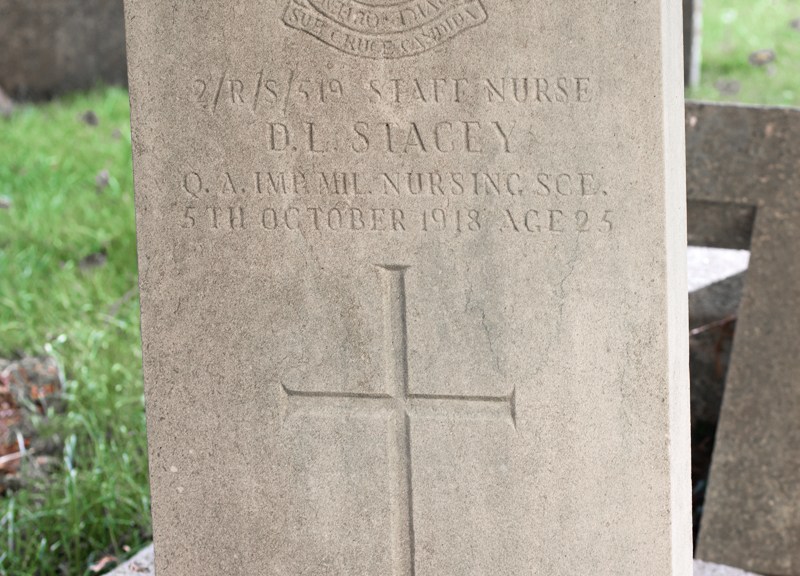
Dorothy Louise Stacey was born in 1893, the eldest child of Alfred Stacey, a farmer, and his wife Mary.
The family lived at Middle Farm in Charlton Horethorne, a small village midway between Sherborne and Wincanton. Alfred Stacey ran the farm, and by the time of the 1901 census, the family of four had a live-in domestic servant, Beatrice Baker.
Things had moved on by the next census return of 1911. Alfred and Mary had moved the young family 150 miles east, where they were now running Buttons Farm in Wadhurst, East Sussex. I can find no familial link for what would have been a significant move in the early 1900s, but it may be that Alfred was headhunted. The records show that Mary and Dorothy were assisting Alfred in running the farm, along with new domestic servant Mary Hide. The family were joined by Marjorie Anderson, a live-in governess for younger daughter Mollie.
Dorothy Stacey joined the Queen Alexandra’s Imperial Military Nursing Service Reserves (QAIMNS) during the war. The official female unit for medical services in the British Army, those joining had to come from ‘good families’ and be qualified nurses. It can only be assumed, therefore, that Dorothy undertook additional training after 1911, presumably in order for her to be able to join up.
Staff Nurse Stacey was based at Worgret Camp, on the outskirts of Wareham, Dorset. Full details of her time there are no longer available, but she would have been exposed to a variety of illnesses while attending the soldiers under her care. Sadly, this was to prove to be her undoing. She passed away in the facility where she worked on 5th October 1918, having contracted a combination of bronchitis and nephritis. She was just 25 years of age.
When the family had been living near Sherborne, Dorothy had attended the Convent of St Anthony’s school. It was to the convent’s chapel that she was taken following her passing.
After the funeral service was held there, Dorothy Louise Stacey was laid to rest in Roman Catholic section of Sherborne Cemetery.
Nelson Victor Pitman was born in April 1890, the fourth of eight children to George Pitman and Amy Roles Pitman (née Treasure). George was a butcher’s assistant, and the family lived in their home town of Sherborne in Dorset.
As with a number of the other servicemen I have been researching, Nelson’s military records are sparse, probably lost to time. He is not listed as living with his parents on the 1911 census and, in fact, is nowhere to be found.
On 2nd January 1915, Nelson marries Alice Moores at the parish church (Sherborne Abbey). His profession is listed as soldier, so we know that, but this point in the war, he had enlisted.
While there are no records of Private Pitman’s service, his battalion, the 1st Royal Warwickshire Regiment was involved in a number of the key battles of the war, including the second Ypres, Arras and Passchendaele. The battalion was also involved in the Christmas Truce, so there is a slight chance that Nelson played football with his German counterparts in one of the defining moments of the Great War.
Private Pitman survived the war to end all wars, but was discharged on 22nd February 1919 with a disability. He was suffering from bronchitis, and steadily went downhill.
Private Nelson Pitman passed away eighteen months later, on 21st November 1920. He was 31 years old.
Samuel Cook was born in Bedfordshire, the eldest of two children to Alfred and Phoebe Cook.
Alfred was a forester, which saw the family move around the country; the 1881 census found them living in Rutland, ten years later the family was recorded in Northamptonshire and by the 1911 census, they were in Dorset.
Samuel was quick to follow in his father’s footsteps, supporting his mother and sister after Alfred died in 1906.
The war was underway when Samuel was called up. His Devonshire Regiment service records show that he enlisted on 11th December 1915. His fitness seemed to have determined the path his military career would take.
Initially Private Cook was classified as C1 (free from serious organic diseases and able to serve in garrisons at home, able to walk 5 miles, see to shoot with glasses, and hear well), but was upgraded to B2 within six months. This identified that he was free from serious organic diseases, able to stand service on lines of communication in France, or in garrisons in the tropics and able to walk 5 miles, see and hear sufficiently for ordinary purposes.
Samuel was first enrolled in 13th (Works) Battalion of the Devonshire Regiment, before being transferred to the 311th (HS) Labour Company in Plymouth.
Private Cook was one of the thousands of soldiers who contracted influenza and subsequently died of pneumonia on 1st November 1918.
There seems to be some dispute over how and when Samuel fell ill. A request for a detailed medical report was sent, “as he appeared to have contracted the disease from which he died whilst on leave for the purpose of getting married”. The same request confirms that he was never admitted to hospital while in the company. (There are no records oh Samuel having married, so I am assuming that his leave may have been for wedding preparations, of normal leave.)
The report came back confirming that he has died from “pneumonia complicating influenza which was contracted whilst on service at Beaulieu”.
However and wherever it happened, the disease claimed Private Samuel Cook’s life; he lies at rest in Sherborne Cemetery, Dorset.
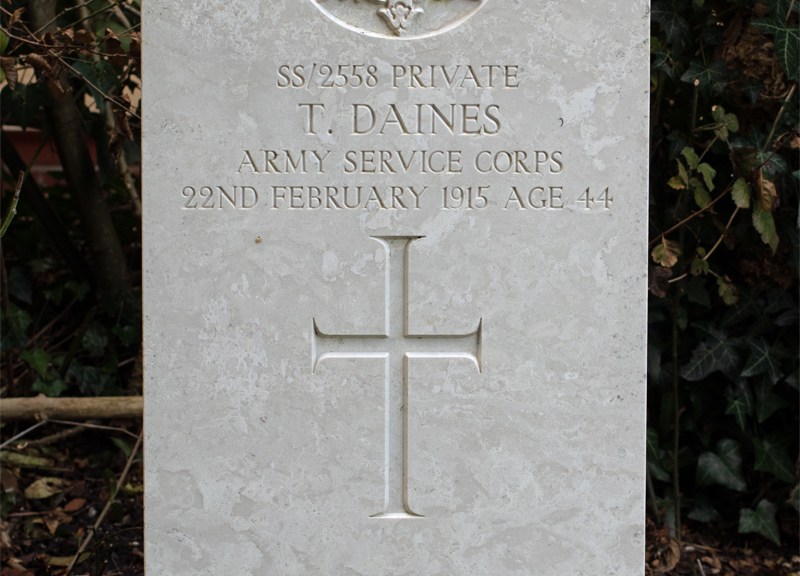
Born in 1871, Thomas Daines was one of fourteen children. His parents, Charles and Sarah, worked on a farm a few miles from Halstead in Essex.
After leaving school, Thomas followed in his father’s footsteps and, by the time of the 1891 census was also listed as an agricultural labourer. He married Kate Rawlinson in the spring of 1893, and they had two children – Matilda and Lewis – before relocating to South East London in around 1898.
The reason for the move was, more than like, job opportunities, and Thomas was soon working at the Royal Arsenal in Woolwich.
Settling into their new city life, Thomas and Kate had five further children: Annie, Thomas, Alfred, Charles and Beatrice. Thomas continued as a labourer, before enlisting in the army within three months of war being declared in October 1914.
Sadly, Private Daines’ service was not to be a long one. Having suffered a bout of influenza, Thomas was admitted to a Red Cross Hospital in Sherborne, Dorset. He died of pneumonia on 22nd February 2015.
Private Thomas Daines lies at peace in the Sherborne Cemetery.
As a sad aside to Thomas and Kate’s story, their eldest son, Lewis, enlisted in the 16th Battalion of the Lancashire Fusiliers. He fought on the Western Front, and was killed in action in Pozières on 26th March 1918.
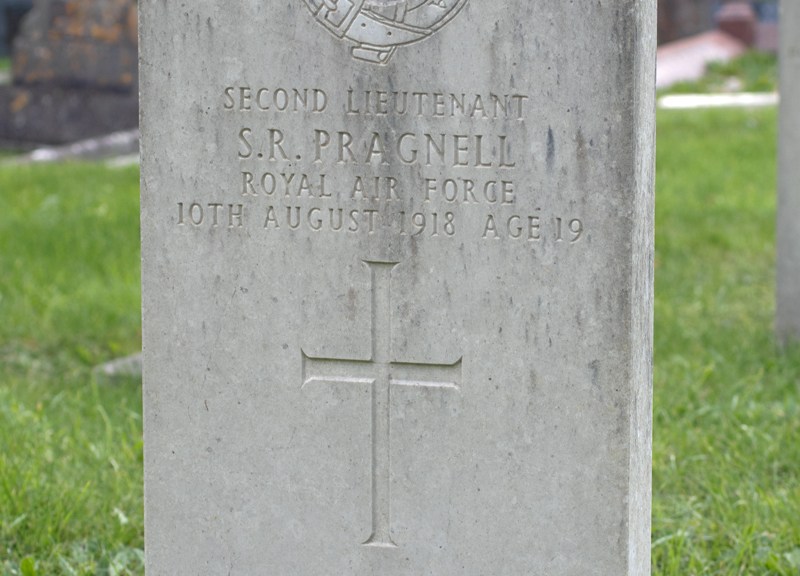
Sidney Ralph Pragnell was the eldest of two children of Edward and Ellen Pragnell. Edward grew up in Sherborne, before moving to London to work as a chef; he found employment as a cook in an officer’s mess, which took him and his wife first to Ireland – where Sidney was born – and then to the barracks at Aldershot.
By the time of the 1911 census, Edward had brought his family back to Dorset, and was running the Half Moon Hotel, opposite the Abbey in Sherborne. Sidney, aged 12, was still at school.
When war broke out, Sidney was eager to play his part, even though he was underage. An article in the local newspaper highlights his keenness and how he progressed.
…he was keen to serve his country and joined every local organisation his age would allow him to. He was an early member of the Sherborne VTC and Red Cross Detachment, and was actually the youngest member of the Volunteers to wear the uniform. Whilst still under age, he enlisted in the Royal Naval Division at the Crystal Palace and after a period of training was drafted as a qualified naval gunner to a merchant steamer carrying His Majesty’s mails and in this capacity went practically round the world. In February he joined the RNAS and after some air training in England went to France to an air station, where he passed all the tests with honours and gained the ‘wings’ of the qualified pilot. Lieutenant Pragnell then decided to go in for scouting and came back to England for advanced training in the special flying necessary for this qualification and it was whilst engaged in this that he met with the accident which resulted in his death.
Western Chronicle: Friday 16th August 1918.
The esteem in which Second Lieutenant Pragnell was held continues in the article, which quotes the condolence letter sent to his parents by his commander, Major Kelly.
It is with deep regret that I have to write you of the death of your son, Second-Lieutenant SR Pragnell. Your boy was one of the keenest young officers I have ever had under my command and was extremely popular with us all and his place will be extremely hard to fill.
The service can ill afford to lose officers of the type of which Lieutenant Pragnell was an excellent example and it seems such a pity this promising career was cut short when he had practically finished his training. May I convey the heartfelt sympathy of all officers and men in my command to you in this your hour of sorrow.
Western Chronical: Friday 16th August 1918.
What I find most interesting about this article is that the letter from Major Kelly detail how Edward and Ellen’s son died, and this this too is quoted by the newspaper.
Your son had been sent up to practice formation flying and was flying around the aerodrome at about 500 feet with his engine throttled down waiting for his instruction to ‘take off’. Whiles waiting your boy tried to turn when his machine had little forward speed. This caused him to ‘stall’ and spin and from this low altitude he had no chance to recover control and his machine fell to earth just on the edge of the aerodrome and was completely wrecked. A doctor was there within a minute, but your boy had been killed instantaneously.
Western Chronicle: Friday 16th August 1918.
Further research shows that the aerodrome Second Lieutenant Pragnell was training at was RAF Freiston in Lincolnshire, which had been designated Number 4 Fighting School with the specific task of training pilots for fighting scout squadrons. He had been flying a Sopwith Camel when he died.
Second Lieutenant Sidney Ralph Pragnell lies at rest in the cemetery of his Dorset home, Sherborne.







 Death and Service