
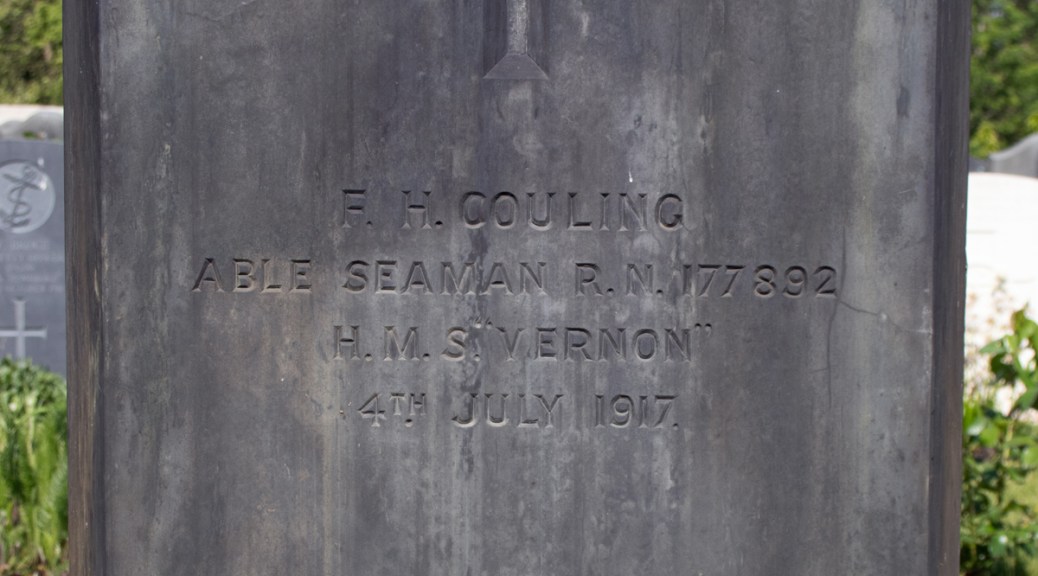

Frederick Henry Couling was born in Lambeth, Surrey, on 15th October 1878. The oldest of five children, his parents were Frederick and Martha Couling. Frederick was a harness maker, and when he died in 1889, Martha was left to raise the family on her own. The 1891 census found she was living with her parents and Frederick’s sister Louisa, while he had moved in with his maternal aunt, Esther and her husband, fishmonger Frederick Dorey.
With his father dead and his schooling completed, Frederick was keen to find a better life for himself and, on 11th January 1894, he joined the Royal Navy. Just fifteen years of age at this point, he was given the rank of Boy 2nd Class, and sent to HMS Impregnable, the teaching ship in Devonport, Devon, for his training. By the end of the year he had been promoted to Boy 1st Class, and in the summer of 1895 he transferred to HMS Pembroke, the Royal Naval Dockyard in Chatham, Kent.
In September 1895, Frederick was assigned to the screw sloop ship HMS Icarus. She would remain his home for the next two years, and during this time he came of age, and was formally inducted into the Royal Navy. His service records from the time confirm that he was 5ft 6ins (1.67m) tall, had dark brown hair, brown eyes and a fresh complexion.
Ordinary Seaman Couling’s naval career didn’t get off to the best of starts. On 5th November – just three weeks after formally enlisting, he broke the terms of his leave and was sent to the brig for 42 days. He seems to have learnt his lesson from this point on, however, and the rest of his service was blemish-free.
Over the next eight years, Frederick would serve on eight ships, returning to HMS Pembroke in between assignments. In November 1899 he was promoted to Able Seaman, the rank he would hold for the rest of his naval career.
On 11th August 1905, Frederick was stood down to reserve status and returned to shore. The 1911 census found him living in rooms at 27 Fortescue Road, Colliers Wood, Surrey. Employed as a window cleaner, the document suggests he is married by this point. A later record gives his wife as Edith Annie Reeve, the daughter of a labourer from Kent.
When war broke out, Frederick was called upon to serve his country once more. Taking the rank of Able Seaman once more, he returned to HMS Pembroke. Over the next couple of years he remained on shore and, from the summer of 1915, was attached to HMS Vernon, a base in Portsmouth, Hampshire,
While there, Frederick became unwell. He returned to Chatham, and was admitted to the Royal Naval Hospital in the town. He was suffering from chronic mastoid disease – an inner ear infection – and this would ultimately take his life. He passed away on 4th July 1917, at the age of 38 years old.
The body of Frederick Henry Couling was laid to rest in Woodlands Cemetery, Gillingham, Kent, not far from the base he had called home for so long.


 Death and Service