Tag Archives: epilepsy

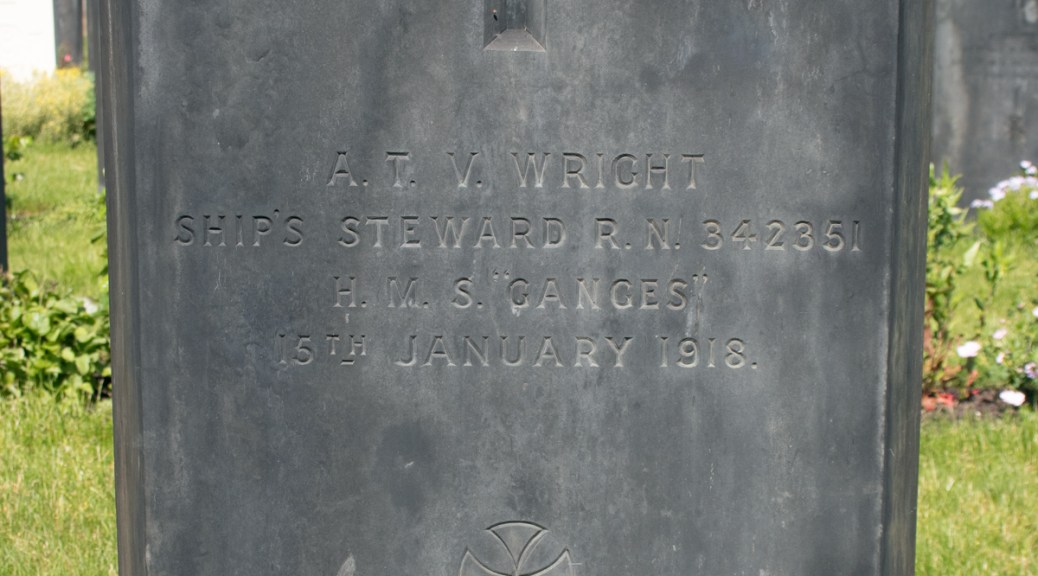
Ship’s Steward Archibald Wright

Ship’s Steward Archibald Wright

Archibald Thomas Victor Wright was born on 3rd August 1883 in Portsmouth, Hampshire. The second of six children – all boys – his parents were George and Alice Wright. George was a gunner and lieutenant in the Royal Navy, and the seafaring life was an obvious choice for his son to follow as well.

Archibald joined the Royal Navy as a Ship’s Steward Boy on 14th September 1898. Just fifteen years old, he was too young for formally enlist but was sent to HMS Pembroke, the Royal Naval Dockyard in Chatham, Kent, for his training.

Over the next three years, Archibald learnt the tools of his trade. He moved between establishments, from HMS Boscawen in Portland, Dorset, to HMS Excellent back in in Portsmouth. It was while on board the battleship HMS Glory, however, that he came of age, and was formally enlisted in the Royal Navy as a Ship’s Steward Assistant. His service records note that, on turning eighteen, he was 5ft 2in (1.58m) tall, with brown hair, dark brown eyes and a fresh complexion.

Ship’s Steward Assistant Wright’s contract was for twelve years, and during this time he would travel the world. By the summer of 1908 he had served on nine ships, returning to naval bases in Kent and Hampshire between voyages. On 15th June 1908 he was promoted to Acting Ship’s Steward, and just a few weeks later, he got married.

Ellen Osborne was born in Southampton just a month or so after her new husband. The daughter of a house furnisher’s clerk, by the time of the 1901 census she was employed as a boarding school teacher. After the couple married, she moved to Kent to be close to the Royal Naval Dockyard in Chatham (also known as HMS Pembroke), where Archibald would more frequently be based. The 1911 census return found her lodging with Lillie Calcutt at 112 Shakespeare Road in Gillingham, Kent.

Archibald’s career, meanwhile, was continuing apace. On 24th September 1909 he was promoted to Ship’s Steward proper, and in August 1913, when his original term of service came to an end, he quickly renewed it. By now, his service records show that he had had a few tattoos added to his arms: a girl on his right arm, a dragon on his upper left, and two cockerels on his lower left arm. Now 30 years of age, he stood 6ft tall (1.83m) tall, and, intriguingly, his eyes were now recorded as being blue.

Ship’s Steward Wright’s career trajectory does not seem to have been without its hiccups, however. Where his annual review up until 1909 have consistently given his character as very good, from hereon in, it dipped to just good. His ability also began to vary, from very good in 1909, to superior for the following couple of years, to just satisfactory in 1913 and 1915.

Archibald spent the last few years of the war split between HMS Pembroke and HMS Ganges – the training base just outside Ipswich, Suffolk. In January 1918, he was admitted to the Royal Naval Hospital in Chatham, following an epileptic fit. This was to prove fatal, and he passed away on 15th January. He was 34 years of age.

Interestingly, Ship’s Steward Wright’s pension ledger gives a damning insight into his health and mental well-being at the time of his passing. It noted the cause of his death as epilepsy aggravated by alcoholism, adding that the disease was neither contracted on nor aggravated by [active service], but due to his own serious negligence or misconduct.

Archibald Thomas Victor Wright was laid to rest in the military section of Woodlands Cemetery in Gillingham, Kent, not far from the dockyard he had called home.
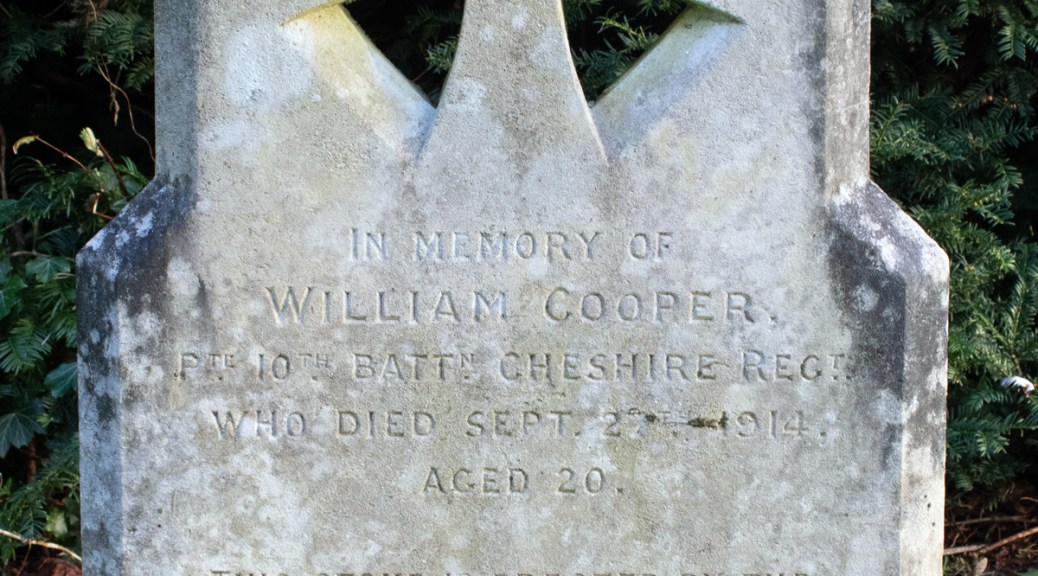

Private William Cooper

Private William Cooper

William Cooper was born in Mobberley, Cheshire, in 1894. Little information is available about his family life, but records suggest that his father was called John.

The first document that can be attributed to William is the 1911 census. This recorded him as living in Newton Hall Lane in Mobberley, with his widowed aunt and two cousins.

William’s trail goes cold again at this point, and can be picked up again when war broke out in the summer of 1914. He enlisted early on, joining the Cheshire Regiment. Attached to the 10th (Service) Battalion, his unit moved to Codford on the edge of Salisbury Plain, Wiltshire, by September.

William Cooper… was taken suddenly ill while on parade on Sunday morning at 8.30, and dropping out of the lines, was carried to the Army Medical Corps tent in the Chitterne Road, but on arrival there death had already taken place.

Lieutenant Spraight, of the Army Medical Corps, stated having examined the body of deceased, want he came to the conclusion that death was due to asphyxia and an epileptic fit.

[Devizes and Wilts Advertiser: Thursday 1st October 1914]

Private William Cooper died on 27th September 1914: he was just 20 years old when he died. It seems that his family were unable to cover the cost of the funeral: he was laid to rest in the peaceful graveyard of St Mary’s Church, Codford, his headstone being erected by his comrades in the battalion.


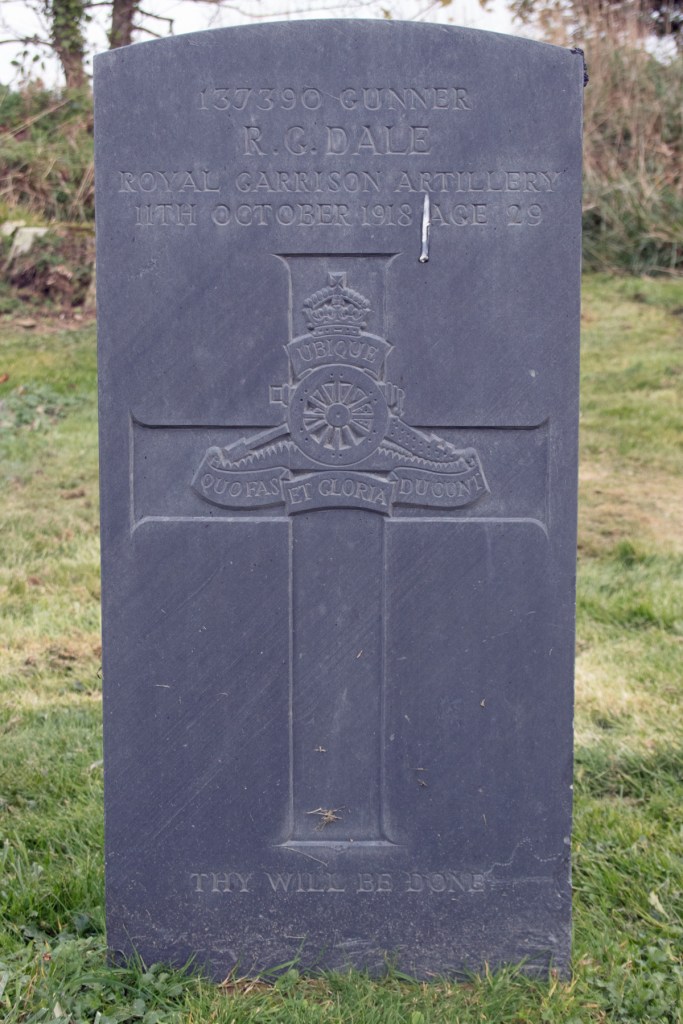
Gunner Richard Dale

Gunner Richard Dale

Richard George Dale was born Padstow, Cornwall, in the summer of 1889, the oldest child to Alice Dale. She married Frederick Bryant in March 1894, but and went on to have two children – Frederick and Albert – but, by the time of the 1901 census, her husband has passed away. The document gives Richard’s surname as Bryant, but there is no real indication that he was Frederick’s son.

Alice had been living with her greengrocer parents, but the 1901 census in a small cottage off Lanadwell Street, a couple of door away from them. As a widow at 31 years old, she is noted as being on parochial relief.

Details of Richard’s later life are a challenge to track down. Absent from the 1911 census, it was around that time that he married Agnes MacKintosh. While she was born in Edinburgh, the wedding took place in St Columb, Cornwall.

When war broke out, Richard was working as a farmer. He enlisted the day after hostilities were declared, and joined the Royal Garrison Artillery. Gunner Dale was, according to the records, 5ft 3ins (1.6m) tall, with medium colour hair, blue eyes and a fresh complexion. He had a scar between his eyebrows.

Gunner Dale served for nearly four years, all the time being based on home soil. He suffered from epilepsy, however, and this is what led to his eventual discharged from armed service in March 1918.

Richard returned home, but his health was compromised. He passed away on 11th October 1918, from a combination of influenza and pneumonia. He was 29 years of age.

Richard George Dale was laid to rest in Padstow Cemetery, in sight of his younger brother Albert, who had passed away eleven years before.


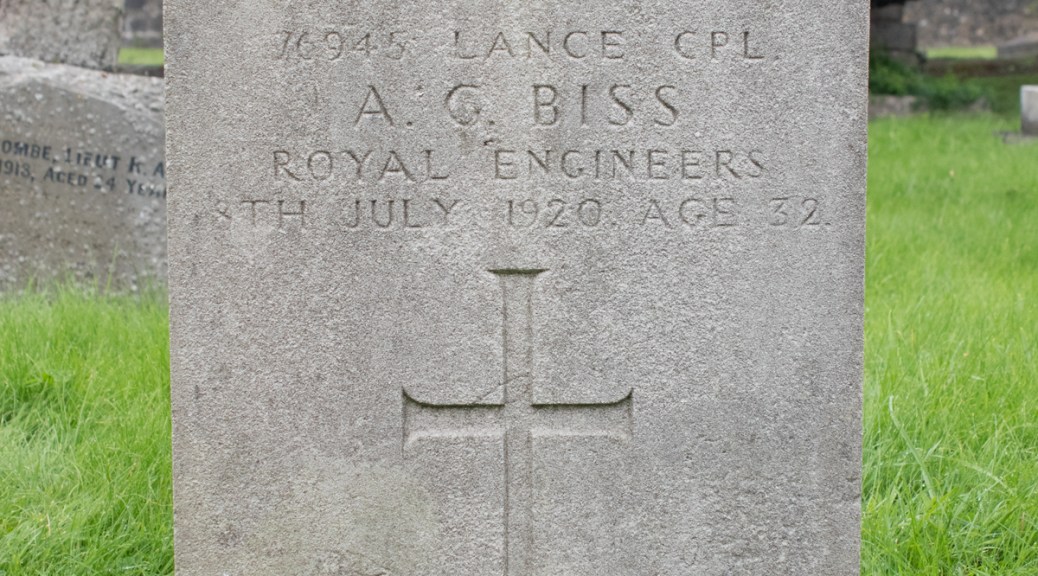
Lance Corporal Albert Biss

Lance Corporal Albert Biss

Albert Gillard Biss was born in Highbridge, Somerset, on 3rd July 1888. The middle of five children, he was the oldest surviving son of Richard and Rosanna Biss. Richard was a tin worker twelve years older than his wife and when he died, in September 1907, Rosanna was left to raise her family alone.

By the time of the 1911 census, Rosanna was living in a five-roomed cottage in Highbridge. Albert and his two younger brothers were living with her, and all three were working as building labourers to bring in money for the family. They also had a boarder, 87-year-old widow Henrietta Crandon, to bring in a little extra each month.

Albert was also saving up for other things. On 15th November 1911, he married Ada Alice Vincent. The couple went on to have three children – Albert Jr, Richard and Irene – before Ada’s untimely death in August 1915, just five weeks after Irene’s birth. At this point Albert had enlisted in the army, and it seems that his sister, Sarah, took on responsibility for her nephews and niece.

Albert was working as a telegraphist for the Post Office when he signed up. He had previously volunteered for the 3rd Somersets, but was assigned to the Royal Engineers when he enlisted. His service records show that he joined up in Weston-super-Mare, was 27 years and three months old, and stood 5ft 10.5ins (1.79m) tall.

Sapper Biss initially served on home soil, but was subsequently moved to the Base Signal Depot as part of the East Africa Expeditionary Force. He was promoted to Lance Corporal in April 1918, but over the next twelve months his health began to deteriorate.

On 6th April 1919, Albert was medically discharged from the army, suffering from a combination of malaria, epileptic fits and tuberculosis. He returned home to Somerset, and moved back in with Rosina. His sister Sarah was living in London by this point, and it is not clear whether Albert’s children came back to Highbridge or not.

Over the next year Albert’s health went from bad to worse. On 8th July 1920 he finally succumbed to a combination of pulmonary tuberculosis, acute nephritis, meningitis and uraemia. He had just turned 32 years of age.

Albert Gillard Biss was laid to rest in the sweeping grounds of Highbridge Cemetery.


After Albert’s death, his two sons fell under the guardianship of their aunt Sarah. Responsibility for Irene, however, was given to an Ebenezer and Eliza Monks, who lived in Clapham Common, London. The 1938 Electoral Register found Irene, who went by the name Monks-Biss, still living with here adopted family.


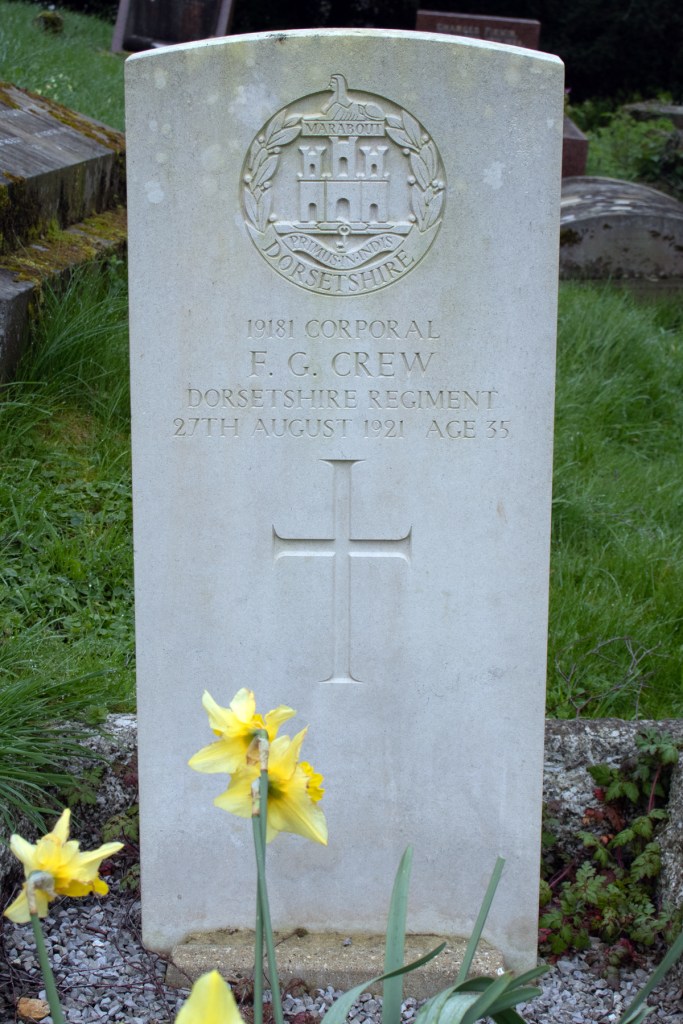
Corporal Frank Crew

Corporal Frank Crew

Frank George Crew was born in Twerton, Somerset, on 25th January 1886. The fourth of five children, his parents were nurseryman and market gardener William Crew and his laundress wife, Fanny.

When Frank finished his schooling, he followed his father into the nursery trade, and this is how he was employed when war was declared. He enlisted in the Dorsetshire Regiment on 19th July 1915, and was assigned to the 3rd (Reserve) Battalion. Private Crew’s service records are limited, but his medical report shows that he was 5ft 9ins (1.75m) tall, weighing around 10st (63.5kg).

On 6th October 1918, Frank, who had been promoted to Corporal by this point, was admitted to the Military Hospital in York with a bullet wound to his right forearm. Given that his battalion remained on home soil for the duration of the conflict, it is unclear whether this was an accidental injury at camp, or if he transferred to another troop when he recovered.

Little additional information for Frank remains. He remained in hospital until 8th November 1918 and it is unclear if he continued with his army service once he recovered – although given the Armistice was declared three days later, it is unlikely that he did.

On 11th November itself, Frank married Kate May, a mason’s daughter from Limpley Stoke, to the west of Bath. By this point he recorded his profession as gardener, so it seems his army career was indeed behind him. The couple went on to have a daughter, Peggy, who was born a year later.

William died in 1920, and by the time of the following year’s census, Frank, Kate and Peggy were living with Frank’s now-widowed mother. The extended family had a home on Padleigh Hill, to the south west of Bath city centre, and Frank seemed to be the main breadwinner, working as a labourer for Stothert & Pitts Ltd, a crane company on the River Avon.

Sadly, Frank was only to survive the census by a couple of months. He passed away on 21st August 1921, dying from a combination of influenza and epilepsy. He was 35 years of age.

Frank George Crew was laid to rest in the quiet Englishcombe Churchyard, close to the family home.


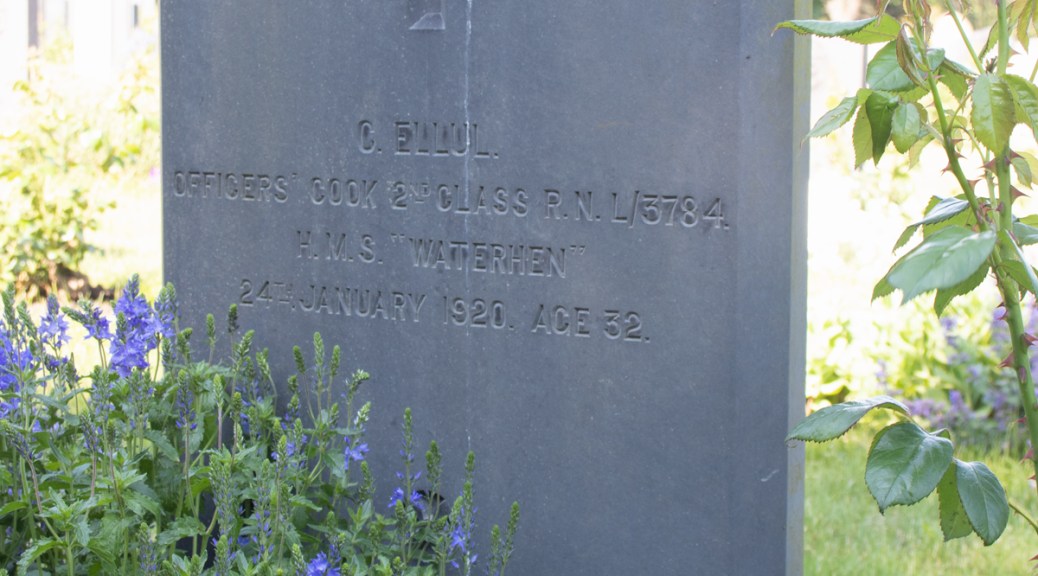
Officers’ Cook Carmelo Ellul

Officer’s Cook Carmelo Ellul

Carmelo Ellul was born in Valetta, Malta, on 26th May 1889. There is little information about his early life, other than the fact that he worked as a baker.

He came to England at some point in the early 1900s, and was living in Portsmouth. It was here that he met Selina Southcott, who had been born on the Isle of Wight, and the couple married in 1904. The couple would go on to have three children, all boys: Maurice, who was born in 1911; Alva, who was born in 1912, but who died as a toddler; and Edwin, who was born in 1916.

Carmelo seemed to want a life of adventure: in the summer of 1912, he enlisted in the Royal Navy. Over the next eight years, Officer’s Cook Ellul served on a number of naval vessels, including HMS Bacchante, which toured the North Sea, and was involved in the Battle of Heligoland in August 1914.

Carmelo’s naval life continued after the war ended, although he seems to have been more shore-based than before. He was serving on HMS Waterhen on 24th January 1920, when he collapsed with an epileptic fit, and died of heart failure. He was just 32 years old.

Carmelo Ellul was laid to rest in the Woodlands Cemetery in Gillingham, Kent, presumably as his ship was moored in the nearby Naval Dockyard in Chatham.