Tag Archives: explosion

Stoker Anthony Eames

Stoker Anthony Eames

Anthony Eames was born on 29th October 1876 in the village of Newhall, Derbyshire. He was one of four children to James and Mary Eames, although Mary passed away in 1880, not long after Anthony’s younger brother was born. James remarried, and he and his new wife (and possibly his late wife’s sister), Theresa Barlow went on to have twelve children of their own.

James was a coal miner, and while Anthony initially followed in his father’s footsteps, he sought bigger and better things. In September 1896, just short of his twentieth birthday, he joined the Royal Navy as a Stoker 2nd Class. His service records show that he was 5ft 3.5ins (1.61m) tall, had brown hair, grey eyes and a fresh complexion. The document also noted that he had tattoos on both of his arms.

Stoker Eames’ initial posting was at HMS Victory, the Royal Naval Dockyard in Portsmouth, Hampshire. He spend a year there, honing his skill, before being assigned to HMS Powerful in September 1897. Three months later, he was transferred to the cruiser HMS Alacrity and, over the remainder of his twelve years’ service, he worked on eight further vessels, rising to the rank of Stoker 1st Class in the process.

It was during this time that Anthony met and married Frances Pelley, a young woman from Portsmouth. The couple went on to have three children and, when Stoker Eames was stood down from active service at the end of his contract in 1908, the family moved to Sheffield. Anthony found employment in the mines again and the family settled in to a small terraced house in the then village of Darnall.

The sea continued to call to Anthony, though, and, on 8th March 1912, he re-enlisted. For the next couple of years he was based at HMS Victory, but when war broke out he was transferred to the battleship HMS Bulwark.

Stoker Eames was on board Bulwark when, on the morning of 26th November 1914, an explosion ripped through the ship, tearing it apart and sinking it. In all 741 souls were lost, Anthony amongst them. He was 38 years of age.

The majority of those who died in the explosion aboard HMS Bulwark were buried in a mass grave in Woodland Cemetery, Gillingham, Kent. Anthony Eames’s body, however, had been identified, and so he was laid to rest in a marked grave in the cemetery.

Leading Stoker Ernest Brown

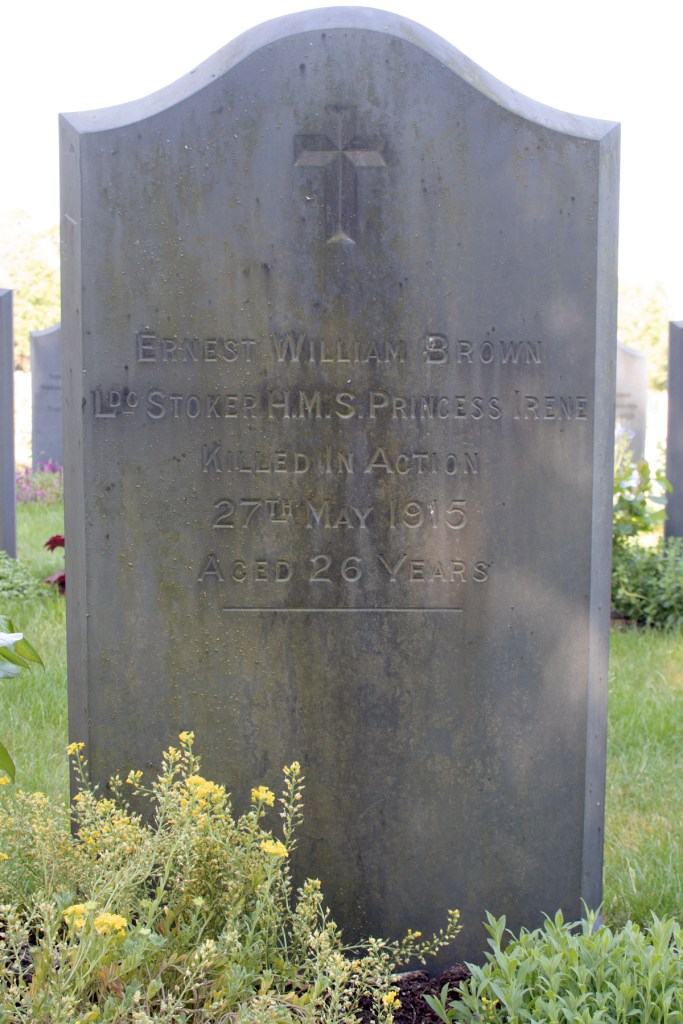
Leading Stoker Ernest Brown

Ernest William Brown was born on 5th April 1889 in Halstead, Essex. One of twelve children, his parents were carpenter Edward and silk weaver Elizabeth Brown.

Ernest initially found work as an errand boy, then as a house painter. He wanted bigger and better things, however, and the Royal Navy offered him that opportunity. He enlisted as a Stoker 2nd Class on 12th March 1908 for a period of twelve years’ service.

Ernest’s early service records are lost to time, but he received a promotion to Stoker 1st Class on 12th March 1909, exactly a year after a joined up. At this point he was assigned to the dreadnought battleship HMS Russell, on board which he served until August 1912.

After a short period at HMS Pembroke, the Royal Naval Dockyard in Chatham, Kent, Stoker 1st Class Brown was transferred to the Apollo-class cruiser HMS Iphigenia. She was to be his home for the next two-and-a-half years, during which time he was promoted again, this time to Leading Stoker.

Returning to HMS Pembroke in March 1915, this was to be his shore base for the next couple of months. On 27th May, Leading Stoker Brown was helping out on the steamer Princess Irene. Tragically, while on board an explosion ripped through the ship, while moored off Sheerness, Kent and he was one of the 352 souls killed. He was just 26 years of age.

Ernest William Brown was laid to rest in the Woodlands Cemetery in Gillingham, Kent. His body having been identified, he was given his own grave, unlike those who were buried in a mass grave nearby.


Officers’ Steward Peter Galea

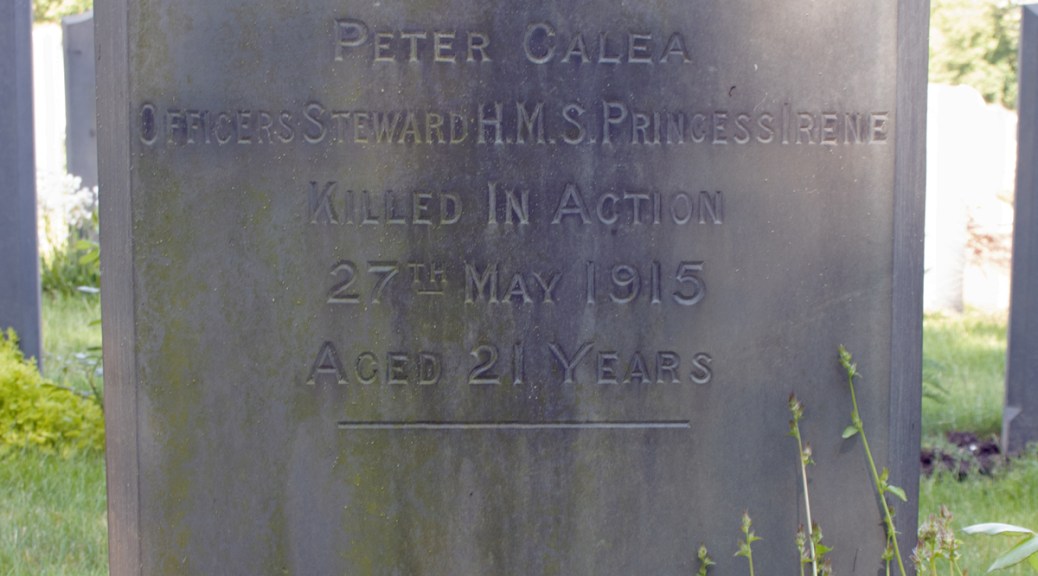
Officers’ Steward Peter Galea

Peter Galea was born in the Maltese town of Senglea on 25th August 1893. His mother’s name was Carmela, but there is little further concrete information about his early life.

What is clear is that Peter found employment by enlisting in the Royal Navy. He joined up on 2nd January 1912 as an Officer’s Steward 3rd Class. His service records show that he was 5ft 9.5ins (1.66m) tall, had brown eyes, black hair and a dark complexion.

Officer’s Steward Galea’s first assignment was on board the dreadnought battleship HMS Orion. He was to spend more than three years on board, although his continuous service was interrupted by three days spent in the cells in May 1913: unfortunately his misdemeanour is not recorded.

In February 1914, Peter was transferred to the Apollo-class cruiser HMS Thetis. She was to be his home for the next year, during which time war was declared across Europe. In March 1915, Officer’s Steward Galea was assigned to another ship, the ocean liner Princess Irene.

Tragically, Peter was on board when, on 27th May 1915, an explosion ripped through the ship, while moored off Sheerness, Kent and he was one of the 352 souls killed. He was just 21 years of age.

Peter Galea was laid to rest in the Woodlands Cemetery in Gillingham, Kent. His body having been identified, he was given his own grave, unlike those who were buried in a mass grave nearby.


Fireman John Donoghue

Fireman John Donoghue

In the naval section of the Woodlands Cemetery in Gillingham, Kent, stands a headstone to a John Donoghue. The stone states that he was a Fireman on board HMS Princess Irene and that he was killed in action on 27th May 1915. He was 25 years of age.

Further research confirms that he was part of the Mercantile Marine Reserve, but there are no records to confirm his service at sea. While John was born in around 1890, with no confirmation of his place of birth, or the names of his parents, it is impossible to narrow down any further details for him.

Records of the Princess Irene’s crew do not include a John Donoghue, although this does not necessarily mean that he was not serving on board, only that records no longer exist. The fact that he was granted an individual headstone, rather than being commemorated in the mass grave that is also situated in the Woodlands Cemetery suggests that his body was able to be identified.

Sadly, however, Fireman John Donoghue’s life is destined to be lost to time, his legacy to be one of the 352 souls lost during the explosion and sinking of the ship on board which he served.


Private William Catlow, AKA William Adams

Private William Catlow

William Adams was born in Skelmersdale, near Liverpool, in around 1868. He was the son of George and Harriet Adams, although as his name was quite common in the area at the time, it is not possible to narrow down details of his early life any further.

At some point after leaving school, William joined the army, using the surname of Catlow. The 1891 census records him as a soldier in the Private Infantry, based at the Habergham Eaves Barracks near Burnley, Lancashire.

On leaving the army, William found work as a labourer and, by the 1890s, he had moved to Kent. He met and married a woman called Kate in 1895, and they went on to have a son, Archibald, the same year. The 1911 census records the family living in Cheriton, near Folkestone, William doing labouring work, and Kate employed as a laundress.

With the outcome of the First World War, William stepped forward to play his part again. By this point, he was 46 years old and, while he was assigned to the 4th Battalion of The Buffs (East Kent Regiment), was given more of a territorial role.

Private Catlow was serving at the site shared by the Cotton Powder Company and Explosives Loading Company to the north of Faversham in the spring of 1916. On the afternoon of 2nd April 1916, a fire caused a series of massive explosions at the factories, and William was one of around 110 people to be killed. He was 48 years of age.

William Adams, known militarily as Private William Catlow, was laid to rest, along with the other victims of the Faversham Explosion, in the town’s Borough Cemetery.


Memorial to the Faversham Explosion, Borough Cemetery