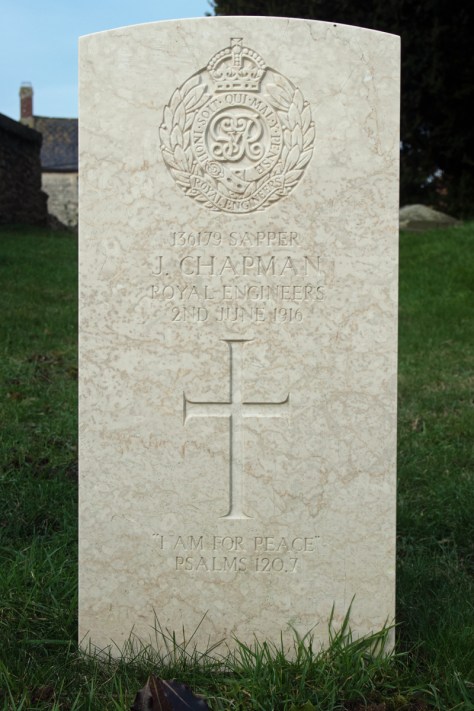
John Chapman was born in October 1892 in the small Somerset village of Ashwick, just to the north of Shepton Mallet. One of five children to Albert and Mary Ann, John followed his father into mining, and, by the time of the 1911 census, he was listed as a coal mining hewer.
In November 1914, he married Louisa Elizabeth Perkins from Shepton Mallet. The war had begun by this point, and before the couple had even been married a year, John had enlisted.
His background made him ideal for the Royal Engineers, and soon Sapper Chapman was bound for France with the British Expeditionary Force. He seems to have been abroad for around six months, and was shipped back to England at the end of April 1916.
John was admitted to a military hospital in Brockenhurst, Hampshire, with bronchial pneumonia, and this is what he succumbed to a matter of weeks later. He died on 2nd June 1916, at the age of 23 years old.
John Chapman is buried in the village of Croscombe, Somerset, where his widow now lived.
An additional tragedy to the loss of this young life is that Louisa was pregnant at this point. The birth of their daughter, Selina, was registered between April and June 1916, and, while I have been unable to pinpoint an exact date of birth for her, it is likely that John never got to see his daughter.
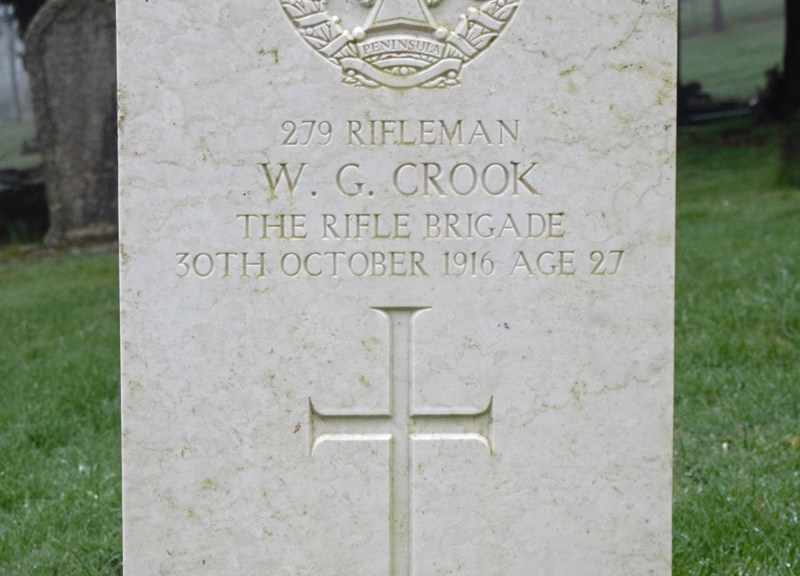
Walter George Crook was born in 1900, one of thirteen children to William – a gardener – and Elizabeth Crook from Shepton Mallet in Somerset.
When he left school, Walter worked as a printer for the town’s newspaper and, by the time of the 1911 census, he was living with his family in a six-roomed house in the middle of the town.
Walter moved on from the Shepton Mallet Journal, and found employment at the Hare and Hounds Hotel in the town. War was coming, however, and he enlisted in the 22nd (Wessex and Welsh) Battalion of the Rifle Brigade.
Rifleman Crook was stationed with his battalion in Salonica, Greece, and it was while he was here that he suffered a cerebral tumour. He was invalided home, and treated in the Royal Victoria Hospital in Netley, Hampshire. Sadly, he lost his fight, passing away on 30th October 1916, aged just 27 years old.
Walter George Crook lies at rest in the cemetery of his home town of Shepton Mallet.
Walter’s brother Gordon is also buried in Shepton Mallet Cemetery – read his story here.
A third brother, Bertie, was also gave his life in the Great War. The local newspaper had given a touching report on his death in April 1916.
Bertie Crook left school at the age of 13, and went into service with Mrs Dickinson at Whitstone, as a stable lad. He was there a year and then, on account of Mrs Dickinson giving up horses and leaving the town, they recommended him to Lord Derby’s stables at Newmarket, under the Hon. G Lambton. Small as he was, Bertie Crook undertook the railway journey alone, with a label in his buttonhole. He served five years apprenticeship, which expired at the beginning of October [1915]. He then tried to join the Royal Field Artillery, but not being tall enough he joined a West country regiment on the 20th October, and left Tidworth Barracks for France in the early part of January. He was in his 21st year, having been born on the 29th July. 1895.
The Hon. George Lambton writes “I was terribly shocked and grieved to hear of the death of your boy… Mrs Lambton and I send our deepest sympathy… I always liked your boy so much when he was in my stable; and I felt sure that with his quiet and courageous character he would make a good soldier. I shall have a plate put up in the stable in memento of his glorious death.”
Shepton Mallet Journal: Friday 21st April 1916
Lance Corporal Bertram Stanley Crook is buried at the 13th London Graveyard in Lavantie, France.
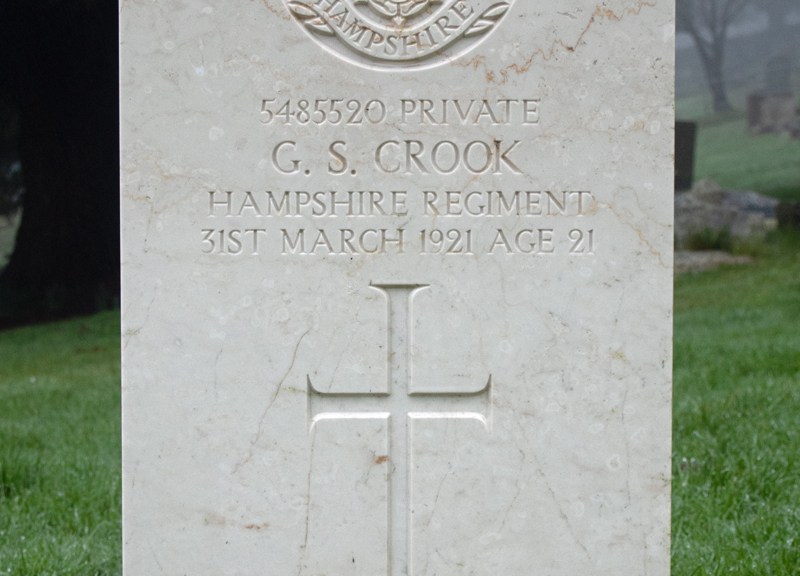
Gordon Spencer Crook was born in 1900, one of thirteen children to William and Elizabeth Crook from Somerset. William, like his father, was a gardener, and the family lived in Lower Lane, a small lane sandwiched between the railway and a stream in the centre of Shepton Mallet.
The military records for Gordon, who seems also to have gone by the name of George, are a challenge to piece together. His older brothers Walter and Bertram both died as a result of the fighting, both in 1916, and it seems likely that Gordon was keen to do his bit as soon as he could, to honour their memories.
He enlisted in the Hampshire Regiment, whose battalions served both in France and on the home front. There is conflicting information about his service, but Private Crook appears to have fought at the front, gaining the Victory and British Medals.
Again, with his passing, there is little information surrounding Gordon, or George. A brief notification in the Shepton Mallet Journal stated that “On March 31, at Royal Victoria Hospital Netley, Gordon Spencer, the dearly loved son of W and E Crook, aged 21 years.”
Gordon Spencer Crook lies at rest in the cemetery of his home town, Shepton Mallet.
Gordon’s brother Walter is also buried in Shepton Mallet Cemetery – read his story here.
A third brother, Bertie, was also gave his life in the Great War. The local newspaper had given a touching report on his death in April 1916.
Bertie Crook left school at the age of 13, and went into service with Mrs Dickinson at Whitstone, as a stable lad. He was there a year and then, on account of Mrs Dickinson giving up horses and leaving the town, they recommended him to Lord Derby’s stables at Newmarket, under the Hon. G Lambton. Small as he was, Bertie Crook undertook the railway journey alone, with a label in his buttonhole. He served five years apprenticeship, which expired at the beginning of October [1915]. He then tried to join the Royal Field Artillery, but not being tall enough he joined a West country regiment on the 20th October, and left Tidworth Barracks for France in the early part of January. He was in his 21st year, having been born on the 29th July. 1895.
The Hon. George Lambton writes “I was terribly shocked and grieved to hear of the death of your boy… Mrs Lambton and I send our deepest sympathy… I always liked your boy so much when he was in my stable; and I felt sure that with his quiet and courageous character he would make a good soldier. I shall have a plate put up in the stable in memento of his glorious death.”
Shepton Mallet Journal: Friday 21st April 1916
Lance Corporal Bertram Stanley Crook is buried at the 13th London Graveyard in Lavantie, France.
Ernest George Morris was born in September 1879, one of six children to John and Eliza Morris. John was a carter for the railways, and this was a trade his son was to follow.
Ernest married Sarah Garrett in Bristol on Christmas Eve 1904, and the young couple went on to have two children, Charles and William.
Ernest’s father died in 1907, and Ernest became head of the family. He moved them in with him in Bristol, and by the 1911 census, the household consisted of Ernest, his mother Eliza, his brothers Frank and William, sister Lily and his own son William.
The census also lists Ernest as a widow; I have not been able to track down any records of when Sarah died. Their eldest boy, Charles, passed very early on, however, so this is likely why Ernest set up home with his family.
By this time, Ernest was working as a carman in the Bristol Goods Yards, and it appears that had a strong character. In September 1912, he was cautioned for “smoking whilst on duty and refusal to give an undertaking to refrain from doing so in future.” He cited his reason that the rulebook “did not prohibit men from smoking when not with a load.”
Ernest was suspended for two days, and was only allowed back to work when he promised to follow instructions in the future. This, it seemed he may not have done, as he was dismissed just three months later.
Ernest’s military service records are hard to piece together. He enlisted in the Rifle Brigade as a Gunner, going on to achieve the rank of Serjeant. He was awarded the Victory and British medals – the standard awards for men involved in the Great War.
Serjeant Morris survived the war, but there is little information for him after that. He passed away on 28th June 1920, aged 40 years old, although there is no record of how he passed. His war pension was awarded to his mother, who was acting as guardian for his son William.
Ernest George Morris lies at rest in the cemetery of his home town of Langport.
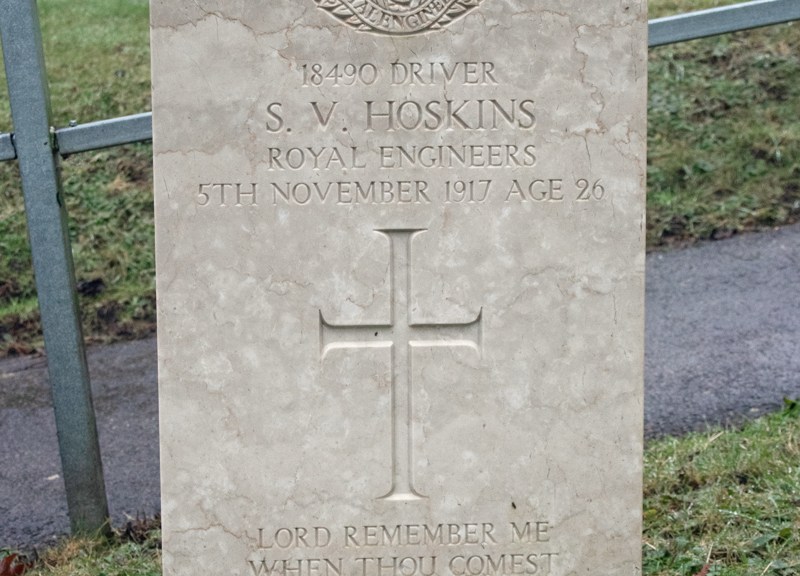
Sidney Victor Hoskins was born in February 1892, one of eleven children to Sidney and Elizabeth Hoskins from Shepton Mallet in Somerset. Sidney Sr worked as a quarryman and labourer in local factories.
Sidney was keen to make a life for himself, enlisting in the army in 1909. He served two years as a driver for the Royal Engineers, before being put on the reserve list. By the time of the 1911 census, he was listed as a packer on the railway. In November of that year, Sidney married Ada Lambert, also of Shepton Mallet.
While working on the line in April 1913, Sidney had an accident, suffering a fractured skull. He wasn’t able to carry out any hard labour form that point.
War broke out and Sidney was remobilised; just a month after Ada gave birth to their one and only child, a daughter they named Ada.
New baby notwithstanding, Driver Hoskins was shipped to France as part of the British Expeditionary Force. After two months he was sent down the line after suffering a fit, and was subsequently treated for pleurisy in Nantes. In November 1914, he returned to England and was ultimately discharged on medical grounds in February 1915.
During his time in France, he had also developed tuberculosis, and eventually spent three months in a sanitorium in Taunton, Somerset, to recover.
The condition continued to haunt Sidney, however, and he succumbed to the illness on 5th November 1917. He was 25 years of age.
Sidney Victor Hoskins lies at rest in the cemetery of his home town of Shepton Mallet.
Sidney’s younger brother, William Napier Hoskins, was also involved in the Great War. He had enlisted in the Somerset Light Infantry, and was based in India. Injured in fighting in the Persian Gulf, he was invalided back to India to recover. He was well enough to return to the fray, and was shipped to Mesopotamia, where he was injured again. He died of his wounds in Kut-al Amarah, Iraq, in 1915, aged just 20 years old.
The boys’ older brother Charles had also died in 1895, aged just six years old. While Sidney Sr and Elizabeth had had a family of eight girls, they were to outlive all three of their sons.
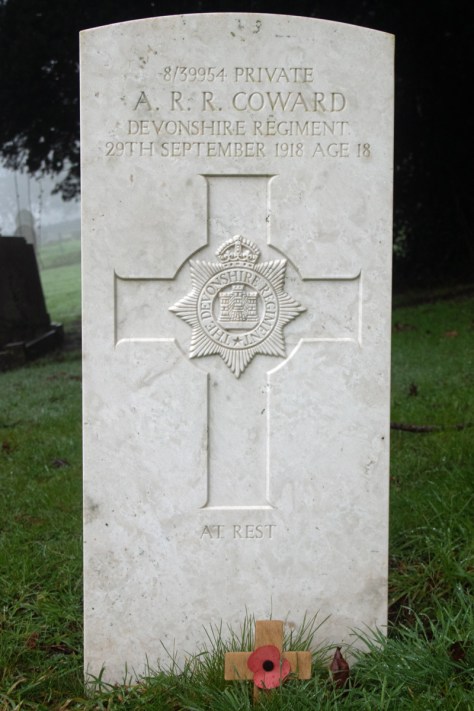
Albert Reginald Robert Coward was born on 26th August 1900, the middle of three children – all boys – for James and Florence Coward. James was a labourer and drayman for the railways, and the family lived in Shepton Mallet, Somerset.
Little remains of Albert’s military service records. His older brother Arthur was a Corporal in the Somerset Light Infantry. He died in France in April 1918, which may have been a contributing factor to his sibling’s decision to do his duty.
Albert enlisted in the 53rd Battalion of the Devonshire Regiment and, given his age, I would presume that this was as soon as he was able to – sometime in 1918.
Whether Private Albert Coward saw any military action is not known. He is listed as having passed away at a military hospital on 29th September 1918, although, as I have been unable to find a cause of death, it is likely to have been an illness, rather than an injury. Albert was aged just 18 years old.
Albert Reginald Robert Coward lies at rest in the cemetery of his home town.
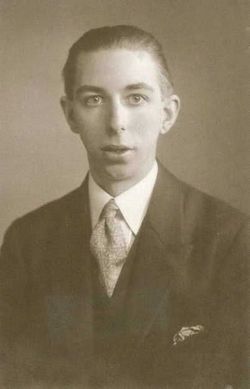
Albert Reginald Robert Coward (courtesy of findagrave.com)
Corporal Arthur William James Coward is commemorated on the Arras memorial in France. He was 23 years old when he died.
Hedley Walter Chinn was born in April 1900, one of six children to Walter and Kate Chinn. Walter was the butcher in the Somerset village of Middlezoy, and this is where the family had made their home.
There is little information on Hedley’s pre-war life, beyond the two census records of 1901 and 1911. With war breaking out and his older sister Lilian dying while nursing the troops (see below), it seems that Hedley was eager to do his duty.
Within months of Lilian’s death in 1917 – and basically as soon as his age allowed – Hedley enlisted in the Royal Naval Air Service as a mechanic. He carried out his initial training on the land-based ships President II, Impregnable and Cranwell, before officially joining the newly-formed Royal Air Force in May 1918.
Air Mechanic Chinn continued his service at Calshott, where he worked as a wireless operator for the flying boats guarding the Solent around Southampton. He continued in the role for the remainder of the war and beyond.
Hedley was eventually transferred to the RAF Reserve in February 1920, when, presumably, he returned to the family home in Somerset.
Little further is evident of Hedley’s life; but he passed away less than a year after being demobbed. There is nothing to confirm the cause of his death; given he died more than two years after the war, it is likely that it was as a result of an illness, although this is a presumption on my part. Either way, he died on 2nd January 1921, aged just 20 years old.
Hedley Walter Chinn lies at rest in the peaceful graveyard of Holy Cross Church in Middlezoy, Somerset.
It is worth noting that Hedley’s sister Lilian also served – and perished as a result of the Great War. Click here to learn more.
When I was researching Hedley’s life, I ran through the contemporary newspapers to trace his name. Nothing evident came up, although Hedley’s father, Walter’s name did appear.
In 1910, he declared himself bankrupt after being unable to pay for meat for his shop, that he had bought at auction. It appears that he had run up debts of over £300 (approximately £23,500 in today’s money) over a number of years; he put these debts down to a number of factors – “illness of my children, bad debts, having to maintain my mother for 14 years; and loss on sale of Middlezoy House, Middlezoy, three years ago, which realised £200 less than the amount I gave for it, and the amount expended on improvements”.
The 1921 census found Walter and Kate still running the butcher in Middezoy, their home empty but for each other. Walter’s debts were finally cleared in 1928 and the bankruptcy annulled.
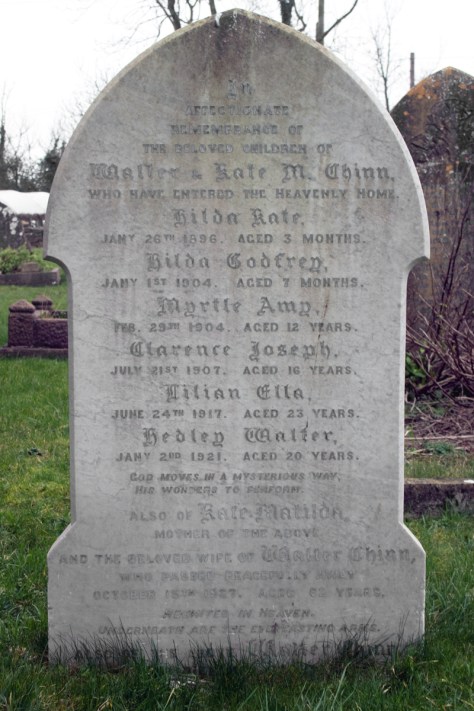
The gravestone in Holy Cross Churchyard is a haunting memorial to the tragic lives of the Chinn family.
Walter and Kat had six children, and would outlive every one of them. The stone confirms that each of their children lies in the grave:
The grave’s epitaph – God moves in a mysterious way, his wonders to perform – sounds cruelly hollow to 21st century ears. The only comfort to take, I guess, is that the whole family was destined to be together again: both Kate (who died in 1927) and Walter (who died in 1933) are also buried in the family grave.
Lilian Ella Chinn was born in 1893, one of six children to Walter and Kate Chinn. Walter was the butcher in the Somerset village of Middlezoy, and this is where the family had made their home.
There is little recorded of Lilian, and the information is confusing – another Lilian Chinn was born around the same time a few miles away, so it’s a challenge to identify the correct details.
What is known, is that, with the war raging, Lilian felt that she needed to do what she could – and enlisted in the Voluntary Aid Detachment in 1916. Serving as a nurse, she was based at the military hospital in Devonport, Plymouth.
Sadly, it is evident that nursing staff were not immune to the ailments and illnesses of the soldiers they were treating. Lilian contracted meningitis and peritonitis, passing away on 24th June 1917, aged just 23 years old.
Lilian Ella Chinn lies at rest in the peaceful graveyard of Holy Cross Church in Middlezoy, Somerset.
It is worth noting that Lilian’s brother Hedley also served – and perished – as a result of the Great War. Click here to learn more.
When I was researching Lilian’s life, I ran through the contemporary newspapers to trace her name. Nothing evident came up, although her father Walter’s name did appear.
In 1910, he declared himself bankrupt after being unable to pay for meat for his shop, that he had bought at auction. It appears that he had run up debts of over £300 (approximately £23,500 in today’s money) over a number of years; he put these debts down to a number of factors – “illness of my children, bad debts, having to maintain my mother for 14 years; and loss on sale of Middlezoy House, Middlezoy, three years ago, which realised £200 less than the amount I gave for it, and the amount expended on improvements”.
The 1921 census found Walter and Kate still running the butcher in Middezoy, their home empty but for each other. Walter’s debts were finally cleared in 1928 and the bankruptcy annulled.
The gravestone in Holy Cross Churchyard is a haunting memorial to the tragic lives of the Chinn family.
Walter and Kate had six children, and would outlive every one of them. The stone confirms that each of their children lies in the grave:
The grave’s epitaph – God moves in a mysterious way, his wonders to perform – sounds cruelly hollow to 21st century ears. The only comfort to take, I guess, is that the whole family was destined to be together again: both Kate (who died in 1927) and Walter (who died in 1933) are also buried in the family grave.
William Gardner was born in Cirencester, Gloucestershire, in around 1877. While I have been unable to totally confirm this, his parents seem to have been William and Sarah Carpenter; William Sr was an agricultural labourer, and both he and his wife were from Cirencester.
It has been difficult to track down William’s early life, because of the potential variations of his surname and the number of William Gardner’s in the Gloucestershire area.
The first time I can definitively identify him is on the 1911 census; he was living in Cheltenham and working as gardener. While the census shows that he had been married for 16 years and had one child. However, William’s wife is not recorded on the census; instead a Lily Marie Denley is boarding with him, as is her daughter, Irina May Gardner Denley.
William’s military life also needs a little piecing together. His gravestone confirms that he was a Serjeant in the Gloucestershire Regiment, and it seems that he enlisted towards the end of the 1800s, as he is recorded as having served in South Africa.
Serjeant Gardner re-enlisted (or was called back up) when the Great War broke out; at the age of 39, he was sent to France, collecting the Victory Medal, the British Medal and the 1915 Star for his service. At some point, however, he transferred back to England, joining the 440th Agricultural Coy. Labour Corps.
While there is no evidence of why William transferred, his later records certainly seem to suggest there were some issues going on in his life. When he was demobbed in February 1919, this seems to have been for medical reasons; his pension records show that he was suffering from neurasthenia (or shell shock), and that this was directly attributable to his war service.
William’s suffering evidently continued: a further record shows that he was admitted to an asylum in March 1921 and the 1921 census corroborates this. William was noted as being one of nearly 900 patients at the Somerset and Bath Pauper Lunatic Asylum in Wells and this is where he died, just a month later. While there is no cause of death, he passed away on 14th July 1921, at the age of 45 years old.
William Gardner lies at peace in the Cemetery in Wells, Somerset.
One additional point for William’s story. Another part of his was pension records give Miss Lily Denley as his dependent, and that she was guardian of his child. No eyebrows raised now, but how must their relationship have been viewed in 1911?
One of the things I have found during this research is that occasionally a mystery will come to light. In the case of the gravestone in the Somerset village of Coxley – nestled on the main road between Wells and Glastonbury – it was the very identity of a person buried there that threw me.
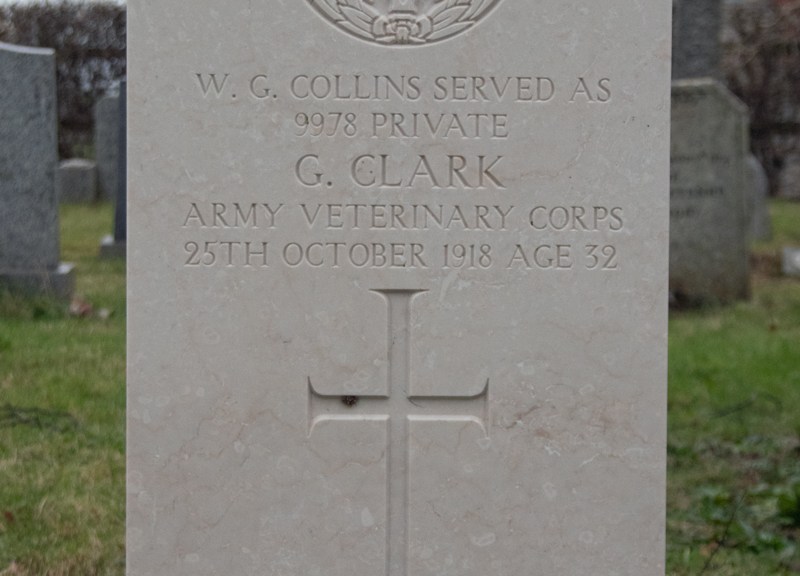
The headstone in question simply says “WG Collins served as Private G Clark in the Army Veterinary Corps”, but the research tools I normally use drew blanks.
Unfortunately, the Findagrave website does not have the burial listed under either name, so that too was a dead end.
The British Newspaper Archives site – a record of media across the UK covering 250 years – similarly has no entry for either name around the time of his death, which suggests it was either not ‘out of the ordinary’ (not headline-grabbing) or his death and funeral were just not submitted to the local paper.
Fold3 – which stores military records – has a record for 9978 Private Geoffrey Clark. The Register of Soldiers’ Effects confirms that a war gratuity was awarded to his sister, Ada Jane Waldron, after his death.
And, as it turns out, it was Ada who proved the key to the mystery of her brother. Working on the basis that Ada’s maiden name was Collins, I used Ancestry.co.uk to try and track her down. The site presented a family tree featuring both an Ada Jane Collins and, more importantly, a William George Collins, and the game was afoot…
William George Collins was born in the Somerset village of Coxley in the summer of 1889. He was the youngest of seven children – Ada was his oldest sister – to James Collins, an agricultural labourer, and his wife Jane.
Following the death of his mother in 1901, and his father a decade later, it’s evident that William wanted to make his way in the world. By the 1911 census, he had moved to Wales, working as an attendant at the Glamorgan County Lunatic Asylum. The asylum, which was in Bridgend, South Wales, was home to nearly 900 patients, and William acted as one of the 120 staff looking after them.
War was on the horizon, however, and the mystery surrounding William returned once more. Military records for William (or Geoffrey) are limited; he enlisted in the Royal Army Veterinary Corps in the summer of 1915 and was shipped to France in September of that year.
There is no record why he enlisted under the name Geoffrey Clark, nor does there seem to be any evidence of either names in his family. As to his passing, there is nothing to give a hint to how he died. All that can be confirmed for certain is that he passed away at the University War Hospital in Southampton on 25th October 1918, at the age of 32.
William’s probate records give his address as Railway Terrace in Blaengarw and show that his effects went to his sister, Ada.
William George Collins – also known as Geoffrey Clark – lies at peace in the graveyard of Christ Church, in his home village of Coxley.











 Death and Service