Joscelin William Currey was born in the summer of 1897, one of six children to Job Arthur Currey and his wife, Eliza Jane. Job was a shoesmith, and brought his young family up in his home town of Taunton, Somerset.
When Joscelin left school, he worked as an errand boy, before becoming an apprentice with local foundry of Messrs. Rudman, Lancey and Co. But with war on the horizon, things were about to change.
Along with his older brothers, Joscelin enlisted in the army, joining the 3/5th Reserve Battalion of the Somerset Light Infantry in August 1914. Initially based on Salisbury Plain, he was soon transferred to Bath, and attained the position of Lance Corporal.
It was in Bath that he fell ill, and was admitted to hospital with cerebrospinal meningitis. Sadly, Joscelin was to succumb to this condition, and he passed away on 28th June 1915. He was just 18 years of age.
Joscelin William Currey was laid to rest in the St James Cemetery of his home town of Taunton.
The newspaper report of Lance Corporal Currey’s funeral confirmed that one of his brothers was a prisoner of war in Germany, while another was in the Royal Field Artillery. Joscelin was the only one of the three to die during the conflict.
Joscelin’s name is spelt variously as Jocelyn and Joslin across the documents relating to him, and his surname is also spelt Curry. For the purposes of this post, I have chosen to use the spelling cited on the Commonwealth War Graves Commission records.
Walter Coleman was born in the spring of 1887, one of seven children to James and Emily Coleman. James was a hairdresser and the family lives in the Somerset town of Taunton.
Walter didn’t follow his father’s trade; instead, after a spell working at a collar factory when he left school, he was soon employed as a groom.
On Christmas Day 1910, he married Kate Norris, and the couple set up in a two-up, two-down in the middle of the town.
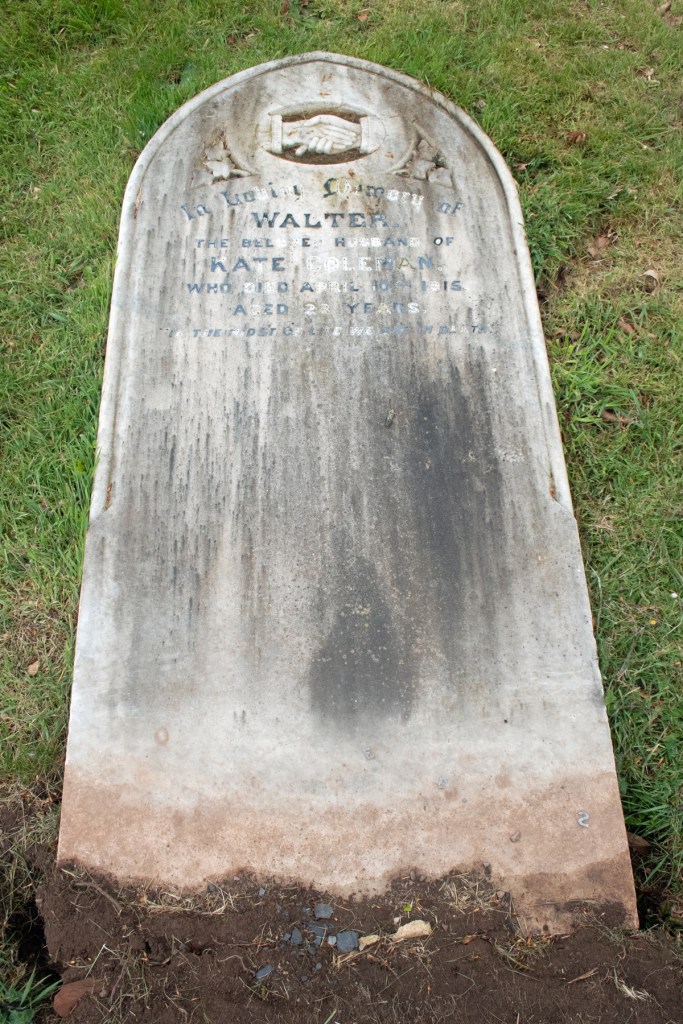
War was on the horizon, however, and when it broke out, Walter signed up straight away. He joined the 72nd Brigade of the Royal Field Artillery as a Driver and trained at the Bulford Camp on Salisbury Plain. It was while he was here on 10th April 1915 that he had an accident and fell off his horse. Sadly, Driver Coleman fractured his skull and died of his injuries that day. He was just 28 years old.
Walter Coleman lies at rest in the St James’ Cemetery in his home town of Taunton.
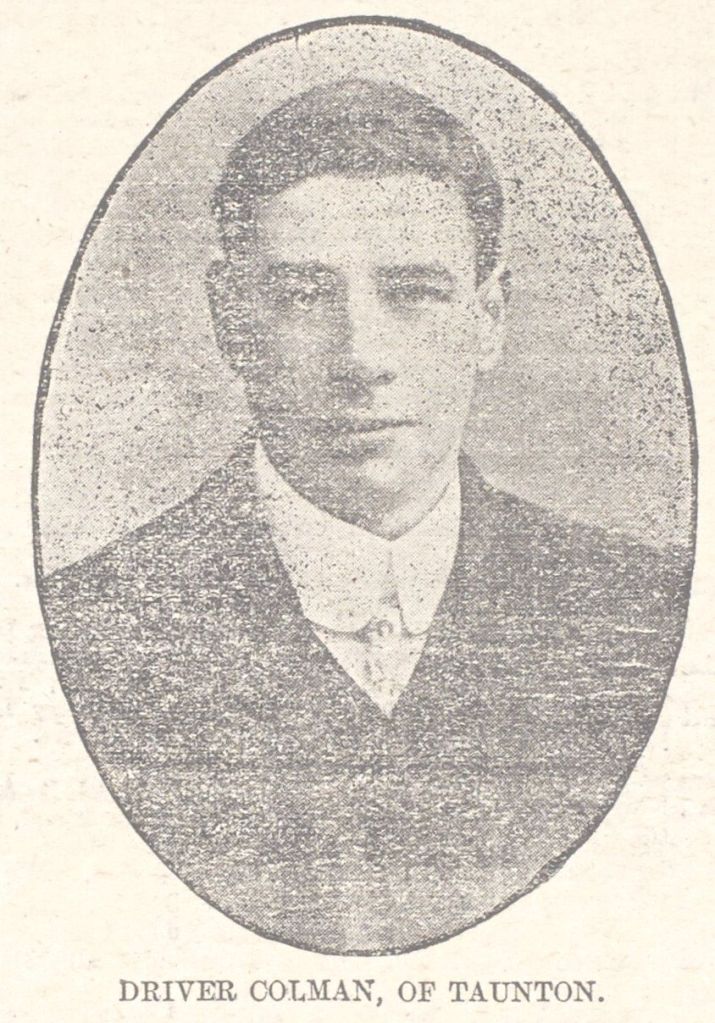
Walter Coleman (from findagrave.com)
Walter’s older brother Henry James Coleman also served in the Great War. Posted to France as part of the Labour Corps, he died of wounds on 12th April 1918. He was 33 years old, and left behind a widow and four children. He is buried at the Longuenesse Souvenir Cemetery in France.
Charles Pretoria Criddle was born on 18th June 1900, the second of five children to Charles and Mary Criddle. Charles Sr was an army reservist, who worked as a labourer for the local council, and the family lived in Taunton, Somerset.
Sadly, little detail of Charles Jr’s life is documented. The Great War broke out when he was only 14, so was too young to enlist at the beginning of the conflict. However, he did volunteer, albeit later on, and joined the 15th Battalion of the Hampshire Regiment at some point in 1918.
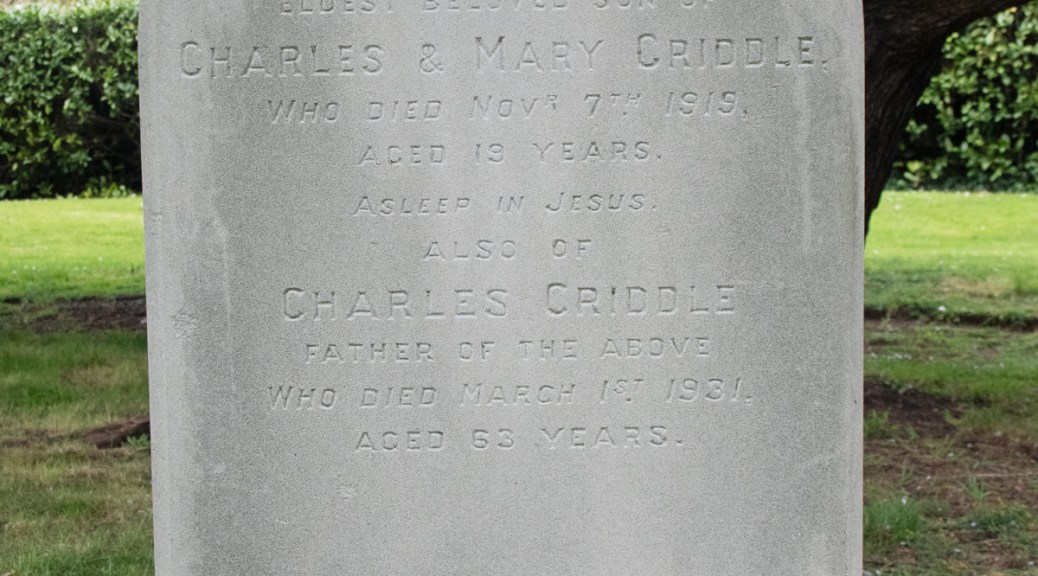
Private Criddle’s was one of those lives to be cut tragically short, not by conflict, but by illness. He survived the war, but was subsequently admitted to a military hospital in Brighton, Sussex, where he passed away ‘from disease’ on 7th November 1919. He was just 19 years of age.
Charles Pretoria Criddle lies at rest in the St James Cemetery in his home town of Taunton, Somerset.
Tragedy was to strike again for Charles Criddle Sr. Less than a week after his son had passed, he was called upon to identify the body of his sister, Emma Cable. She had taken her own life after suffering an increasing number of fits over the previous few years.
Emma was a widow, and, since the previous winter, had become increasingly depressed and less physically able, having suffered a debilitating bout of influenza. Early on the morning of Sunday 16th November 1919, she took herself out, dressed in only her nightgown and a pair of boots, and had drowned herself in the River Tone.
At the inquest into her passing, her doctor noted that he had seen her on the previous Thursday “but her condition was not such that he could certify her as insane, but she had been violently hysterical.” [Taunton Courier and Western Advertiser: Wednesday 19th November 1919]
The Coroner recorded a verdict that the deceased drowned herself while of unsound mind.
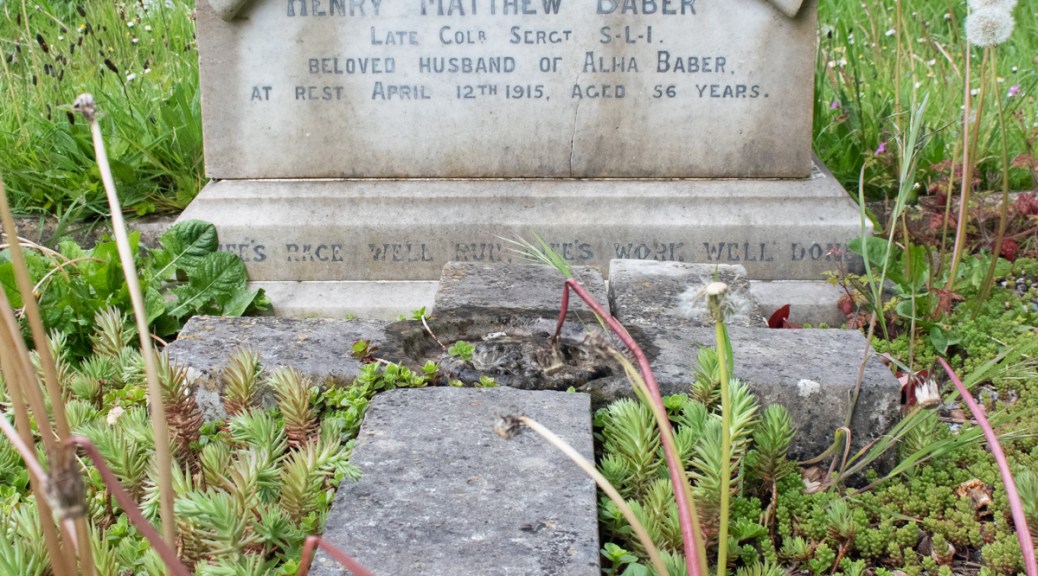
Henry Matthew Baber was born in the spring of 1859, the second of six children to Henry and Jane Baber. Henry Sr was a cordwainer – or shoemaker – and the family lived in Bristol. Or, at least, most of them did. The 1871 and 1881 censuses show Henry Sr and Jane happily living with their children, but Henry Jr is noticeable in his absence.
In August 1887, Henry married Sarah Jane Hardwidge in the village of Paulton, near Bath. His younger brother Alfred and two of his sisters, Annie and Ellen, all bear witness to the wedding, at which Henry gives his profession as coachman.
The newlyweds settle down in Weston-super-Mare, and go on to have two children, Henry and Kathleen. Sadly, the couple’s happiness was to be cut short, when, in 1891, Kathleen passed away, followed just two years later by Sarah, at the age of just 32 years old.
With a young boy to bring up, Henry sought a new companion and, just over a year after Sarah’s death, he married Alma Quantick, who was fourteen years Henry’s junior. Together, they went on to have six children and, by the time of the 1901 census, the family were living in the Somerset village of Yatton. Henry, by this time, was working as an insurance agent for Prudential, a profession that was to last him through to the start of the First World War.
From the early 1890s, Henry had enlisted in the local Yeomanry. While only a reserve force, he had a short spell in Egypt, fighting at Tel-el-Kibir in 1882. Harry worked his way up through the ranks, eventually attaining the role of Colour Sergeant. He was brought out of reserve status on 4th August 1914, at the age of 55, and was assigned to the 4th Battalion of the Somerset Light Infantry.
There is little else to confirm his military career during the Great War; he was discharged in November 1914, but there is nothing to confirm whether he had seen active service during those four months or not.
Colour Sergeant Baber’s passing is also shrouded in mystery. He died on 12th April 1915, but the cause of his death is lost to time. He was 56 years old when he died.
Henry Matthew Baber lies at rest in the graveyard of St Mary’s Church in Yatton, Somerset.
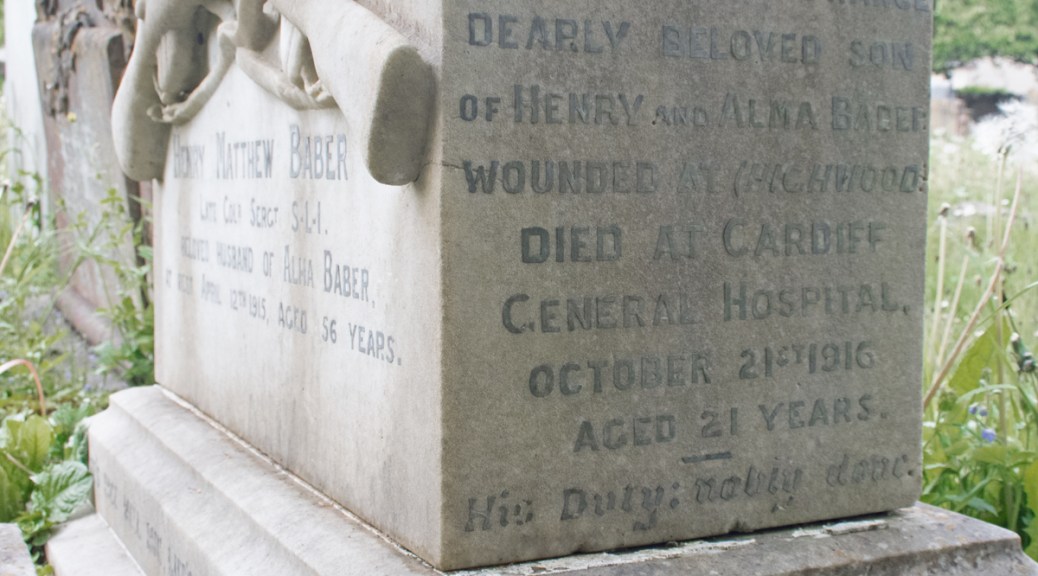
Henry and Alma’s eldest son William Albert Baber is also interred in the family grave and, within eighteen months, Alma had lost both her husband and her eldest son. William was 19 years old when war broke out, and his story can be found here.
William Herbert Baber was born in May 1895, the oldest of six children to Henry and Alma Baber. By the time of William’s birth, Henry was an insurance agent for the Prudential insurance company and brought his family up in the Somerset village of Yatton. William’s father had been widowed early on, and so, in addition to his five younger siblings, he also had an older half-brother, also called Henry.
By the time of the 1911 census, William was working as a clerk in a coal office, and the family were living in a five room house not far from the village centre.
Little remains documented about William’s military service. He enlisted in the Somerset Light Infantry, but transferred to the 24th Battalion of the London Regiment. He was involved in the Battle of High Wood – part of the Somme offensive – and was wounded during the skirmish.
Evacuated back to home soil, Private Baber was treated in one of the military hospitals in Cardiff. Sadly, he was to succumb to his wounds, and passed away on 16th October 1916. He was just 21 years old.
William Herbert Baber lies at rest in the family grave in the churchyard of St Mary’s in Yatton.
William’s father Henry was also called up for war duty. You can read more about his story here.
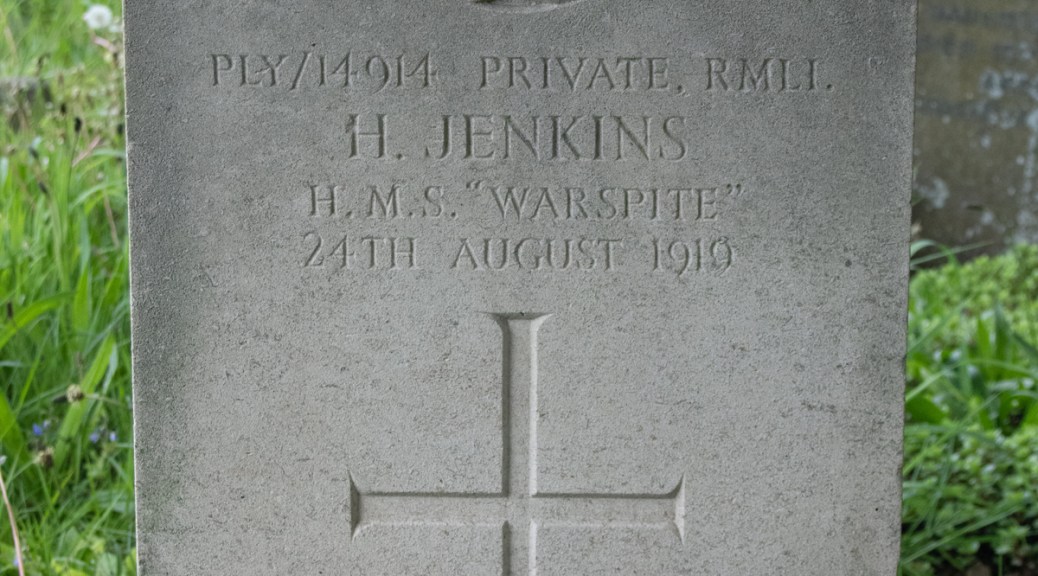
Herbert Jenkins was born in 1891, the youngest of five children to George and Amelia Jenkins. George was a domestic gardener, and the family lived in the Somerset village of Yatton next to the Prince of Orange public house. Amelia helped make ends meet, by working as a seamstress and upholsterer.
Amelia passed away in 1909, and it was around his time that Herbert felt the calling of military service. He enlisted as a Private in the Royal Marines Light Infantry on 17th September 1909.
Sadly, little documentation remains about Private Jenkins’ naval service, although the 1911 census gives his location as the Stonehouse Barracks in Devon.
Herbert’s family life held a series of highs and lows. His father George died in 1915, and he went on to marry Blanche Elvins, a bootmaker’s daughter from Bristol, the following year. Sadly, however, she passed away in December 1918, and Herbert was alone again.
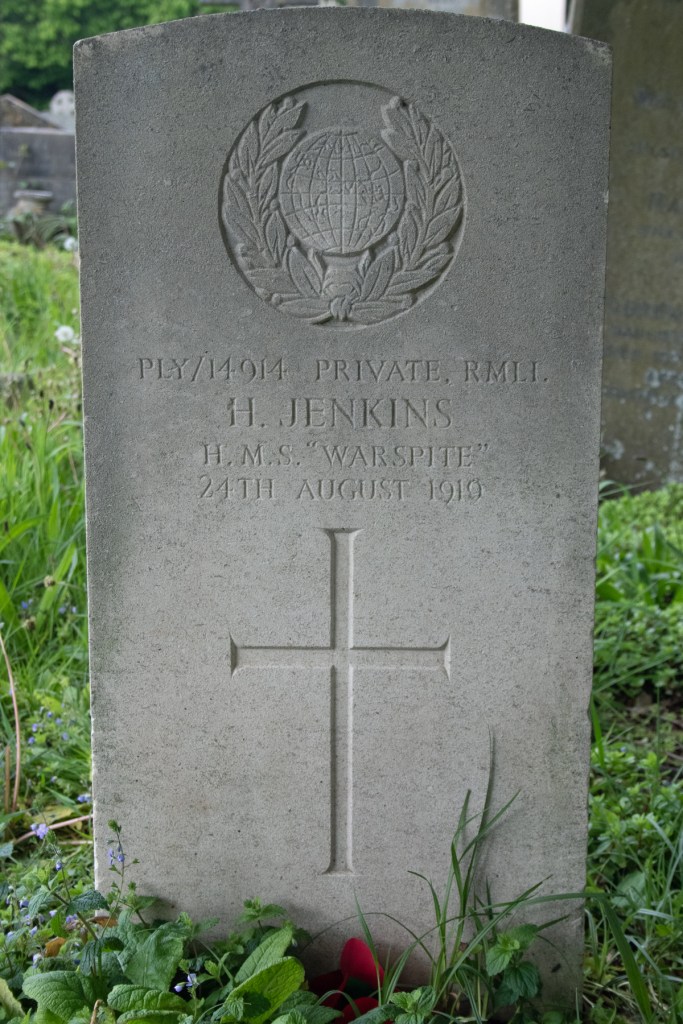
By this time, the Great War was over, although Private Jenkins was still serving. He was assigned to HMS Warspite, which had fought, and been damaged, in the Battle of Jutland. While there is no evidence that Herbert had been on board during the skirmish, this is the last vessel on which he served.
As with his military career, details of Herbert’s passing are lost to time. All that is known is that he died in Bristol on 24th August 1919 and that the cause was ‘disease’. He was just 27 years of age.
Herbert’s next of kin was his sister Jennie; she brought him back to his home town of Yatton to be buried in the graveyard of St Mary’s Church.
Ernest Frederick Hawkins was born in Street, Somerset, in 1884. He was the youngest of six children to Charles Hawkins and his wife Elizabeth. Both of Ernest’s parents were shoemakers in the Clark’s Factory in the town, and this was the trade Elizabeth continued in after her husband’s death in 1887.
Ernest’s life has some mysteries about it and there is a sense that he spent time trying to escape from something. In August 1904, he enlisted in the army, joining the Scottish Rifles (also known as the Cameronians). He did this under an assumed name, preferring to be called James Fisher.
“James” gave his next of kin as his parents, listing them as George and Annie in South Acton (even though these were not his actual parents’ names, and that his father had passed away 17 years previously).
His enlistment papers give an interesting insight into the young man. He was listed as 22 years old, 5ft 4ins (1.62m) tall, with brown eyes, black hair and a sallow complexion. His arms were adorned with a number of tattoos, including Buffalo Bill on his upper right arm and a ship surrounded by flags on his upper left.
Private Fisher served for a year on home soil, before being shipped out to India. He returned to the UK in October 1907, and transferred to the Army Reserve.
Ernest returned to Somerset, and it was here that he met Sarah Jane Manning. The couple married in a registry office in Bristol, and went on to have two children, Hubert and Iris.
War broke out, and Private Fisher was remobilised. By August 1914 he was promoted to Lance Corporal, and sent to France as part of the British Expeditionary Force. Here he became caught up in a number of the key battles of the conflict.
On 24th July 1916, during the British attacks on High Wood at the Somme, he was wounded in the right arm, and invalided back to England for treatment. Admitted to the War Hospital in Guildford, Surrey, it was confirmed that he had received a gun-shot wound to his right arm, which had resulted in a compound fracture of the humerus, radius and ulna. Sadly for Ernest, the only option was a full amputation of his right arm.
After some time to recover, Ernest was transferred to the Pavilion Military Hospital in Brighton where he was fitted for an artificial limb. He spent three months in the Brighton facility, before being moved to the Queen Mary’s Convalescent Home in Roehampton to recuperate. He was eventually discharged – from the hospital and the army – on 10th March 1917, and returned to his wife and family in Somerset.
There is little further documented information about Ernest. He and Sarah went on to have a further child – Leslie – in 1917. Sadly, where Ernest had been a toddler when his father had died, Leslie was consigned to be a babe-in-arms when Ernest passed away.
Ernest Frederick Hawkins – also known as James Fisher – died in Swindon on 2nd July 1918, at the age of 34. He lies at rest in St Mary’s Cemetery in his adopted home town of Taunton, Somerset.
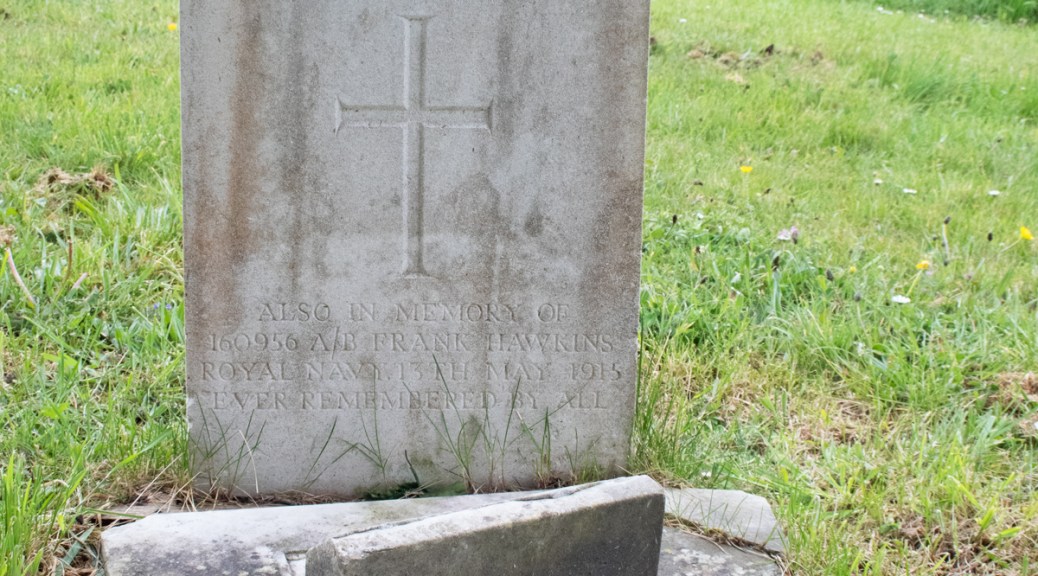
Ernest’s gravestone also commemorates his brother Frank Hawkins. Frank was nine years older than Ernest, and, like his younger brother, had decided that the military life was for him.
Frank enlisted in the Royal Navy in November 1894 and was assigned a Boy 2nd Class on HMS Impregnable – the training ship based in Chatham, Kent. Over the period of his twelve years’ service, Frank rose through the ranks to Able Seaman. When his term was up, he joined the Royal Fleet Reserve for a further five years.
When war came, Able Seaman Hawkins was immediately called back into action. He was assigned to HMS Goliath, serving off German East Africa and the Dardanelles. On the night of the 12th May 1915, the ship was guarding the water off Gallipoli, when it was struck by three Ottoman torpedoes. The resulting explosions caused the ship to sink quickly, and 570 souls – out of a total complement of 750 crew – were lost.
Able Seaman Hawkins was one of those lost, and was subsequently commemorated on his brother’s gravestone.
Leonard Francis Tucker was born in 1898, the middle of three children to Arthur and Frances Tucker. Arthur was a tailor from Taunton, Somerset, and this is where he brought his young family up.
Sadly, little documentation remains of Leonard’s life. His grave confirms that, when war came, he served in the Royal Navy, and, at the time of his death, he was a Deck Hand on HMS Vivid.
His Commonwealth War Graves Records confirm that his parents were living in Melbourne – his pension ledger confirms Arthur as his next of kin, with an Australian address. There is nothing to confirm their emigration, or whether Leonard emigrated as well.
Leonard’s young life is summed up in a short notice in the local newspaper, which has the simple comment “Tucker – Sept. 28th, at 10 Westgate-street, Taunton, Leonard Francis Tucker, aged 20.” [Taunton Courier and Western Advertiser: Wednesday 9th October 1918]
Slightly more confusing is the next name on that list: “Tucker – Sept. 29, at 10 Westgate-street, Taunton, Frances Ellen Tucker, aged 44.” It would seem that Leonard’s mother was in England, not Australia, at the time of his death, and that she passed away a day after him.
Combined with when Leonard died, it would suggest both he and his mother died from one of the respiratory conditions running rampant through England at the time, possibly influenza or pneumonia. There is nothing to confirm this outright, but it seems the likeliest outcome for the poor mother and son.
Leonard Francis Tucker lies at rest in St Mary’s Cemetery in his home town of Taunton.
As an aside to this, there is no record of where Frances was buried, but it is likely that she too was laid to rest in St Mary’s Cemetery.
Arthur Webb Butler Bentley was born on 1st January 1884 to Dr Arthur Bentley and his wife Letitia. The oldest of five children, they were a well-travelled family. Dr Bentley had been born in Devon, but his and Letitia’s first two children were born in Singapore, while their second two were born in Ireland, where Letitia herself had been born.
By the time of the 1891 census, the family were living in Paddington, London, where Arthur’s father was a medical practitioner.
Arthur Jr looked set to follow in his father’s footsteps; becoming a student of medicine in Edinburgh, although it seems his life was destined to take a different route.
By 1905, his father was working at a practice in Egypt. It was around this time that his mother made the newspaper headlines.
VICTIM OF CHROLODYNE
A painful story was told at the Clerkenwell Sessions when Letitia Bentley, the wife of a doctor holding an official position in Cairo, pleaded guilty to the theft of a diamond and ruby ring from the shop of Messrs. Attenborough, Oxford Street [London]. It was stated that Mrs Bentley was addicted to the drinking of spirits and chlorodyne, and that 240 empty bottles which had contained the latter drug had been found in her rooms in Bloomsbury.
Dr Bentley said he would keep his wife under strict supervision in the future, and she was bound over.
Shetland Times: Saturday 3rd June 1905.
The ring concerned was valued at five guineas (around £700 in today’s money), and another report confirmed that her husband “supplied her with ample means” [financially].
In the 19th century, chlorodyne was readily used as a treatment for a number of medical conditions. Its principal ingredients were a mixture of laudanum (an alcoholic solution of opium), tincture of cannabis, and chloroform, it readily lived up to its claims of relieving pain and a sedative.
Letitia does not appear in any other contemporary media; sadly, however, she passed away “at sea” in June 1907, presumably on the way to or from Cairo, where Arthur Sr was still working. She was just 47 years old.
Arthur seems to have taken the decision to move away, and he emigrated to Canada, settling in Winnipeg. Leaving England behind, he left the idea of medicine with it, finding work as a lineman instead, constructing and maintaining telegraph and power lines.
Arthur’s father is the next member of the family to appear in the local newspapers. Working in Cairo during the winter and Llandrindod Wells in the summer, he travelled to Wales in April 1911. One evening he collapsed and died while in the smoking room of his hotel. The media reported that he was “formerly Colonial Surgeon to the Straits Civil Service, Singapore” and that “he was going to deliver a lecture at Owen’s College [now the Victoria College of Manchester] on tropical diseases, upon which he was an expert.“
Arthur Jr was now 27, and had lost both of his parents. War was on the horizon, though, and he seemed keen to become involved. He enlisted in December 1915, joining the Canadian Expeditionary Force. His sign-up papers gave him as just short of 32 years old, standing at 5ft 8ins (1.72m) tall, with a fair complexion, blue eyes and brown hair. The document also recorded his next of kin as his brother, William, who was living near Cairo.
Arthur arrived in England on 25th September 1916; during his time in the army he remained on English soil, primarily at a signal base in Seaford. Transferred to a reserve battalion in January 1917, he was eventually discharged seven months later.
His records suggest that his services were no longer required, but t is likely that Arthur’s discharge was his transfer to the Yorkshire Regiment, complete with a commission.
The now Second Lieutenant Bentley was assigned to the 3rd Special Reserve Battalion but never saw action in Europe. The troop’s main duties were to train men for service overseas and to provide coastal defences. While there is no confirmation of exactly where Arthur was based, there were units in and around Hartlepool, County Durham.
Sadly, there is little further information about Arthur. By the end of the war, he was living in Taunton, Somerset, where his younger sister Eileen had settled. Second Lieutenant Bentley survived the war, but passed away not long afterwards, on 2nd December 1918. There is no cause given for his death. He was just 35 years old.
Arthur Webb Butler Bentley lies at rest in St Mary’s Cemetery in Taunton, Somerset.
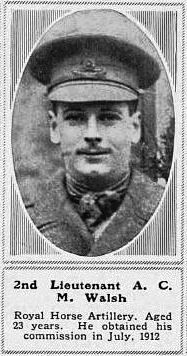
Archibald Charles Mark Walsh was born on 3rd February 1892, the youngest of three children to Henry Alfred Walsh and his wife Ann. Henry had a distinguished military career, and his sons – Archibald and his older brother Theobald – seemed destined to do the same.
Henry’s service took him around the world, and, by the time Archibald was born, the family had settled in Devon. In tracing the family’s life, however, an unusual quirk arises around the turn of the century.
In 1901, the majority of the Walsh family disappear from census records. For someone like Henry, this would not be unusual; his career took him overseas, and it is likely that records were lost or destroyed.
However, Archibald and his sister Gwladys do appear in the records. They are set up in a seafront villa in the Kent town of Hythe, Gwladys is listed as both a school pupil and the head of the household – at the age of 14 – and the two siblings are living there with a governess, Mary Porter.
By the time of the next census, Cadet Walsh had followed his father into the military. He was a student at the Military Academy in Woolwich, and the following year achieved his commission, becoming a Second Lieutenant in the Royal Horse Artillery.
When war broke out, Archibald’s regiment were shipped off to the Western Front. In March 1915, he was caught up in the Battle of Neuve Chapelle, and was badly wounded.
Shipped back to England for treatment, he was admitted to the Hall-Walker Hospital for Officers in Regents Park, London. Sadly, Second Lieutenant Walsh’s injuries were too severe, and he passed away on 18th March 1915. He was just 23 years old.
Brought back to Taunton, near his family home, Archibald Charles Mark Walsh lies at rest in St Mary’s Cemetery.