Tag Archives: gun

Able Seaman Gerald Brine

Able Seaman Brine

Gerald Montague Brine war born in October 1897, the youngest of seven children to John and Annie Brine. John was a potter, and, while the children were born in Dorset, the family soon moved to the Somerset village of Binegar.

Gerald’s three older brothers all went to work in a local stone quarry, as an engineer, breaker and foreman respectively. When Gerald left school, he found work with the local blacksmith as a striker. It was while employed there, in 1912, that his mother Annie passed away, aged just 50 years old.

War was on its way however, and where his brothers enlisted in the army, Gerald was bound for the sea. He enlisted in the Royal Navy on 3rd November 1915 and, as an Ordinary Seaman, was assigned to HMS Iron Duke. He was aboard the vessel when it became embroiled in the Battle of Jutland in May 1916, and was subsequently transferred to HMS Discoverer.

Promoted to Able Seaman in April 1918, the Discoverer headed back to Chatham a couple of months later. A Somerset newspaper picks up on Gerald’s sad tale from there.

When one of His Majesty’s ships was returning to port, and her crew were looking forward to “leave”, an unfortunate tragedy occurred by which Gerald Montague Brine, a young Able Seaman [and] a native of Binegar, lost his life. It appears that in the course of storing gear, a loaded revolver was removed by mistake to the armourer’s room, instead of to the officer’s cabin, and was placed on a table.

Curiosity led Peter Macfarlane, another able seaman, to handle it, and as he was bringing it to his side from an upward position, he, to use his own words, unconsciously pulled the trigger. It fired, and the bullet entered Brine’s body just under his left shoulder, fracturing his spine and producing paralysis of his lower limbs.

Wells Journal: Friday 12th July 1918

Gerald’s parents had a telegram to say that he was seriously wounded and in the Royal Naval Hospital, Chatham. They travelled at once to Chatham and found him very ill, but conscious. They remained with him until he died a week later, on 1st July 1918. He was just 20 years of age.

At the inquest, Macfarlane described Brine as his best chum, and all witnesses agreed that “the best possible relations existed between the members of the crew.” According to the doctor’s evidence at the inquest, Gerald was unable to be saved. The jury reached a verdict of Accidental Death.

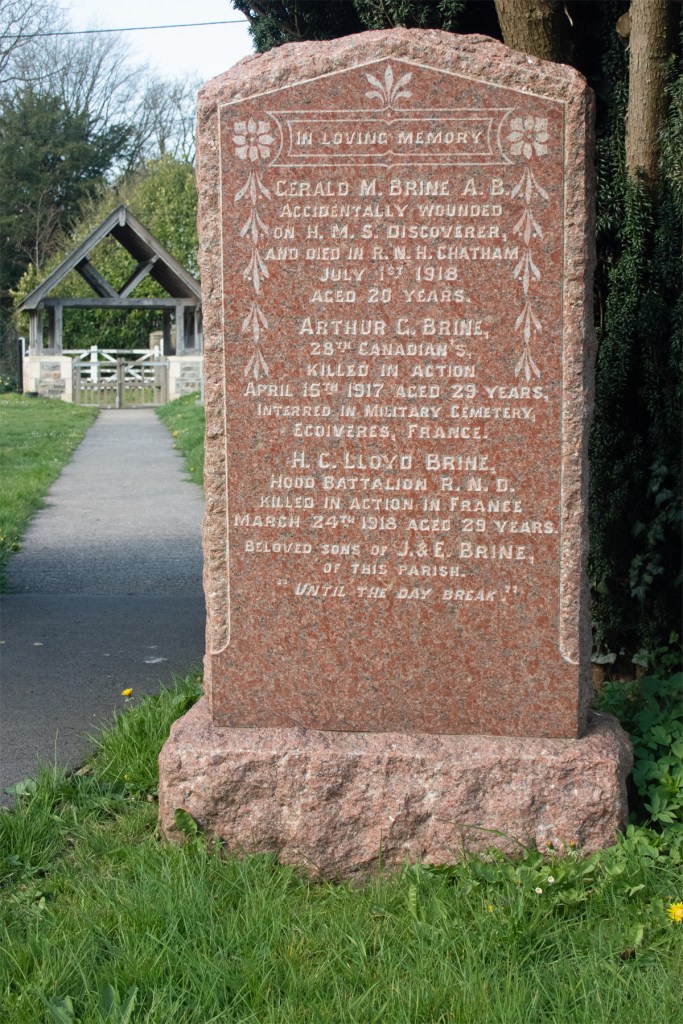
Able Seaman was brought home to Binegar, and lies at rest in the graveyard of Holy Trinity Church.


Gerald’s grave also acts as a memorial to two of his older brothers.


Arthur Brine, who had been the stone breaker in the quarry, emigrated to Canada after his mother had died, finding work there as a fireman. The Great War brought him back to European shores, however, and he enlisted in the Canadian Expeditionary Force, joining the 188th Battalion.

Private Brine arrived in England in October 1916; he transferred to the 28th Canadians, and set off for France the following January. He was caught up in the Battle of Arras and was hit and killed by a piece of shrapnel on 15th April 1917. He was just 29 years old.

Arthur Brine lies at peace in the Ecoivres Cemetery to the north west of Arras in Northern France.


Herbert Brine had been the foreman at the stone quarry He married Sarah Lucy James shortly before his mother’s death in 1912; the couple went on to have two children, Arthur and Kenneth.

Herbert was mobilised in July 1917, initially joining the 3rd Reserve Battalion. He was drafted, as an Able Seaman, to the Hood Battalion, Royal Naval Division (RND) in November 1917, before re-joining his RND Battalion at Flesquières, near Cambrai, two months later.

In early March 1918, the Germans started bombardments in preparation for a major offensive. For ten days from 12th March, the Flesquières salient was drenched with nearly a quarter of a million (mostly mustard) gas shells, There were over 2,000 resultant casualties in the RND. After this preparatory shelling, the Germans attacked in enormous numbers.

By the end of the day, the situation was precarious and the Division was forced to retreat in steps, through Bertincourt, Ytres and the Metz lines, through the old Somme battlefields.

Able Seaman Brine was first reported missing on 24th March, but was only accepted as having been killed in action on that date nine months later.  As such, Herbert is commemorated by name on the Arras Memorial; his name also resides on Gerald’s gravestone back home in Binegar.


The Great War took its toll on the Brine family. Three of the four brothers died during those tumultuous years, leaving only John’s oldest son, Wallace, to carry on the family name. John himself died in 1942, aged 84, and lies with his wife and youngest boy in the small Binegar churchyard.


Private Bernard Dyke

Private Bernard Dyke

Bernard Dyke was born in 1897, the oldest of three children to Albert and Edith Dyke from Bridgwater, Somerset. Albert worked for a brewery, and the young family lived in a house on the main road west out of the town.

Bernard received a scholarship to attend Dr Morgan’s School, a grammar school in the town, and he was a pupil there from autumn 1910 to spring 1913. He left at the age of 16, and became a merchant’s clerk.

War was on the horizon, however, and Bernard joined up. Full details of his military service are not available, but he enlisted in the Devonshire Regiment. Private Dyke spent some time at the Tregantle Fort, near Plymouth, and it was here that he was caught up in an accident.

It has transpired than a rather remarkable shooting fatality occurred at Tregantle rifle ranges, near Plymouth, on Friday, when Private Bernard Dyke, aged about 24, of the Devon Regiment, received a gunshot would in the left side, and almost immediately expired.

The soldier was acting as an observer for a Lewis gun section when he received the fatal injury, the section being at the time out of action awaiting the appearance of a moving target. On the deceased’s left hand side was a musketry party of nine carrying out an exercise, and when he received his injury only one or two rounds had been discharged by this party.

When the first shot or so had been fired deceased suddenly shouted “Oh! Oh!” and dropped. An officer and NCOs ran to assist him, but found that life was extinct. A military doctor was soon on the spot, and found the bullet had entered the deceased’s left side below the ribs and made its exit at the top of his right arm.

As the musketry party was 80 degrees to the right of the firing party it is strange that a shot could have been fired so wide, but the explanation may be found to be in a ricochet or a soldier’s erratic action.

Western Morning News: Monday 21st January 1918.

Private Bernard Dyke died on 18th January 1918, aged just 20 years old. He lies at rest in the Wembdon Road Cemetery in his home town of Bridgwater, minutes’ walk from his family home.


Bernard Dyke (from ancestry.co.uk)

Private Harold Cook

Private Harold Cook

Harold Cook was born in February 1899, the youngest of nine children to George and Amelia Cook from the Somerset town of Street. George worked as a bootmaker, presumably for the Clark’s factory in the town.

Harold lost his mother at a young age; Amelia passed away in 1901, aged just 41 years old.

By the time of the 1911 census, George, his two older sons – Maurice and George Jr – and his four daughters – Beatrice, Florence, Alice and Gladys – were all employed by the factory. In fact, the only member of the family not employed by Clark’s was Harold himself, who was still at school.

Harold’s military records are not available, but, from the information I have been able to gather, it appears that he enlisted as soon as his age allowed. He joined the Suffolk Regiment, and was in training when an accident occurred.

The local newspaper – the Central Somerset Gazette – picks up his story:

It appears that about 11pm on August 24th [Private Cook was] in bed and suddenly got up, saying he was lying on something. This proved to be the oil bottle of his rifle and he said he would put it away. He got hold of his rifle and turned it muzzle downwards in order to put the oil bottle in the butt. When he closed the butt-trap the rifle went off.

He at once exclaimed “Who put the safety catch forward?”. Corporal Butler and [Private Johnson] then bandaged Private Cook’s foot (which was drilled clean through) and he was taken away at once.

From subsequent evidence by the Adjutant, it transpired than the rifle had been faultily loaded and that the safety catch had been broken.

Deceased had received every possible attention at the American Hospital in Cambridge, but his leg had to be amputated and subsequently septicaemia set in and to this he succumbed.

The jury, in accordance with the Coroner’s summing up, returned a verdict of “Accidental Death.”

Central Somerset Gazette: Friday 19th October 1917

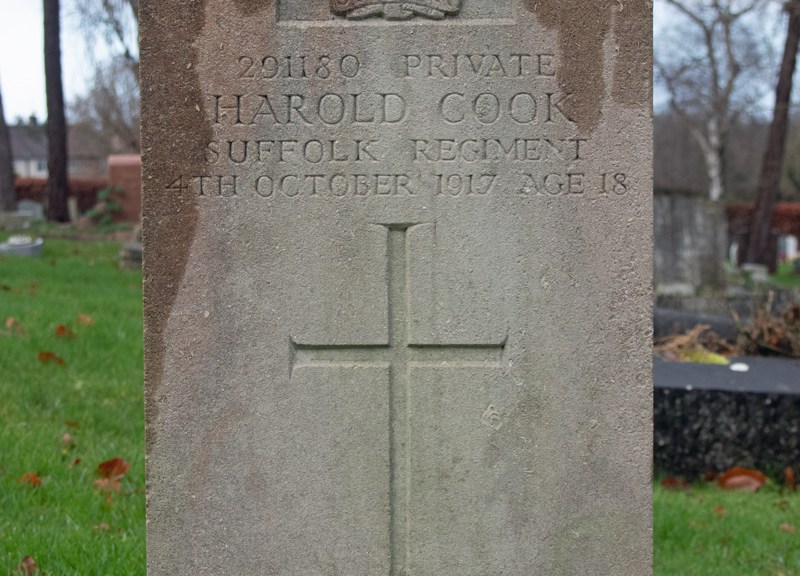
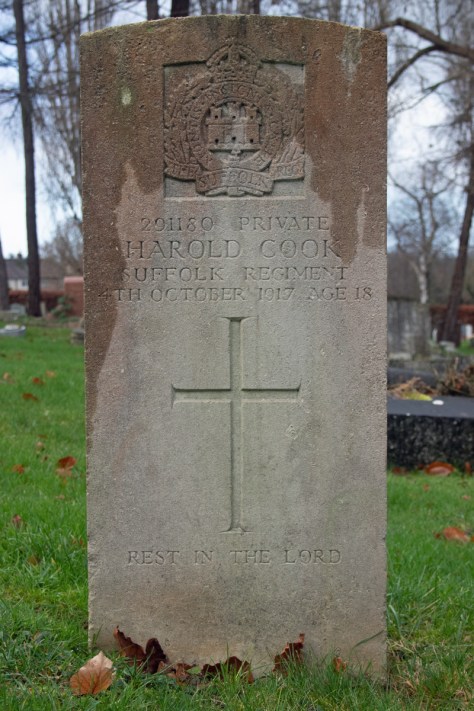
Private Cook died on 4th October 1917, aged just 18 years old.

His body was brought back to his home town of Street and he lies at rest in the local cemetery.


Rifleman John Armes

Rifleman John Armes

John Henry Armes was born in Cannock, Staffordshire in 1881. One of eight children to Richard and Mary Armes, his father was a colliery worker and labourer. After their mother’s untimely death in 1890, this was a trade into which his three boys – Richard Jr, John and Alfred – followed.

The 1901 census finds John living with his widowed father and working as a coal hewer. A year later, he married Caroline Caldwell and, by the outbreak of the war, the couple were living in Ilkeston, Derbyshire with their growing family of seven children.

Records of John’s enrolment are not evident, but it is likely to have been later in the war, rather than earlier, given that his trade was one of those protected from enlistment.

By 1915, Caroline had given birth to the couple’s seventh child and John had signed up to the King’s Royal Rifles, stationed at the fort in Grain, North Kent.

Rifleman Armes’ pension record shows that he was accidentally killed on active service, and the contemporary media pick up the story.

[He] had been on outpost duty. On coming off duty about half-past seven on Monday morning he placed his rifle in a rack in a hut, and went to breakfast. Another rifleman names John Bathams Olliff, picked up the rifle to unload it, but having trouble with the extractor he took the magazine of the rifle out, and then thinking all the cartridges were in the magazine he pressed the trigger to close the bolt of the rifle, and a shot went off. At that moment Rifleman Armes came round the door of the hut and received a bullet in the chest.

Exclaiming, “My God, Armes is here,” Olliff rushed to his assistance, and Armes said “I am done for. It was an accident.” Medical aid was telephoned for, but Armes died shortly after the doctor arrived.

Est Kent Gazette: Saturday 5th February 1916

An inquest was held, which found that the two Johns were great friends and had asked to serve together. The jury exonerated John Olliff from blame and recorded a verdict of accidental death.

John Henry Armes died at the age of 34, likely without seeing his youngest child. He lies at rest in St James’ Churchyard in the village of Grain in Kent, close to the barracks where he lost his life.


There are a couple of other protagonists in this story.

John’s widow, Caroline, married again later in 1916, to a George Chapman. She went on to live to the age of 77, outliving three of her children and both of her husbands.

John Battams Olliff, who had accidentally shot John, was born in London in 1880. The son of a butcher, he had emigrated to Canada in 1911. John returned to the UK to fight in the war, joining the King’s Royal Rifles in May 1915. Little information about his post-war survives, but it appears that he remained in England. There is no record of him marrying, but he died in 1938, at 58 years old.