Tag Archives: hernia

Rifleman Henry Banks

Rifleman Henry Banks

The early life of Henry Ernest Banks is destined to remain lost to time as there is little documentation available to corroborate details. The first concrete documentation for him is his marriage certificate, and this sheds lights onto the man he had become.

The wedding took place on 7th August 1905, and confirms that Henry was 19 years of age. His father was recorded as being James Banks who, by this point was deceased. He had been a chairmaker, and his son had followed in a similar type of work, being employed as a French polisher.

Henry’s bride was 19-year-old Blanche Hearnden, who was noted as being the daughter of deceased traveller William Hearnden. At the time of their marriage, the newlyweds were living at 13 Busby Street, Bethnal Green, London. Now long since gone, the road led directly to St Matthew’s Church, which is where their nuptials took place.

By the time of the 1911 census, Henry and Blanche were living with her mother in Whitechapel. They had had a child, son Ernest, the previous year, and the mixed household included Blanche’s three sisters and their children. Money must have been tight, but four members of the household were bringing in some money, Henry working as a French polisher, with two of his sisters-in-law working as a cigarette packer and a printer’s assistant. Blanche and her other sister were listed as housewives, while her mother, who was also called Blanche, was noted as being a charwoman.

When war broke out, Henry was called upon to play his part. Details of his military service are sketchy, but it is clear that he enlisted in the London Regiment, and was attached to the 17th (County of London) Battalion, which was also known as the Poplar and Stepney Rifles.

Rifleman Banks’ unit was sent to France on 9th March 1915. Within a matter of weeks, however, he was back in the UK, and appears to have been admitted to a hospital in Paignton, Devon.

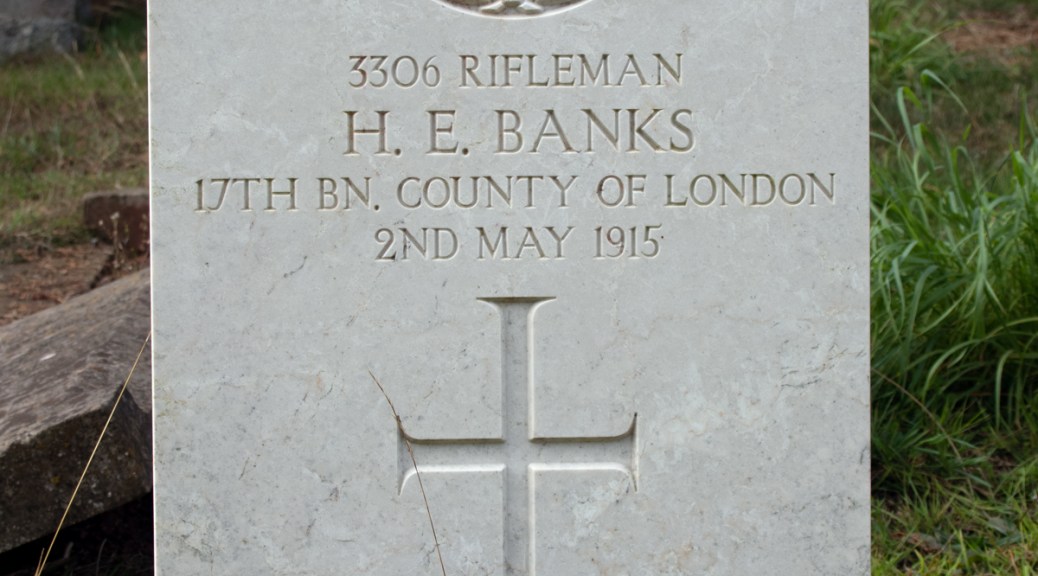
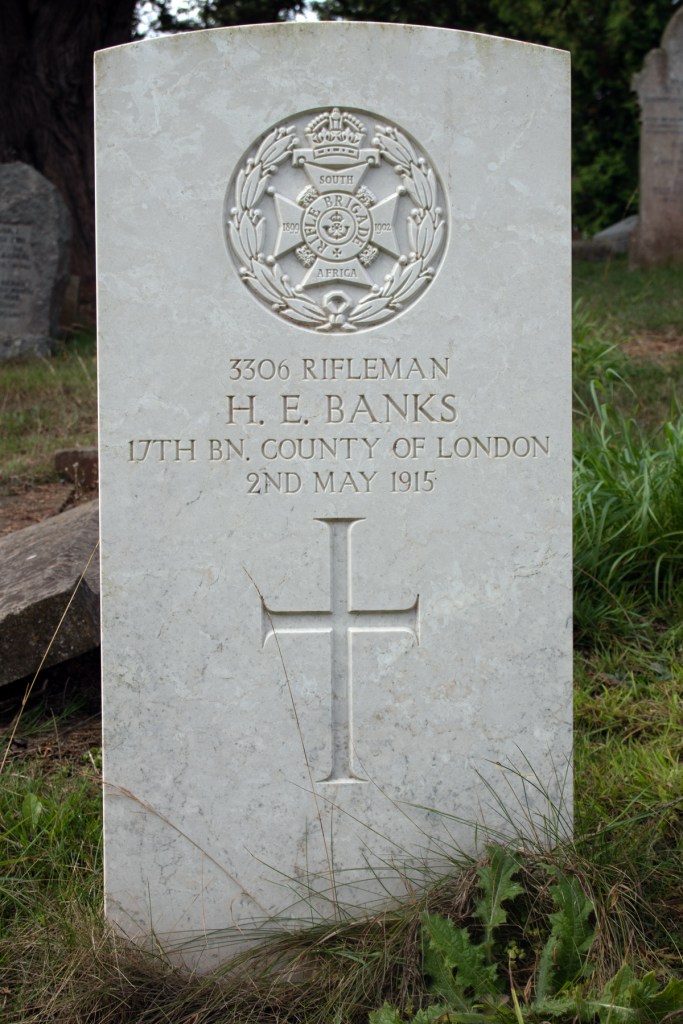
Henry died on 2nd May 1915, and one record – his entry on the Grave Registration Form – that sheds a little light on Henry’s passing. It is noted being as a result of a strangulated hernia, although this is the only document that gives any details about his death. Henry was 28 or 29 years of age.

Henry Ernest Banks was laid to rest in Paignton Cemetery, Devon.


Private Arthur Lavender

Private Arthur Lavender

Arthur Reginald Lavender was born in Bath on 17th January 1889, the second of two children to George Charles (or Charles George) Lavender and his wife, Elizabeth. George raised the family in Bath and seems to have been a jack of all trades, finding work where he could, as a porter in a warehouse according to the 1891 census and a stationary engine driver ten years later.

On 1st December 1907, at the age of just 18, Arthur married Kate Pearce, a painter’s daughter from Weston-super-Mare. The young couple went on to have a son, Sidney, who was born the following year.

By 1911, Arthur was working in Weston-super-Mare as a warehouseman at a local laundry and, on the day of that year’s census, was staying with his father-in-law. Kate, meanwhile, had taken Sidney to see her brother, Frank, who lived in Bristol.

War was coming to Europe, and, in November 1915, Arthur signed up, joining the Royal Army Medical Corps as a Private. After initial training – including a course on First Aid, he was sent overseas on 11th April 1916, where he was assigned to the 27th Casualty Clearing Station.

Private Lavender’s time in the RAMC seems to have been a complicated one. He was admitted to a field hospital within a month of arriving in France with a double inguinal hernia, a condition that continued to dog him over the coming months.

Arthur was eventually shipped to England in March 1917 for an operation at the Metropolitan Hospital in London. The operation itself seemed to have been a success, but, while admitted, he contracted pneumonia, and it was this lung condition that was to end his life. Private Lavender passed away on 7th May 1917, aged just 28 years old.

Arthur Reginald Lavender was laid to rest in the Milton Cemetery in Weston-super-Mare.


Private William Bellham

Private William Bellham

William Harry David Bellham was born in September 1888, the only child to William and Rosina Bellham. William Sr was a foreman for a collar manufacturer, and the young family lived in Taunton, Somerset, in a house they shared with Rosina’s mother, Mary Hale.

Life continued pretty much unchanged. When William Jr left school, he became a stenographer for a coal merchant, and, when war erupted in 1914, he didn’t sign up as soon as you would expect for someone of his age.

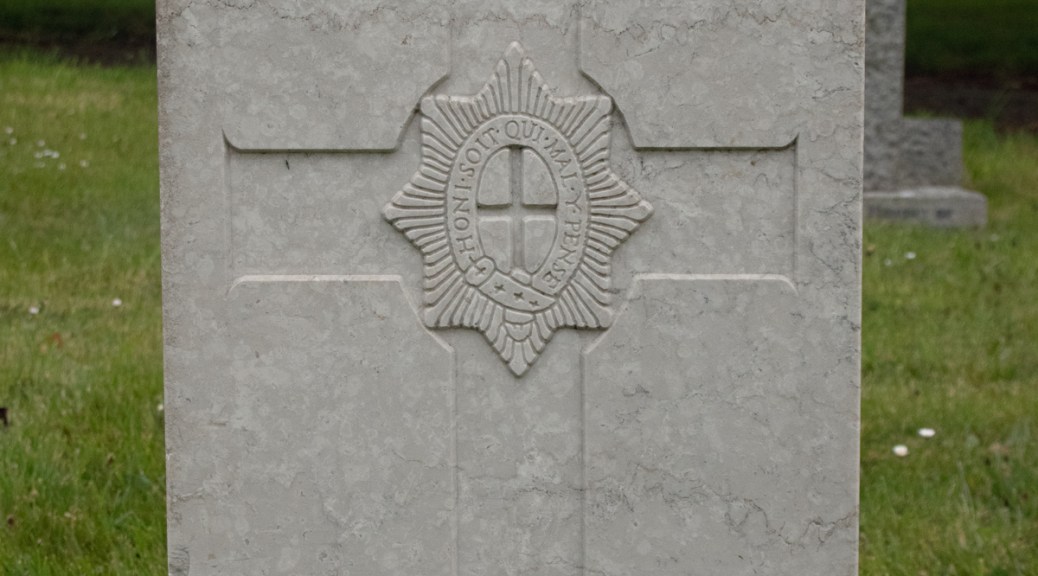
William enlisted in February 1916 and was assigned to the Coldstream Guards – given he stood 5ft 11ins (1.8m) tall, this probably went in his favour. Initially placed on reserve duty, Private Bellham was eventually mobilised in January 1917, and sent to Caterham for training.

Within a matter of weeks, William had an accident. Slipping on some ice, he suffered an inguinal hernia, which subsequently became strangulated, causing him severe pain. After initial treatment in hospital, he was discharged, but was then admitted again five months later when the hernia returned. A further operation was ruled out by the medical examiner, and he was discharged from the army on medical grounds at the end of June 1917.

Once back in Taunton, it did become necessary for William to undergo an additional operation. This was carried out in the local hospital and, according to the records, was a success. Sadly, however, William subsequently contracted pneumonia, and he died on 10th December 1917. He was just 29 years old.

William Harry David Bellham was buried in St Mary’s Cemetery in his home town of Taunton.


Cruelly, the contemporary local media had a less sympathetic take on the incident that caused William’s troubles. The Taunton Courier and Western Advertiser [on Wednesday 26th December 1917] suggested that he “was not really strong enough to stand the strain and hardships of military training and was invalided out after some months’ service.” Not exactly the picture that his medical records had outlined.


Private Oliver Chubb

Private Oliver Chubb

Oliver Job Chubb was born on 3rd December 1884 in the village of Smallbridge in Devon. He was one of six children to Job Chubb, who was an agricultural labourer, and his wife Louisa. Oliver did not seem to be one for settling down; after his parents had moved the family to Ilminster in Somerset when he was just a child, by 1901 he was living in Lyme Regis, working as a carter in a market garden.

In 1902, at the age of 17, Oliver enlisted in the Somerset Light Infantry. Eighteen months later he transferred to the Royal Navy, serving as a Stoker on a number of ships during what would become twelve years’ service, including the Royal Oak, Skirmisher and Newcastle.

In 1906 he married Rosina Keirle, a brickmaker’s daughter from Somerset. The wedding was in Bridgwater, and the couple went on to have three children, Olive, Albert and Cecil.

There is a sense that Oliver either had perpetually itchy feet, or that he was always running from something. The 1911 census found him aboard HMS Suffolk in the Mediterranean, where he listed himself as single. By the end of his naval service in November 1915, however, Stoker Chubb disembarked in the port of Victoria, British Colombia, and immediately signed up for military service with the Canadian Expeditionary Force.

Again, however, indecision seems to have set in. He listed his marital status as ‘single’ and confirmed his next of kin as his sister Elsie, but on his military will, he left everything to Rosina.

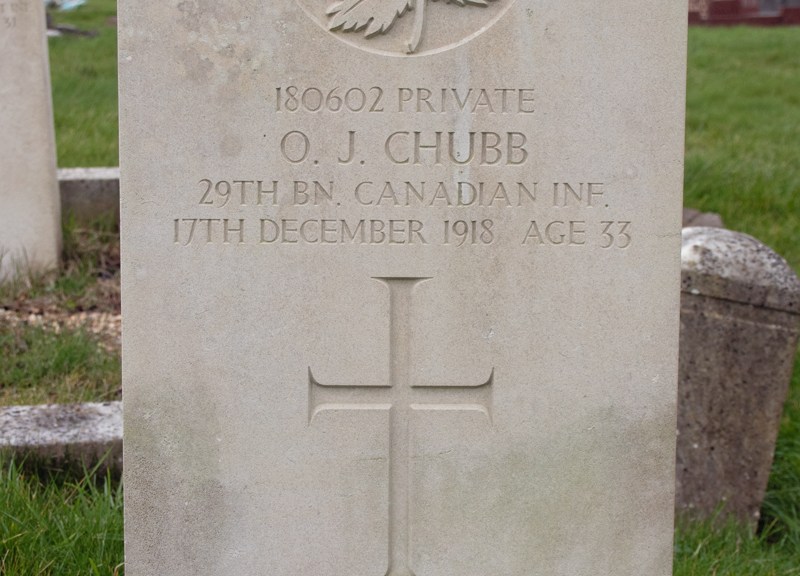
Private Chubb was assigned to the 29th Battalion of the Canadian Infantry; they served on the Western Front from early in 1915 through to the end of the war. He was involved in the fighting at Ypres, and, in September 1916, was treated in England for an inguinal hernia. After three months’ recover, he returned to the front.

While Private Chubb seems to have had a good overall manner, there were blips in his character. In May 1917, he was sentenced to three days’ field punishment for being absent without leave for 21hrs. In March 1918, he was sentenced to another five days’ field punishment for going AWOL for 48 hours. On 11th April 1918, Private Chubb received 14 days’ field punishment for drunkenness on duty.

In December of that year, Oliver was invalided back to England for medical treatment; he was admitted to the Fort Pitt Military Hospital in Chatham with lymphatic leukaemia. Sadly, Private Chubb passed away shortly after being admitted, dying on 17th December 1918. He was 34 years old.

Oliver Job Chubb lies at rest in St John’s Cemetery in Bridgwater, where his family still lived.