Tag Archives: Kent

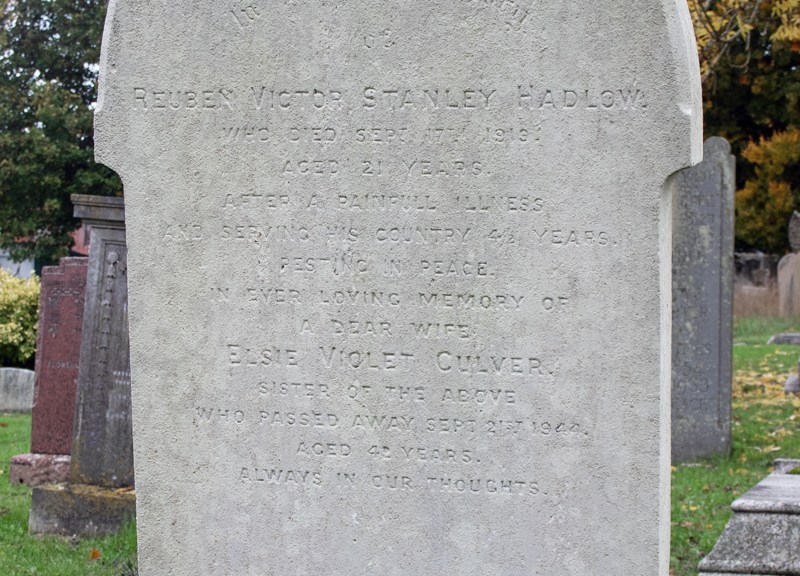
Air Mechanic Reuben Hadlow

Air Mechanic Reuben Hadlow

Reuben Victor Stanley Hadlow was born in the spring of 1898. He was one of thirteen children to John Charles Tarpe Hadlow and his wife Gertrude, publicans at the Star pub in Whitstable, Kent.

When war broke out, Reuben was working as a blacksmith; he enlisted in the army in the summer of 1914, serving on the home front.

In February 1916 Private Hadlow transferred to the Royal Flying Corps as a Air Mechanic 2nd Class, and was assigned to the 65 Training Squadron in Croydon. He was promoted to Air Mechanic 1st Class six months later.

When the RFC became the Royal Air Force, Air Mechanic Hadlow moved across to the new institution. He moved to support 156 Squadron in November 1918, then the 35 Training Depot Station shortly after.

Air Mechanic Hadlow contracted phthisis (tuberculosis) towards the end of that year, which led to his being discharged from the RAF on 22nd January 1919.

Reuben’s health did not recover after returning home – his parents were running the King’s Arms pub in Boxley near Maidstone by this point. He passed away on 17th September 1919, aged twenty-one.

He lies at rest in the churchyard of St Mary and All Saints, in his parent’s village.

Poignantly, his gravestone is not a traditional war grave. Instead it states that he died “after a painful illness and serving his country 4 1/2 years”.

Petty Officer Stoker Frederick Cheal

Petty Officer Stoker Frederick Cheal

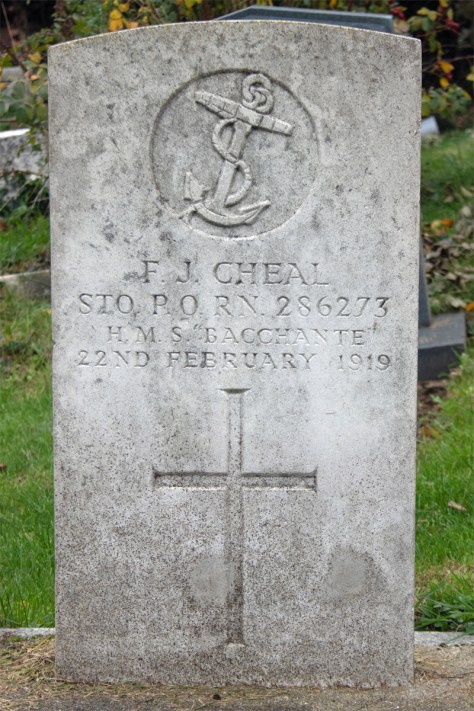
Frederick James Cheal was born in Reigate, Surrey in July 1880. One of six children, his father Francis was an agricultural labourer and cowman, while his mother Ann looked after their children.

While born in the landlocked Home Counties, Frederick appeared to be drawn to a life on the open seas. He enlisted in the Royal Navy on 26th October 1897, for a period of 12 years.

Stoker Cheal served his time on a number of vessels over that time, ships with names like Hannibal, Warrior and Furious. Having completed his service, Frederick was discharged on 28th October 1910.

Frederick’s wanderlust remained, though, and it appears that his discharge was more of transfer. He immediately enrolled in the fledgling Canadian Navy for a period of five years, dividing his time between land-based instruction and service on the HMS Niobe.

War broke out, and Stoker Cheal’s service was extended beyond the initial five-year term. Again, rather than his service coming to an end, he transferred back to the Royal Navy in August 1916.

Promoted, Petty Officer Stoker Cheal was assigned to the HMS Bacchante, an armoured cruiser that served as an escort to the British convoys off the African coast.

Frederick was admitted to the Royal Naval Hospital in Chatham, Kent, in early 1919 with influenza and pneumonia. He passed away on 22nd February, aged 38.

He lies at rest in the graveyard of St Margaret’s Church in Rainham, Kent.


Here is where a mystery lies. There is no discernible link between Frederick Cheal and Rainham, other than that is where his widow lives.

A lot of Rose Anne Cheal’s life is sadly lost to time. There are no marriage records to link her to Frederick, and I have been unable to identify her maiden name or whether she was even English (the couple could easily have met during Frederick’s time in Canada).

From her later records, it is evident that she lived in Rainham, just around the corner from the church where her husband is buried. The 1939 register confirms that she was a couple of years older than Frederick; she was born on Christmas Eve 1878. The register also confirms that the couple had two children, Francis, who was born in 1914, and Kathleen, born two years later.

Some mysteries are not meant to be solved; Frederick lived a full life on the open seas, spending 22 years serving two navies. He died in the same way as many other returning soldiers and sailors, a victim of the Spanish Flu pandemic. He left a wife and two young children, a sad tale repeated countless times across the continent.

Deck Hand Harry Cook

Deck Hand Harry Cook

Harry Sidney Cook was born in April 1892, the youngest of six children. His parents John, a clay digger, and Ann lived in Rainham, Kent, and had two other boys and three girls.

By the 1911 census, the family seem to have gone their separate ways. John and his youngest son were boarding away from the rest of the family, and Harry listed himself as a fisherman. There is no immediate record of his mother, Ann, while his oldest brother Arthur had passed away, and his closest sibling Albert was working as a labourer in Essex.

Shortly after the census was taken, he married Alice Pearce. They lived in a house by Rainham Station and soon had a son, Frank Sidney.

Harry enrolled in the Royal Navy in March 1916, and served on a number of vessels during the war and in the months afterwards. Shortly after enrolling, he and Alice had twins, Daisy and Edith.

Deck Hand Cook was serving on HMS Hermione in February 1919. A guard ship in Southampton, towards the end of the war, she became the HQ Ship for motor launches and coastal motor boats serving the Solent.

It was while he was working there that Harry contracted pneumonia. He was admitted to the Haslar Royal Naval Hospital in Gosport, but passed away on 14th March 1919. At 26 years old, he had become a father for the fourth time just three weeks before; it is likely that he never got to meet his youngest daughter, Alice.

Deck Hand Harry Cook was brought back to his home town of Rainham to be buried. He lies at rest in the St Margaret’s Churchyard, Rainham.

Driver Walter Colchin

Driver Walter Colchin

Walter George Colchin was born in 1884 in Borden, Kent. His parents, Herbert and Frances, moved the family – three sons, including Walter, and a daughter – to the village of Iwade, where they ran the Woolpack Inn.

There isn’t a great deal of information about Walter’s life. He married Bertha Sparks from the neighbouring village of Milton in 1916.

Walter joined the war effort at some point after that – I have been unable to find an exact date – and enlisted in the Royal Army Service Corps, before transferring to the Agricultural Company Labour Corps.

Private Colchin was on active service in Steyning, West Sussex, when the war came to a close. On 23rd December 1918, he suffered a cerebral haemorrhage and died. He was 34 years old.

Walter Colchin is buried in the graveyard of All Saints Church in his home village of Iwade.

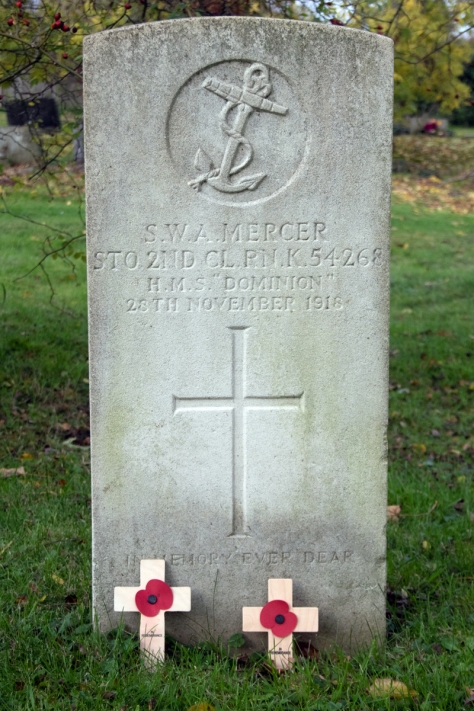
Stoker 2nd Class Stuart Mercer

Stoker Stuart Mercer

Stuart William Arthur Mercer was born in February 1890, one of seven children to William and Eliza Mercer. The family lived in the village of Upchurch, Kent, where William worked as an agricultural labourer.

Stuart followed in his father’s footsteps, and by the time of the 1911 census, he and his brother Bert were working as fruit plantation labourers with William.

He married the delightfully named Elsie Lily Singyard who was also from Upchurch, in 1914, but the couple didn’t have any children.

It was not until towards the end of the Great War that Stuart signed up for service. He enlisted in the Royal Navy on 27th September 1918, and was assigned to the HMS Pembroke II training base in Chatham.

Stoker Mercer’s service was short, however; he had contracted bronchial pneumonia within weeks of the war ending and was admitted to the Royal Navy Hospital in Chatham. He passed away there on 28th November 1918. He was 28 years old.

Stoker Stuart Mercer lies at rest in the St Mary the Virgin churchyard in his home village, Upchurch in Kent.

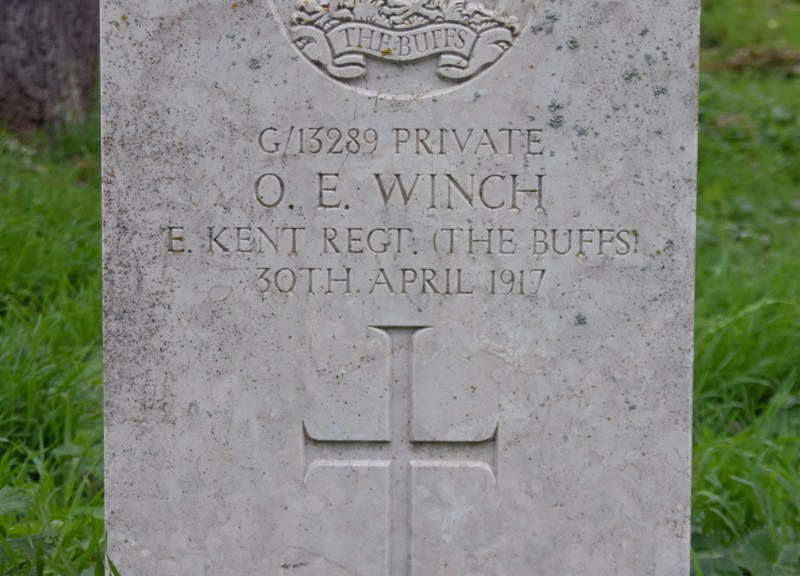
Private Osbourne Winch

Private Osbourne Winch

Osbourne Ethelbert Winch was born in Kent in 1888, one of three sons to Ernest and Ann Winch. Being the eldest, he inherited his unusual combination of names from his grandfathers – Osbourne on his mother’s side and Ethelbert on his father’s.

Osbourne had moved out of the family home by the time of the 1911 census, and, when war broke out, was quick to enlist. His records show that he was a tall man – standing at 5ft 10ins (1.78m) and he was declared fit for territorial service.

Private Winch joined the 45th Provisional Battalion, before moving to the Royal East Kent Mounted Rifles (also known as the Buffs) in 1916. Soon to be posted to the Front Line, Osbourne married Elsie Taylor in March that year, and he was posted in April.

Along with the move to the Buffs, Private Winch received promotions, first to Lance Corporal and then to Corporal. He again transferred to the Base Depot at Etaples in December 1916 and, for some reason, he reverted to being Private. His records confirm this was “under Para 12.VV.W.L.9/Geb No 5080 (AGI)”, although I have not been able to established what this means. There is no mention of disciplinary behaviour in his records, so whether this was because of the transfer to the depot, I cannot say.

Either way, he was transferred to the Front again on 13th December 1916, and remained on the Cavalry rate of pay.

Private Winch remained at the Front for a number of months. On 19th April 1917, possibly while involved in the Nivelle Offensive, he received gunshot wounds to the head and right hip. He was moved to a hospital in Béthune in northern France, where his hip was operated on.

Osbourne was transferred back to the UK on the Hospital Ship Cambria for medical treatment. His medical report from the UK hospital makes for grim reading:

Private states that he lay out for 2 days before being brought in. Gun shot wound head and right hip 19.4.17. Op on hip at Béthune – bad cough on admissions and moist sound in chest. Large septic wound over right hip exposing iliac crest and much comminution of ilium [breakage of the hip bone]. Acute pneumonia developed and patient grew steadily worse.

Medical Report: E Hamilton-Browne, Military Hospital, Endell Street, London WC

Private Osbourne Winch died at 4pm on 30th April 1917. He was 28 years old. He lies at peace in the graveyard of St Bartholomew’s Church in his home village of Bobbing in Kent.

Private Henry Thurley

Private Henry Thurley

Henry Edward Thurley was born in 1895, the tenth of twelve children to George and Charlotte Thurley. George was a brickmaker from Enfield, Middlesex, and the family moved around to follow his work.

Born in Sheerness, Kent, by the 1901 census, Henry was living with his family in Shoeburyness, Essex. Ten years later, the family had relocated back in Kent, and Henry had joined his father in the brickmaking business, while also working as a waterman – working on boats in the nearby Medway estuary.

When the Great War came, Henry was quick to enlist. He joined the East Kent Regiment – also known as “The Buffs” – in August 1915. After his initial training, Private Thurley was sent to France as part of the British Expeditionary Force.

Private Thurley was wounded on 6th March 1916, receiving gunshot wounds to his right foot, head and eyes. He was sent home to recover, but within a couple of months, he was back on the front line, serving for King and country again.

Henry was wounded again on 16th January 1917; this time is was his right eye that was affected, and he was shipped back to the UK and admitted to Merryflats War Hospital in Glasgow. His wounds appeared more serious this time, and he succumbed to them at 3:50pm on 1st February 1917. He was just 21 years old.

Private Henry Thurley was buried in the churchyard of St Mary the Virgin in his home village of Upchurch in Kent.

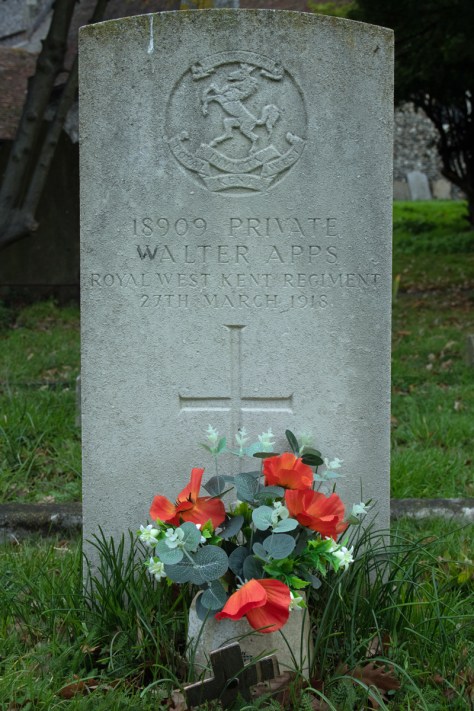
Private Walter Apps

Private Walter Apps

Walter Apps was born in 1896 in Kent. He was one of thirteen children to Richard Apps, a shepherd, and his wife Emeline. By the age of 14 he was listed as working on the farm the family lived on; his older brother Bertie was also helping out.

In February 1916 Walter was called up; his enlistment papers show he worked as a horseman, and that he joined the Royal East Kent Regiment (also known as the Buffs because of the colour of their tunic).

Private Apps was posted to the Western Front as part of the British Expeditionary Force in October 1916, and was soon transferred to the Royal West Kent Regiment.

He saw active service, and was wounded on 17th July 1917, receiving a gun shot wound to the face, which resulted in him losing the sight in his left eye.

Private Apps was repatriated on 8th August 1917, and remained there. He was discharged from the army as being no longer medically fit to serve at the beginning of the following March, but sadly passed away on 27th March 1918. He was just 22 years old.

Walter Apps lies at rest in the graveyard of St Bartholomew’s Church in Bobbing, Kent.

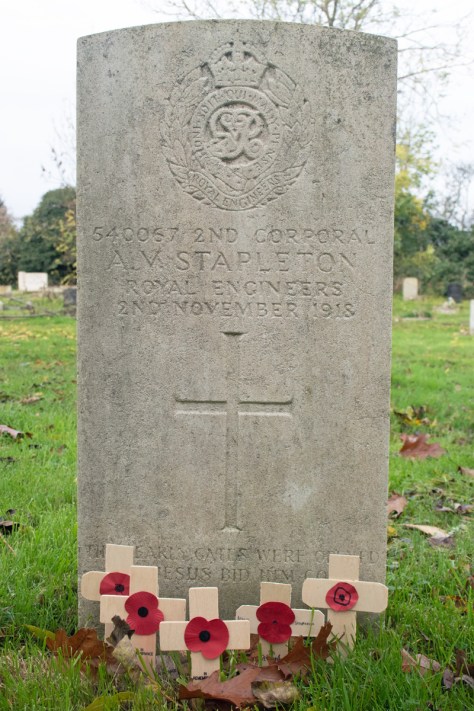
Lance Corporal Albert Stapleton

Lance Corporal Albert Stapleton

Albert Victor Stapleton was born in East London in 1893. One of five children to James and Mary Anne Stapleton, he lost his father when he was only eight years old. Mary Anne married again, and where her first husband has been a glass blower, her second, Edward, was a cooper/barrel-maker, and the family moved to Rainham in Kent.

Albert joined the armed forced early, enlisting in the Royal Engineers in December 1910 for a period of four years. When war was declared, this was extended for a further four years.

In 1915, Private Albert married Daisy, and they lived in the Rainham area. Over the next couple of years, he was promoted, joining the London Electrical Engineers and becoming Lance Corporal.

On 24th October 1918, just a couple of weeks before the end of the war, Albert was admitted to hospital in South London with influenza; while there, he developed pneumonia in the right lung. Lance Corporal Stapleton died on 2nd November 1918. He was 25 years old.

Lance Corporal Albert Victor Stapleton lies at rest in the churchyard of St Mary the Virgin in the quiet village of Upchurch in Kent.


Tragically, just weeks after Albert’s death, Daisy gave birth to a son. Albert William Stapleton would never know his father.

Private Frederick Smith

Private Frederick Smith

Frederick Smith was one of twelve children to George and Ann Smith of Rainham in Kent. Sadly, the couple lost their first four children early on, but at least seven of Frederick’s siblings survived beyond childhood.

His father was a labourer, and Frederick’s two surviving older brothers followed him into this profession.

A lot of Frederick’s service records are missing, but I have been able to ascertain that he enlisted in early 1915, joining the 8th Battalion, Queen’s Own (Royal West Kent Regiment). He trained at Fort Darland in Chatham before being shipped overseas.

The battalion was involved in the Battle of Loos later that year, but it was the fighting at Wulverghem in Western Flanders that changed Private Smith’s life. The German army launched a gas attack on the Allied lines on 30th April 1916; in the second attack on 17th June, Frederick was injured by the gas, and was shipped back to home soil.

The East Kent Gazette takes up the story:

He was brought to Camberwell Hospital, where he was for seven weeks. Enteric fever developed, and young Smith died on Thursday in last week [14th September].

East Kent Gazette: Saturday 23rd September 1916.

Frederick was just 19 years old.

Private Frederick Smith lies at rest in the graveyard of St Margaret’s Church in Rainham, Kent.