Tag Archives: Military Police Corps

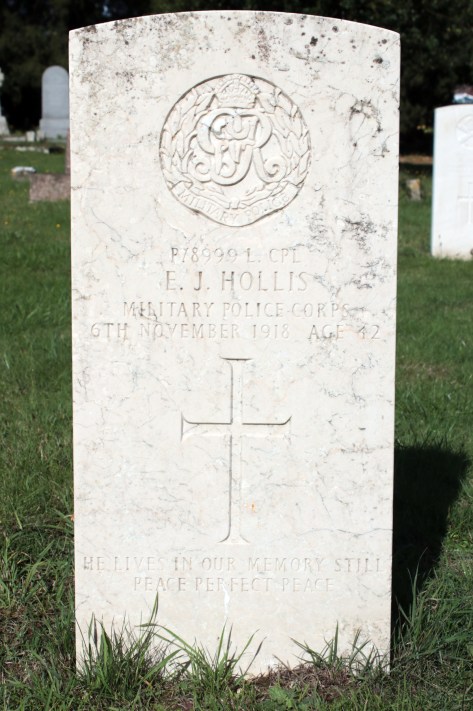
Lance Corporal Edward Hollis

Lance Corporal Edward Hollis

Edward Joseph Hollis was born in the village of Cogges, Oxfordshire, in the spring of 1876. The youngest of four children, his parents were Joseph and Rebecca Hollis. Joseph was a blacksmith, who died shortly before Edward’s birth, leaving a son who would never know his father.

Rebecca had children to raise, and did so while continuing her job as a gloveress. The 1881 census found the family living on Oxford Road, with her widowed father, cowman James, also residing at the house.

Edward remained living with his mother through to the 1901 census, records suggesting that they stayed living in the same property. By this point, Rebecca had give up her work making gloves, and was listed as a charwoman. Her son, however, had found employment as a gardener’s assistant.

Rebecca died in 1902, at the age of 60 years old. Soon after, her son moved to Wiltshire, having found work as a labourer in Trowbridge. On 20th January 1907, he married local woman Rose Banks in the parish church. A cloth worker, she was nine years her new husband’s junior. The couple set up home at 9 Court Street, to the south of the town centre, and went on to have three children, daughters Elsie, Margaret and Bessie.

War broke out in the summer of 1914, and Edward stepped up to play his part. There is little information about his time in the military, but it is clear that he had enlisted by the summer of 1918. He saw the war out as a Lance Corporal in the Military Police Corps, and was based at Chiseldon Camp, near Swindon, Wiltshire.

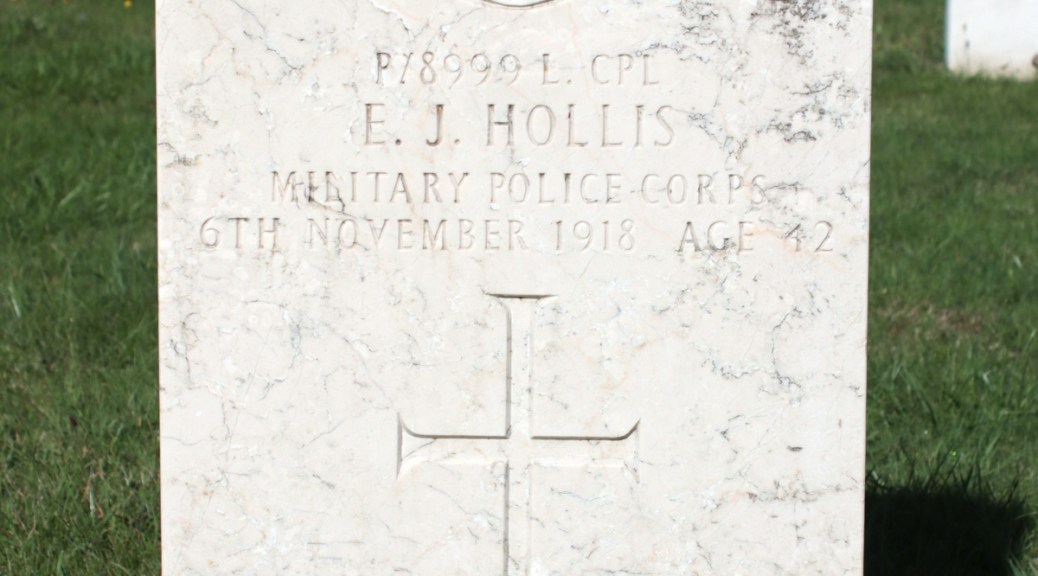
While there, Edward’s health was becoming impacted. He was admitted to the camp hospital with a combination of influenza and bronchial pneumonia, but his heart gave out. He died on 6th November 1918, at the age of 42 years old.

The body of Edward Joseph Hollis was taken back to Trowbridge for burial. He was laid to rest in the town’s cemetery.


Like her mother-in-law before her, Rebecca was now a widow, with young children to raise. She took the risk of emigrating, and moved the family to Ontario, Canada. Here she met farmer James Morgan, and the couple married on 5th July 1920. She died in 1918, also aged 42.

Her and Edward’s legacy were their children. All three married and had families in Canada.


Corporal Herbert Wear

Corporal Herbert Wear

Herbert Francis Wear was born in the summer of 1895, one of twelve children to Charles and Harriet Wear. Charles was a farmer from Congresbury, and when he died in 1907, aged just 51 years old, it fell to Harriet and her children to keep the farm running.

At this point, however, much of Herbert’s trail goes cold, and it is a challenge to piece together anything concrete. When war broke out, he stepped up to play his part, enlisting in January 1917. He was assigned to the Military Police Corps and initially served in the Military Foot Police.

However, at some point during the conflict, Corporal Wear transferred to the Labour Corps, where he was attached to the 449th Agricultural Company. This meant he remained relatively close to home, as he was based in the Taunton area of Somerset.

The next record for Herbert is the British Army Register of Soldiers’ Effects, which confirms that he passed away in Somerset. An entry in the Bristol Times and Mirror (Wednesday 4th December 1918) states that “The funeral of the late Lance-Corporal HF Wear, Stonewell Farm, Congresbury, will take place to-day… 2:30pm.”

Herbert’s death certificate confirmed that he died at home from a combination of influenza and pneumonia. He was 23 years of age when he breathed his last.

Herbert Francis Wear was laid to rest close to his father in the graveyard of St Andrew’s Church in Congresbury.


Lance Corporal Ernest Phillips

Lance Corporal Ernest Phillips

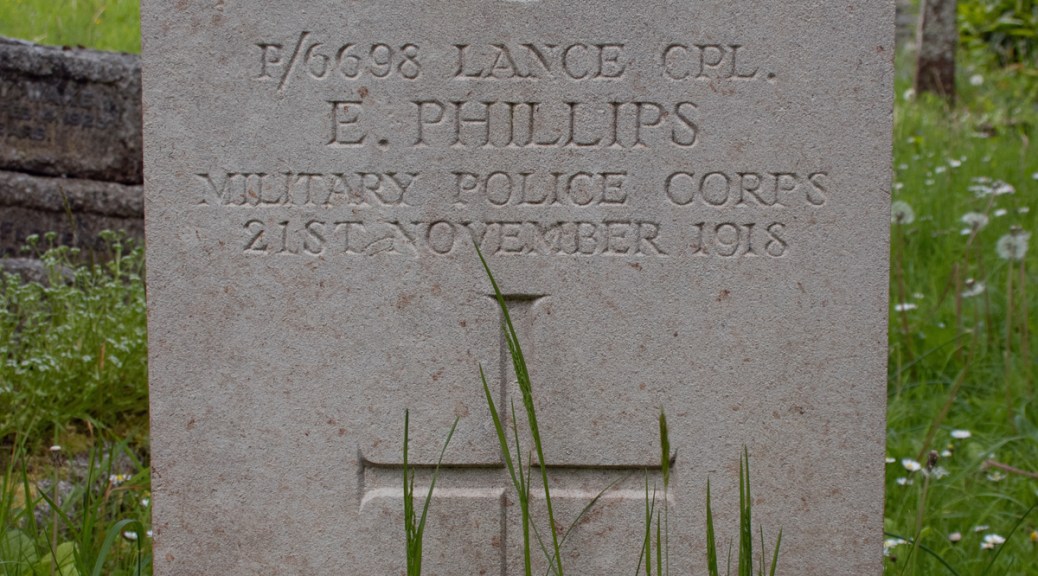
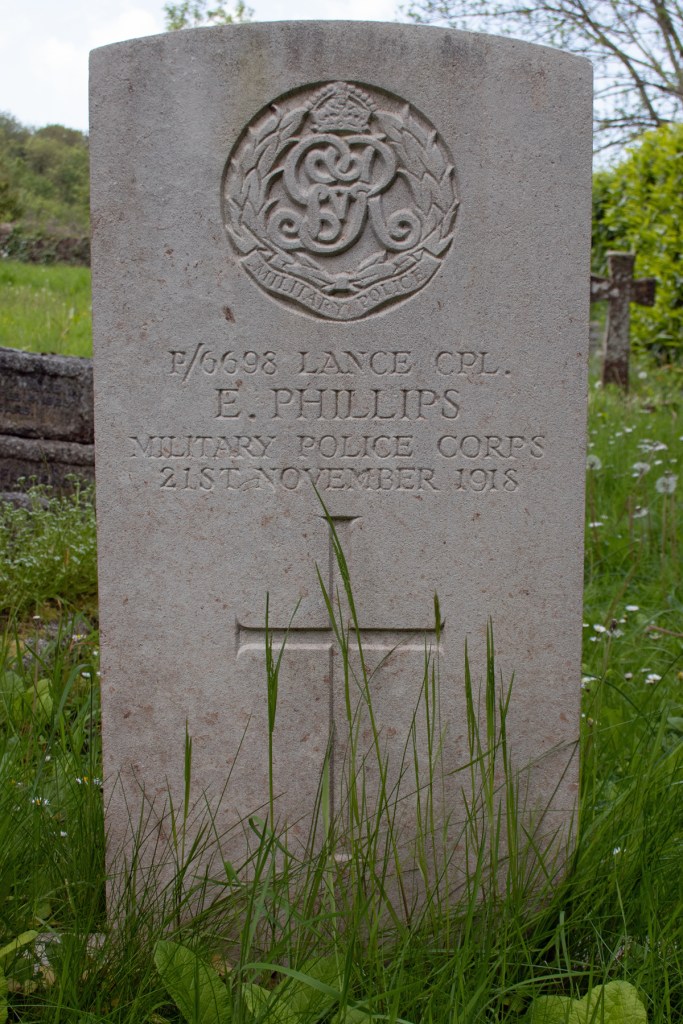
Ernest Algernon Phillips was born at the start of 1879 in the Somerset village of Winscombe. One of nine children, his parents were Arthur and Elizabeth Phillips. Arthur was a gardener, and Ernest followed suit when he finished his schooling.

By the time of the 1911 census, he was boarding with his younger sister Rose and her family – brother-in-law Leonard and nephew Leslie. Just a couple of weeks later, on 11th May 1911, Ernest married Winifred Carey. She was a coachman’s daughter from Winscombe, and the couple set up home in a cottage on the outskirts of the village.

When war broke out, Ernest felt a need to play his part. He enlisted in Bristol on 8th December 1915, but was not formally mobilised until the following June. Initially assigned to the Devonshire Regiment, he was transferred to the Worcestershire Regiment and attached to the 6th Battalion.

Private Phillips’ troop was based on home soil, and he was barracked in the garrison in Harwich, Essex, for the next six months. On 31st January 1917, he was transferred to the Military Police Corps, and given the rank of Acting Lance Corporal. Full details of his service from this point on are lost to time, but it is clear that he remained on home soil until the end of the war.

By November 1918, Ernest had fallen ill. He was admitted to the Queen Alexandra Military Hospital in London on 20th November, suffering from pneumonia. Within a matter of hours, while this seemed to have cleared, his pulse was ‘rapid, irregular and compressible.’ He was medicated, but did not respond to treatment, and passed away the following day. His death was noted as apparently being caused by clots of blood in the heart, but, at the request of his family, no postmortem examination was carried out. He was 39 years of age.

Ernest Algernon Phillips was brought back to Somerset for burial. He was laid to rest in the quiet graveyard of St James the Great Church in Winscombe.


Lance Corporal Stephen Reed

Lance Corporal Stephen Reed

Stephen Reed was born in August 1887, one of seven children to Stephen and Eliza Reed from Bridgwater, Somerset. Stephen Sr was a labourer, eventually working as a carter for the local council.

Stephen Jr sought bigger and better things, however. After initially working as a butcher, he enlisted in the army in January 1907. He served a term of three years in the Coldstream Guards, before being stood down to reserve status in 1910.

Stephen had by then, found his calling in life and joined the police force. Standing at 6ft 1in (1.84m) tall, he would have cut an imposing figure. By the time of the 1911 census, he was boarding at the barracks in Dorchester, where he was listed as a police constable.

In May 1913, Stephen, by now aged 25, married Emily Maud Bower, in their home town. By March of the following year, the young couple had settled back in Swanage, Dorset, and had had a child, Stephen George.

War was on the horizon, however, and Private Reed was re-mobilised in August 1914, finding himself overseas within weeks. He was quickly promoted to Lance Corporal, and, after a couple of years – including fighting at Mons and receiving a subsequent gunshot wound to his hand – was transferred to the Military Police Force.

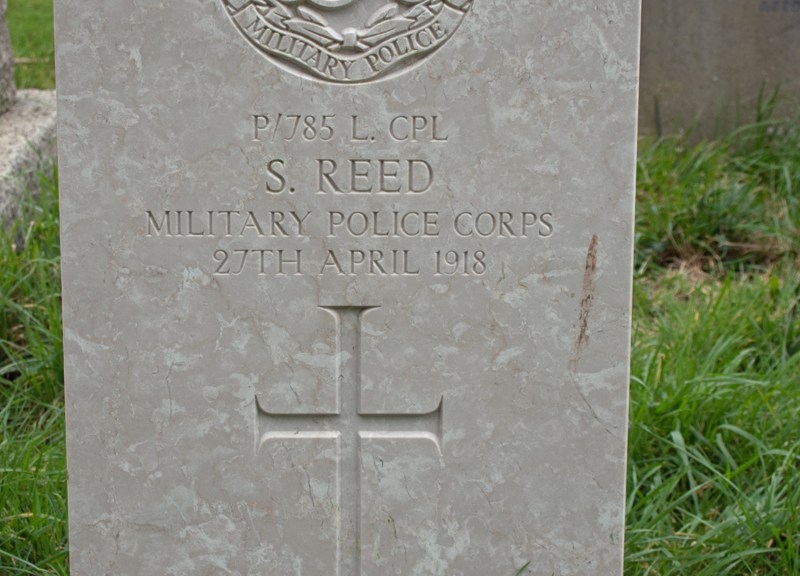
In April 1918, Lance Corporal Reed contracted tuberculosis, and was ill enough to be evacuated back to England for treatment. He was admitted to the Royal Victoria Hospital in Netley, Hampshire, but passed away within a day of arriving. Sadly, his records show that a telegram was sent to Emily summoning her to the hospital, but, as this was dated the same day he passed away, it seems unlikely that she would have arrived in time.

Lance Corporal Reed died on 27th April 1918. He was 31 years old.

Stephen Reed lies at rest in the Wembdon Road Cemetery in his home town of Bridgwater.


A sad addition to Stephen’s military records is a latter to his widow in September 1918, asking for acknowledgement of receipt of his belongings. The items in question boiled down to: pair of braces; button stick; shaving brush; 2 boot brushes; comb; pipe lighter; handkerchief; pocket knife; safety razor; towel; flannel vest; waistcoat; identity disc; wrist strap; pair of scissors; tie clip; mirror; pipe; cigarette holder; 4 cap badges; card case; wallet and photos; wallet and correspondence; cigarette care; cigarettes; tobacco.

We can assume that these items – especially the photographs and correspondence – gave some level of comfort to Emily, but seeing her late husband’s life summed up in a bagful of belongings must also have been heart-breaking.