
George William Rae was born on 7th February 1883 in South Shields, Country Durham. The youngest of five children, he was one of four sons to Henry and Elizabeth Rae. Henry was a boatman, and it seemed inevitable that George would follow in his father’s footsteps.
There are big gaps in George’s timeline: the 1891 census found him living with his aunt and uncle. The next record for him confirms his marriage to Mary Elizabeth Smith in January 1904. There is little information about her, but the couple had five children, three of whom died before they reached their first birthday.
Tragedy followed tragedy: George’s father died in 1908, and his mother passed the following year. Mary died shortly after the birth of her and George’s last child, also named George, in 1911. The census taken that year recorded George Sr as a fireman aboard the coal hulk Haytian, which was moored in Portland Harbour, Dorset. He was one of the vessel’s sixteen crew members.
Now a widower, George had two children to support. In the summer of 1913, he married a second time, to Elizabeth Flood. Again, there is little information available about her, but the couple went on to have a child, daughter Emily, who was born in the summer of 1914.
Conflict was closing in on Europe by this point, and on 24th March 1916, George formally joined the Royal Naval Reserve. His service record shows that he was 5ft 4ins (1.63m) tall, with blue eyes and a fair complexion. He was also noted as having a tattoo of a woman and two flags across his chest.
Engineman Rae was assigned to the gunboat-turned-minesweeper HMS Halcyon. She remained his home for the next eighteen months, patrolling off the coast of East Anglia. By the summer of 1917, George became shore-based, initially at HMS Actaeon in Portsmouth, Hampshire, then at HMS Pembroke, the Royal Naval Dockyard in Chatham, Kent.
Pembroke was a busy and overcrowded place at this point in the war. The battleship HMS Vanguard had sunk, and its replacement crew – who were stationed in Chatham – were left in limbo while new postings were found for them. The base also suffered an outbreak of meningitis, and temporary accommodation was set up to space out the servicemen and, hopefully, slow the spread of the disease. Engineman Rae found himself in one of these speedily-created barracks in the dockyard’s Drill Hall.
On the night of the 3rd September 1917, four German aircraft carried out a daring raid on the North Kent coast. Chatham came under fire, and two explosives landed a direct hit on the Drill Hall. Dozens of men were killed while they were sleeping, and many more – including Engineman Rae – were injured.
George was taken to the Royal Naval Hospital in Chatham for treatment, but his wounds would ultimately prove fatal. He succumbed to them on 11th September 1917, at the age of 34 years old.
The body of George William Rae was taken back to County Durham for burial. He was laid to rest in South Shields’ Harton Cemetery.
Tragedy would continue to haunt the Rae family. Elizabeth died a year after her husband, leaving three children – two from George’s first marriage, and one from his second – orphans. Sadly, there is little additional informational about what happened to them – none appear in the 1921 census.
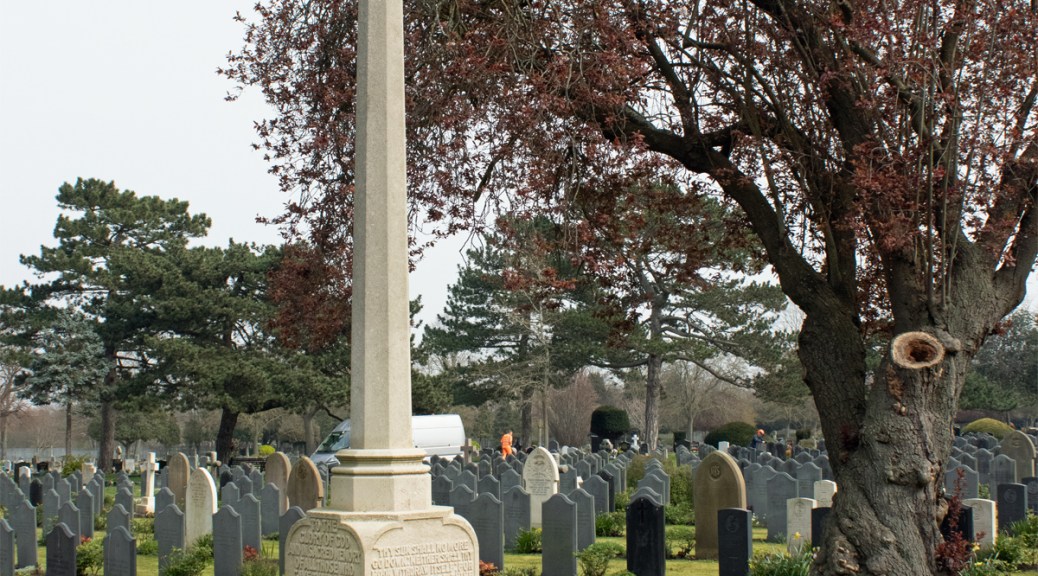
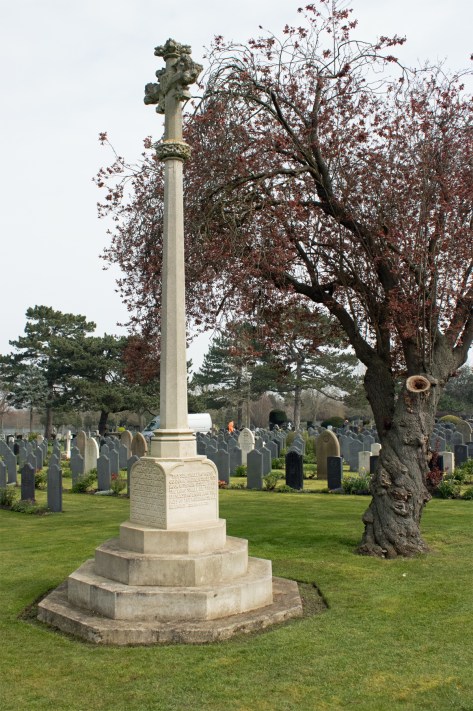
[Note: the photo above is of the memorial to the Chatham Air Raid victims, close to the mass grave for those whose bodies were not identified, in Woodlands Cemetery, Gillingham, Kent.]

