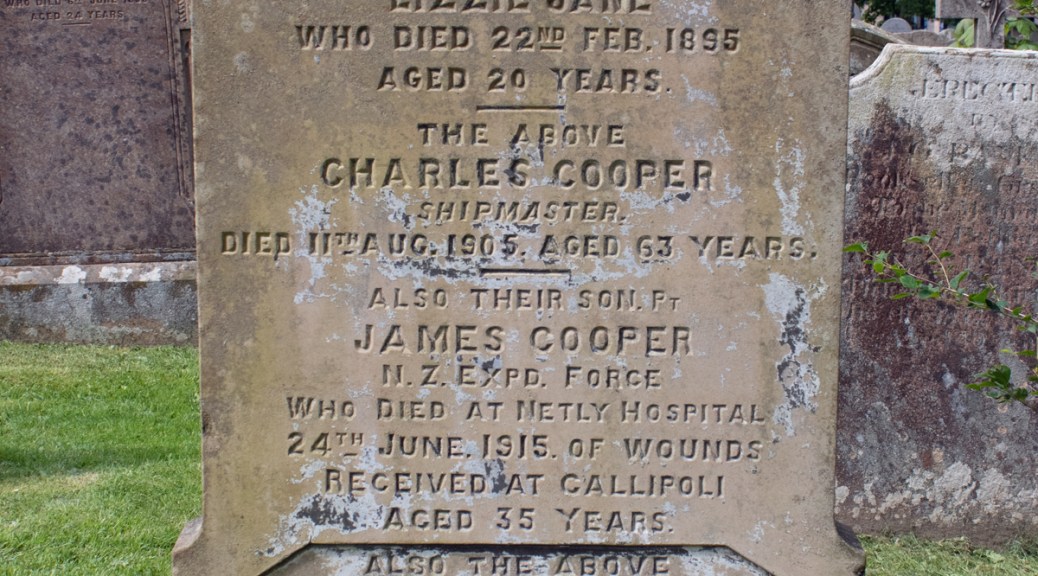
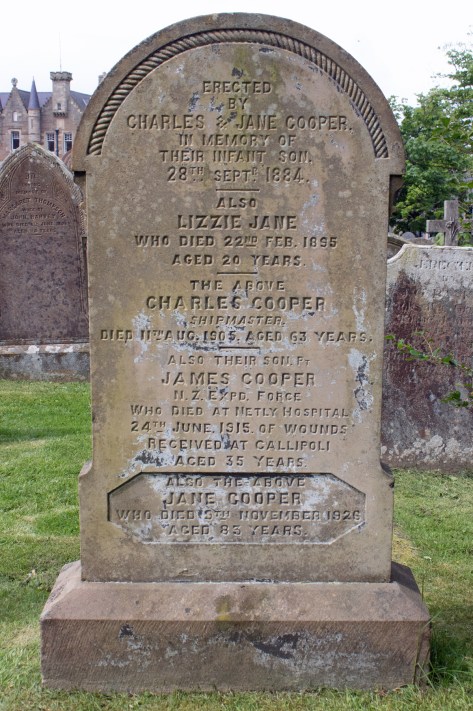
Private James Cooper, a native of Kirkwall, died in the Red Cross Hospital at Netley last Thursday from a wound received at the Dardanelles. Private Cooper, who was 35 years of age, was a son of Mrs Cooper, School Place, Kirkwall (with whom much sympathy is felt), and of the late Capt. Charles Cooper. After being employed for some time in a shop in Kirkwall, he decided to follow his father’s vacation [sic] and went to see for some years, during which time he served in the Naval Reserve. He was in New Zealand when the war began, and at once enlisted in the 6th Hamaki Coy. With the New Zealand contingent he went to Egypt and took part in the fighting with the Turks near the Suez Canal. In April the contingent was sent from Egypt to the Dardanelles, and towards the end of that month Private Cooper received a gunshot wound in the left arm. With other wounded he was sent to the base hospital at Alexandria, and thence, after a few weeks, was sent home to the hospital at Netley. In all his letters home he wrote cheerfully and made light of his wound, but the nurse wrote that the wound was a serious one. At Netley the arm was amputated. Private Cooper gradually sank and died last Thursday.
[Orkney Herald: Wednesday 30th June 1915]
James Cooper was born on 9th October 1879 in Kirkwall, Orkney. He was one of seven children – and the youngest of three sons – to Charles and Jane Cooper. With her husband being away at sea a lot of the time, Jane was used to raising her family on her own.
In August 1905, tragedy struck the family:
At an early hour on Friday morning last, the town of Stromness was thrown into a stat of alarm by the report that a sad burning fatality had taken place on board the barquentine Brazilian on Ness patent slip. To accurately describe how the accident took place is impossible, but from careful enquiries we learn that on Thursday evening Captain Charles Cooper, belonging to Kirkwall, accompanied by an acquaintance, left the town and went on board the vessel, where they lit a fire and make a cup of coffee, after which friend left him. At that time the fire was very low, and no danger apprehended. At an early hour of the morning, the vessel was observed to be on fire, and an alarm given. In a short time the fire hose from the town was on the scene, and two streams playing on the burning vessel. The fire was fortunately confined to the cabin and companion way, where the rescue party discovered the body of Capt. Cooper terribly burned and disfigured, to such an extent that it was quite unrecognisable… There can be no doubt but that death was caused by suffocation, but what led to the fire is not known. It is supposed, however, that after the friend left the vessel, Capt. Cooper had taken the paraffin oil flask to put some oil on the nearly burnt-out fire, when possibly an explosion took place, and the cabin got suddenly full of smoke.
[Orkney Herald: Wednesday 16th August 1905]
Charles was 64 when he died. Jane brought his body across the island, and he was buried in the family plot in the churchyard of St Magnus’ Cathedral.
By this point, James was serving in the Royal Navy. The exact details are unclear, but he seems to have bought his way out, after completing six years. He travelled to Australia, and worked as a cook for a while, before moving on to New Zealand, setting up home in the town of Thames, on the country’s North Island.
When war was declared, he was quick to step up, and, joined the Auckland Regiment of the New Zealand Expeditionary Force. His service papers show that he was 5ft 7ins (1.7m) tall and weighed 159lbs (72.1kg). He had brown hair, grey eyes and a medium complexion. He had a tattoo of a naval coat of arms on his right forearm, and one of a full length woman on the back of his left forearm.
Private Cooper’s unit left New Zealand on 16th October 1914, heading for Egypt. As the newspaper report stated, he moved from there to Gallipoli, before being medically evacuated to Egypt, and then to Netley Hospital, Hampshire.
After his passing, the body of James Cooper was taken back to Orkney for burial. He was laid to rest in the family plot at St Magnus’ Cathedral, reunited with his father after ten years.