
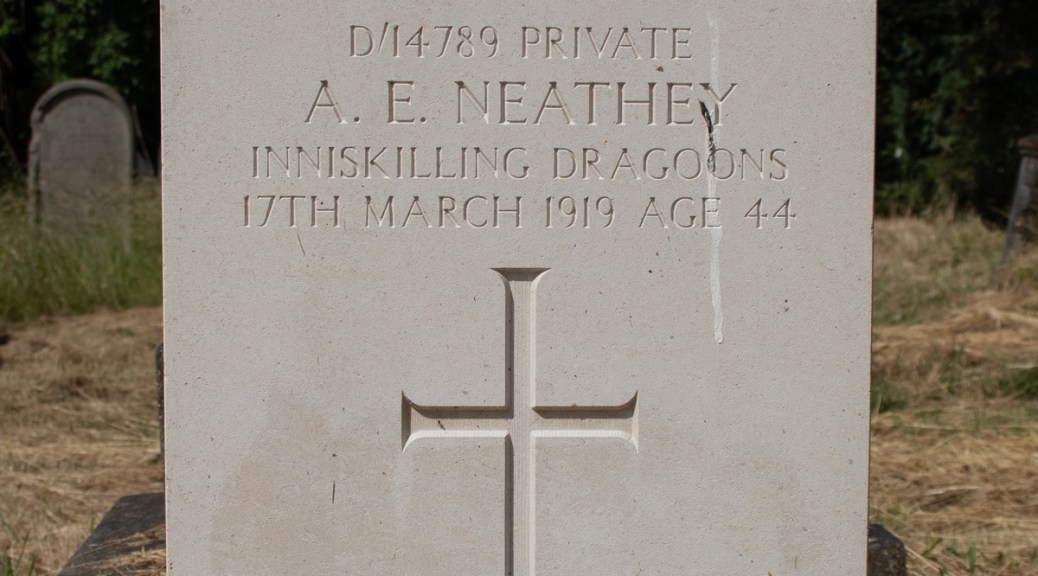

Albert Ernest Neathey was born in Bath, Somerset, early in 1875. The third of six children, his parents were John and Rose Neathey. John was a baker and the family lived at 11 Trinity Square. When John died in 1890, Rose and the four youngest children remained there, and by the time of the following year’s census, three of the Neathey siblings were bringing in a wage.
The 1891 document recorded Rose as living on her own means, while Albert, then 16 years of age, was employed as a telegraph messenger. His older sister, Alice, was a dressmaker’s apprentice, while his younger brother, Sidney, was apprenticed to a hairdresser.
The family are missing from the 1901 census, but the following year Albert got married. His new bride, Mary Louisa Slip, was a mason’s daughter, and the couple exchanged vows in Christ Church, Bath, on 18th September. They would go on to have one child, Doris, born in the summer of 1903, but she would only live for a few months, before passing away on 1st November.
Albert was, by this time, working as a postman, and the 1911 census found him and Doris living at 18 Lansdown Road, to the north of the city. Mary was noted as assisting in the business, although her trade was recorded as being general grocery. The couple were sharing their home with Albert’s ten year old nephew, Norman.
When war broke out, it was inevitable that Albert would be called upon to play his part. Full service details are not available, but a later newspaper report sheds light onto not only his army career, but his personal life:
DEATH OF A WELL-KNOWN BATH POSTMAN
The death occurred at the Bath War Hospital… of Mr Albert Ernest Neathey, of 18 Lansdown Road. Mr Neathey, who was only 44 years old, was the second son of the late Mr John Neathey, of Walcot.
When quite young he entered the service of the Bath Post Office as telegraph boy, and rose to be a postman. Altogether he was a postal servant for nearly 30 years. While thus engages he was a member of the Post Office Band, in which he played cornet.
His military career began with the old 1st Volunteer Battalion of the [Somerset Light Infantry], which whom he served six years. After leaving the infantry he joined the North Somerset Yeomanry. At the outbreak of war he was mobilised with the Yeomanry, and from August 1914, to the November of the same year he was stationed with the regiment in different parts of this country. When the regiment was sent to France, he was sent, much against his will, to the Regimental Depot at the Drill Hall, Lower Bristol Road, and remained there as a member of the staff until his death. While there he was promoted to Corporal. His constant wish was to be with his regiment in France, but his state of health would not have allowed him to stand the rigours of a campaign.
On Tuesday last he was not feeling well, but would not give up his work, and it was not until Saturday that he did so. Then he was sent to the War Hospital, where he was detained, and he passed away at 8:30 on Monday morning. The cause of his death was congestion of the lungs following influenza. For twenty years he was a member of the Foresters (Queen of the West Lodge). He was greatly respected by all who knew him. He leaves a widow, but no children.
Bath Chronicle and Weekly Gazette: Saturday 22nd March 1919
As part of his retention on home soil, Albert was transferred across to the 6th Dragoons (Inniskilling) Reserve Regiment. Nothing on the available documents, however, suggest a promotion during his time in Bath. Albert Ernest Neathey died on 17th March 1919: he was laid to rest in the city’s sweeping Lockbrook Cemetery.






 Death and Service