In amongst the rows of naval headstones in the Woodlands Cemetery, Gillingham, Kent, is one dedicated to Robert McQueen. The inscription notes that he was a Fireman on board HMS Princess Irene, a liner that was conscripted by the Royal Navy as a minelayer during the First World War.
The headstone records that he died during the catastrophic explosion on 27th May 1915 that destroyed the ship, killing more than 300 people in the process. It also confirms that Robert was 23 years old when he died.
Birth records identify at least six Robert McQueens born in 1891/92, and without a place of birth, or parental names, it is not possible to definitively confirm which of these was serving on the Princess Irene on that fateful day. He was in what would become the Merchant Navy: their records are sparser than the Royal Navy equivalents, and none match the man who lies buried in Gillingham.
The life of Robert McQueen, therefore, is destined to remain lost to time, although his sacrifice will never be forgotten.
Phillip William Turner Files was born on 13th April 1894 in Walmer, Kent. One of eight children, his parents were George and Annie Files. George was a carpenter at a local colliery, but living so close to the sea, his son was inevitably drawn there. On 25th January 1910, Phillip gave up his life as an errand boy and joined the Royal Navy.
Phillip’s service records show that he was 5ft 4ins (1.62m) tall, with dark brown hair, blue eyes and a fresh complexion. He was just 15 years old when he enlisted, and, as he wasn’t of full age, he was given the rank of Boy 2nd Class. He was initially sent to HMS Ganges, the shore-based establishment in Suffolk for his initial training.
Phillip remained at HMS Ganges for the next year, and was promoted to Boy 1st Class on 5th September 1910. The following January he was moved to the Royal Naval Dockyard in Portsmouth, Hampshire, also known as HMS Victory.
Over the next year, with Victory as his base, Boy Files was sent to serve on three ships – the dreadnought battleship HMS Albermarle, and the cruisers HMS Sappho and HMS Philomel. While on board Philomel, Phillip came of age and, because of his technical abilities, was given the rank of Ordinary Signaller – changing to Signalman when the ranks were updated later in 1912.
Phillip remained on Philomel until October 1913 and, after a brief spell back in Portsmouth, he was transferred to the armoured cruiser, the converted RMS Laconia. She was to be Signalman Files’ base for the next year, when, on 9th March 1915, he was transferred again, this time to HMS Princess Irene.
Princess Irene was a converted liner, requisitioned as a minelayer when war broke out. On 27th May 1915, an explosion ripped through the ship, while moored off Sheerness, Kent. Signalman Files was one of the 352 souls killed. He was just 21 years of age.
Phillip William Turner Files was laid to rest in the Woodlands Cemetery in Gillingham, Kent. His body having been identified, he was given his own grave, unlike those who were buried in a mass grave nearby.
Signalman Files’ headstone spells his first name with one L. However, all the other documents relating to Phillip spell it with two.
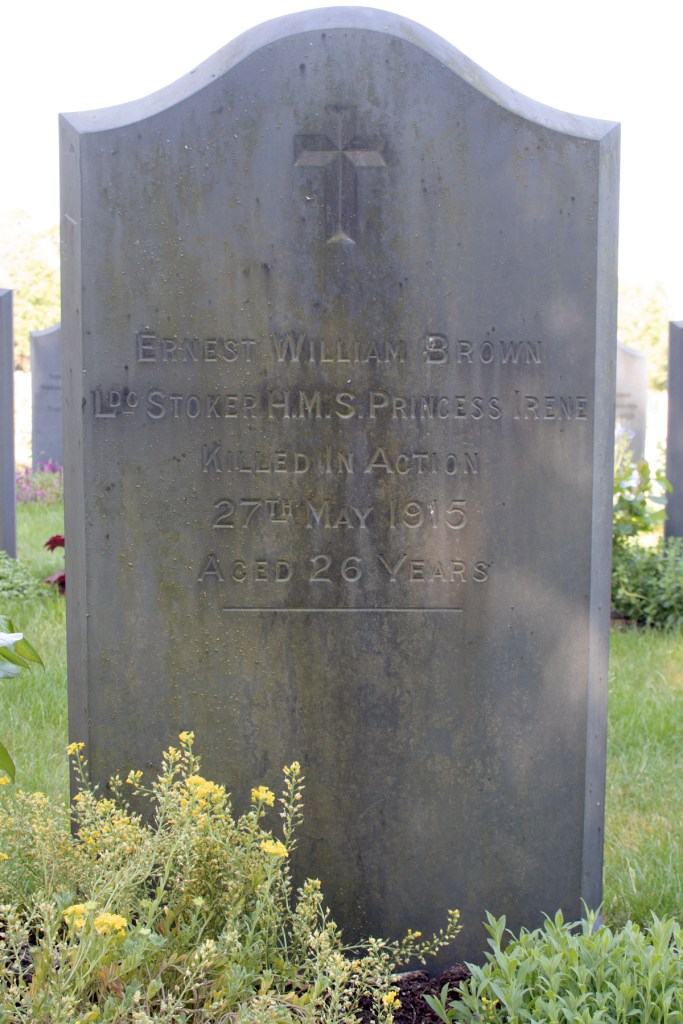
Ernest William Brown was born on 5th April 1889 in Halstead, Essex. One of twelve children, his parents were carpenter Edward and silk weaver Elizabeth Brown.
Ernest initially found work as an errand boy, then as a house painter. He wanted bigger and better things, however, and the Royal Navy offered him that opportunity. He enlisted as a Stoker 2nd Class on 12th March 1908 for a period of twelve years’ service.
Ernest’s early service records are lost to time, but he received a promotion to Stoker 1st Class on 12th March 1909, exactly a year after a joined up. At this point he was assigned to the dreadnought battleship HMS Russell, on board which he served until August 1912.
After a short period at HMS Pembroke, the Royal Naval Dockyard in Chatham, Kent, Stoker 1st Class Brown was transferred to the Apollo-class cruiser HMS Iphigenia. She was to be his home for the next two-and-a-half years, during which time he was promoted again, this time to Leading Stoker.
Returning to HMS Pembroke in March 1915, this was to be his shore base for the next couple of months. On 27th May, Leading Stoker Brown was helping out on the steamer Princess Irene. Tragically, while on board an explosion ripped through the ship, while moored off Sheerness, Kent and he was one of the 352 souls killed. He was just 26 years of age.
Ernest William Brown was laid to rest in the Woodlands Cemetery in Gillingham, Kent. His body having been identified, he was given his own grave, unlike those who were buried in a mass grave nearby.
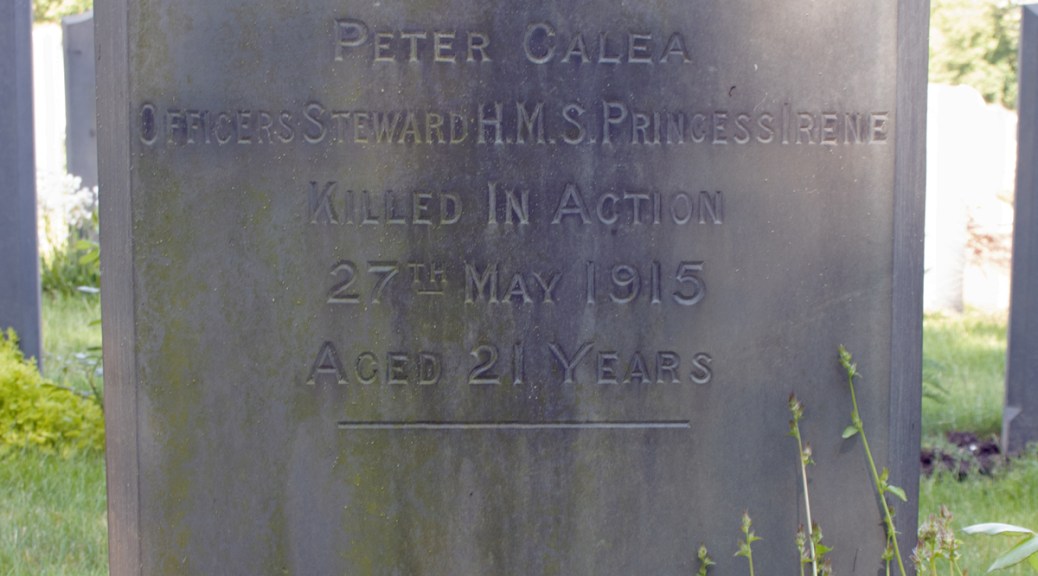
Peter Galea was born in the Maltese town of Senglea on 25th August 1893. His mother’s name was Carmela, but there is little further concrete information about his early life.
What is clear is that Peter found employment by enlisting in the Royal Navy. He joined up on 2nd January 1912 as an Officer’s Steward 3rd Class. His service records show that he was 5ft 9.5ins (1.66m) tall, had brown eyes, black hair and a dark complexion.
Officer’s Steward Galea’s first assignment was on board the dreadnought battleship HMS Orion. He was to spend more than three years on board, although his continuous service was interrupted by three days spent in the cells in May 1913: unfortunately his misdemeanour is not recorded.
In February 1914, Peter was transferred to the Apollo-class cruiser HMS Thetis. She was to be his home for the next year, during which time war was declared across Europe. In March 1915, Officer’s Steward Galea was assigned to another ship, the ocean liner Princess Irene.
Tragically, Peter was on board when, on 27th May 1915, an explosion ripped through the ship, while moored off Sheerness, Kent and he was one of the 352 souls killed. He was just 21 years of age.
Peter Galea was laid to rest in the Woodlands Cemetery in Gillingham, Kent. His body having been identified, he was given his own grave, unlike those who were buried in a mass grave nearby.
In the naval section of the Woodlands Cemetery in Gillingham, Kent, stands a headstone to a John Donoghue. The stone states that he was a Fireman on board HMS Princess Irene and that he was killed in action on 27th May 1915. He was 25 years of age.
Further research confirms that he was part of the Mercantile Marine Reserve, but there are no records to confirm his service at sea. While John was born in around 1890, with no confirmation of his place of birth, or the names of his parents, it is impossible to narrow down any further details for him.
Records of the Princess Irene’s crew do not include a John Donoghue, although this does not necessarily mean that he was not serving on board, only that records no longer exist. The fact that he was granted an individual headstone, rather than being commemorated in the mass grave that is also situated in the Woodlands Cemetery suggests that his body was able to be identified.
Sadly, however, Fireman John Donoghue’s life is destined to be lost to time, his legacy to be one of the 352 souls lost during the explosion and sinking of the ship on board which he served.





 Death and Service