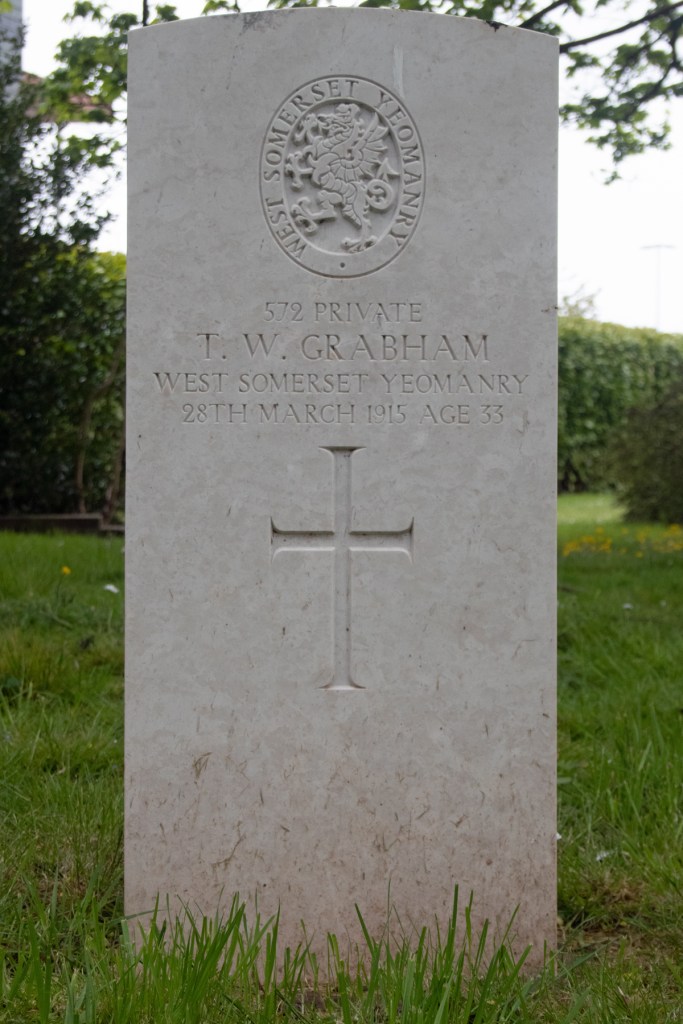
Thomas William Grabham was born in September 1883, one of six children to Thomas Richard Grabham and his wife Emma. Thomas Sr was a labourer and drayman for a brewery and the family lived in Taunton, Somerset.
When Thomas Jr left school, he found work as a grocer’s porter, before he too found work in a brewery, working as a maltster. He married a local woman, Maria Rowsell, and the couple went on to have a son, who they named after Thomas’ father.
Details of Thomas’ military service are sketchy; he enlisted in the West Somerset Yeomanry, but there are no details of when this was.
Sadly, Private Grabham’s period of service was short; his pension records show that he passed away from a perforated gastric ulcer on 28th March 1915. He was just 32 years old.
Thomas William Grabham lies at peace in St Mary’s Cemetery in his home town of Taunton.
Sadly, the tragedy for the young Grabham family was not to end there. Maria, Thomas’ widow, died just five months after her husband.
Young Thomas was just eight years old when his parents died; he seems to have been brought up by a Mrs Kate Barnes, possibly a maternal aunt. Here, however, the family’s trail goes cold.
Arthur Ernest Taylor was born at the end of 1892, the middle of three children to James and Sarah. James was a baker, and the family lived in Bruton, a small town in the west of Somerset.
Only one of James’ three sons followed him into the baking business; this was his youngest, Reginald. The oldest of the three brothers, Oatley, found employment in Wales as a miner. Arthur, on the other hand, stayed in Bruton, but found work as a cycle repairer when he left school.
In December 1913, Arthur married Gertrude James, the daughter of a local carpenter; the young couple went on to have a son, Gerald, the following year.
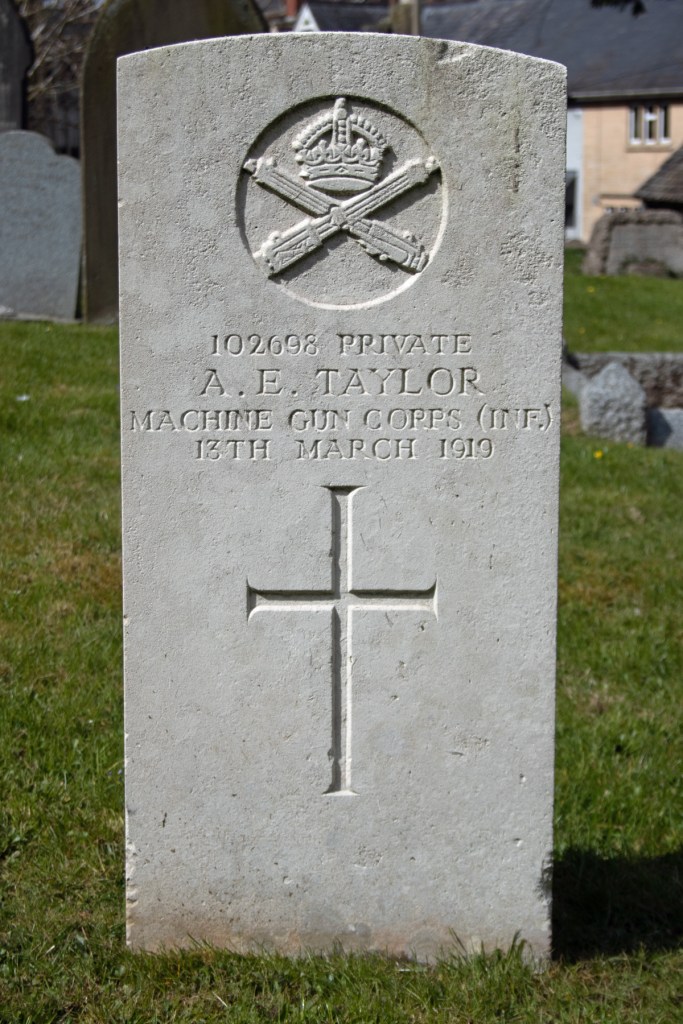
Sadly, little information about of Arthur’s military career survives. He enlisted in the Machine Gun Corps, although there is nothing to confirm exactly when he enrolled.
The next time Private Taylor appears in the records is a notice in the Western Gazette on 28th March 1919. The newspaper reports that he passed away in the Military Hospital in Grantham, Lincolnshire. Further documentation shows that he passed away on 13th March 1919, at the age of 27 years old. Sadly, there is no confirmation of the cause of his passing.
Arthur Ernest Taylor was brought back to Somerset, and his body lies at rest in the graveyard of St Mary’s Church in his home town of Bruton.
Walter Charles Selman was born on 7th June 1899, the youngest of four children to Walter and Annie Selman. Walter Sr was a gardener and, by the time of the 1911 census he had moved the family to the sleepy Somerset village of Burrington.
Sadly, there is little documentation surrounding Walter’s young life. His gravestone confirms that he enlisted in the Wiltshire Regiment; although there is no date to confirm when he enrolled, it is likely to have been in the second half of the conflict, given his age.
Private Selman was assigned to the 4th Battalion, but there is no clear confirmation of where he served. The 1/4th Battalion fought in India and Egypt; the 2/4th was also based in India but remained there for the duration. The 3/4th Battalion – the most likely to be Walter’s troop – was a reserve troop, based on home soil.
Where little is known about Private Selman’s military service, there is similarly little information about his passing. His pension records bluntly put his cause of death as ‘disease’; as with many other recruits towards the end of the war, it is likely that this was, in fact, either influenza or pneumonia.
Sadly, the mustering of the Allied armies – and the associated mixing of young men from across the country in crowded barracks – brought a real danger of disease, and lung complaints were commonplace. While there is no definite proof, it appears that Private Selman may have succumbed to one of these conditions; he passed away in a military hospital on Salisbury Plain on 7th April 1918, two months short of his 19th birthday.
Walter Charles Selman lies at rest in the graveyard of Holy Trinity Church in his home village of Burrington, Somerset.
Cyril John Rowsell was born in the spring of 1897, one of four children to John and Edith Rowsell. John had been married previously, to a woman called Martha. She had died in 1893, not long after giving birth to the second of their two children – sadly, the child died when little more than a babe in arms. Cyril, therefore, had a half-sibling in his older brother Albert, as well as two full brothers, Richard and George, and a sister, Irene.
Cyril had been born in the Somerset village of Yeovil Marsh, but his father had moved the family to nearby Haselbury Plucknett, where he was the local miller.
John Rowsell was obviously a man of many talents, because, by the 1911 census, he was listed as a dairy manager. By now Cyril was 14 years old, and the family had moved again, this time to the village of Westbury-sub-Mendip, near Wells.
War was on the horizon, and Cyril seemed keen to play his part as early as he could. Full details of his military service are not readily available, but it is evident that he enlisted soon after the conflict began.
Cyril enlisted in the Somerset Light Infantry in 1914 and was assigned to the 1st Battalion as a Private. The Somerset Light Infantry were involved in a number of the fiercest battles on the Western Front, and he seems to have been lucky enough to escape injury until April 1918.
During the Battle of Bethune, Private Rowsell was shot and injured. Initially treated at the scene, he was evacuated to England and admitted to the General Hospital in Birmingham. Sadly, he did not recover from his wounds, and he passed away on 30th April 1918. He was just 21 years of age.
Cyril John Rowsell lies at peace in the graveyard of St Lawrence’s Church in Westbury-sub-Mendip, Somerset.
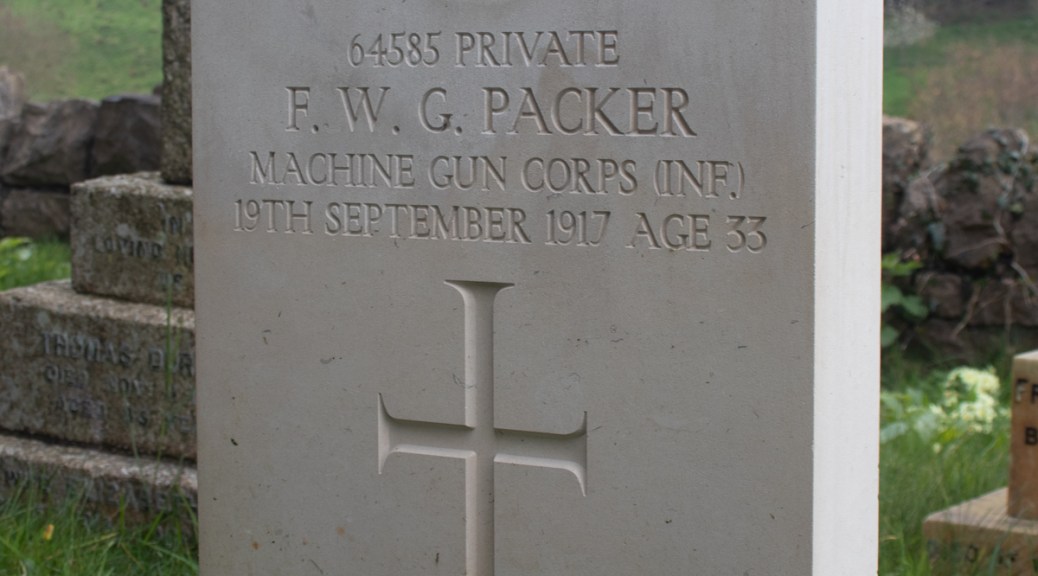
Francis William George Packer was born in Bristol on 28th July 1884. The eldest of three children, he was the son of a grocer, Francis Packer Sr, and his wife, Eliza.
When Francis left school, he followed his father into the grocery business and married Kate Taverner on 1st September 1907. They had one child, a daughter called Dora, in 1909 and, by the time of the census two years later, Francis had moved his young family to Bath.
By the time he was called up, in December 1915, Francis had moved the family again, this time to the sleepy village of Blagdon, in the Somerset Mendips. He formally enlisted in the Machine Gun Corps of the Somerset Light Infantry in July 1916, and was sent to the front in January the following year.
Private Packer’s battalion fought at Arras, and it was here that he was injured. On 1st May 1917, he received a gunshot wound to his right thigh, which fractured his femur. He was initially treated on site, before being shipped back to England, where he was admitted to King George’s Hospital in London.
Sadly, it seems there were complications with his treatment, and Private Packer died from his wounds four months later, on 19th September 1917. He was 33 years old.
Francis William George Packer was brought back to his family in Blagdon, and lies at rest in the churchyard of St Andrew’s there.
The local paper reported on Francis’ funeral, but what struck me is that there seems a glaring omission in the list of those who attended. It was obvious that he wanted a strictly private funeral, but:
The mourners were Mr FE Packer (father), Mr S Emery (brother-in-law), Mr SG Packer (uncle), Mr W Taverner (uncle), Mrs ES Packer (mother), Mrs E Emery (wife’s sister), Amy Parker and Nellie Parker [his sisters-in-law], A Packer (aunt), Dolly Parker, Dolly Flower, Mr J Jones (uncle), Mr CJ Redwood, Mr J Nelson and Mr AH Bleacove.
Western Daily Press: Wednesday 26th September 1917
There is nothing in the report to suggest that Francis’ widow attended the funeral.
Francis’ younger brother, Albert Packer, also fought and died in the First World War. Find his story here.
Henry John Venn was born in September 1900, the youngest of three children to Charles and Mary Venn. Charles was a gardener, and the family lived in the small Somerset village of Shipham.
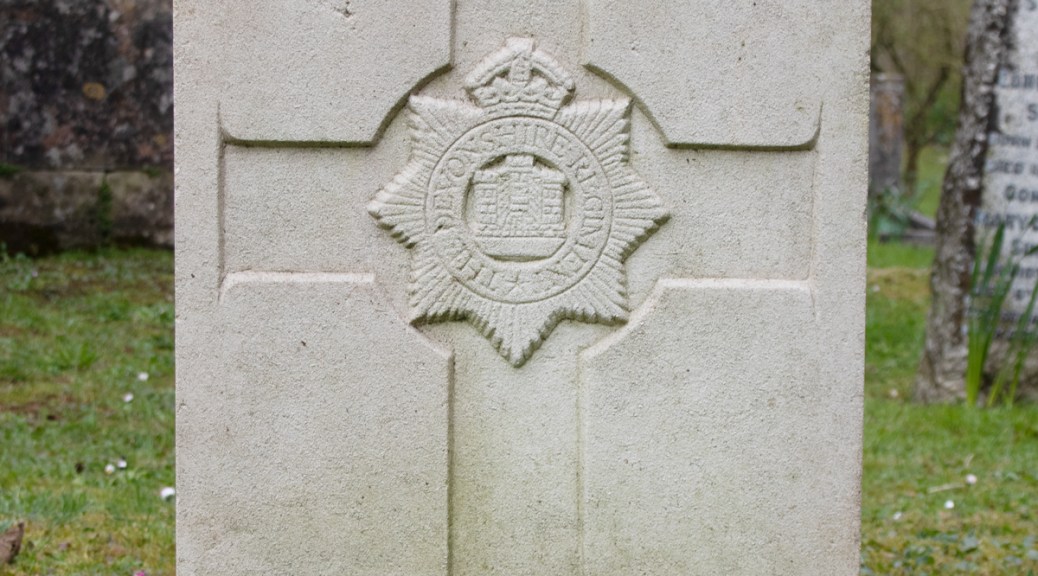
Sadly, there is little information available about Henry’s life, although when war broke out, he enlisted as a Private in the Devonshire Regiment. There is no documentation to confirm exactly when he enrolled, although, given his age when the conflict began, it it unlikely to have been before 1918.
Indeed, later records show that his parents were refused a war gratuity. This was only usually the case where a soldier had completed less than six months’ service. It is likely, therefore, that Private Venn did not join up before he turned 18 years old in September 1918.
Henry joined the 53rd Training Reserve Battalion; they were based at the Rollestone Camp near Stonehenge, Wiltshire. It is here that he likely became unwell, as he was subsequently admitted to the Military Hospital on Salisbury Plain. He was suffering from influenza and pneumonia, and this is what he succumbed to. Private Venn passed away on 10th November 1918 – the day before the Armistice that ended the conflict. He was just 18 years old.
Henry John Venn lies at rest in the graveyard of St Leonard’s Church in his home village of Shipham in Somerset.
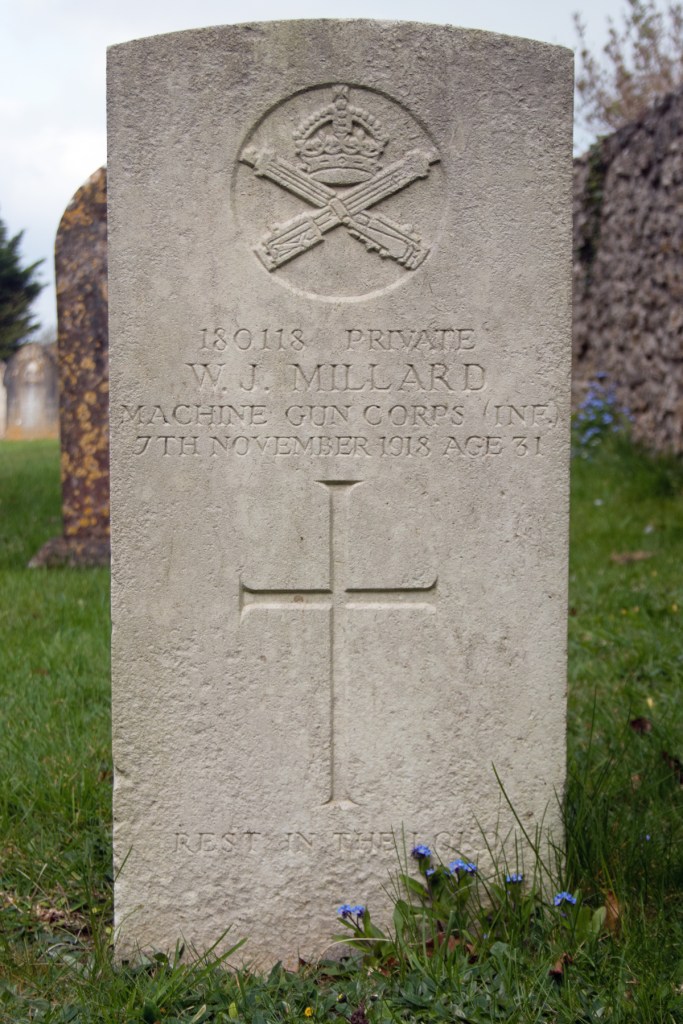
Walter John Millard was born in the summer of 1887, the youngest of nine children to Robert and Elizabeth. Robert was a farmer, and brought his family up in the village of Wedmore, Somerset. Walter followed in his father’s footsteps, and by the time of the 1911 census, was listed as a farm labourer in Wedmore, working for a William Millard, who presumably was a cousin of the family.
In March 1915, Walter married Jessy Masters, daughter of a grocer in nearby Wells. The couple set up home in the neighbouring village of Wookey, but would later make their home in Westbury-sub-Mendip.
In December 1915, aged 28, Walter was called up, and assigned to the Reserve Machine Gun Corps. He was not formally mobilised for almost three years when, in October 1918, he was shipped to Rugeley, Staffordshire, for training.
During this time, Private Millard was taken ill, and was admitted to the Military Hospital at Cannock Chase within weeks with influenza. His health deteriorated and, on 7th November 1918, he died from pneumonia. He was 31 years of age.
Had it not been for the quirk of fate of having been mobilised a month before the war ended, tragically, this would likely not be a story that needed to be told.
Walter John Millard was brought back to Somerset, and lies at rest in the graveyard of St Lawrence Church in Westbury-sub-Mendip.
William Diamond was born in around 1888, although documentation relating to his life are tantalisingly absent. From what does remain, the following can be identified.
William was one of ten children, whose mother was Maryann (or Mary Ann) Diamond. His father had passed away by the time of the 1911 census, by which point the Maryann was living with six of her children, including William, in the village of Litton, on the north side of the Somerset Mendips.
When war broke out, William enlisted, and was assigned to the 15th Battalion of the Hampshire Regiment. Again, there is little documentation to confirm his military service; sadly, the next time Private Diamond appears in the records is to confirm his passing.
The local newspaper reported on his funeral:
The funeral took place on Sunday afternoon, at Litton, his native place, of Private W Diamond, 28 [sic], late of the Hampshire Regiment, who died in hospital in Northampton after a serious illness, after serving some seven months at the front.
Among the chief mourners was a younger brother in khaki (an elder one is now serving in India) and several officers of the AOF, of which deceased was a member.
Shepton Mallet Journal: Friday 24th August 1917
Private William Diamond passed away on 15th August 1917, at the age of 29 years old. He lies at rest in the churchyard of St Mary the Virgin, in Litton, Somerset.
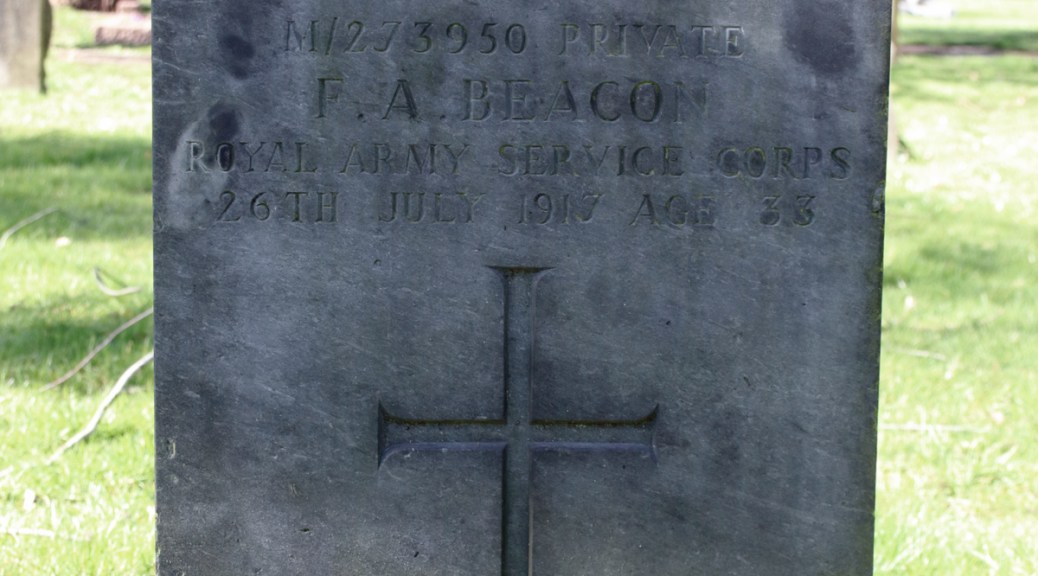
Frank Archibald Beacon was born in 27th April 1884, one of five children to William and Frances Beacon. William was a bargeman and the family lived in the village of Barrow Green near the North Kent marshes.
Tragically, William died at the age of only 36, leaving Frank without a father from the age of 2 years old. Frances found work as a charwoman, before finding love again. She married James Seager in 1895, who took in Frank and his siblings as his own.
After leaving school, Frank found work both as a builder and farm labourer and this was to stand him in good stead until the outset of war.
In January 1909, Frank married Kate Amelia Smart; she was the daughter of a victualler, and was born on Kent’s east coast, in Sandwich. The couple settled down to live in Newington, a village close to where Frank grew up, and had two children, Annie and Frank.
War was looming, and Frank enlisted. He joined the Royal Army Service Corps, working as a Private for the Mechanical Transport Company. Full details of his military service are not evident, but he was awarded the Victory and British Medals, which suggest that he service overseas at some point.
In the summer of 1917, Private Beacon fell ill, and was admitted to the Military Hospital in Boscombe. He was suffering from pleurisy and tetanus, and is was to these illnesses that he was to succumb. He passed away on 26th July 1917. He was 33 years old.
Frank Archibald Beacon was laid to rest in the Woodlands Cemetery in Gillingham, Kent, close to where he had made a new home with Kate.
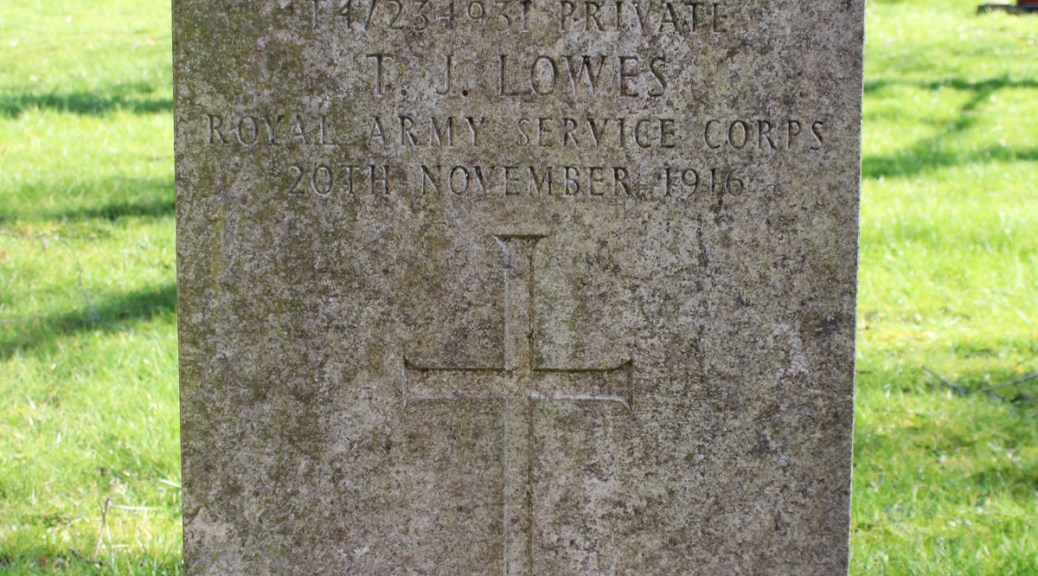
TJ Lowes is another of those names that challenges you to find out more about their lives. A quick search against the surname and service number identified the full name of Thomas James Lowes, and the Commonwealth War Graves Commission website confirms he was the husband of Mary Lowes.
There is enough circumstantial evidence available to suggest a particular set of records, but nothing to fully connect this gravestone to those records.
Based on that documentation, this is what I believe to be the Thomas James Lowes’ life.
Thomas James Lowes was born in Chatham, Kent, in 1863. One of eight children, his parents were Joseph and Jane Lowes, who came from Durham. Joseph was a shipwright, and moved the family to Hampshire in around 1860, before settling in Kent a year or so later. Given his trade, it the sea ports were an obvious draw, and he found work in the Naval Dockyard in Chatham.
When he left school, Thomas found work as a painter, and this was work that stood him in good stead all his life. He started decorating houses, but soon found employment in the dockyard.
Joseph died at some point in the 1880s, and by the 1891 census, Thomas was living at home with his mother and three of his younger siblings, all working to bring money in.
It was later that year that he got married, to a woman called Mary. The couple went on to have two children – Elsie (who was born in Sutton, Surrey) and Thomas Jr (who was born back in Kent). The young family came to live close to the dockyard again, as this is where Thomas was obviously earning his living.
War was on the horizon and, while Thomas’ full service records do not exist, it’s been possible to piece some bits together. He enlisted in the Royal Army Service Corps early on in the conflict, and worked as a farrier for No. 2 Company Depot. From here on in, however, Private Lowes’ documentation becomes confusing.
The Army Register of Soldier’s Effects confirms the service number documented elsewhere – T4/234931 – and that he passed away on 20th November 1916. It states that the the money was passed to his father, Thomas, which doesn’t tally up with the other records.
The other documentation available – the Pension Ledger and Index Cards – all include the Private Lowes’ service number, but give his widow , Mary Lowes, as his beneficiary.
Thomas contracted pneumonia while on active service; he was admitted to the Royal Herbert Hospital in Woolwich, but succumbed to the illness on 20th November 1916. He was 53 years old.
Thomas James Lowes was laid to rest in the Woodlands Cemetery in Gillingham, Kent.












 Death and Service