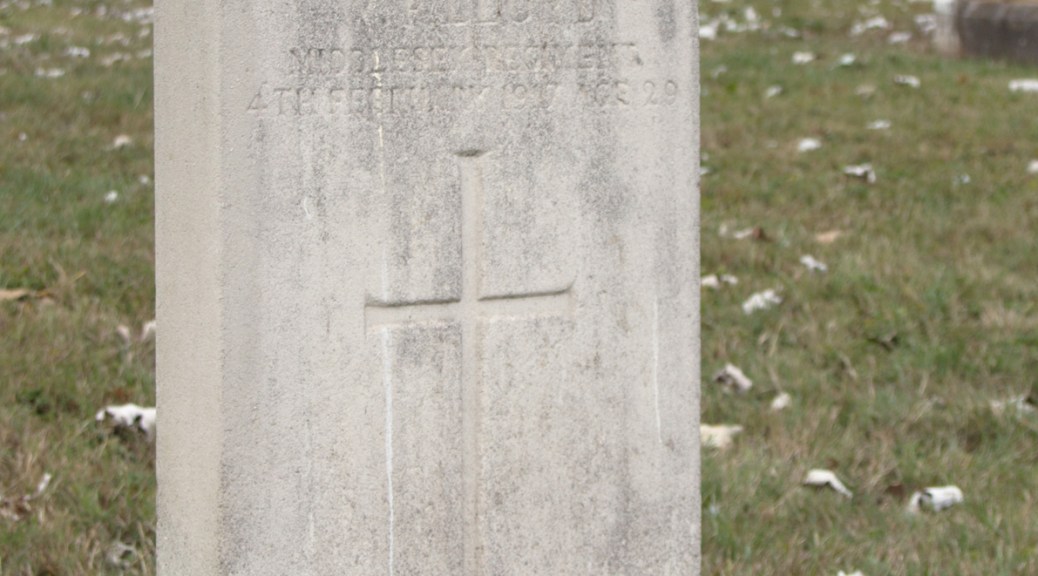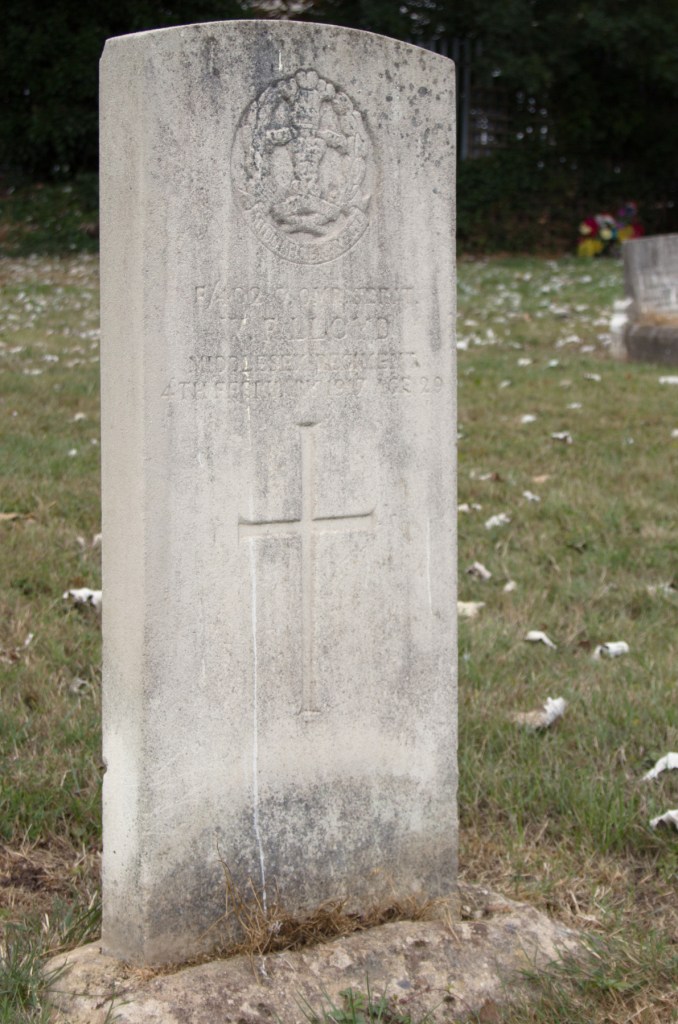
Much of the life of William F Lloyd is destined to remain lost to time.
Buried in Streatham Park Cemetery, Surrey, his entry on the Commonwealth War Graves Commission register states that he was a Quartermaster Sergeant in the Middlesex Regiment, and had transferred to the 101st Training Reserve Battalion. It also confirms that he was the son of Mrs Annie Shane, of 24 Paulet Road, Camberwell.
The only document relating to William’s military service – his Pension Ledger record – adds a bit more detail. It records that he died from appendicitis on 4th February 1917. He was 29 years old when he passed. This document gives his mother’s name as Mrs Annie Lloyd, so it would seem that she re-married at some point after his passing.
There do not appear to be any potential census records for William, certainly not for a William F Lloyd, although to achieve the rank of Quartermaster Sergeant by age that he did would suggest he had enlisted prior to the First World War. It may be, therefore, that he was overseas at the time the census returns were taken.
Sadly, there is little more information that can be uncovered. William F Lloyd retained his anonymity after death, and he lies at rest in the large grounds of Streatham Park Cemetery.
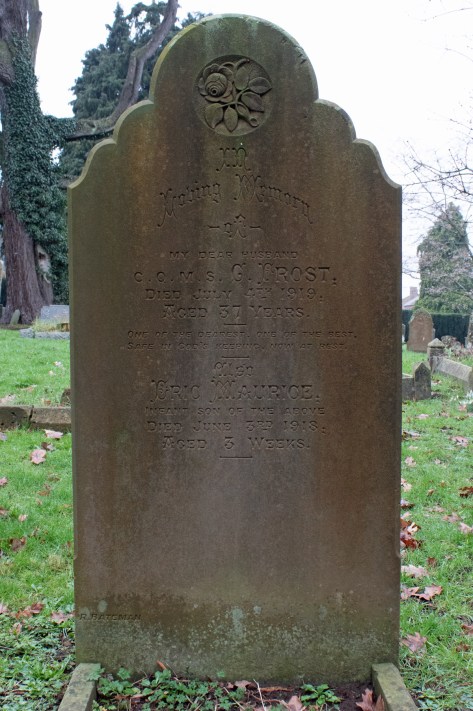
Iva Victor Brewer was born on 2nd May 1886, the fourth of four children to James and Annie Brewer. James was a farm labourer from Weston-super-Mare, but the family were living in Bathampton by the time of Iva’s birth. James died in 1887, and Annie remarried three years later. Her new husband, Thomas Dolman, was the manager of the George Inn in Bathampton, and the couple went on to have four children of their own, half-siblings to Iva.
Tragedy struck again when Annie passed away in February 1897, at the age of just 37 years old. By the time of the next census in 1901, Iva was boarding with his stepfather’s parents; the following year, however, Thomas also passed away, and the children were left to build their own lives.
Iva – who was now going by his middle name, Victor – found an escape in the army and, according to the 1911 census was an Acting Bombardier in No. 69 Company of the Royal Garrison Artillery, based in Colaba, at the tip of the Mumbai peninsula.
By the time war was declared, Victor had cemented his military career. Full details of his service are no longer available, but the summer of 1916 he had left India for Aden, and was then mentioned in dispatches that October for his bravery in the field at the Somme.
In November 1917, the now Battery Quartermaster Sergeant Brewer was injured in fighting at Passchendaele, and was medically evacuated to Britain for treatment. It seems that he was treated in South Wales, and it seems a whirlwind romance set in when he was living in Pontardawe, near Swansea. On 2nd January 1918, Victor married Laura Seddon, a railway inspector’s daughter from the village of Ystalyfera, just up the valley from Victor.
The couple moved to Bathampton before Victor returned to the fighting. He was badly wounded and, having been evacuated back to Britain in May 1918, he was admitted to the Northern Central Hospital in London where his shattered leg was amputated. Sadly, bronchial pneumonia set in while he was recovering, and he passed away from the subsequent sepsis. Quartermaster Sergeant Brewer passed away on 7th May 1918, days after his 32nd birthday.
Iva Victor Brewer was brought back to Bathampton for burial. He was laid to rest in the quiet graveyard of St Nicholas’ Church in the village.
Tragedy was to strike again, sadly. After his funeral, Laura returned to Wales and found employment at a draper’s store.
…the loss of her husband played on her mind.
On Monday she set off for Bathampton, and on her way posted two letters to her late husband’s relatives.
One ran: “I cannot live without my husband. If you don’t hear from me, search Bathampton, as I shall be there somewhere.” Another letter asked her relatives to let her mother in the Swansea Valley know.
She reached Bath, and it is thought she there took a taxi to Bathampton. She then paid a visit to the cemetery, and placed her hat and handbag on her husband’s grave. At the canal-side nearby she laid her fur coat on the bank, and, it is supposed about midnight, plunged into the water
Western Gazette: Friday 9th April 1920
Laura was just 27 years old when she died: she was buried with Victor, husband and wife reunited again.
George William Willis Bunting was born in Faversham, Kent, in the spring of 1889. The middle of eleven children to George and Mary Ann Bunting, he was also the oldest boy. George Sr was a labourer in the town’s munitions works, and his son followed suit, and was recorded as a cordite labourer there in the 1911 census.
When war came to Europe, George Jr was keen to play his part. He enlisted in the Royal Garrison Artillery, and was assigned to the 343rd Siege Battery. While full details of his service are not available, George’s life was laid out in a newspaper report following his death:
The death has occurred in quite pathetic circumstances of Battery Quartermaster Sergeant George William Bunting, 1st Kent Heavy Battery, Royal Garrison Artillery… who, after serving throughout the war, and coming unscathed through more than three years service in France, though he had several narrow escapes, had died of pneumonia at his home, just as he was anticipating return to civil life.
BQMS Bunting joined the Faversham Volunteer Corps (in which his father also formerly served) some seven years before the war, and when was broke out he was at the annual training with the Battery. War service immediately followed and in 1915 he went to France and, except for leave, had been out there ever since until a few weeks back when he returned for demobilisation. He was not feeling at all well when he arrived home, indeed he seems to have been so unwell that when he got indoors he remarked “I’m done.”
His words, unhappily, were only too prophetic, for he never left the house again, pneumonia developing and culminating in his death on February 27th, only nice days after his arrival.
Prior to the war the deceased, who was in his 30th year and unmarried, had been employed at the Cotton Powder Works ever since he left school. At the commencement of his war service, he was a Corporal, but his keenness at his work steadily gained him promotion and eventually he reached the rank of Battery Quarter Master Sergeant. Keen and conscientious himself, he expected the same in others, and it says much for his example and influence that he was held in the very highest regard by the men of his Battery, while to his officers he was a greatly valued NCO.
Faversham News: Saturday 15th March 1919
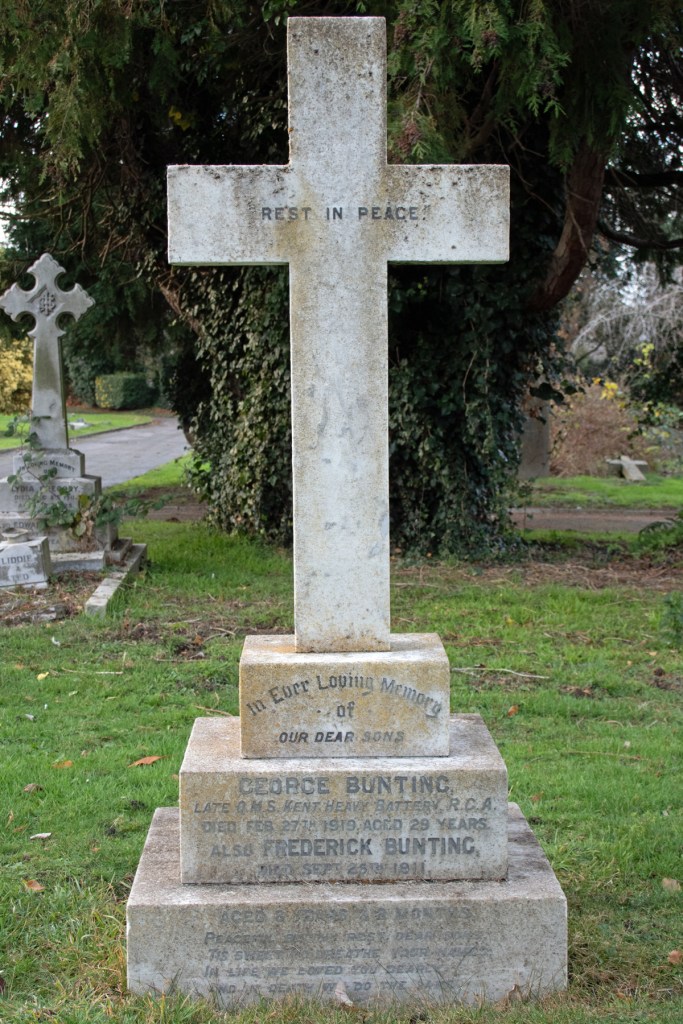
Quartermaster Serjeant George William Willis Bunting died at his Faversham home on 27th February 1919. He was just 29 years of age. He was laid to rest in the town’s Borough Cemetery.
Percy George Macey was born in Frome, Somerset, in the autumn of 1889. He was the oldest of six children and the only son to Arthur and Susan Macey. Arthur was a general labourer and domestic gardener from Wiltshire, whose family had moved to Somerset in the 1870s.
When he left school, Percy found work at a local foundry, and, by the time of the 1911 census, was listed as a brass fitter. By this point he had met Winifred Rowe, a labourer’s daughter from Wiltshire, who had found work as a servant to a Frome butcher. The couple married at the start of 1913, and went on to have a son – who they called Arthur, after Percy’s recently deceased father – later that year.
War was coming, and Percy joined the Somerset Light Infantry. Full details of his military service are not available, although at some point during the conflict he was promoted to Serjeant and transferred to the Labour Corps under the Devonshire Regiment. He was awarded the Victory and British Medals, but does not appear to have seen any service overseas.
By the end of the war, Percy had risen to the rank of Quartermaster Serjeant. The end of his life is, however, shrouded in a bit of mystery. He passed away on 15th March 1921 in Cheltenham, Gloucestershire; although no cause for his death is evident, it seems likely to have been from an illness of some sort, as there are no contemporary newspaper reports to suggest anything out of the ordinary. He was just 31 years old.
Percy George Macey was brought back to Frome; he was laid to rest in the Dissenters’ Cemetery in Vallis Road.