Tag Archives: Seaman

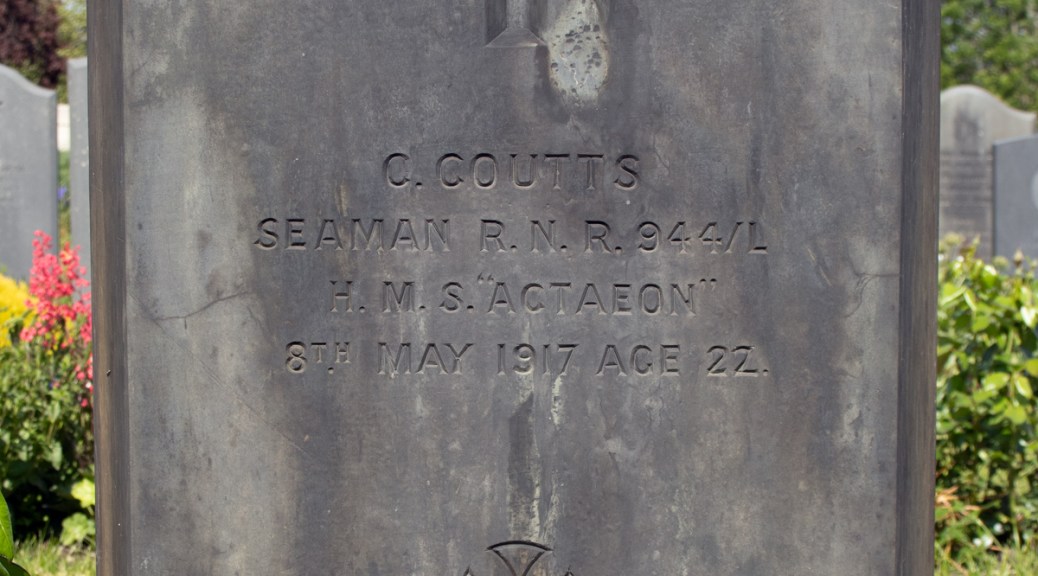
Seaman Christopher Coutts

Seaman Christopher Coutts

Christopher Coutts was born in Lerwick, Shetland, on 2nd August 1894, and was the only child to Robina Coutts. There is little information about his early life, but by the time war broke out, he was working as a shop assistant.

Given the location of his island home, it makes sense that Christopher also had a knowledge of the sea and seafaring. This was put to use during the war, and he was assigned to the Royal Naval Reserve as a Seaman. Initially based in Shetland, by the summer of 1916, he had been transferred to HMS Acteon, the torpedo school based in Sheerness, Kent.

Information has been received here that Christopher Coutts, RNR, has died in Hospital at Haslar. He had been in failing health for some time, and the end was not unexpected. Prior to the outbreak of war, deceased was employed as a shop assistant with Mr Brown, Freefield. After war broke out, he joined the RNR (Shetland Section), and after undergoing a period of training in Lerwick proceeded south to one of the naval depots, where he contracted the illness to which he has now succumbed. Deceased was a bright and promising young man, and much sympathy is extended to his sorrowing mother and other relatives.

Shetland Times: Saturday 12th May 1917

Given the location of HMS Acteon and the subsequent place of his burial, it is likely that Seaman Coutts died at the Royal Naval Hospital in Chatham, Kent, rather than Haslar Hospital, which is in Gosport, Hampshire. He died on 8th May 1917, at the age of 22 years old.

Christopher Coutts was laid to rest in the naval section of Woodlands Cemetery, Gillingham, Kent.


Seaman Christopher Coutts
(from findagrave.com)

Seaman Angus McLeod

Seaman Angus McLeod

Angus McLeod was born on 18th April 1881 in the hamlet of Deiraclete (or Diraclett) on the Isle of Harris, Scotland. Little information is available about his early life, but a later record suggests his parents were called Norman and Mary.

Given the remote location of his birth, it is unsurprising that Angus was to gain knowledge of a life a sea, whether for work, or as a mode of transport. When war broke out, his expertise was called upon, and he joined the Royal Naval Reserve as a Seaman. He enlisted on 31st October 1916, and his records show that he was 5ft 9.5ins (1.77m) tall, with grey eyes and a fresh complexion.

Over the next fifteen months, Seaman McLeod was based out of HMS Pembroke – the Royal Naval Dockyard in Chatham, Kent. His exact records are unclear, although it seems that he served mainly on merchant vessels and travelled as far as India.

By the end of 1917, Angus was becoming unwell. He was suffering from stomach cancer, and was medically discharged from naval service on 1st February 1918. He had been admitted to the Royal Naval Hospital in Chatham by this point, but his condition was to get the better of him. He passed away on 14th February, at the age of 36 years old.

More than 500 miles from his home – and his widow, Johanna – Angus McLeod was laid to rest in the naval section of Woodlands Cemetery, Gillingham, Kent.


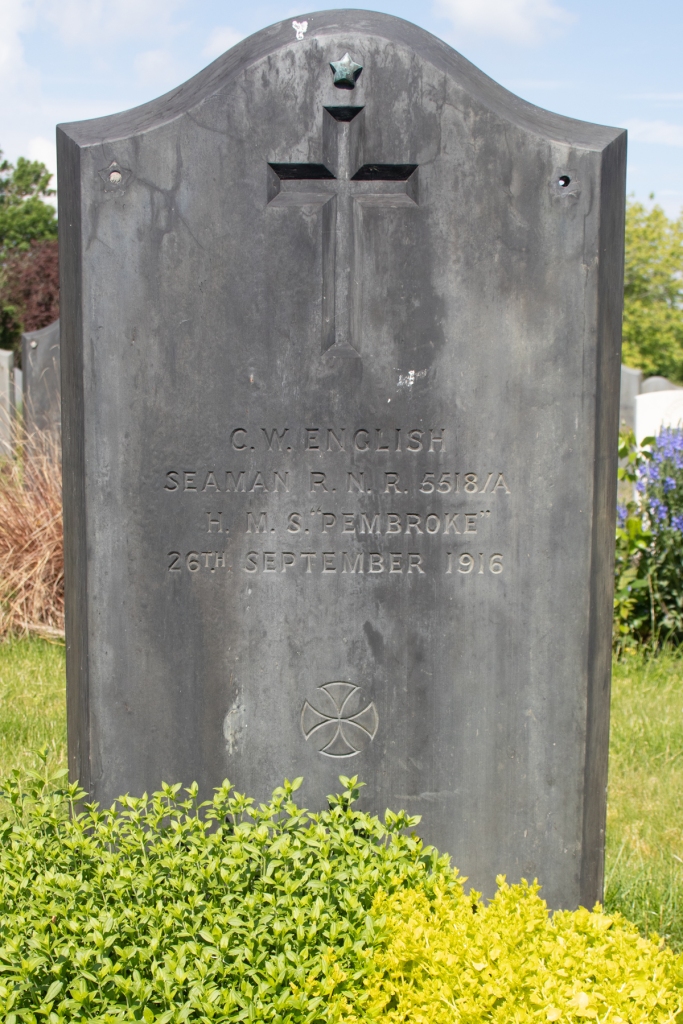
Seaman Charles English

Seaman Charles English

Charles William English was born on 30th August 1895 in the Suffolk town of Southwold. According to his later naval service records, his parents were Ellis and Sarah English, although there is little other information available to back this up.

Charles evidently had a draw to the sea and, when he enlisted in the Royal Naval Reserve on 10th January 1914, he was working as a fisherman. His service records confirm that he was 5ft 9ins (1.75m) tall, with grey eyes and a fresh complexion.

Over the next few years, Seaman English served off the east coast, and was attached to HMS Mantua, a former cruise ship taken over by the Royal Navy to patrol the North Sea. In between trips, Charles made HMS Pembroke, the Royal Naval Dockyard in Chatham, Kent, his home and it was to here that he returned in the autumn of 1916 when he fell ill.

Charles was admitted to the Royal Naval Hospital in the town, tests showing that he was suffering from lymphatic leukaemia. This was to prove fatal, and Seaman English passed away on 26th September 1916, aged just 21 years of age.

It seems likely that Charles William English’s family were unable to foot the bill for bringing their son back to Suffolk. Instead, he was laid to rest in Woodlands Cemetery, Gillingham, not far from the base he had come to call home.


Seaman Peter Bennoit

Seaman Peter Bennoit

Peter Bennoit was born in 1897 in St George’s, Newfoundland. The son of fisherman and sporting guide Peter Bennoit and his wife, Selina, little more is known about his early life.

When war was declared in Europe, he was quick to take up the call to arms. He made the journey to St John’s, and enlisted in the Newfoundland Royal Naval Reserve on 14th October 1914. He set sail for Britain on board the training ship HMS Calypso and, having arrived in November, he was transferred to HMS Pembroke, the Royal Naval Dockyard in Chatham, Kent.

Seaman Bennoit remained in Chatham for the next couple of month, presumably to await a formal posting. This was not to happen, however: he was admitted to the Royal Naval Hospital in Chatham with mastoiditis, a bacterial infection of the inner ear. The condition was so serious that Peter succumbed to it: he passed away on 20th January 1915, at the age of just 18 years old.

Peter Bennoit was 2500 miles (4000km) from home, so it was not possible for him to be interred in Newfoundland. Instead, he was laid to rest in the Roman Catholic section of Woodlands Cemetery in Gillingham, Kent, not far from where he had passed.


Seaman James McNichol

Seaman James McNichol

James McNichol was born on 21st December 1884, in Greenock, Renfrewshire. His parents were James and Elizabeth McNichol, but there is little additional information about his early life.

On 22nd May 1908, James enlisted as a Seaman in the Royal Naval Reserve. Again, little information is available, although he appears to have spent most of his career based out of his home town or on the ship Spindrift, based out of Glasgow.

James’ service records do shed some light on him. His height was recorded as 5ft 4ins (1.63m), he had a fair complexion and blue eyes. He also had a tattoo of a tombstone on his right arm and the words True Love on his right.

James had married a woman called Elizabeth at some point, and, while the marriage documents are lost to time, she is noted as his next of kin on his naval death records.

By the summer of 1912, Seaman McNichol was assigned to the battleship HMS Bulwark. The ship patrolled the English Channel at the outbreak of war, but by that autumn of 1914, she had moved to North Kent, guarding the waters around the Isle of Sheppey against potential German invasion.

James was on board Bulwark on the morning of 26th November 1914, when an explosion ripped through the ship and sinking it. More than 740 lives were lost, Seaman McNichol among them. He was just 29 years of age.

James McNichol was laid to rest in a marked grave in Woodlands Cemetery, Gillingham, not far from a mass grave where scores of his colleagues had been buried.


Seaman James McNichol
(from findagrave.com)

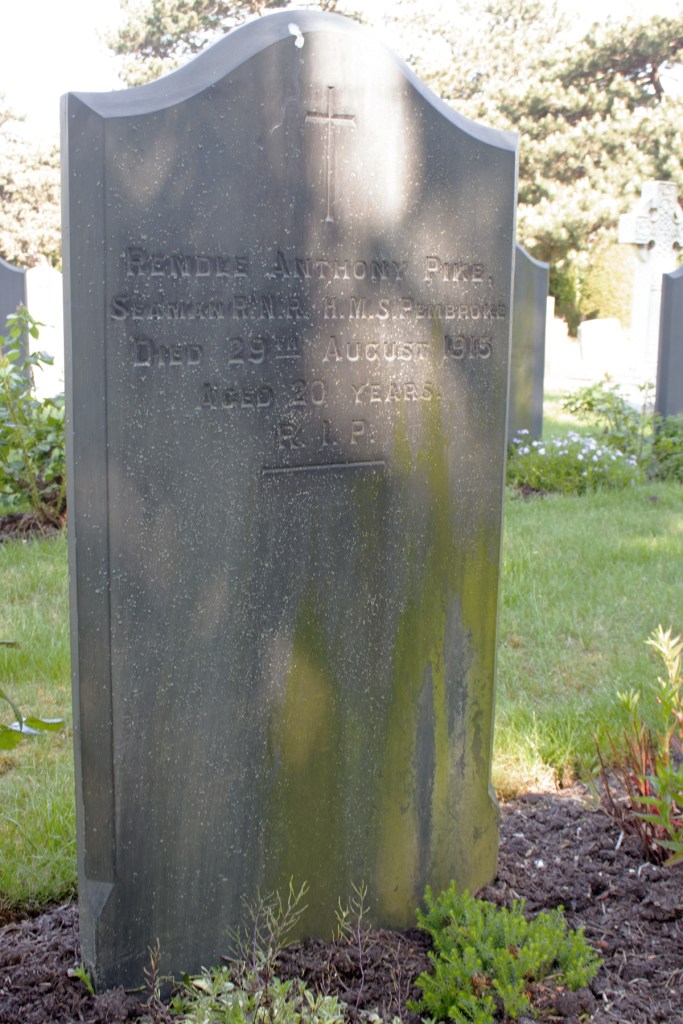
Seaman Rendle Pike

Seaman Rendle Pike

Rendle Anthony Pike was born on 9th May 1895 in Newfoundland. He was one of nine children to Lewis and Mary Pike, but there is little additional information about his early life.

Lewis was a fisherman, and it seems likely that Rendle would have had experience of seafaring when he was growing up. When war broke out, therefore, it made sense that he enlisted in the Royal Naval Reserve.

Again, full details of his service was unavailable, but Seaman Pike joined up within the first year of the war and, by the summer of 1915, he was based at HMS Pembroke, the Royal Naval Dockyard in Chatham, Kent.

Tragically, Rendle’s time in the navy was to be a short one. The next record available for him is that of his passing. According to his service documents, he died ‘of disease‘ on 29th August 1915. He was just 20 years of age.

Rendle Anthony Pike was laid to rest in Woodlands Cemetery in Gillingham, Kent, not far from the dockyard at which he had been based.


Seaman Albert Cluett

Seaman Albert Cluett

Albert Cluett was born on 2nd August 1896, one of three children to fisherman Richard Cluett and his wife, Johanna. The couple were third generation immigrants to North America, and had made their home on the remote Fogo Island, to the north of Newfoundland.

There is little concrete information about Albert’s life; given his father’s occupation, it seems likely that he would have had a good working knowledge of seafaring, and this led him to enrol in the Newfoundland Royal Naval Reserve when war broke out.

Details of Seaman Cluett’s military life are scant. All that we know is that, by the summer of 1917, he was based at HMS Pembroke, the Royal Naval Dockyard in Chatham, Kent. He was billeted in the Drill Hall, which had been set up with temporary accommodation because the barracks themselves had become overcrowded.

On the night of the 3rd September 1917, the German Air Force carried out an air raids on Chatham. The town was heavily bombed and the Drill Hall received a direct hit. Seaman Cluett was badly injured and died of his wounds in hospital the following day. He had just celebrated his 21st birthday.

Albert Cluett was laid to rest, along with the other victims of the Chatham Air Raid, in the Woodlands Cemetery, Gillingham.


Seaman Albert Cluett
(from ancestry.co.uk)

Another young man from Fogo, Seaman Thomas Ginn, also died during the bombing raid; given the remoteness of the Newfoundland town, it seems very unlikely that he and Albert did not know each other.


Seaman James Anderson

Seaman James Anderson

James Anderson was born on 9th April 1892 in Galway, Ireland. He was one of eleven children to labourer Thomas Anderson and his wife, Mary. Thomas was a labourer and fisherman, and it was into the sea-faring life that James entered into when he finished school. The 1901 census notes that the family were Roman Catholic, and that, while not all of them were able to read and/or write, those that could – James included – could do so in both English and Irish.

James was set on using his knowledge of boats to build a career for himself and, on 9th December 1911, he enrolled in the Royal Naval Reserve. His service records show that he was 5ft 3.5ins (1.61m) tall, had a fresh complexion and blue eyes.

Over the next few years, Seaman Anderson served on a number of different vessels, plying the seas around Ireland, to and from Liverpool. He was on board the Cressy when war was declared, and within a couple of weeks, he had been stationed at HMS Pembroke, the Royal Naval Dockyard in Chatham, Kent.

There is little information about James’ life during the war, although, as he appears to have been permanently based at HMS Pembroke, it is likely that his skills were being put to training new recruits, rather than serving at sea.

As the war progressed, Chatham Dockyard became busier. In the summer of 1917, the base became so overcrowded that temporary accommodation was set up in the barracks’ Drill Hall: this is where Seaman Anderson found himself billeted.

On the 3rd September 1917, the first night air raid carried out by the German Air Force bombarded the town, and scored a direct hit on the Drill Hall; Seaman Anderson was among those killed that night. He was just 25 years of age.

James Anderson was laid to rest, along with the other victims of the Chatham Air Raid, in the Woodlands Cemetery, Gillingham.


Seaman Alexander Kennedy

Seaman Alexander Kennedy

Alexander Kennedy was born in Cromore on the Isle of Lewis on 15th June 1895. He was one of five children – four of them boys – to John and Isabella Kennedy.

Living in the remote coastal township, he would have grown up knowing the sea and, when the opportunity arose, he volunteered for the Royal Naval Reserve. His service records show that he enlisted on 12th December 1913; they also note that he was 5ft 6.5ins (1.69m) tall, had blue eyes, a fresh complexion and a scar under his chin.

Seaman Kennedy was kept on a retainer until war broke out the following summer, at which point he was sent to the other end of the country – HMS Pembroke, the Royal Naval Dockyard in Chatham, Kent – for formal training. His time in the navy was then split between the dockyard and the battleship HMS Implacable.

Over the next couple of years, Seaman Kennedy toured the Mediterranean, berthing in Egypt, Malta and Gibraltar between stops back in the ports on the English coasts. By the summer of 1917, he had returned to HMS Pembroke for good.

At that point in the war, Chatham Dockyard was a particularly busy place, and Alexander was billeted in overflow accommodation set up in the naval barracks’ Drill Hall.

On the night of the 3rd September, the German Air Force conducted the first night time raid on England. Chatham came in the firing line, and the Drill Hall received a direct hit. Seaman Kennedy was among those killed. He was just 21 years of age.

Alexander Kennedy was laid to rest in the Woodlands Cemetery in nearby Gillingham, along with the other victims of the Chatham Air Raid.


Seaman Alexander Kennedy
(from ancestry.co.uk)

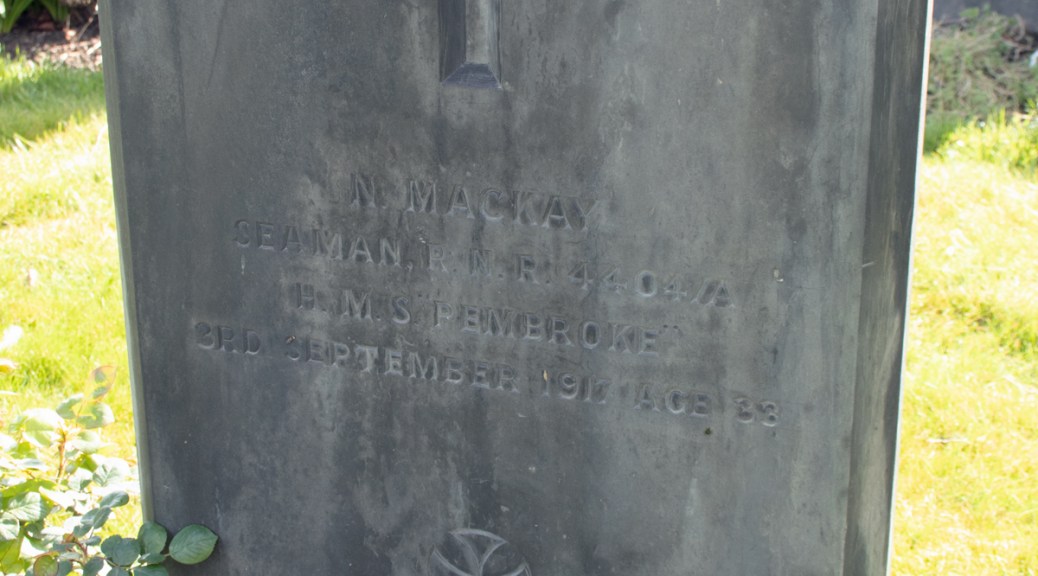
Seaman Neil Mackay

Seaman Neil Mackay

Neil Mackay was born on 16th September 1888 in Stornoway, Scotland, the son of Murdoch and Johanna (known as Murdo and Annie) Mackay.

Sadly, little information remains about his early life; most of what can be gleaned comes from his Royal Naval Reserve records. The document confirms that he was 5ft 9ins (1.75m) tall, had blue eyes, a dark complexion and a scar between his eyes.

Neil enlisted as a Seaman on 3rd September 1912 and, over the next couple of years, he travelled the world, visiting Maine in the United States, New Zealand and Newfoundland on his voyages.

When war broke out, he was assigned to HMS Northbrook, a troopship taking soldiers to India; he returned to the United Kingdom on HMS Dalhousie, in 1915, before making the same round trip, this time on HMS Lawrence, later that year.

In April 1916 Seaman Mackay returned to England, and was based at HMS Pembroke, the Royal Naval Dockyard in Chatham, Kent, for around eighteen months.

The summer of 1917 was to prove a busy time at HMS Pembroke, and Neil found himself billeted in temporary accommodation in the barracks’ Drill Hall. On 3rd September 1917, the town came under fire from a German air raid; the Drill Hall received a direct hit and Neil was killed. He was just shy of his 29th birthday and had completed five years’ service that day.

Neil Mackay was among 98 servicemen to be killed during the Chatham Air Raid that night. The victims were laid to rest in a mass funeral at Woodlands Cemetery in nearby Gillingham a few days later.