Tag Archives: Shipwright

Commissioned Shipwright William Hallett

Commissioned Shipwright William Hallett

William Amos Hallett was born on 2nd March 1867 in Pimlico, Middlesex. The oldest of six children, his parents were Charles and Rosa Hallett. Charles was a police inspector and, by the time of the 1871 census, the family has moved to Sheerness in Kent, where he worked.

In the summer of 1893, William married Emily Nokes. By this point he had been working for the Royal Navy for four years, initially as a Shipwright, then as a Leading Shipwright. His service records show that he was 5ft 8ins (1.73m) tall, with light brown hair, blue eyes and a fresh complexion.

Based out of HMS Pembroke, the Royal Naval Dockyard in Chatham, Kent, by June 1900 William had served on HMS Urgent, HMS Sphinx. Most of his time, however, had been spent between his Chatham base and its Sheerness counterpart, HMS Wildfire.

In November 1901 William was promoted to the rank of Carpenter. Over the next decade he served on eight vessels, and his service record for that time give an insight into his character. He was regularly commended for his hard-working and zealous nature: “[he] gets through more work in his time than any carpenter I’ve been shipmates with… He is excellent in every way.” His ability did not go unnoticed, another report noting his “special knowledge [in] geometrical drawing.”

In the summer of 1910, his superior, Captain Morgan, noted that Carpenter Hallett “worked well and zealously and has got a good deal of work done under somewhat difficult circumstances and with a small staff…” He was recommended for advancement, and it seemed that a promotion was in the offing.

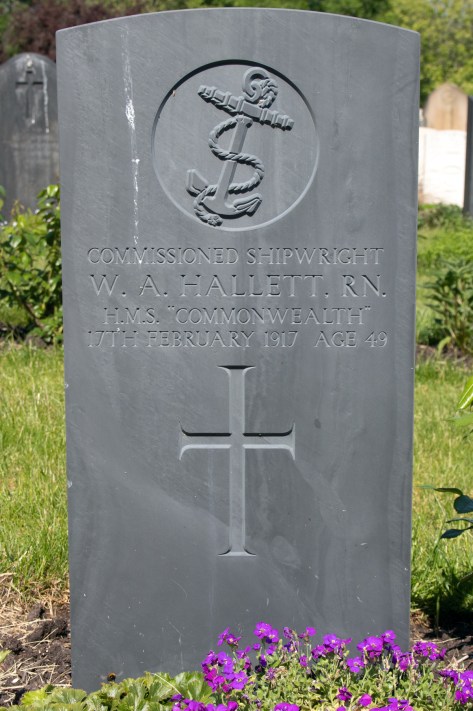
By the time war broke out, William was a Commissioned Shipwright. Details of his service are harder to trace, but by the end of 1916, he was assigned to the battleship HMS Commonwealth. The next record notes his passing:

HALLETT – On 17th February, at RN Hospital, Chatham, Chief Carpenter RN William Amos Hallett, aged 49 years, eldest son of the late Mr Charles Hallett, of Sheerness.

[Sheerness Guardian and East Kent Advertiser: Saturday 24th February 1917]

There is no further information about William Amos Hallett’s passing. He was laid to rest in the military section of Woodlands Cemetery, Gillingham, Kent, not far from HMS Pembroke, the dockyard he had for so long called home.


Shipwright 2nd Class Laurence Durell

Shipwright Laurence Durell

Laurence Edward Horsnell la Vavasour dit Durell was born on 24th December 1894, one of seven children to Edward and Julia. Edward was born in Jersey, in the Channel Islands, but he and Julia were living in Camberwell, Surrey, when Laurence was born.

The census records from the time show a family who came to be divided. In 1901, Edward was working as an artificial limb maker, while Julia looked after their son and the house the family shared at 14 Kerfield Crescent.

By 1911, things had changed significantly. Edward was now employed as a grocer’s storeman, and he and Laurence – apprenticed to a carpenter – were living with his parents, Edward and Sarah, at their home in St Clement, Jersey. Julia, meanwhile, was still on the mainland, where she was employed as a housekeeper for Frederick Manford, a 31-year-old cinema attendant in Hastings. Laurence’s younger sister, Phyllis, was also living there.

Laurence seemed keen to carve out a career for himself and, on 3rd January 1913, he enlisted in the Royal Navy as a Ship’s Carpenter. His service records show that he was 5ft 8ins (1.72m) tall, with dark hair, blue eyes and a fresh complexion. He was first sent to HMS Victory, the Royal Naval Dockyard in Portsmouth, Hampshire, for his training.

Over the next five years, Ship’s Carpenter Durell served on six ships, and as war broke out in the summer of 1914, his role became more and more vital. In May 1917, while serving on board the cruiser HMS Castor, he was promoted to the rank of Shipwright 2nd Class.

During the summer of 1918, Laurence contracted pneumonia. He was transferred to the hospital ship Soudan, but the condition was to prove too severe. He passed away on 15th July 1918, at the age of 23 years of age.

Laurence Edward Horsnell la Vavasour dit Durell was taken back to Jersey for burial. He was laid to rest a family plot in St Clement Churchyard, not far from where his relatives still lived.


Shipwright Laurence Durell
(from ancestry.co.uk)

Shipwright 1st Class Thomas Collins

Shipwright 1st Class Thomas Collins

Thomas Collins was born in the Blackfriars area of Glasgow on 12th March 1877. His was a common name, and it is a challenge to find identify much about his early life. He did, however, have a brother called Andrew, and, when he finished his schooling, he found work as a carpenter and joiner.

Thomas sought new opportunities and, on 21st January 1899, he enlisted in the Royal Navy. Working as a Carpenter’s Crew, he was initially assigned to HMS Vivid, the Royal Naval Barracks in Devonport, Devon. His service records show that he was 5ft 5ins (1,65m) tall, with dark brown hair, grey eyes and a dark complexion.

Devonport was to become Thomas’ base, but, over the twelve years of his initial navy contract, he went on to serve on eight separate vessels. He records suggest that he was good at what he did, and his moved up through the ranks as a result. However, he seemed to have another side to him, which occasionally revealed itself.

Thomas was promoted to Leading Carpenter’s Crew on 19th December 1901, but what had been noted as a very good character seemed to take a downturn at this point. He was committed to cells for two weeks in January/February 1903, while serving on HMS Highflyer, with an incident leading to his demotion to Carpenter’s Crew once more. This also appears to match with a drop in his character: noted as Very Good in his reviews of 1899 to 1901, he slipped to Good in 1902 and fair in 1903 and 1904.

His imprisonment seems to have been the shake up Thomas needed. From here on in, his character was consistently recorded as Very Good and, by August 1909, he had regained the rank of Leading Carpenter’s Crew. There was, however, a serious blip in this good behaviour, noted in his service records:

This man was tried for the manslaughter of Richard Ernest Bell, blacksmith, on [illegible date], who died from injuries received in a fight with Collins on HMS Cambridge. Verdict of Jury at Assizes: “Not guilty”. Judge in summing up stated that he considered Collins was technically guilty of manslaughter.

Thomas had been on the mess deck of HMS Cambridge on 26th August 1905, when he became embroiled in a fight with Petty Officer Bell. Medical evidence showed that Bell died as a result of a blow behind his ear, the punch delivered by Leading Carpenter’s Crew Collins. While it seems likely that he unintentionally caused the Petty Officer’s death, he was cleared by the jury, and remained assigned to HMS Cambridge until November 1905.

Thomas’ initial term of service came to an end on 20th January 1911, and he had no hesitation in re-enlisting. On board HMS St George at the time, his new contract brought with it the rank of Shipwright 2nd Class. Over the next five years, he served on four more ships, and rose a rank to Shipwright 1st Class.

On 8th January 1916, Thomas married Flora Peacock. Little information is available about here, although the wedding took place in Harwich, Essex. Thomas was serving on board the cruiser HMS Conquest by this point, and was based out of the Royal Naval Dockyard in Chatham, Kent.

On Tuesday evening, March 28th, a cutter belonging to HMS Conquest, which was taking forty liberty men off to the ship, was caught in a blizzard and nothing was seen or heard of her again till the morning, when she was found cast up on shore many miles away. All hands were drowned.

The cutter was being towed out by a steam-launch. The hawser broke and the boat drifted away ad capsized.

Westerham Herald: Saturday 8th April 1916

Shipwright 1st Class Thomas Collins was one of those lost from the cutter. He had not long turned 39 years of age. He was laid to rest in the Roman Catholic section of Woodlands Cemetery, Gillingham, not far from the dockyard at which he had been based.


Thomas’ headstone incorrectly gives his surname as Collings.


Shipwright 3rd Class Thomas Cochran

Shipwright Thomas Cochran

Thomas Tannahill Cochran was born on 28th February 1899, in Gillingham, Kent. He was one of nine children to Woodrow Cochran and his wife, Janet, née Tannahill. Woodrow was an engine fitter and both he and Janet were from Paisley in Scotland; they moved to Kent not long after getting married, presumably as Woodrow found work in the Naval Dockyard in Chatham.

Thomas followed his father and older brothers into the Navy, initially enlisting as a Boy Shipwright on 12th August 1913. He served most of his time at the local dockyard, before setting out to sea in March 1918.

At this point, Shipwright Cochran’s service records need a bit of translation. Tragedy certainly occurred, but the details are a bit disparate.

According his naval service records, Shipwright Cochran was aboard HMS Pembroke II when he was killed in action off the Belgian coast on 23rd April 1918. However, HMS Pembroke II was actually a land-based vessel in Kent.

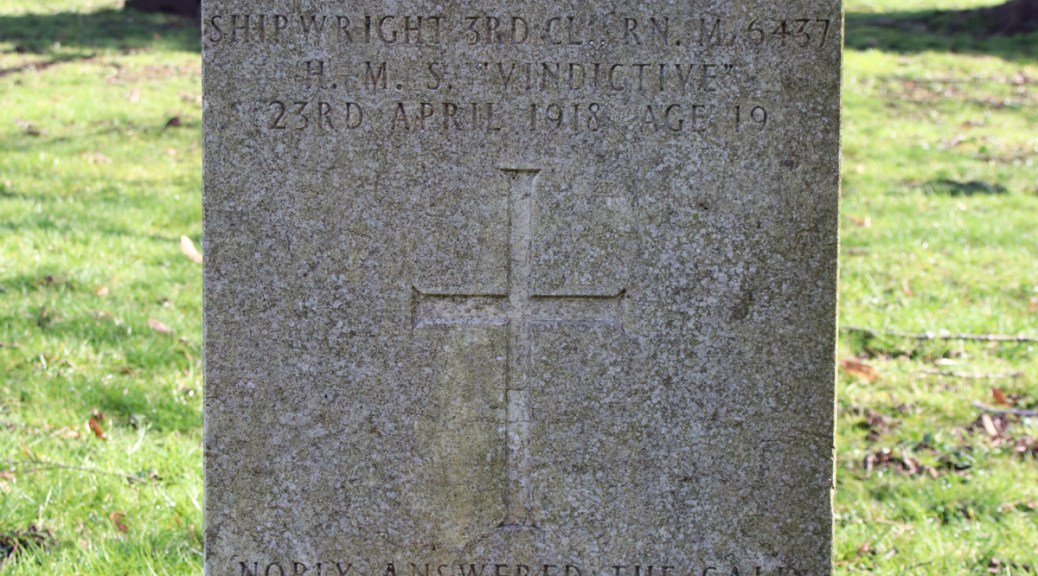
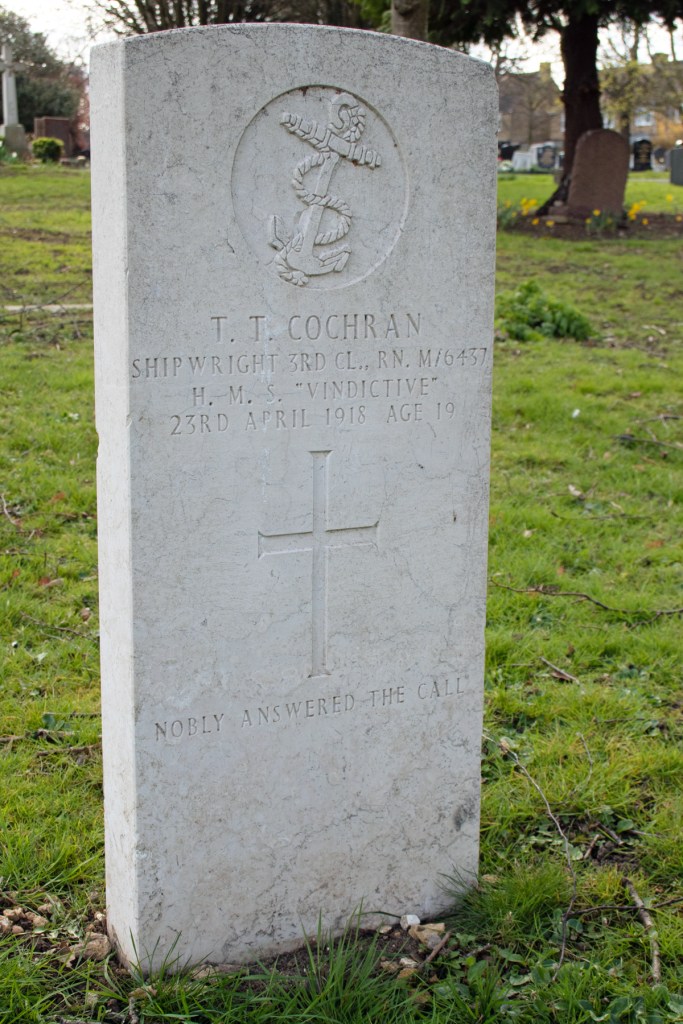
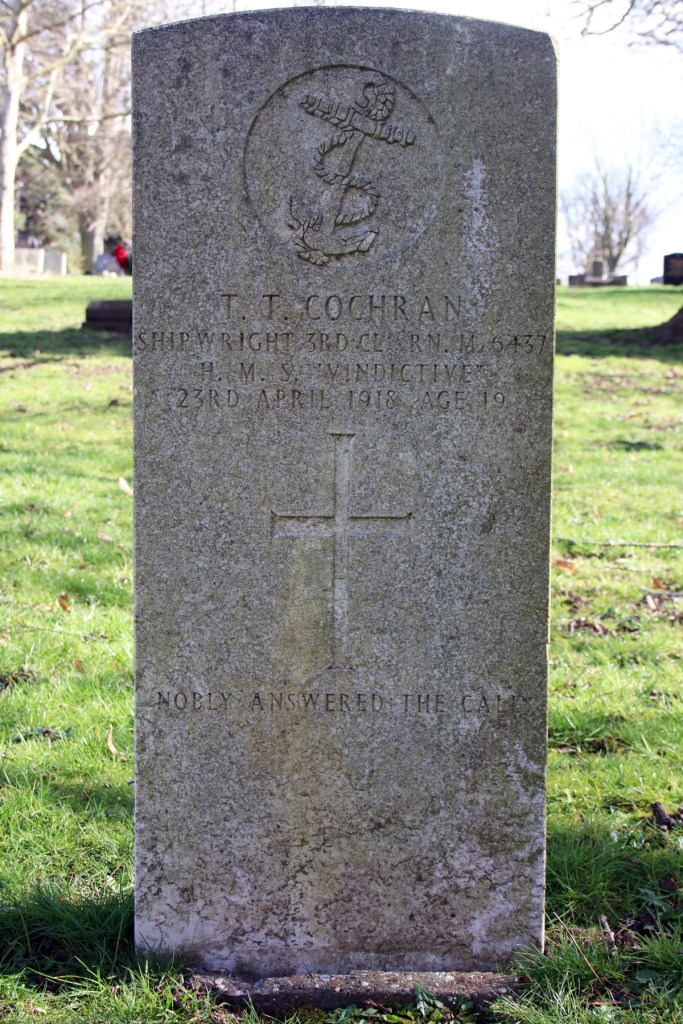
His gravestone, however suggested that he was assigned to another ship – HMS Vindictive. This was one of the vessels involved in the “Zeebrugge Raid”, an attempt by the Royal Navy to block the Belgian port by scuppering obsolete vessels in the canal entrance.

The Vindictive was to lead a diversion, drawing any attack away from the raid’s true target. However, bad weather blew the ship off course, which brought her within reach of enemy guns. Sadly, casualties were numerous, and Shipwright Cochran was one of those who fell in the German attack. He died on 23rd April 1918 at just 19 years old.

Thomas Tannahill Cochran’s body was recovered, and he lies at rest in the Woodlands Cemetery in his home town of Gillingham, Kent.


Shipwright Thomas Cochran