Tag Archives: Somerset

Sapper Arthur Naile

Sapper Arthur Naile

Arthur Edward Naile was born in the summer of 1888, the youngest of ten children to James and Mary Naile. Both of his parents were born in Bath, Somerset, and this is where they raised their growing family.

The Nailes lived in the Camden area of the city, consecutive census returns showing different addresses, as the children grew and then left home. In 1891, they lived at 11 Malvern Buildings, a small terraced house on a steep hill. Ten years later, they had moved to 3 George’s Road, to another terraced cottage close to their old home. By 1911, only Arthur was still living at home, which was now the four-roomed terrace at 51 Brooklyn Road, in the more built up Larkhall area no the northern outskirts of the city.

During all of this time, James had worked as a printer’s compositor. By 1911 he was 64 years of age, and was employed by a newspaper in the area. Arthur, meanwhile, was working as a grocer’s assistant.

On 9th August 1914, he married soldier’s daughter Bessie Brine. She was working as a dressmaker, and lodging with Charles and Eleanor Richman, in a small cottage in Dover Place. Their marriage certificate shows that Arthur was living three doors down, so it is likely she caught his eye not long after he moved in. They went on to have a son, Leslie, in November 1916.

War was raging across Europe by this point, and Arthur had stepped up to serve his country. He joined the Royal Engineers as a Sapper, but there is little concrete information about his time in the army. He was awarded the Silver War Badge, which was given to men medically discharged from military service during the conflict, which would suggest that he was badly wounded at some point. He died in a hospital in Hastings, East Sussex, an annexe of which was dedicated to personnel who had been blinded during the war.

Sapper Arthur Edward Naile passed away from a combination of influenza and diabetes on 31st October 1918: he was 30 years of age. His body was taken back to Somerset for burial, and he lies at rest in a peaceful corner of Bath’s sweeping Locksbrook Cemetery.


After Arthur’s death, Bessie was left to bring up their young son. In the autumn of 1923, she married again, to John Forman, and not long afterwards the three of them emigrated to Australia, in search of a better life. They settled in Bunbury, Western Australia, and went on to have two children, Ron and Nan.

When war broke out again, Leslie was old enough to step up, and joined the Royal Australian Air Force. By 1943, he found himself as a Flight Sergeant in Waltham, Lincolnshire. He had joined 100 Squadron of Bomber Command and, on the night of 25th June 1943, was piloting a Lancaster over the Netherlands. His plane was hit and destroyed, killing all those on board. Father and son both lost to war, Flight Sergeant Naile was just 26 years of age when he passed. He was buried in Westbeemster, and commemorated on memorials in Runnymede, Surrey, and Canberra, Australia.

Bessie lived on until her early 70s. She died on 8th December 1960, and is buried in the family plot in Bunbury Cemetery.


Private Charles Morris

Private Charles Morris

Charles William Morris was born in the summer of 1887, the third of four children – and the only son – to James and Emily Morris. James was a house painter: both he and Emily came from Bath, Somerset, and this is where the Morris family were born and raised.

When he completed his schooling, Charles found work as a clerk: by the time of the 1911 census, he was employed by the Urban Sanitary Authority. Only two of the children were still living at home by this point, and so James and Emily had taken in a boarder, 25-year-old motor engineer Zackarias MacPherson Jackson, to bring a little more money in.

When war was declared, Charles quickly stepped up to play his part. A later newspaper report provides an insight into his service:

The death occurred on Saturday midnight, at 11, Margaret’s Buildings, Hedgmead, of Mr Charles W Morris, at the age of 33. Previous to joining the forces in 1914, he was a member of the Coleford (Somerset) Cricket Club. Joining the North Somerset Yeomanry as a trooper, he went to France, afterwards being transferred to the 5th Dorsets (Cyclist Corps). Eventually he was taken prisoner and was in Germany for two years suffering great hardships. On his return to his native city he joined the St Stephen’s Rugby FC. He was a member of the Walcot Liberal Club, and at the time of his death was employed by his brother-in-law (Mr Z McJackson [sic], motor engineer). Another brother-in-law us Mr W Hollick, headmaster of Coleford schools, and formerly an assistant master at Holy Trinity School, Bath.

The funeral took place at Locksbrook Cemetery on Thursday. The deceased was extremely well known in the neighbourhood in which he resided, and quite a large number of friends attended the cemetery to pay their last respects.

Bath Chronicle and Weekly Gazette: Saturday 4th June 1921

Zackarias had married Charles’ younger sister, Gladys, in 1915, the one time lodger having literally become a member of the family.

Charles William Morris died on 28th May 1921, through causes unknown. He was laid to rest in a peaceful corner of the sprawling Bath cemetery.


Private George Tucker

Private George Tucker

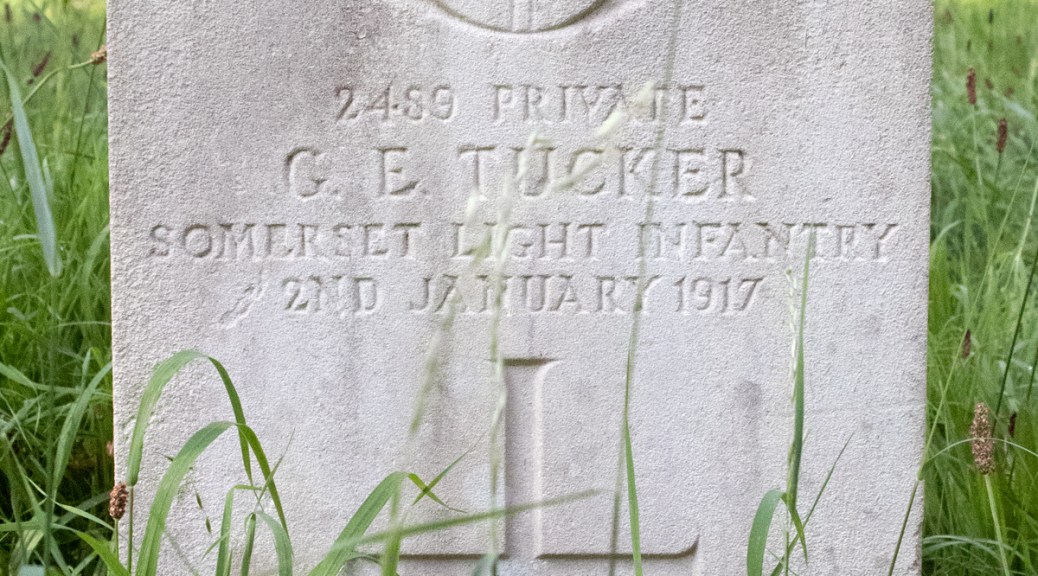
George Edward Tucker was born in Lyncombe, Bath, Somerset in the autumn of 1883. The fourth of eight children, his parents were stone mason Edward Tucker and his wife, both of whom were from northern Somerset.

When he finished his schooling, George found work as an errand boy. By the time of the 1911 census, however, he had taken a job as a painter, possibly being employed by his father’s boss.

George married Rosina Hurley at Bath Register Office at the start of 1913. the couple set up home and went on to have two children, Edina and Audrey.

George enlisted in the opening weeks of the First World War, joining the Somerset Light Infantry as a Private. His time in service was not to last long, however. He was out on a route march on 1st December, when he was pulled up with acute pain in the chest.

Private Tucker was sent back to barracks, and given light duties. A subsequent medical confirmed an enlarged heart, and he was medically discharged from military service on 31st December 1914.

At this point, George’s trail goes cold. The next record for him is that of his passing, on 2nd January 1917. He was 33 years of age.

George Edward Tucker was laid to rest in Bath’s sweeping Locksbrook Cemetery.


Private Stanley Newman

Private Herbert Newman

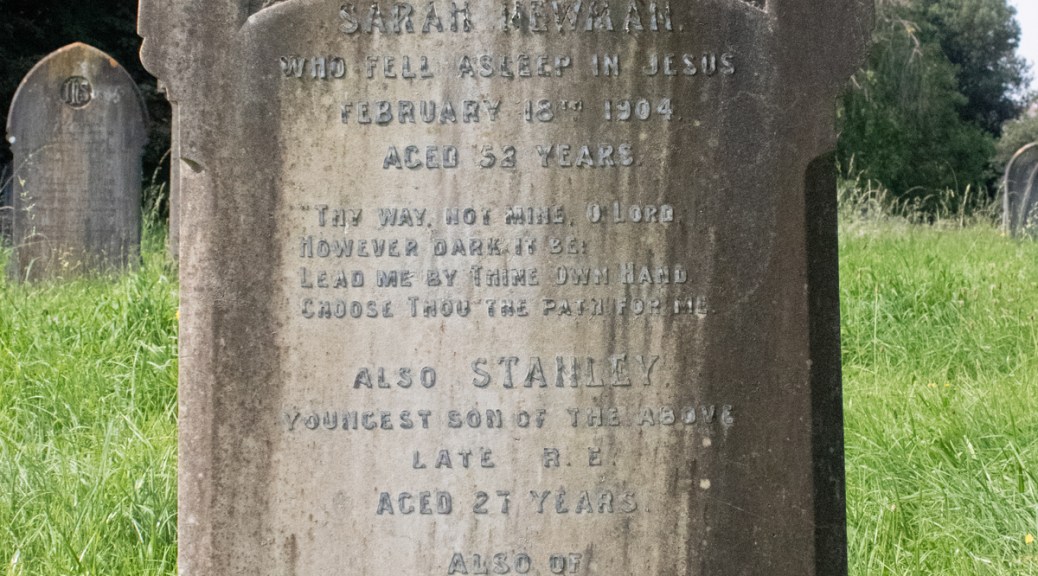
Stanley Herbert Newman was born on 14th May 1890 in the Walcot area of Bath, Somerset. One of at least six children, his parents were Charles and Sarah Newman. Charles was a stonemason and, when Sarah died in 1904, he married again, to widow Matilda Shearn, raising her children as part of the family.

When Stanley left school, he found work as a mason’s labourer – presumably either assisting his father, or having found work through him. On 3rd August 1912, he married Rosa Bean, a farm worker’s daughter from Bathwick, to the east of the Bath. The couple set up home at 7 Margaret’s Hill, and went on to have two children, Mabel and Albert.

With a growing family to support, Stanley’s work as a labourer was not going to bring enough money in, and he sought a more reliable career. On 2nd September 1912, he enlisted in the army, joining the Royal Engineers. His service record shows that he was 5ft 5.5ins (1.66m) tall.

Detailing Sapper Newman spent just over two years in the Royal Engineers, his time there coming to an end on 11th December 1914 when he was deemed medically unfit to serve.

At this point Stanley’s trail goes cold. At some point he joined the Somerset Light Infantry, although his service documents for this period of time in the army as lost to time. Attached to a Depot Battalion, it seems likely that he remained in Somerset, although this is not conclusive.

Private Newman died in a military hospital on 28th July 1917, through causes unknown. He was 27 years of age.

Stanley Herbert Newman was laid to rest in the family plot in Bath’s sweeping Locksbrook Cemetery. He was reunited with his mother, who had been buried there thirteen years before. His father, Charles, was buried with them in 1921.


Boy Mechanic William Mackay

Boy Mechanic William Mackay

William James Mackay was born in Bath, Somerset, on 2nd January 1900. The son of a woman called Matilda, the following year’s census found him living as a nurse child in the home of John and Elizabeth Logie. The household was made up of the Logies, their five children, a boarder, and another nurse child, Harold Fellows.

The next census, taken in the spring of 1911, shows a change in circumstances for the family. Matilda and William were living in the Walcot area of the city, with Matilda’s husband, William Smith. The document suggests that the couple had been married for twelve years, but this would not account for the younger William’s original surname. The census return states that he had taken the name of Smith as well, and there was a fourth resident in the household, widow Elizabeth Clarke.

War came to Europe in the summer of 1914, and William Jr was keen to step up and play his part. Because of his age he was unable to enlist immediately, and it was not until the start of 1917, that he was able to enlist.

William – who had returned to the name Mackay by this point – was working as a clerk when he joined the Royal Naval Air Service (RNAS) on 23rd January 1917. His service records show that he enlisted as a Boy Mechanic, and that he was 5ft 8.5ins (1.74m) tall. He had brown hair, brown eyes and a fresh complexion.

Boy Mechanic Mackey was assigned to HMS Daedelus, one of the RNAS shore-based facilities: it was here that he was to receive his training over the spring and summer. Military barracks were notoriously cramped and hotbeds for illness and disease, and William was not to be immune to health issues. He contracted cerebrospinal meningitis within months of arriving at the base, and passed away on 5th August 1917. He was just 17 years of age.

William James Mackay was brought back to Somerset for burial. He was laid to rest in the sweeping grounds of Bath’s Locksbrook Cemetery.


Lance Sergeant John Legg

Lance Sergeant John Legg

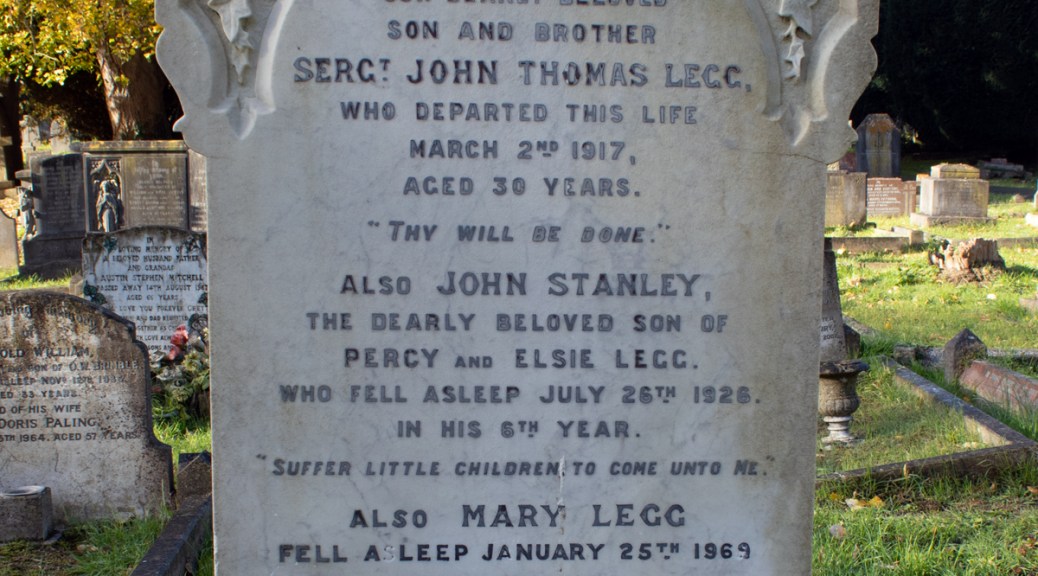
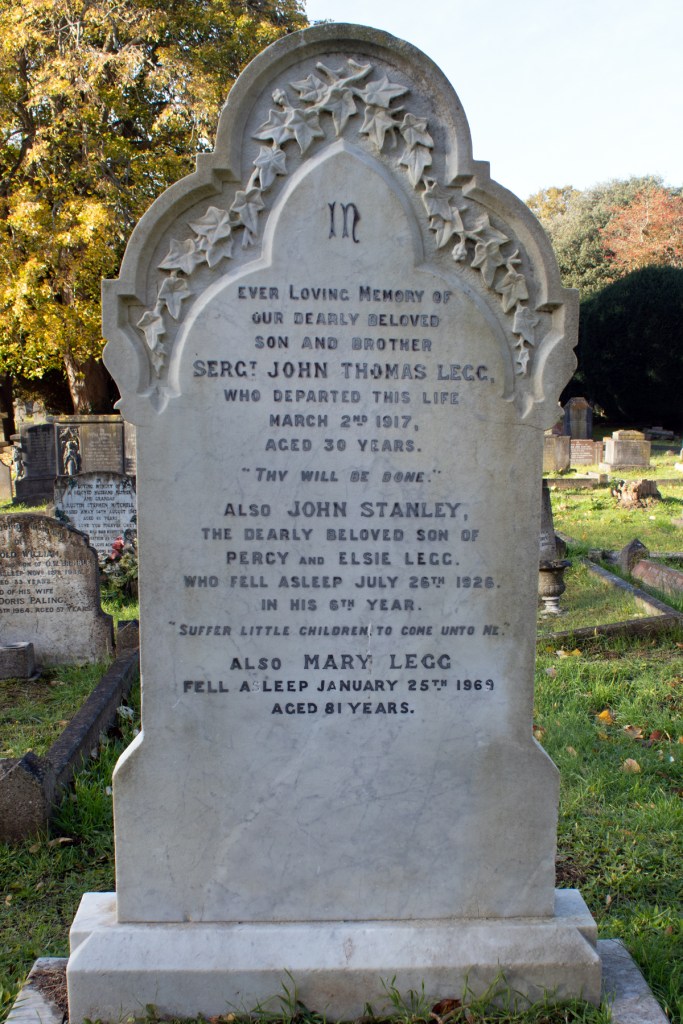
John Thomas Legg was born in the summer of 1885, the oldest of five children to Benjamin and Sarah Legg. Benjamin was a carpenter from Dorset, and it was in Bridport that John was born. Within a year or so, however, the young family moved north to Weston-super-Mare, Somerset, and this is where they settled.

When he completed his schooling, John found a job as a clerk. By the time of the 1911 census, he was working as a political assistant/clerk, and five of the six members of the Legg household were gainfully employed. Benjamin was still working as a carpenter, while John’s two sisters were dressmakers, and his younger brother Percy was a tailor’s assistant.

In the summer of 1914, war came to Europe, and John was one of the first to step up and serve his King and Country. He initially enlisted in the North Somerset Yeomanry, and was assigned to the 1st/1st Battalion. Private Legg’s unit was quickly sent to France, and fought at the Battle of Nonne Bosschen that November.

John’s service records are sparse, and so it is not possible to confirm exactly when and how he served. He moved from the North Somerset Yeomanry to the 6th Battalion of the Reserve Cavalry Regiment: his promotion to Corporal and then Lance Sergeant suggests that this move enabled him to share his skills with incoming recruits. It is unclear whether he was based in Somerset by this point, but it is certainly where he ended up by the start of 1917.

The remains of Sergeant JT Legg, North Somerset Yeomanry, were buried at Weston-super-Mare Cemetery on Wednesday. The first portion of the service was held at St Saviour’s Church, which the sergeant formerly attended, and the interior of which bears many evidences of his skill as an amateur wood-carver… Sergeant Legg was formerly chief clerk in the offices of the Well Division Conservative Association.

Bath Chronicle and Weekly Gazette: Saturday 10th March 1917

John Thomas Legg passed away on 2nd March 1917: he was 31 years of age. He was laid to rest in the sweeping grounds of Milton Road Cemetery, Weston-super-Mare, a short walk from where his family still lived.


Lance Corporal George Carey

Lance Corporal George Carey

George Edward Carey was born at the start of 1877 and was the oldest of eight children to Samuel and Hester Carey. Samuel was a solicitor’s clerk from Clevedon in Somerset, and this is where the family were born and raised. Samuel was not one to sit on his laurels, however, and the 1891 census recorded his occupations as law clerk, innkeeper and insurance agent.

George followed a different path to his father, and found work as a printer’s apprentice when he finished his schooling. He worked up to being a full compositor quite quickly, and was employed as such when, on 30th January 1899, he married Lizzie Taylor. A civil engineer’s daughter, she was working as a teacher when the couple wed: they set up home in Clevedon, and went on to have four children.

By 1911, the Carey family were living in a seven-room house on Strode Road, Clevedon. George was still working as a compositor, but was employed by the local sanitary works. His widowed brother, Albert, who was lodging with his brother and sister-in-law also did the same job.

With storm clouds brewing over Europe, George stepped up to play his part. He enlisted in the Royal Engineers in the autumn of 1914 and was attached to the 503rd Field Company in Exeter. Little information is available about his time in the army, and he only comes to light again a year or so later.

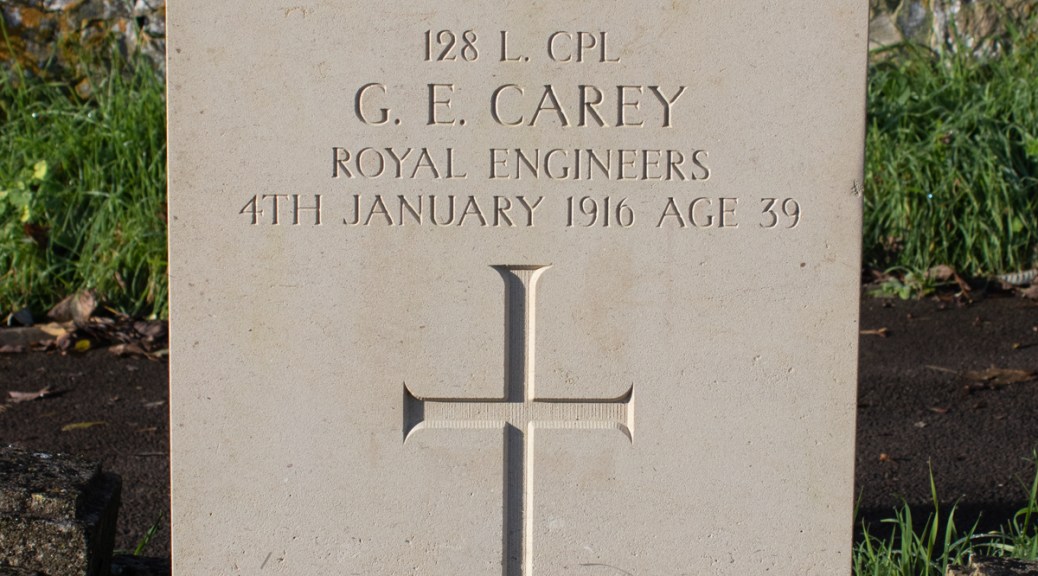
Lance-Corporal Carey, 2nd Wessex RE, who has been employed at the office in Colleton-crescent, Exeter, was found dead, with his neck broken, at the bottom of a flight of stairs at the Grapes Inn, South-street, on Thursday morning. The discovery was made by Mrs Dorothy, wife of the licensee of the inn. Information was given to the police, and Dr Pereira visited the scene, and subsequently the body was removed to the mortuary by PCs Wise and Barrett. Carey was fully dressed. He was about 48 years of age, and leaves a widow and four children. For about fourteen months he had been engaged on the Wessex RE staff, and was billeted at a house in the Friars. His home is at Clevedon, Somerset, where he was engaged as a compositor before mobilisation with the Territorials. He was under orders for transfer to another station.

Taunton Courier and Western Advertiser: Wednesday 12th January 1916

George Edward Carey died on 4th January 1916: he was, in fact, not quite 39 years of age. His body was brought back to Somerset for burial and was laid to rest in the stunning graveyard of St Andrew’s Church in his home town of Clevedon.


Private Wilfred Butler

Private Wilfred Butler

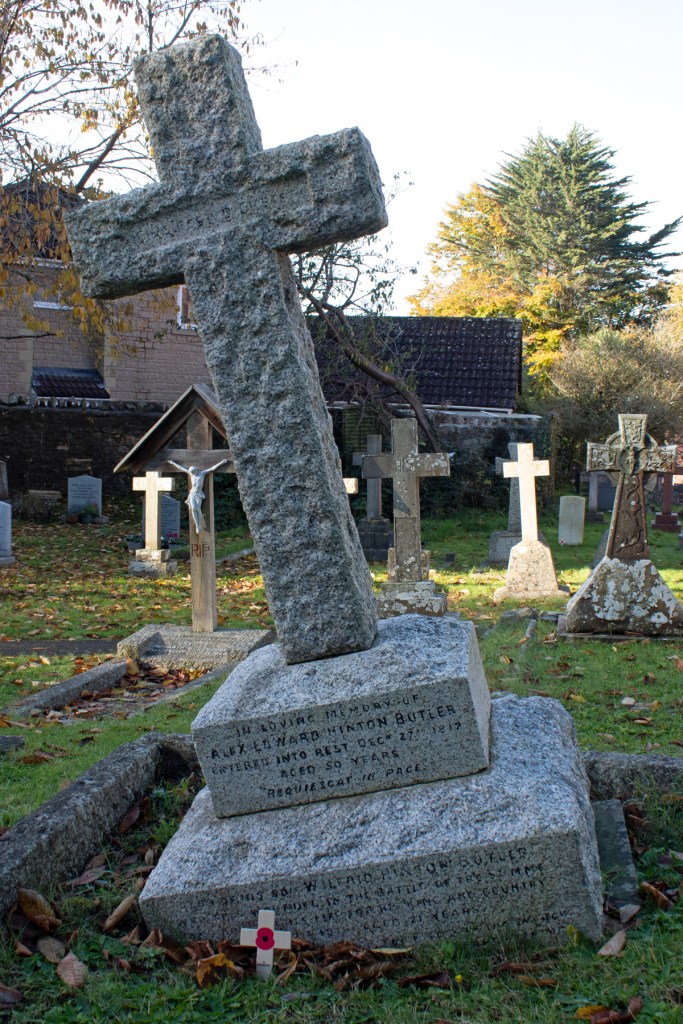
Wilfrid Hinton Butler was born on 11th June 1895 in Cowley, Oxfordshire, one of four children to Alexander and Mary Butler. Alexander was a foreign stamp importer who, by 1899, had moved the family to the outskirts of Clevedon, Somerset.

The 1911 census found Alexander and Mary living in Clevedon, with Wilfrid’s two younger siblings. Wilfrid himself is missing from the document and, intriguingly, his parents are noted as having only two children: this is likely an misunderstanding over the number of children, and the number residing at home.

At this point, Wilfrid drops off the radar completely, and it is only through later documentation that we can identify what became of him. When war broke out, he joined up, enlisting in the London Regiment. Initially assigned to the 15th (County of London) Battalion (Prince of Wales’s Own Civil Service Rifles), he moved across to the 13th (County of London) Battalion (Kensington) at some point during the conflict.

Private Butler was firmly ensconced in northern France by 1916 and his unit fought in some of the bloodiest battled of the Somme. He was not to come out unscathed, however, and it is likely that he was wounded during the Battle of Morval.

The injuries Private Butler had received were severe enough for him to be medically evacuated back to Britain for treatment. He was admitted to hospital in Kings Norton, Birmingham, but his wounds were to prove fatal. He passed away on 2nd October 1916: he was 21 years of age.

Wilfrid Hinton Butler was taken back to Somerset for burial. He was laid to rest in the graveyard of St Mary’s Church, Walton Clevedon.


Private Horace Broderick

Private Horace Broderick

Horace Sydney Broderick was born in the summer of 1880, and was the youngest of ten children to Edward and Sarah Broderick. Edward was a clothier from Newport Pagnell, Bedfordshire, but the family were born and raised in Horfield, Gloucestershire.

By the time of the 1891 census, the family had moved to the south of Bristol, setting up home at Rugby House in Walton-in-Gordano, Somerset. Horace was still at school, and of the four other siblings living at the family home, only one, Horace’s older brother, Walter, was gainfully employed, assisting his father in the cloth trade. The Brodericks were supported by two live-in staff, a cook, Elizabeth Phipps, and a housemaid, Ada Perrett.

The next census, taken in 1901, found Horace and three of his sisters still living at Rugby House with their parents. Edward was now employing his son as a clerk to the family business, and two new staff had come on board, cook Lily Collier and housemaid Florence Hadeley.

By the time of the 1911 census, Edward and Sarah had been living in Rugby House for more than twenty years. Both now in their 70s, they still had their oldest daughters living with them, but Horace is nowhere to be found. Indeed, there is no sign of him on any of the UK census returns, and it is not until six years later that he seems to surface again.

When war broke out, Horace stepped up to enlist. He joined the Army Service Corps and, based on his service number, was employed as a Driver Mechanic. Beyond this, Private Broderick’s time in the military is lost to time.

New has been received in Bristol of the death at the Royal Herbert Hospital, Woolwich, of Pte. Horace Sydney Broderick, youngest son of the late Mr Edward Broderick (of the firm Broderick & Co,. Limited, St James’s Barton, Bristol) and of Mrs Broderick, of Walton Park, Clevedon. Deceased soldier was in his 37th year.

Bristol Times and Mirror – Thursday 15 March 1917

The report appeared in a dozen or so contemporary newspapers and, as no specific detail is given, it is likely that Horace passed away from illness, rather than injury or any unexpected cause. He died on 13th March 1917, at the age of 36 years old.

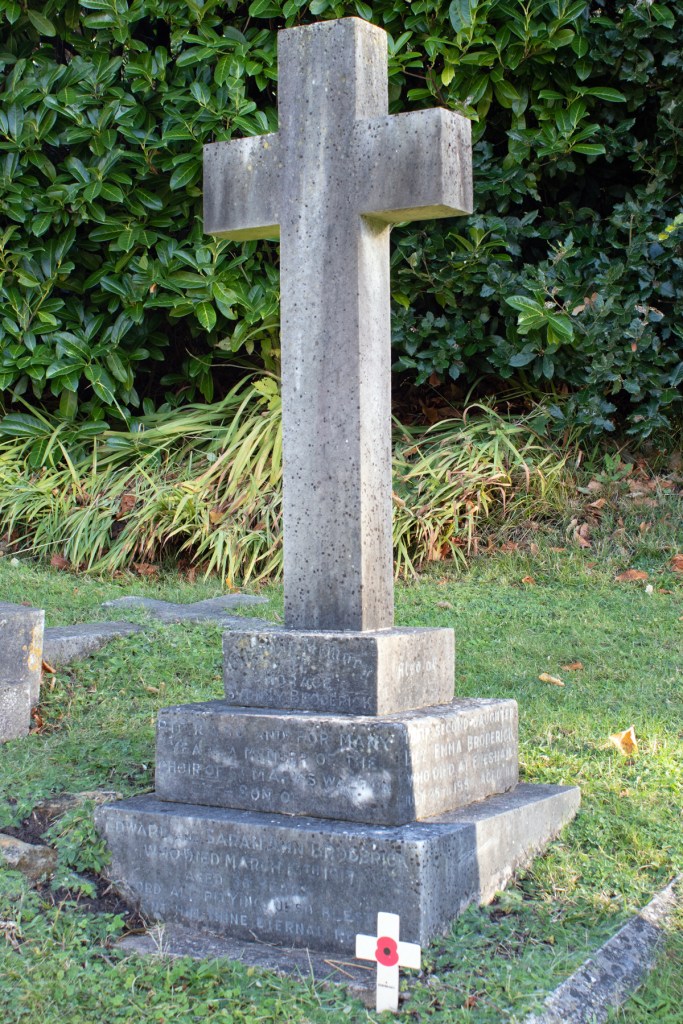
Horace Sydney Broderick’s body was brought back to Somerset for burial. He was laid to rest in the graveyard of St Mary’s Church, Walton Clevedon, next to Edward, who had passed away two years before.


Private Henry Preece

Private Henry Preece

The early life of Henry George Preece is a challenge to piece together.

The Commonwealth War Graves Commission give his father’s name as Edwin Preece, and suggest that the was the landlord of the George Hotel in Milverton.

The Army Register of Soldier’s Effects give the sole beneficiary of Henry’s estate as his sister Bessie.

The census record of 1911 appears to link the three members of the family, but give only a tenuous connection to Somerset. Edwin was a Coachman from Nunney, but the family – including Edwin’s wife Elizabeth, and two children, Henry and Bessie – were all living in Bayford, Hertfordshire, where the siblings had been born in 1900 and 1902 respectively.

It seems likely that the Preece family moved to Somerset not long after the census was taken, and this is potentially when Edwin took up his new role in Milverton.

War broke out in 1914, and Henry stepped up to play his part. He enlisted in the Devonshire Regiment, and was assigned to the 2nd Battalion. Full service details are lost to time, but Private Preece had joined up by April 1918.

Henry’s trail goes cold again at this point. He was admitted to a military hospital in Chatham, Kent, in the autumn1918, although the reason for this is unclear. He passed away there on 29th October: he was just 19 years of age.

The body of Henry George Preece was taken back to Somerset for burial. He was laid to rest in the graveyard of St Michael’s Church in Milverton.