Tag Archives: Somme

Private Owen Owen

Private Owen Owen

Owen Jonah Owen was born in 1880, the oldest of eleven children to Jonah and Elizabeth Owen. Jonah was a quarryman at one of the slate mines around Llanberis, Gwynedd, and this is where the family were raised.

Owen followed his father into the slate quarries and, on 26th September 1903, he married Ann Jones, the daughter of another quarry worker. The couple went on to have four children: Richard, Jonah, Delia and Gwyneth.

He was well known and respected in the village, had a passion for singing and “had conducted singing festivals held by the Congregationalists of the district.” [Caernarvon & Denbigh Herald: Friday 24th November 1916]

War was closing in on Europe, and Owen was keen to play his part. Sadly his service records have been lost over time, but it is clear that he had enlisted in the army by May 1916. Private Owen joined the Royal Welch Fusiliers, and was assigned to the 14th Battalion.

Part of the 38th Division, the battalion was to be caught up in some of the fiercest and most desperate fighting of the First World War. In July 1916, Owen would have been entrenched at The Somme and, after the first few horrific days, his battalion was one of those involved in the fighting at Mametz Wood.

Private Owen was badly wounded during the battle and medically evacuated to Britain for treatment. Admitted to a military hospital in Birmingham, he was to remain there for a number of months until, on 12th November 1916, his body finally succumbed to his injuries. He was 36 years of age.

Owen Jonah Owen was brought back to his home village for burial. He was laid to rest in the graveyard of St Peris Church in Llanberis.


Rifleman Frederick Partridge

Rifleman Frederick Partridge

Frederick George Partridge was born on 26th May 1890 in Kingsteignton, Devon. He was one of ten children to clay cutter George Partridge and his wife, Anna. George passed away in 1903, but Frederick left school, and also found work as a cutter, helping to pay his way at home.

When was came to Europe, Frederick was keen to play his part. He enlisted on 18th November 1915, and was assigned to the King’s Royal Rifle Corps as a Rifleman. His service records show that he stood 5ft 9ins (1.75m) tall and weighed 145lbs (66kg). He was of good physical development, but had slightly flat feet.

After his initial training, Rifleman Partridge was sent to France, arriving in April 1916. His regiment soon found itself on the front line and, that summer, was firmly ensconced at the Somme. Sadly, Frederick was not to escape injury – he received a gun shot wound to his left thigh on 2nd September.

The wound was serious enough for him to be medically evacuated back to England for treatment. He was admitted to the Royal Victoria Hospital in Netley, near Southampton, but died of his injuries on 12th September 1916. He was just 26 years of age.

Frederick George Partridge was brought back to Devon for burial. He was laid to rest in the graveyard of St Michael’s Church in Kingsteignton.


Bombardier Harold Cornall

Bombardier Harold Cornall

Harold William Cornall was born on 16th August 1890 in Kingsteignton, Devon. He was the oldest of six children to William and Elizabeth Cornall. William worked as a carter and labourer for a tannery in the town, and, when he left school, this was where Harold also went for work.

In the autumn of 1912, Harold married Hilda Potter, from nearby Newton Abbot. The couple set up home and went on to have one child, a daughter called Winifred.

War broke out and, on 29th August 1914, Harold enlisted in the Royal Field Artillery. He was assigned to the A-Battery of the 90th (Howitzer) Brigade and was given the rank of Bombardier. He soon found himself in the thick of battle, as the brigade was sent to The Somme.

Bombardier Cornall was injured in the spine by some shrapnel, and medically evacuated to England in June 1916. Sadly, his injuries led to him becoming paralysed, and he passed away at the King George’s Hospital in London on 20th August 1916. He was just 26 years of age.

Harold William Cornall’s body was brought back to Devon; he was laid to rest in the graveyard of St Michael’s Church in his home town of Kingsteignton.


Bombardier Thomas Greenslade

Bombardier Thomas Greenslade

Thomas Greenslade was born in Alcombe, on the outskirts of Dunster in Somerset, in the spring of 1894 and was one of ten children. His parents were Devon-born cab proprietor Richard, and his wife Emma, who passed away in 1905, aged 38 years old.

When he left school, Thomas helped his father with his business; the 1911 census recorded him and his older brother Charles as drivers, his younger two sisters as housekeepers for their father, and his youngest two siblings as still being at school.

Storm clouds were approaching Europe and, in the summer of 1915, Thomas signed up to play his part for King and Country. He joined the Royal Field Artillery, and was assigned as a Bombardier to C Battery of the 74th Brigade. His troop was one of the Howitzer Brigades, and it seems likely that his knowledge of horses stood him in good stead.

Little information on Bombardier Greenslade’s military service survives. His regiment saw conflict at Loos, the 1916 Battles of the Somme and the Third Battle of Ypres, and it is likely that he was involved in these skirmishes.

What can be confirmed is that, by July 1917, Thomas was in the War Hospital in Bristol. The reason for his admission is unclear, but it led to his demise. Bombardier Greenslade passed away on 11th July 1917: he was just 23 years of age.

Thomas Greenslade’s body was brought back to Dunster. He was laid to rest in a quiet corner of the village’s cemetery.


Private Roderick Smith

Private Roderick Smith

Roderick Morgan Smith was born on 14th April 1896 in Upton Park, Essex. One of twin sons to Francis and Frances Smith, he had three siblings altogether. Francis is absent from the two census returns on which Roderick features, but the documents confirm that Frances – who was a certified teacher – was married, so he may have been elsewhere at the time.

By the time of the 1901 census, the family had moved from East London to Monmouthshire, where Roderick’s mother was teaching at the school in the village of Wonastow. Ten years later, they had moved across the River Severn to Withycombe in Somerset, not far from where Frances had been born. Other records show that they subsequently moved to Bath, then to Weston-super-Mare.

When war broke out, Roderick was keen to join up. He enlisted as a Private in the Durham Light Infantry, and was assigned to the 7th Battalion. He was sent to France in the spring of 1915, and would have been involved with his regiment at Ypres and the Somme.

It was at the Somme that Private Smith was gassed and wounded. Full details are not recorded, but they were enough for him to be medically evacuated to England. He was admitted to the military hospital in Taunton, but passed away on 7th May 1916. He was just 20 years of age.

Roderick Morgan Smith was brought to Weston-super-Mare and laid to rest in the town’s Milton Road Cemetery.


Roderick’s twin, Frank Morgan Smith, also played his part in the First World War. He enlisted in the Bedfordshire Regiment as a Private, and was assigned to the 7th Battalion. He also found himself embroiled at the Somme, and he too was wounded.

Sadly, Frank’s wounds were too severe for him to be repatriated to England; he died in a French hospital on 3rd December 1916, also aged 20 years old. He was laid to rest at the Wimeraux Cemetery.


Lance Corporal William Neads

Lance Corporal William Neads

William John Neads was born on 16th December 1892, the middle of three children to cab driver and groom William Neads and his wife Ellen. Both William Sr and Ellen were from Somerset, although William Jr and his brother Charles – who was eleven months older – were both born in the Monmouthshire village of Cwmcarn.

William’s parents soon moved the family back to Clevedon in Somerset, and, when he left school, he found work as a farm labourer. He was eager to see more of the world, however and, in April 1913, he emigrated to Canada.

After working as a labourer there for a year or so, back in Europe war was declared. Keen to do his bit for King and Country, William enlisted in the 1st Battalion of the Canadian Infantry in January 1915. He soon found himself caught up on the Front Line.

In October 1916, he was involved in the Battle of the Somme – either at Le Transloy or The Battle of the Ancre Heights – and received a shrapnel wound to his left shoulder. Initially admitted to the Canadian General Hospital in Etaples, he was subsequently evacuated to England and the Northern General Hospital in Leeds. He spent three months recovering from his injuries, and was back on the Western Front in January 1917.

Later that year, William – now a Lance Corporal – was involved in the fighting at the Second Battle of Passchendaele (part of the Third Battle of Ypres). He was wounded again, this time receiving a rather unceremonious gunshot wound to the right buttock. Treated at the scene, he was evacuated back to England and admitted to the Fusehill War Hospital in Carlisle on 17th November.

Sadly, despite treatment, Lance Corporal Neads’ health deteriorated, and he passed away from his injuries on 16th December 1917, his 25th birthday.

William John Neads was brought back to his family’s home of Clevedon, and buried in the clifftop churchyard of St Andrew’s, overlooking the sea.


Tragically, William’s father had died in May 1917, at the age of 51. While no details of his passing are recorded, it meant that Ellen had, in just over a year, seen her son wounded, her husband die and her son wounded again and die as a result.


Private William Baber

Private William Baber

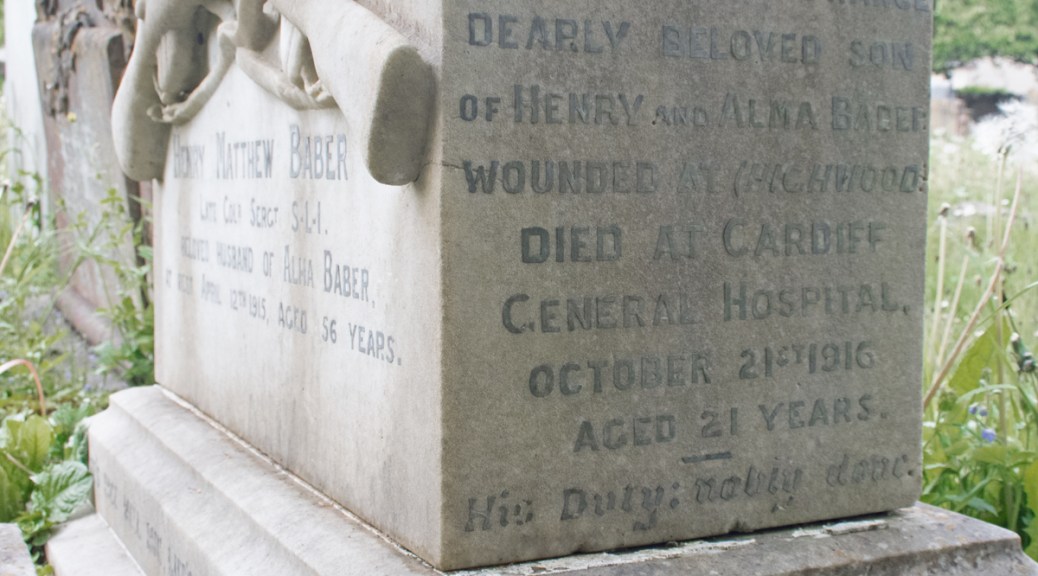
William Herbert Baber was born in May 1895, the oldest of six children to Henry and Alma Baber. By the time of William’s birth, Henry was an insurance agent for the Prudential insurance company and brought his family up in the Somerset village of Yatton. William’s father had been widowed early on, and so, in addition to his five younger siblings, he also had an older half-brother, also called Henry.

By the time of the 1911 census, William was working as a clerk in a coal office, and the family were living in a five room house not far from the village centre.

Little remains documented about William’s military service. He enlisted in the Somerset Light Infantry, but transferred to the 24th Battalion of the London Regiment. He was involved in the Battle of High Wood – part of the Somme offensive – and was wounded during the skirmish.

Evacuated back to home soil, Private Baber was treated in one of the military hospitals in Cardiff. Sadly, he was to succumb to his wounds, and passed away on 16th October 1916. He was just 21 years old.

William Herbert Baber lies at rest in the family grave in the churchyard of St Mary’s in Yatton.


William’s father Henry was also called up for war duty. You can read more about his story here.


Private William Woodbury

Private William Woodbury

William Alfred Woodbury was born in the Somerset village of Nether Stowey in April 1899, the oldest of four children to Alfred and Nellie Woodbury. Alfred was a farm labourer, and, by the time William was a couple of years old, he had moved the family to the town of Bridgwater to work as a carter.

After leaving school, William found work at Barham Brothers’ Brickworks in the town. When war broke out, he enlisted in the Somerset Light Infantry almost as soon as he was able to, at the beginning of 1916.

Assigned to the 6th (Service) Battalion and Private Woodbury was sent out to the Western Front in April. He would almost certainly have seen action at the Battle of Delville Wood – part of the Somme offensive – and was wounded in the shoulder and arm on 18th August 1916.

Shipped back to the UK for treatment, William was admitted to the Western General Hospital in Cardiff, but tragically died from his wounds less than a fortnight later on 30th August 1916. He was just 17 years old.

His funeral was reported in both the Shepton Mallet Journal and the Central Somerset Gazette; his father, who had been serving in France as part of the Army Veterinary Corps, managed to return home for his son’s funeral.

William Alfred Woodbury lies at rest in the St John’s Cemetery in his home town of Bridgwater.


Corporal John Welch

Corporal John Welch

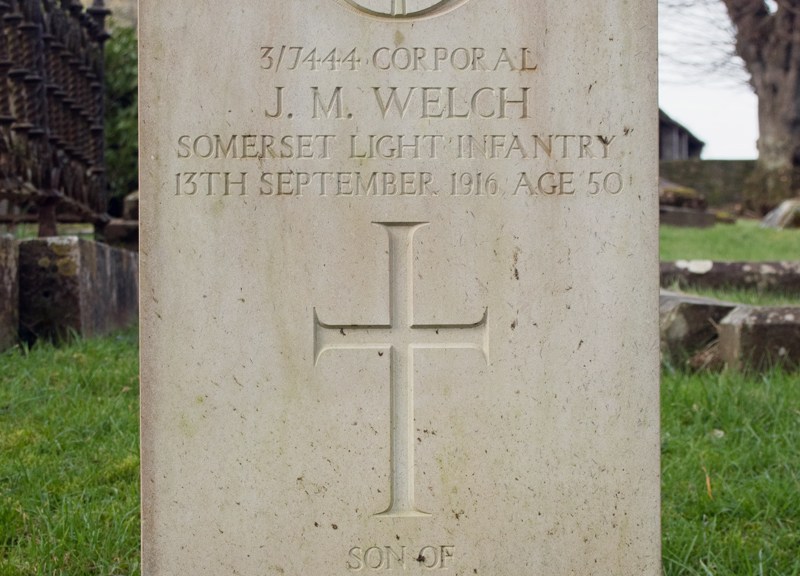
John Milton Welch was born in Yeovil on 19th February 1866, one of five children to William and Anne Welch. William was a chemist by trade, but John’s calling was elsewhere. He became a clerk, initially for a brewery, but by the time of the 1911 census, he was working for a political agency.

In that census, John can be found living with his parents – who were in their 80s by this point – and his two sisters, both school governesses. He is listed as single; although an earlier census suggests he had married a lady from the Isle of Wight called Sarah, I have found nothing to corroborate this, beyond the fact that she had wed a John M Welch, a brewery clerk from Yeovil.

War beckoned and even though he was 48 when the conflict broke out, John enlisted. Private Welch joined the Somerset Light Infantry; his service record no longer exists, but his medal record show that he arrived in France in May 1915, and was subsequently awarded the Victory and British Medals and the 1915 Star. His service obviously warranted promotion, and he was elevated to Corporal.

His troop – the 6th (Service) Battalion – was involved in several of the skirmishes of the Battle of Somme, and it is likely that Corporal Welch was injured during one of these – probably either the Battle of Delville Wood or the Battle of Flers-Courcelette. Wherever it happened, he was shipped back to England, and was treated for his injuries at the Royal Victoria Hospital in Netley, Hampshire

Sadly, Corporal Welch was not to recover; he passed away on 13th September 1916, at the age of 50.

John Milton Welch lies at rest in the graveyard of St James’ Church, in the quiet Somerset village of Milton Clevedon.


Private William Cottrell

Private William Cottrell

William Cottrell was born in April 1885, the third of twelve children to Henry and Annie Cottrell from Bampton, Devon. When William left school, he became an assistant to the village baker, but new opportunities lay ahead.

In May 1907, William married Maria Wall, the daughter of a stonemason from Wedmore in Somerset. With weeks, the young couple had embarked for a new life, boarding the Empress of Britain in Liverpool, setting sail for Canada.

Emigrating to Manitoba, William became a labourer, and he and Maria had three children – Leslie, Ronald and Kathleen.

War came, and William enlisted in the Canadian Expeditionary Force in August 1915. Shipped to England in the spring of the following year, Annie followed suit, returning to Somerset with the three children.

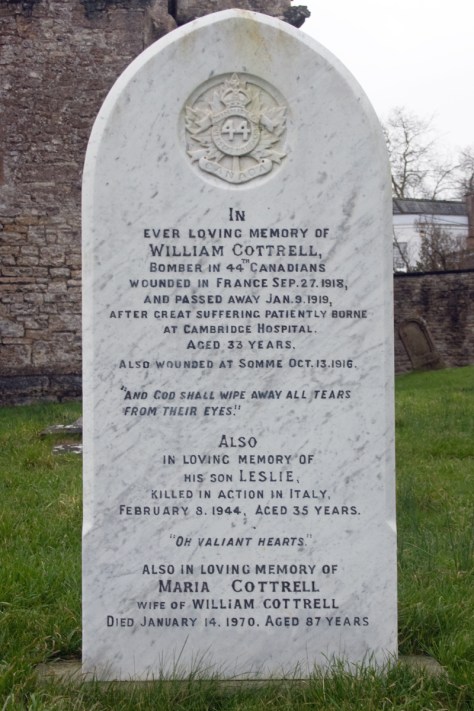
Private Cottrell was assigned to the 44th Battalion Canadian Infantry, setting off for France in August 1916, just weeks before his fourth child – Ruby – was born.

The battalion was involved in some of the fiercest fighting of the war, and it was during the Somme Offensive that William was shot in the left arm. Initially treated in the field, he was soon shipped back to England to recover in a military hospital in Epsom. Discharged after three months, he was returned to his battalion in early 1917.

The fierce fighting continued, and Private Cottrell was wounded again in October 1918. Further treatment back in the UK was needed, and he was admitted to the 1st Eastern General Hospital in Cambridge.

Details of the William’s injuries at the Somme are readily available, but information on his second lot of injuries is scarcer. They must have been pretty severe, however, as he was not discharged. He lost his final battle after four months, succumbing to his wounds on 9th January 1919. He was 33 years old.

William Cottrell lies at rest in the graveyard of St Mary’s Church in his widow’s home village of Wedmore, Somerset.


William’s gravestone is also a memorial to his eldest son, Leslie, who was killed during the Second World War.

Details of his military service are sketchy, but he enlisted in the Queen’s Own Royal West Kent Regiment. His battalion – the 1st – was involved in the fighting in Italy, and it was here that he lost his life. He was killed on 8th February 1944 and is buried in the Sangro River War Cemetery, in Abruzzo.