Tag Archives: tuberculosis

Gunner William Wellman

Gunner William Wellman

William Wellman was born in March 1890 and was one of nine children. His parents, road builder Thomas and collar machinist Eliza were both born in Somerset, and it was in Chard that they married and raised their family.

William and his siblings found work in the local lace industry – the 1911 census recorded most of the family in Chard, but William was boarding in Stapleford, Derbyshire, with his older brother Fred; both were working as lace hands.

War was coming to Europe, and, as a previous member of the territorial force of the Somerset Light Infantry, William was keen to play his part. In February 1915, he enlisted in the Royal Field Artillery: his records show that he was 5ft 7ins (1.69m) tall, had light brown hair, grey eyes and a slender build, weighing 129lbs (58.5kgs).

Gunner Wellman was sent to Wiltshire for training but, while in barracks, he fell ill. Having contracted tuberculosis of the kidney, he was admitted to a hospital in Sutton Veny. After two months’ treatment, his health did not improve sufficiently enough, and he was discharged from the army on medical grounds in February 1916.

William returned to Chard, but was not to get any better. He passed away at home on 1st April 1916; he was just 26 years old.

William Wellman was laid to rest in the cemetery of his home town, not far from his brother, Private Arthur Wellman.


William and Arthur were not the only two of the siblings to fight in the Great War.

Their youngest brother, Private Bert Wellman fought with the Somerset Light Infantry, and died in fighting in Mesopotamia on 22nd November 1915. He was just 20 years of age.

Able Seaman Ernest Cornock

Able Seaman Ernest Cornock

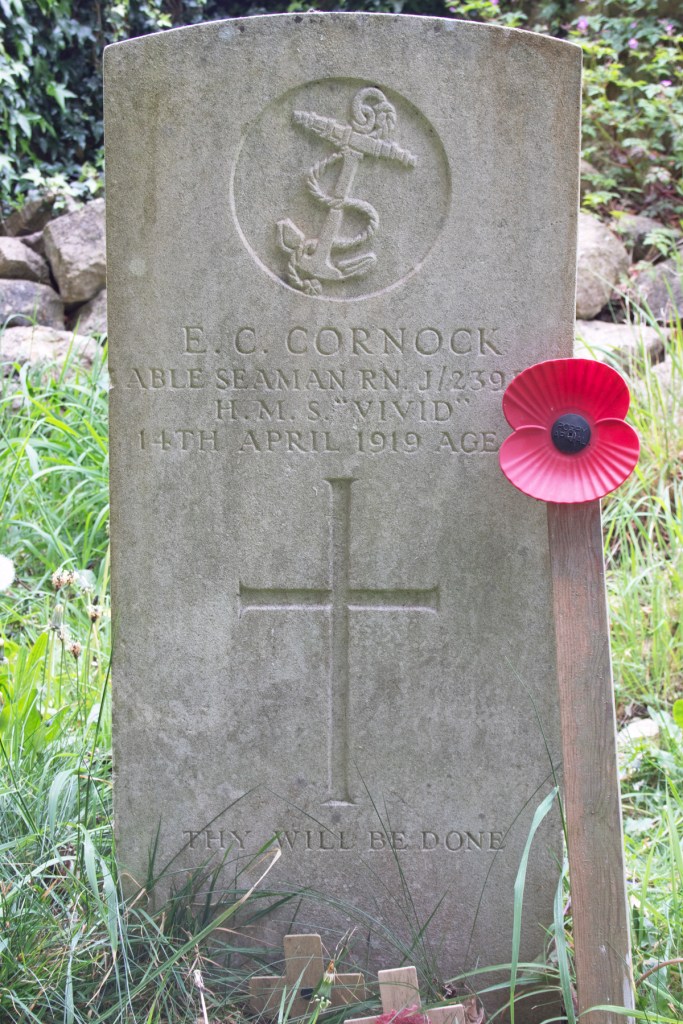
Ernest Charles Cornock was born on 16th June 1896, in the Gloucestershire town of Wotton-under-Edge. His parents were carter Charles Cornock and his wife, Millicent, both born and bred in the town, and he was one of eight children.

When he left school, Ernest found work as a rubber winder in the local mill. However, he wanted bigger and better things and so, on 8th April 1913, he enlisted in the Royal Navy. His service records show that he stood just 5ft 3ins (1.60m) tall, had brown hair grey eyes and a fresh complexion. He was also noted as having a scar on his right cheek.

As Ernest was under age when he joined up, he was initially given the rank of Boy 2nd Class. He was sent to HMS Vivid, the Naval Dockyard in Devonport and, after four months’ training, during which he was promoted to Boy 1st Class, he was given his first posting on board the battleship HMS Queen.

After five months on board, Boy Cornock was given another assignment, and was transferred to HMS Lion. While on board, a number of things happened: the First World War broke out, and the battle cruiser fought at Heligoland Bight and Dogger Bank; Ernest came of age, and was given the rank of Ordinary Seaman on his 18th birthday; with ongoing good conduct, in September 1915, he was then given a promotion to Able Seaman.

After a short spell back in Devonport, Ernest served on a further five ships, taking him through to the end of the war. By the start of 1919, however, Able Seaman Cornock’s health was beginning to suffer. Having contracted tuberculosis, he was medically discharged from service on 19th February, and was admitted to a sanatorium back in Gloucestershire. Sadly the condition was to get the better of him, and he passed away on 14th April 1919, at the age of just 22 years old.

Ernest Charles Cornock was brought back to Wotton-under-Edge for burial. He was laid to rest in the graveyard of St Mary the Virgin Church in the town, not far from his second cousin, Albert Cornock, who had been buried just the week before.


As an aside to Ernest’s tale, the newspaper that reported on his funeral also noted that his grandmother, Ruth Cornock, had not long received a message from the King, congratulating her on the fact that nine of her sons had served in the conflict


Private Albert Cornock

Private Albert Cornock

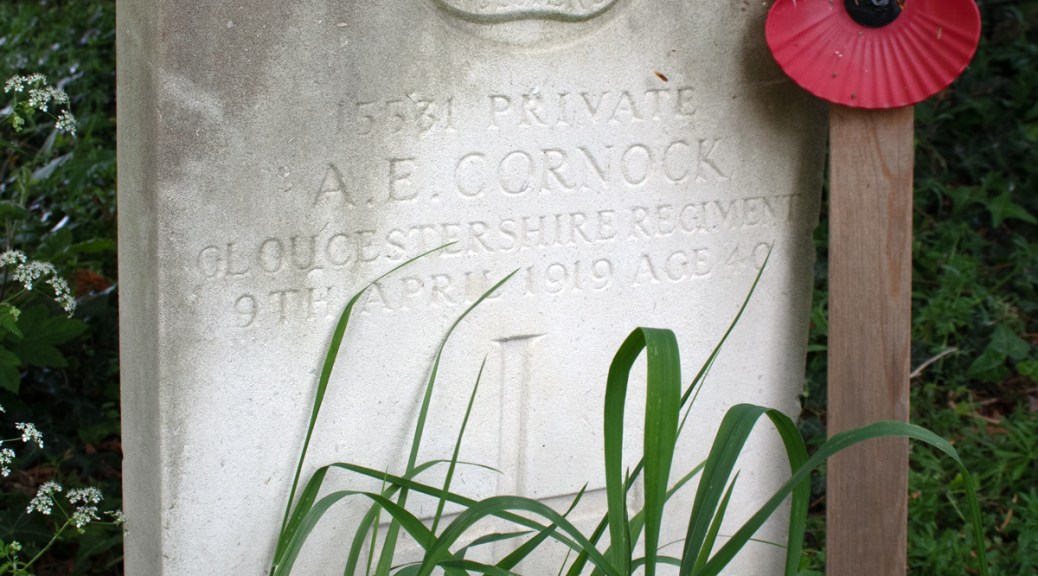
Albert Edward Cornock was born in 1878, and was one of eight children. His parents, John and Hannah Cornock, were both born in Wotton-under-Edge, Gloucestershire, ant this is where the family were brought up.

John was a labourer, and this was the trade than Albert also fell into. On 2nd August 1903, he married local woman Bessie Carter. The couple settled in their home town and went on to have eight children.

War came to Europe in 1914, and Albert was amongst those to enlist early on. He joined the 10th (Service) Battalion of the Gloucestershire Regiment in Bristol on 13th November. Albert’s service records show that he was 5ft 4ins (1.62m) tall and weighed 119lbs (54kg). He had a fresh complexion, brown eyes and black hair.

Private Cornock’s initial training was split between Cheltenham and Salisbury Plain, but he was eventually sent out to France as part of the British Expeditionary Force in August 1915. He spent nearly eighteen months overseas, but, towards the end of the following year, he contracted tuberculosis, and was sent back to England for treatment.

Albert’s lung condition was to ultimately lead to his discharge from the army on medical grounds. His last day of service was 8th February 1917.

At this point, Albert’s trail goes cold. He returned home to Gloucestershire, and lived on another couple of years. He passed away at home on 9th April 1919, aged 40 years old: while the cause of his passing is not clear, it seems likely to have been as a result of the illness that saw him discharged from the army.

Albert Edward Cornock was laid to rest in the graveyard of St Mary the Virgin Church in his home town of Wotton-under-Edge. He lies not far from his cousin, Ernest Cornock, another victim of the First World War, who was buried just a week later.


Leading Telegraphist Ernest Webber

Leading Telegraphist Ernest Webber

Ernest Webber was born on 19th April 1897 in Newton Abbot, Devon, although there is little further documented about his early life

The 1911 census records Ernest as being at the Scattered Home in Newton Abbot. This was, in fact, the Greenaway Home for Boys, part of the town’s Union Workhouse. It was run by a Mrs Louise Foote, had 22 ‘inmates’ and was located on the Highweek Road.

The following year, however, Ernest found a way to better himself, enlisting in the Royal Navy. His service records confirm that he joined up on 9th October 1912 and gave a physical description of him: he was 5ft 5ins (1.65m) tall, had fair hair, blue eyes and a fresh complexion. He was also noted as having a scar on his left index finger.

As he was below the age for full service, he was given the rank of Boy, and was sent to HMS Ganges, the naval base in Ipswich, Suffolk, and HMS Impregnable, a training ship, for his initial instruction. Some talent seems to have been unearthed as he was soon promoted to Boy Telegraphist.

In August 1913, Ernest was assigned to the battleship HMS Conqueror. He spent nearly two years on board and, during that time, came of age. Now formally inducted into the service, he was given the rank of Ordinary Telegraphist, before being promoted again – to the full role of Telegraphist – in April 1915.

Two months later Telegraphist Webber was transferred to HMS Phaeton; over the next year, he spent time on two further vessels, before being assigned to HMS Victorious in April 1916. With this assignment came a further promotion: Ernest was now a Leading Telegraphist.

In the summer of 1917, Ernest moved again, this time to HMS Vivid, the Royal Naval Dockyard in Devonport. At this point, however, he had fallen ill, and was medically discharged from duty on 5th September 1917, having contracted tuberculosis.

At this point, Ernest’s trail goes cold. He returned to Newton Abbot, but the events of the next year are lost to time. All that can be confirmed is that he passed away, presumably of his lung condition, on 11th December 1918. He was just 21 years of age.

Ernest Webber was laid to rest in the graveyard of All Saints Church in Highweek, near Newton Abbot.


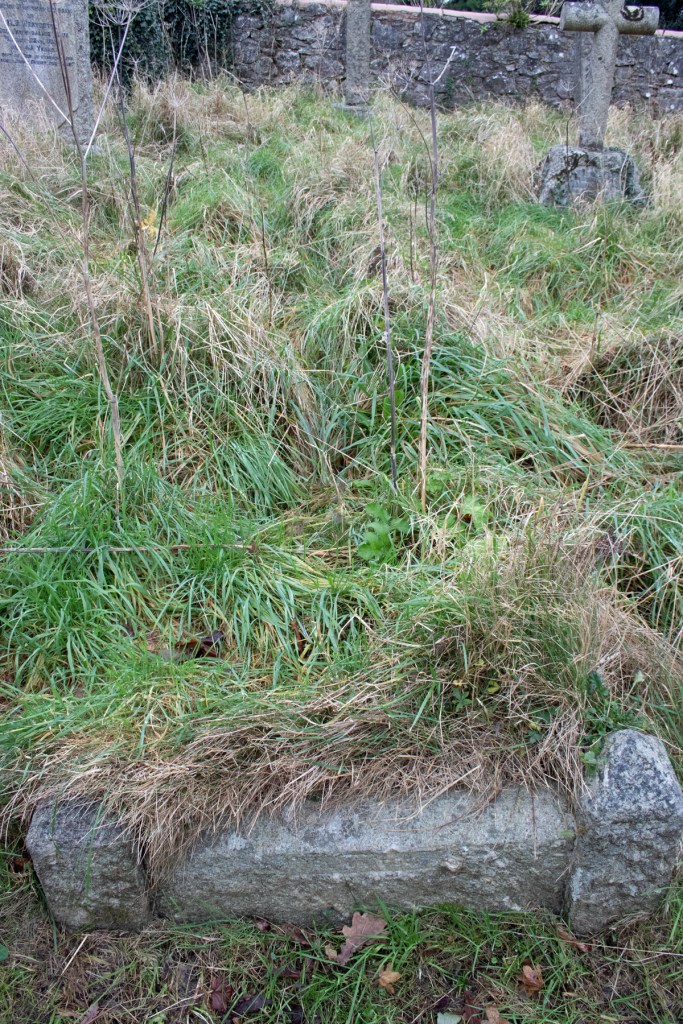
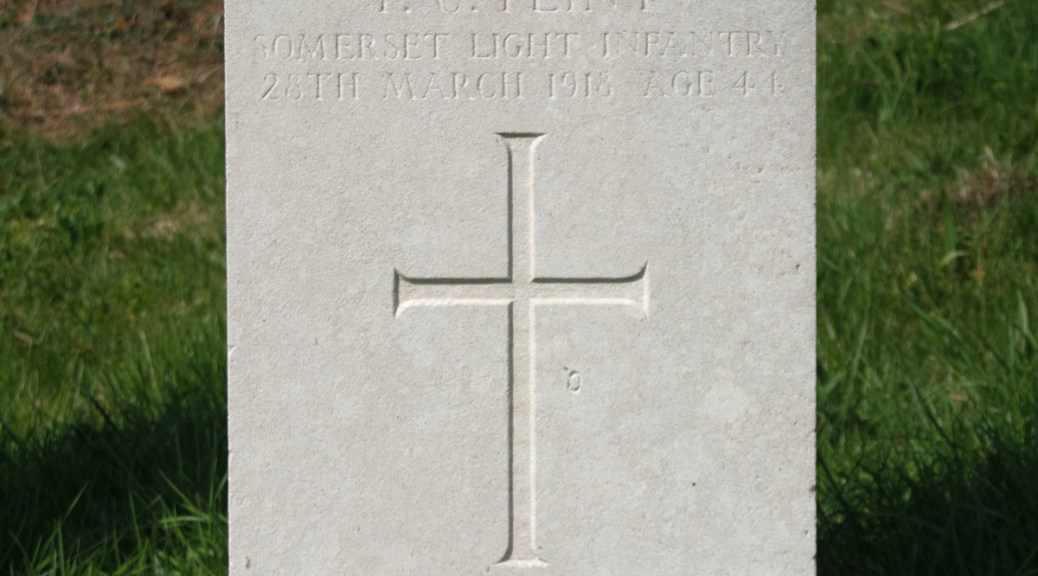
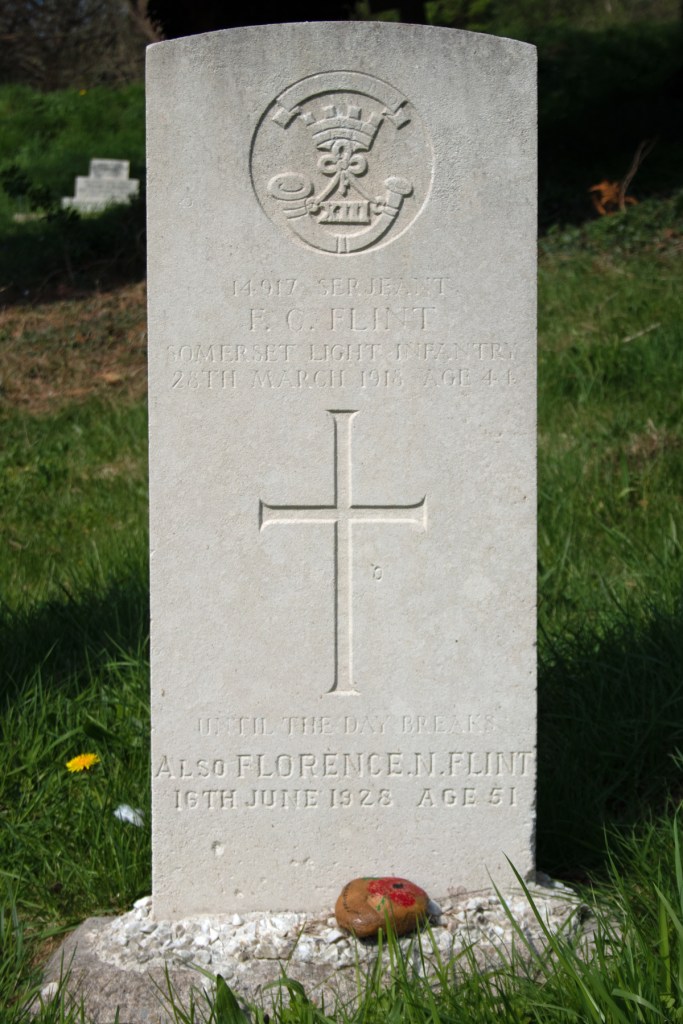
Serjeant Frederick Flint

Serjeant Frederick Flint

Frederick Charles Flint was born in the summer of 1872 in Bath, Somerset. He was the oldest of seven children to tailor Frederick Flint and his wife, Mary Ann.

Tailoring, however, was not a career that Frederick Jr wanted to follow and, in November 1890, he enlisted in the 7th Battalion of the Somerset Light Infantry. Over his twelve years’ service, he was posted to India and South Africa, gaining clasps for the Punjab Frontier 1897-1898, Relief of Ladysmith, Tugela Heights, Orange Free State, Cape Colony, Transvaal, South Africa 1901 and 1902 and the King’s South Africa Medal.

He returned to England in 1902, when he found employment as a postman back in Bath. He met Florence Novena Fishlock and the couple married at St Michael’s Church in Bath on 5th February 1905, before moving to nearby Radstock.

Frederick remained with the Post Office until the outbreak of war, when he again enlisted for duty, re-joining the Somerset Light Infantry. While he did not serve overseas, Serjeant Flint took on a training and mentoring role on Salisbury Plain. Suffering from tuberculosis, he was formally discharged from the army on medical ground in August 1915, and returned home.

The next few years proved challenging for Frederick, as his illness left him incapacitated. He was nursed through by Florence, but eventually his body could take no more. He succumbed to the condition on 28th March 1918, at the age of 45 years old.

Frederick Charles Flint was laid to rest in the graveyard of St Nicholas’ Church in Radstock. Florence passed away ten years after her husband; she was laid to rest in the same plot in the summer of 1928.


Serjeant Frederick Flint (from findagrave.com)

Private Hubert Hext

Private Hubert Hext

Hubert Hext was born in Ashburton, Devon, in September 1898. He was the youngest of three children to painter and decorator William Hext and his wife, Susan.

Little information is available on Hubert’s early life, and there is also scant detail about his military career. All that can be confirmed is that he enlisted on 6th May 1914, and joined the Devonshire Regiment as a Private.

He was initially assigned to the 5th Battalion – they sailed to India in October 1914 – but at some point transferred to the 14th (Labour) Battalion – which was in France by October 1916. Sadly, it’s not possible to identify exactly where Private Hext served.

The military documents available confirm that Hubert contracted tuberculosis and was discharged from the army on medical grounds. However, one records suggests this was on 25th October 1916, while another gives the date of 25th October 1917. Either way, Private Hext’s army career was over by the middle of the conflict.

Hubert returned home, and, for a while, his trail goes cold. Sadly, the next record for him is the confirmation of his passing. He died on 11th November 1918 – Armistice Day – at the tender age of just 20 years old.

Hubert Hext was laid to rest in the graveyard of St Andrew’s Church in Ashburton, Devon.


Sapper Ronald Blackwell

Sapper Ronald Blackwell

Ronald James Ewart Blackwell was born in London in February 1890, one of eight children to Frederick and Elizabeth Blackwell. Frederick was a tailor from Devon, while Elizabeth had been born in Somerset. By the time of the 1911 census, they had moved back to Somerset, settling in the village of Dunster.

Ronald followed in his father’s footsteps and, by the time war broke out, was living and working in Taunton. It’s clear that he wanted to play his part in the growing conflict, enlisting in the Royal Engineers in January 1915.

Sapper Blackwell’s service records confirm that he stood 5ft 6.5ins (1.69m) tall; they also note that he had the tattoo of a heart on his left forearm. His skill as a tailor is mentioned numerous times, and it appears that this talent was how his time was put to use. He was shipped to France on 25th January 1915, and, by the end of the conflict, he was in Italy. It was from here that he returned to England on 26th January 1919.

It seems that Ronald’s return to the UK was as a result of him becoming ill, as, within a month of coming home, he was medically discharged from the army, having been suffering from tuberculosis.

Ronald returned to Somerset, but was to be dogged by the lung disease for a further year. He passed away at home on 25th June 1920, aged just 30 years old.

Ronald James Ewart Blackwell was laid to rest in Dunster Cemetery, not far from his parents’ then home.


Ronald’s older brother, Harold Frederick Blackwell, also fought in the First World War. He was a Private in the 2nd Battalion of the Essex Regiment. He was killed during the Allied advance into Flanders in August 1918, and was laid to rest in the Terlincthun British Cemetery in Northern France.


Private Cuthbert Collard

Private Cuthbert Collard

Cuthbert William George Collard was born in the spring of 1899, one of nine children to William and Eliza Collard. William was an agricultural labourer from North Newton in Somerset, and this is where he and Eliza raised their family. While probably helping his father out as a child, Cuthbert found work at the local blacksmith’s when he left school.

Cuthbert was barely fifteen when war broke out in Europe, and so had to wait until April 1917 before he was of age to enlist. He joined the Devonshire Regiment, and his service records show that he was 5ft 2ins (1.57m) tall, had black hair, brown eyes and a pale complexion.

Assigned to the 4th (Reserve) Battalion, Private Collard served his time on home soil. While full details are not available, it appears that he contracted tuberculosis during his training. This was serious enough for treatment in a sanatorium to be recommended, and he was medically discharged from military service because of the lung condition on 9th January 1918. He had been in the army for just 280 days.

At this point, Cuthbert’s trail goes cold. Whether he was admitted for medical treatment is unclear, but it appears that he returned to North Newton. He passed away on 19th June 1919 at the family home, aged just 20 years old.

Cuthbert William George Collard was laid to rest in the graveyard of the village church, St Peter’s.


Private John Lake

Private John Lake

John Walker Lake was born in Eastbourne, East Sussex, in the spring of 1892, the only child of estate manager and auctioneer Percy Lake and his wife Elizabeth.

John’s mother passed away in 1900, when he was only eight years old, and details of his early life are hard to come by. However, by the time of the 1911 census, he had left school and enrolled in a mining college in Guston, near Dover, Kent.

When war broke out, John was quick to enlist. He joined the London Regiment on 18th September 1914, and was assigned to the 2nd/23rd Battalion. His service records show that he stood 5ft 8ins (1.72m) tall, had light hair, blue eyes and a fair complexion.

Private Lake was not to remain in the army for long. Within weeks of joining, he contracted tuberculosis and, on 22nd February 1915, after just 158 days, he was discharged from service as being no longer medically fit for duty.

At this point, John’s trail goes cold. He initially returned to live with his father in Eastbourne. By the autumn of 1918, however, he was in Weston-super-Mare, Somerset, probably for health reasons.

The tuberculosis got the better of John Walker Lake, however; he passed away on 20th October 1918, at the age of 26 years old. He was laid to rest in the Milton Road Cemetery in Weston-super-Mare.


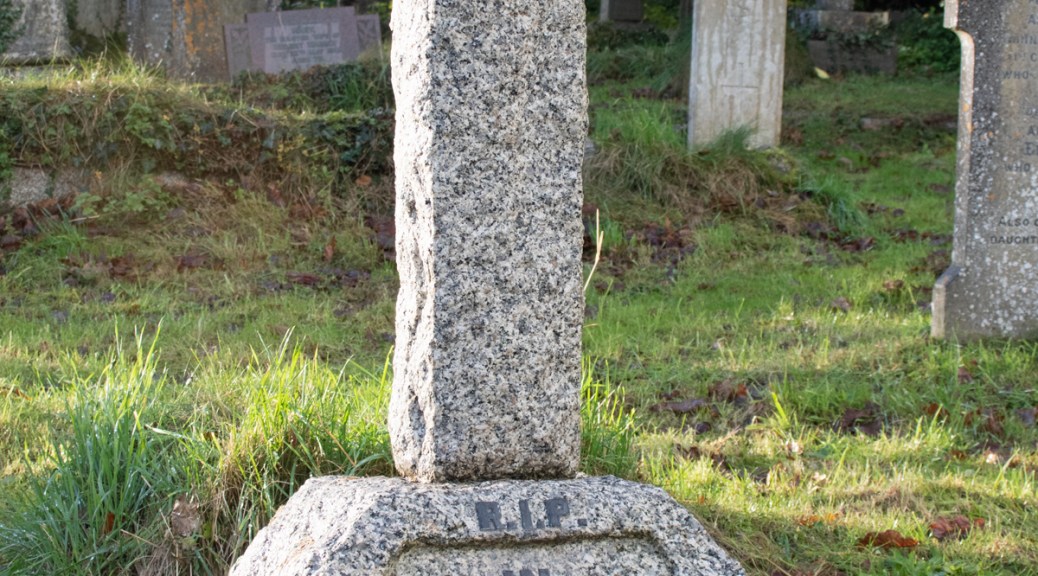
Private Gilbert Metters

Private Gilbert Metters

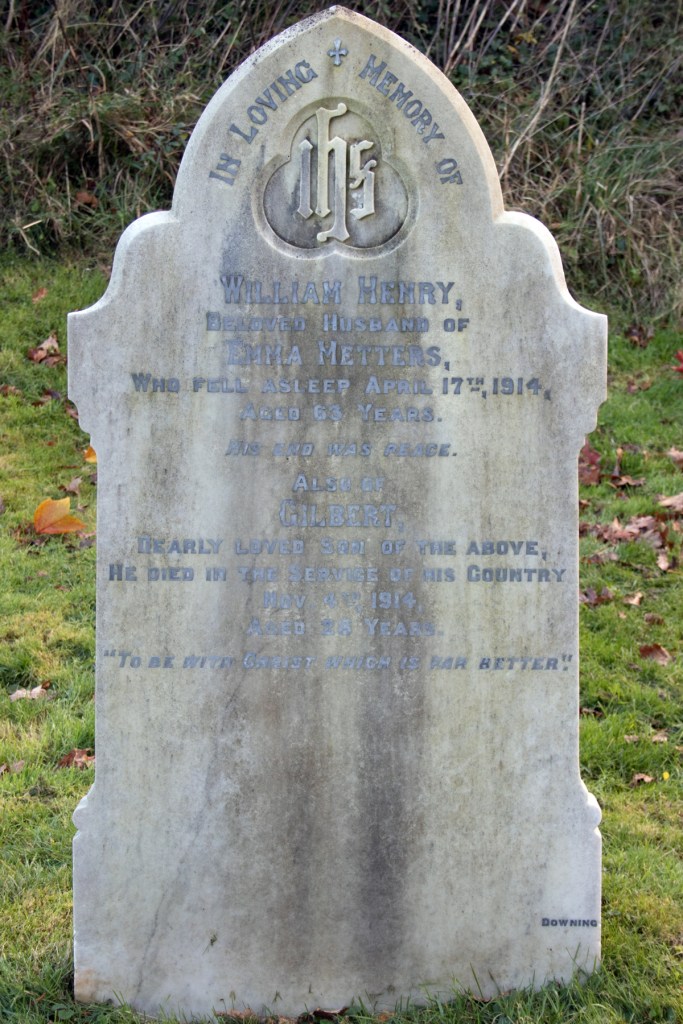
Gilbert Metters was born in Linkinhorne, Cornwall in March 1885, one of four children to William and Emma Metters. William was a farmer and haulier who moved his family to Chudleigh in Devon not long after Gilbert was born.

When Gilbert left school, he found work as a domestic gardener. By the time of the 1911 census, he was living with his parents, younger sister and Emma’s sister in Old Way, not far from the village centre. On 17th April 1914, William passed away, leaving Emma widowed.

When war broke out, Gilbert was one of the first from the town to sign up. He enlisted in the 8th Battalion of the Devonshire Regiment, and was soon off to Hampshire for training. Tragically, within weeks of arriving, Private Metters contracted tuberculosis, and passed away in the camp hospital. He was 29 years of age, breathing his last on 4th November 1914.

Gilbert Metters’ body was brought back to Chudleigh for burial, and was laid to rest alongside his father in the family grave.


The local newspaper reported on Gilbert’s funeral. It suggested that when enlisting “although not one of the strongest, he managed to pass the medical test.” It went on to say that:

He always assisted in every good cause in the town, and was very highly respected. He endeared himself with the officers and men of C Company.

Western Times: Friday 13th November 1914